Robotics Digest
Robotics Paper Digest — 2026-11-06
🤖 Scanned 331 papers from today’s arXiv announcement (cs.RO / eess.SY / cs.LG), picked 5 for modular & legged robotics — summarized by DeepSeek.
🤖 从今日 arXiv 新论文(cs.RO / eess.SY / cs.LG)中扫描 331 篇,围绕模块化与足式机器人精选 5 篇 — 由 DeepSeek 生成双语摘要。
1. Kinematic analysis of a double-closed-loop four-bar chain-based leg for a multimodal quadruped-pentarotor robot
多模态四足-五旋翼机器人的双闭环四杆链腿部运动学分析
Authors / 作者: Prashant Raturi, Santhakumar Mohan
arXiv: 2611.07470 · PDF
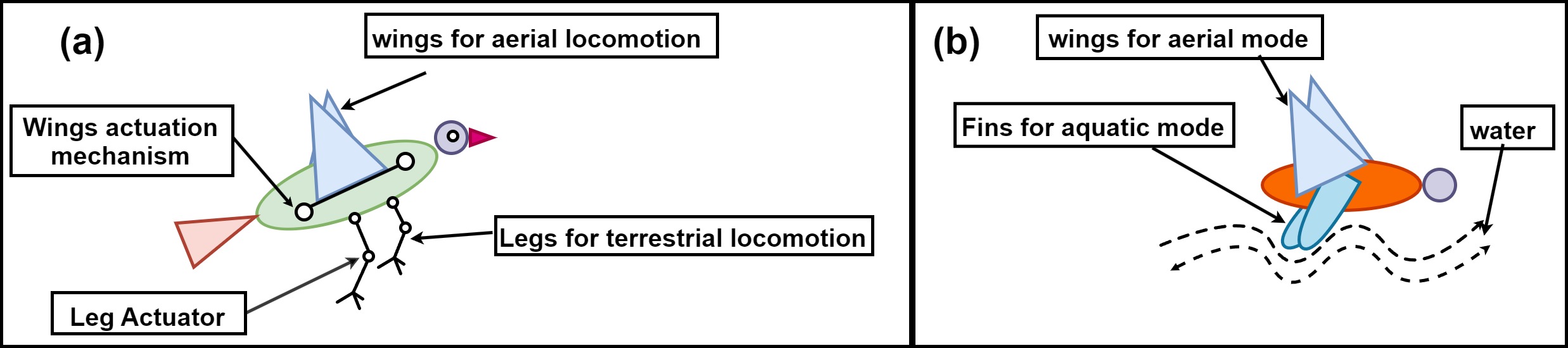
This paper develops kinematic and singularity models for a 3-DoF double four-bar closed-loop leg that mediates between terrestrial quadruped and aerial pentarotor modes. A Jacobian is derived in both joint and task spaces to support gait design for ground locomotion and mid-air reconfiguration, and several gaits are validated in MATLAB and on a single-leg test rig.
中文摘要: 本文针对一种三自由度双四杆闭环腿机构开展运动学建模与奇异性分析,该机构是多模态四足-五旋翼机器人在地面模式与空中模式之间切换的关键部件。作者在关节空间与任务空间分别建模并推导雅可比矩阵,为地面步态设计与空中重构步态设计奠定基础;随后在MATLAB中设计多种步态,并在单腿实验台上完成了实际验证。
💬 Closed-loop linkage legs with explicit Jacobian/singularity analysis are rare and directly inform modular leg module design and gait feasibility.
💬 带显式雅可比与奇异性分析的闭环连杆腿较为少见,可直接为模块化腿单元设计与步态可行性判断提供依据。
Why read it / 推荐理由: It offers concrete closed-chain leg kinematics that a modular legged robot designer can reuse when specifying reconfigurable leg modules and mode-switching gaits. 它提供了可复用的闭环腿运动学模型,有助于模块化足式机器人设计者规划可重构腿模块与模式切换步态。
2. STEP: Spatiotemporal Training with Explicit Prediction for Perceptive Humanoid Locomotion
STEP:面向感知式人形机器人行走的显式预测时空训练框架
Authors / 作者: Youhao Lyu, Chenghao Sun, Zhenxuan Ding, Shuting Zhang, Ziyang Dong, Wenhao Cui
arXiv: 2611.08097 · PDF
STEP is a one-stage RL framework that fuses depth and proprioception into a compact policy state via learned queries, then supervises cross-modal relationships with bidirectional masked prediction and action-dependent state evolution with an action-conditioned predictor using an EMA target in policy space. Simulation ablations show improved terrain traversal over fusion baselines, with depth-dropout and delay experiments confirming the value of both prediction objectives.
中文摘要: STEP提出一种单阶段强化学习框架,用可学习查询将深度图与本体感知令牌聚合成紧凑的策略状态,并通过双向掩码预测显式监督地形-机体跨模态关系,同时以动作条件预测器在策略表示空间内用EMA目标约束状态的动作相关演化。仿真对比表明其地形通过能力优于现有融合方案与消融版本,深度丢失与延迟实验进一步验证了两类预测监督的有效性。
💬 Explicit action-conditioned latent prediction in policy space is a principled way to structure perceptive locomotion learning, though real-robot validation is absent.
💬 在策略空间中引入动作条件隐状态预测为感知式行走学习提供了有原则的结构化方法,但缺少真机验证。
Why read it / 推荐理由: Its masked cross-modal and action-conditioned prediction losses are directly transferable to sim-to-real perceptive locomotion controllers for legged platforms. 其跨模态掩码预测与动作条件预测损失可直接迁移到足式平台的感知式行走sim-to-real控制器中。
3. CRISP: Constraint-Resolved Interactions between Subsystems for Predictive Whole-Body Cooperation
CRISP:基于子系统约束分解的预测式全身协作控制
Authors / 作者: Dario Valenzuela, Jeeseop Kim
arXiv: 2611.07268 · PDF
CRISP decomposes a humanoid into a single rigid body torso plus floating-base arm and lower-body models, encoding rigid connections and the closed end-effector chain as holonomic constraints whose Lagrange multipliers parametrize interaction wrenches. A high-level NMPC jointly optimizes subsystem trajectories, arm torques, ground reaction forces and interaction wrenches online, and is validated in simulation and on a G1 humanoid for dual-arm cooperative manipulation.
中文摘要: CRISP将人形机器人分解为单刚体躯干与浮动基座的双臂、下肢子系统,把肩部刚性连接与末端执行器间闭环运动链表示为完整约束,并用拉格朗日乘子参数化交互力/力矩。高层非线性MPC联合优化子系统状态轨迹、手臂力矩、地面反作用力与交互力旋量,实现交互力的在线设计与优化;仿真与G1人形机器人硬件实验验证了双臂协作操作的有效性。
💬 A clean NMPC formulation that preserves dynamic coupling across subsystem models while optimizing contact wrenches online, with real G1 results.
💬 该NMPC形式在保持子系统间动态耦合的同时在线优化接触力旋量,并在真实G1上完成了验证,构思清晰。
Why read it / 推荐理由: Its constraint-decomposed whole-body MPC with explicit wrench optimization is directly applicable to multi-legged modular platforms needing coordinated contact-force control. 其约束分解式全身MPC与显式力旋量优化可直接用于需要协调接触力控制的多足模块化平台。
4. Terrain-Indexed Motion Priors and Geometric Support for Extreme Humanoid Parkour
地形索引运动先验与几何支撑:面向极限人形跑酷
Authors / 作者: Chenghao Sun, Youhao Lyu, Zizheng Li, Shuting Zhang, Ziyang Dong, Wenhao Cui
arXiv: 2611.08056 · PDF
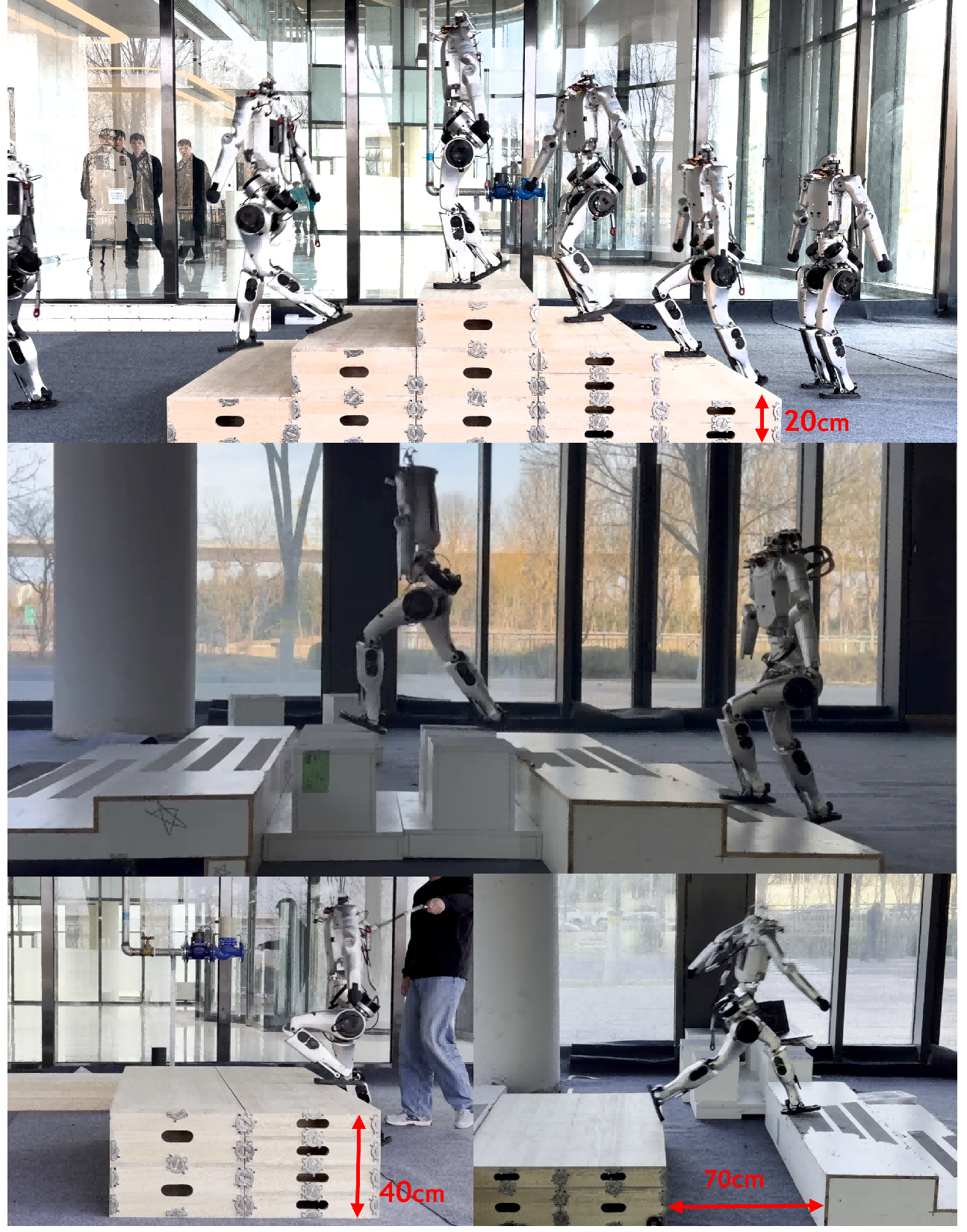
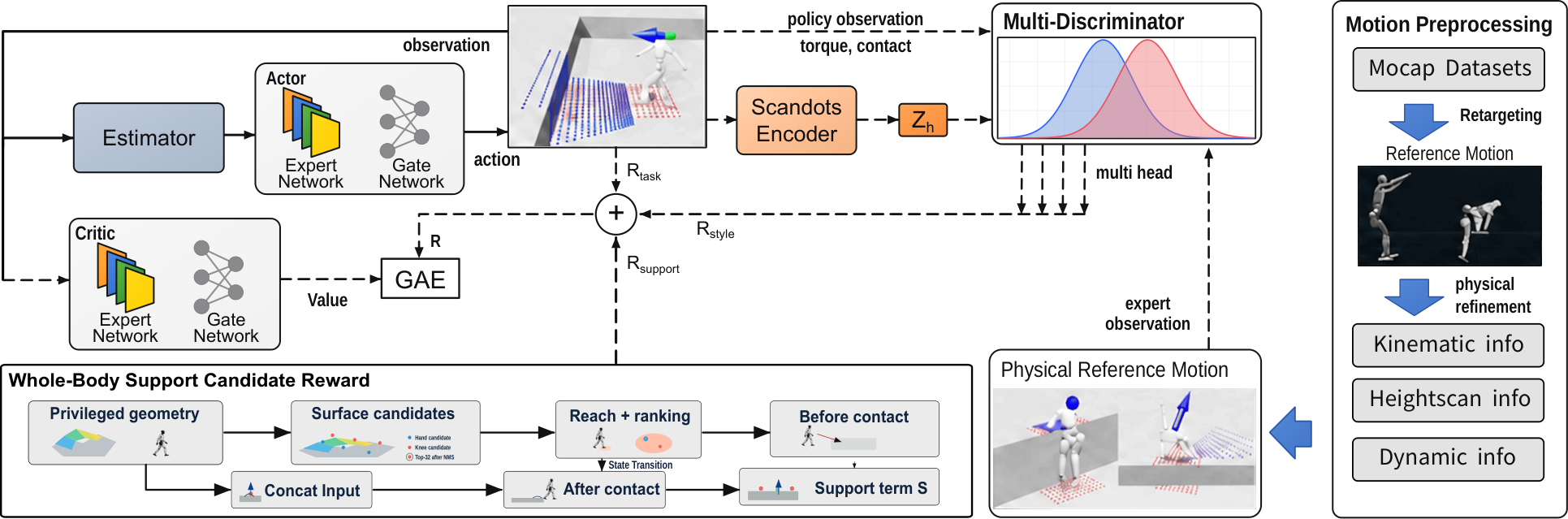
The paper proposes a three-stage progressive imitation framework in which privileged imitation yields executable robot references, terrain-indexed adversarial motion priors guide skill acquisition, and geometric support guidance with reduced prior weight adapts hand-knee contact placement. On a Noetix E1 it reaches 96.34% hybrid success in simulation and transfers without policy fine-tuning, completing 29/30 obstacle trials and 4/5 hybrid courses.
中文摘要: 本文提出三阶段渐进式模仿框架:首先用特权模仿生成物理可执行的机器人参考动作;其次以地形索引的对抗式运动先验引导技能习得;最后在降低运动先验权重的同时引入几何支撑引导,实现手膝支撑接触模式的适配。该方法在Noetix E1上仿真混合任务成功率96.34%,无需真机策略微调即完成迁移,30次单项障碍试验通过29次、5条混合路线完成4条。
💬 Terrain-indexed motion priors plus contact-adaptation guidance give a practical recipe for deploying demonstrated skills whose contact patterns do not fit the robot.
💬 地形索引运动先验结合接触适配引导,为部署接触模式与机器人本体不匹配的示范技能提供了实用方案。
Why read it / 推荐理由: It demonstrates zero-shot sim-to-real transfer of an RL locomotion policy on real hardware with ablation-backed design choices relevant to modular legged control. 它展示了RL行走策略在真实硬件上的零样本sim-to-real迁移,并通过消融验证了与模块化足式控制相关的设计选择。
5. PhySA: Decoupling Aesthetic and Physical Rewards for Humanoid Locomotion
PhySA:解耦人形机器人行走中的美学奖励与物理奖励
Authors / 作者: Yunwan Fu, Sicheng He, Jiageng Mao, Yue Wang
arXiv: 2611.07679 · PDF
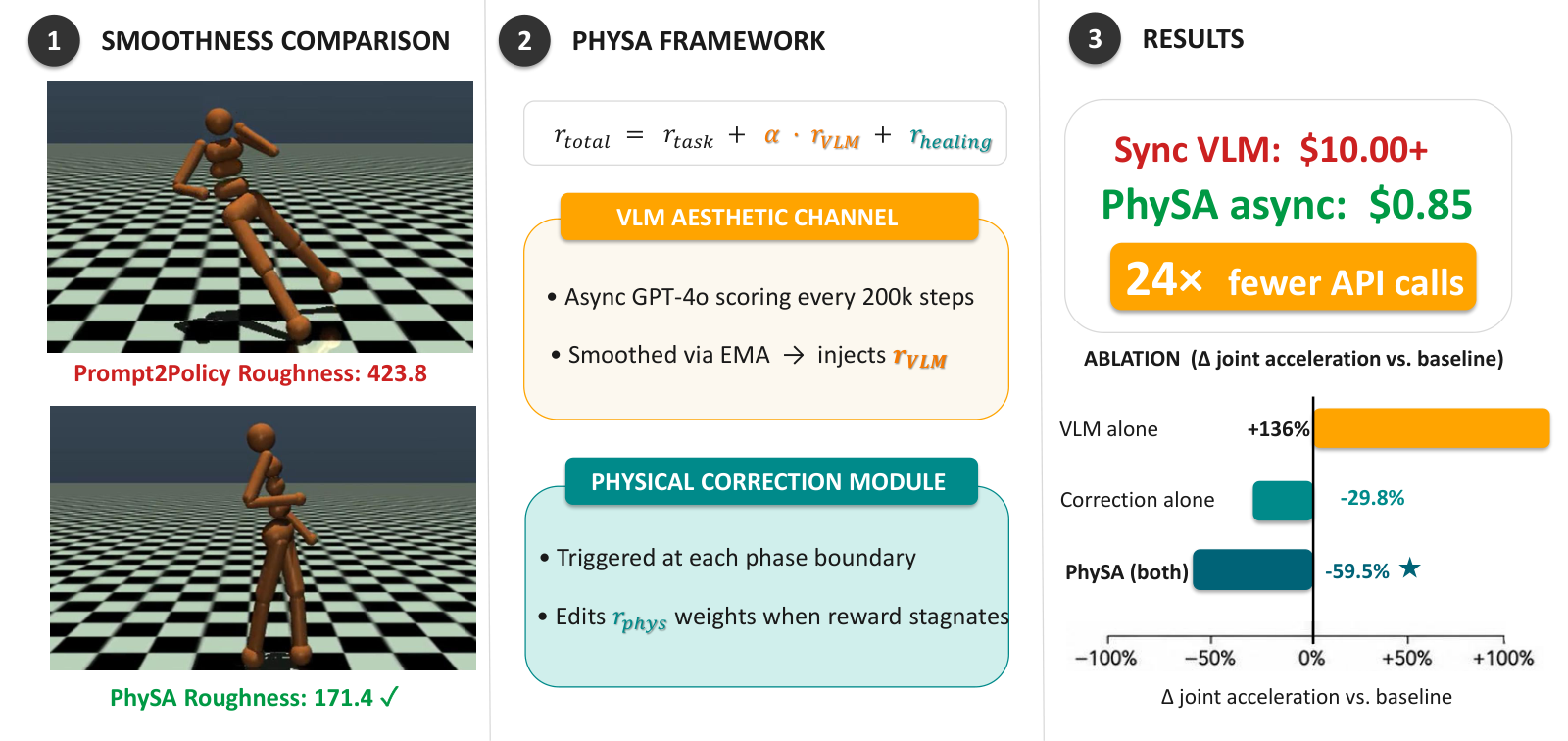
The authors show that VLM aesthetic scores are positively correlated with joint acceleration (mean Pearson r=+0.66 across four VLMs), so aesthetic and smoothness rewards conflict. PhySA separates a sparse asynchronous VLM channel from a phase-triggered correction channel that adjusts physical penalty weights from simulator state; on MuJoCo Humanoid-v5 it cuts joint acceleration 26-32% versus PPO/Text2Reward/Eureka, but the gain does not transfer to IsaacLab or the Unitree G1.
中文摘要: 作者发现四个主流视觉语言模型给出的美学评分与关节加速度正相关(平均皮尔逊r=+0.66),说明美学偏好与运动平滑性目标相互冲突。PhySA将稀疏异步的VLM奖励与一个由仿真状态触发的相位校正通道分离,后者动态调整物理惩罚权重;在MuJoCo Humanoid-v5上,相比PPO、Text2Reward与Eureka使关节加速度降低26%–32%,但该增益无法迁移至IsaacLab或宇树G1真机。
💬 A useful cautionary ablation showing reward-channel design matters and that simulator-specific smoothing gains may not survive sim-to-real.
💬 该工作是有价值的警示性消融:奖励通道设计确实关键,但特定仿真器上的平滑性增益未必能经受sim-to-real考验。
Why read it / 推荐理由: It quantifies how a plausibly attractive VLM reward signal can fight physical smoothness objectives, a trap worth knowing when shaping RL locomotion rewards. 它量化了看似诱人的VLM奖励信号如何与物理平滑性目标相冲突,是设计RL行走奖励时需要警惕的问题。