Robotics Digest
Robotics Paper Digest — 2026-11-04
🤖 Scanned 350 papers from today’s arXiv announcement (cs.RO / eess.SY / cs.LG), picked 5 for modular & legged robotics — summarized by DeepSeek.
🤖 从今日 arXiv 新论文(cs.RO / eess.SY / cs.LG)中扫描 350 篇,围绕模块化与足式机器人精选 5 篇 — 由 DeepSeek 生成双语摘要。
1. Online iLQR-MPC with Whole-Body Control for Robust Humanoid Locomotion
面向鲁棒人形机器人运动的在线 iLQR-MPC 与全身控制
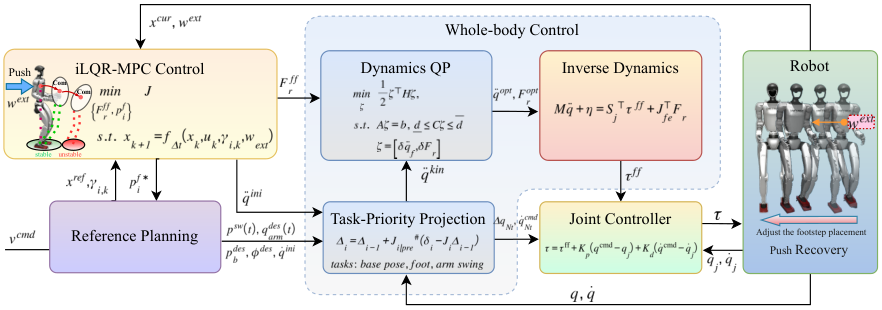
Authors / 作者: Xiang Li, Linlin Ou, Ruihan Wu, Xinyi Yu
arXiv: 2611.04204 · PDF
This work couples a single-rigid-body-model iLQR-MPC that jointly optimizes contact forces and footstep locations in one receding-horizon problem (no separate step planner) with a 500 Hz whole-body controller mapping the plan to joint torques. Contact/motion constraints enter the backward pass via augmented-Lagrangian and relaxed-barrier penalties; the MPC replans at 100 Hz with 8.9 ms mean solve time, and the Unitree G1 sustains walking and recovers from 245 N forward and 175 N lateral impulses in MuJoCo.
中文摘要: 本文提出一种面向人形机器人运动的在线模型预测控制框架:基于单刚体模型(保留姿态动力学与完整接触力旋量),采用 iLQR-MPC 在单一滚动时域问题中联合优化接触力与落脚点,无需独立步态规划器;通过增广拉格朗日与松弛障碍罚函数把接触与运动约束嵌入反向传播。随后由全身控制器在 500 Hz 将规划映射为关节力矩并保持接触可行性。MuJoCo 仿真中 MPC 以 100 Hz 重规划(平均求解 8.9 ms),Unitree G1 实现稳态行走,并能从 245 N 前向与 175 N 侧向冲量扰动中恢复。该方法无需平台专用策略训练,扰动响应可通过显式代价与约束解释。
💬 A clean demonstration that joint force-footstep iLQR-MPC plus a WBC can give interpretable, training-free disturbance recovery on a real humanoid model.
💬 该工作清晰展示了联合优化接触力与落脚点的 iLQR-MPC 配合全身控制,可在无需策略训练的情况下实现可解释的扰动恢复。
Why read it / 推荐理由: Directly relevant to MPC-plus-WBC locomotion stacks and the augmented-Lagrangian constraint handling you can adapt to modular multi-legged platforms. 与 MPC 加全身控制的运动框架高度相关,其增广拉格朗日约束处理方式可迁移到模块化多足平台。
2. Caging Vision-Language Navigation for Legged Robots via Barrier-Certified Safety Architecture
基于屏障函数安全架构的腿足机器人视觉语言导航约束框架
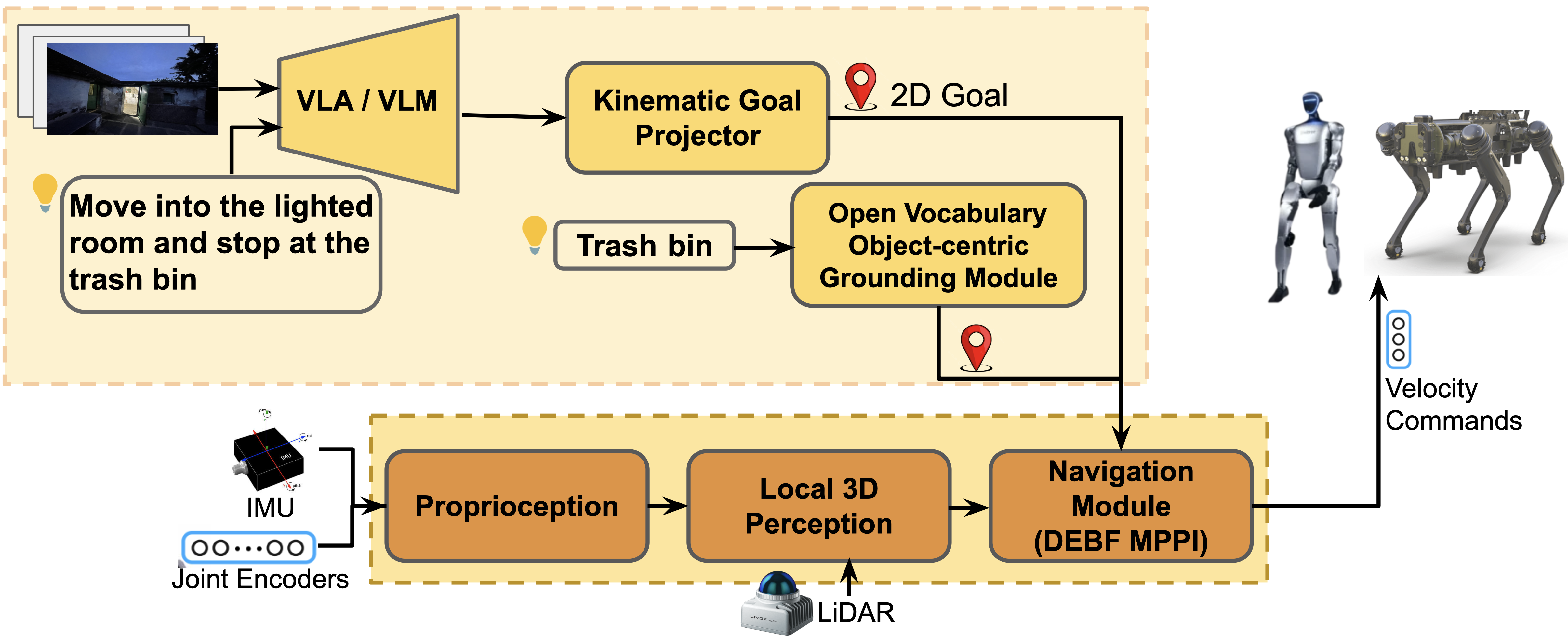
Authors / 作者: Abhijeet M. Kulkarni, Saimouli Katragadda, Yuze Du, Zijun Sha, Guoquan Huang
arXiv: 2611.04972 · PDF
The authors keep an end-to-end VLA planner but ‘cage’ it with a physical-grounding layer: state estimation, in-situ 3D perception and an SDF map feed a low-dimensional Bezier-parameterized MPPI planner with Discrete Exponential Barrier Function constraints, yielding provable collision-avoidance guarantees. The modular system is VLM/VLA-agnostic and platform-agnostic, validated in real-world experiments on humanoid and quadruped robots.
中文摘要: 本文不放弃端到端视觉-语言-动作(VLA)规划能力,而是为其增加物理落地与安全约束层:利用高效状态估计、原位三维感知与符号距离场(SDF)表示生成可执行轨迹,并将低维 Bezier 参数化 MPPI 规划器与离散指数屏障函数(dEBF)约束结合,在给定假设下提供可证明的避碰保证。系统高度模块化,兼容多种 VLM/VLA 模型且与机器人平台无关,并在人形与四足机器人上开展了大量真实世界实验,验证了其通用性与高效性。
💬 A pragmatic architecture that wraps learned VLN with SDF-based barrier-certified planning, with real quadruped/humanoid validation.
💬 该工作用基于 SDF 的屏障函数认证规划包裹学习式视觉语言导航,并在真实四足与人形平台上验证。
Why read it / 推荐理由: Shows how to combine learned high-level navigation with certifiable low-level planning, which is directly useful for traverse-capability-aware path planning on legged platforms. 展示了如何将学习式高层导航与可认证的低层规划结合,对腿足平台的通过能力感知路径规划很有参考价值。
3. Moving Horizon Estimation and Constrained Model Predictive Control for Balancing a Wheel-Legged Robot Under Unknown Disturbances
未知扰动下轮腿机器人平衡的移动 horizon 估计与约束模型预测控制
Authors / 作者: Haitham El-Hussieny
arXiv: 2611.04357 · PDF
This paper pairs a moving horizon estimator (virtual-leg model augmented with horizontal hip force, body pitch torque and gyroscope bias, with accelerometer compensation and impact-triggered process-noise inflation) with an offset-free constrained MPC for sagittal balance of a 9.95 kg wheel-legged robot. In MuJoCo with realistic sensor noise, bias, quantization and delay, MPC+MHE cuts RMS speed error to 0.11 m/s versus 0.24 m/s for ground-truth LQR, and holds 6 cm wind position error versus 81 cm for LQR.
中文摘要: 本文针对 9.95 kg 轮腿机器人矢状面平衡,提出移动 horizon 估计器(MHE)与无偏约束模型预测控制(MPC)的组合。估计器基于虚拟腿模型,引入水平髋部力、机身俯仰力矩与陀螺零偏,加速度计模型去除预测髋加速度,并在检测到冲击时增大过程噪声。MPC 显式考虑电机力矩约束。在含传感器噪声、零偏、量化与延迟的 MuJoCo 仿真中,MPC+MHE 将速度 RMS 误差降至 0.11 m/s(真值状态 LQR 为 0.24 m/s);在未知 2 kg 负载与 10 N 逆风下风场平均位置误差 6 cm,而真值 LQR 达 81 cm。
💬 A careful state-estimation-plus-MPC study that quantifies how much disturbance rejection comes from estimation versus control, on a leg-articulated platform.
💬 该工作在腿式关节平台上细致区分了状态估计与控制各自对扰动抑制的贡献。
Why read it / 推荐理由: The MHE design and impact-aware noise adaptation are directly transferable to modular legged robots that must balance under unknown payloads and contacts. 其 MHE 设计与冲击感知噪声自适应策略可直接迁移到需在未知负载与接触下保持平衡的模块化腿足机器人。
4. HLO-AMP: Hierarchical Loco-Manipulation from Object-Aware Motion Priors
HLO-AMP:基于物体感知运动先验的分层移动操作
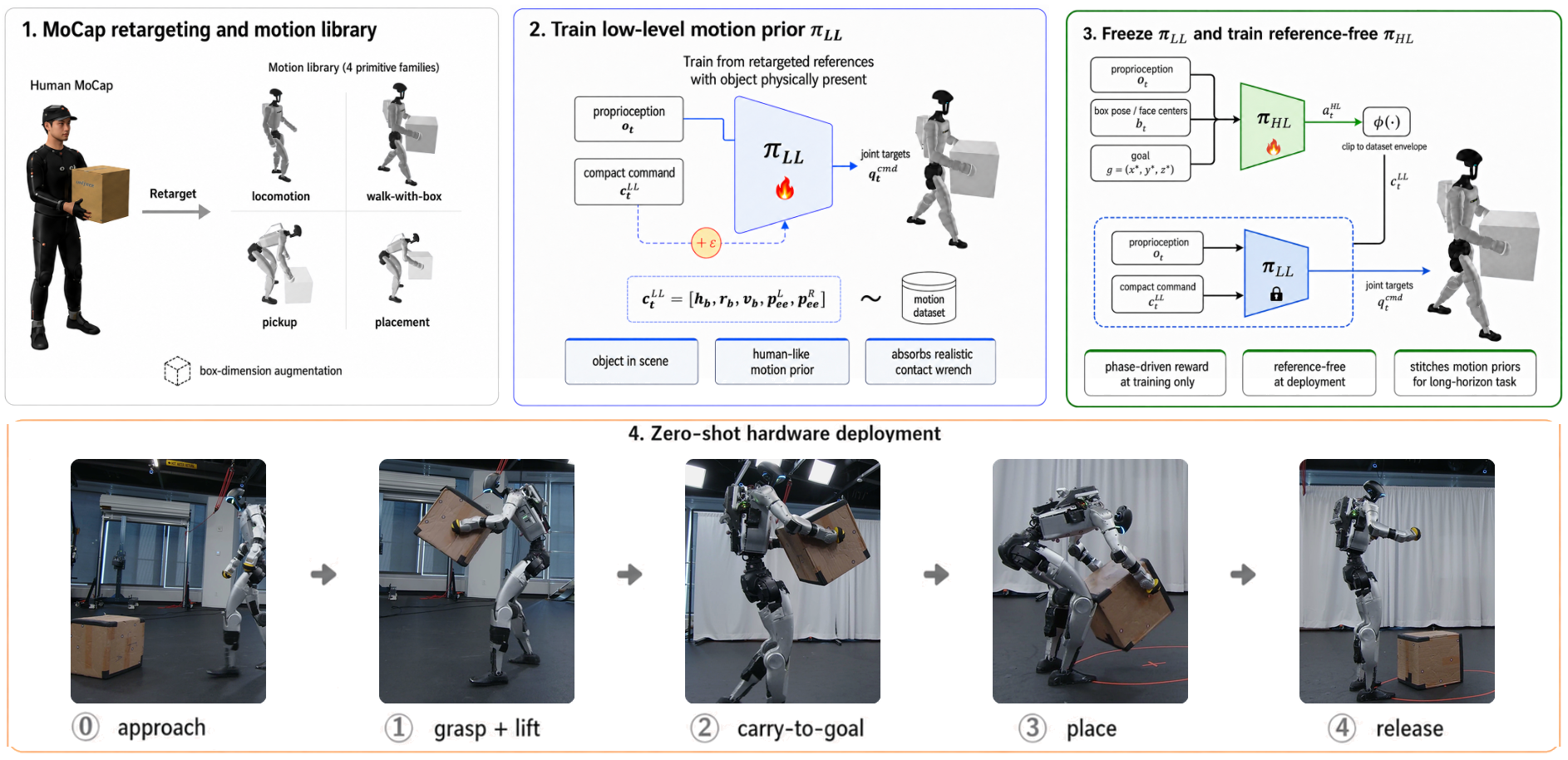
Authors / 作者: Jean-Pierre Sleiman, Bilal Hammoud, He Li, Jonathan Foster, Sylvain Bertrand, Jessica K. Hodgins et al.
arXiv: 2611.05113 · PDF
Instead of a task-agnostic WBC trained with randomized end-effector force proxies, the low-level controller is trained as an object-aware motion prior via motion imitation on retargeted MoCap references spanning the task’s motion primitives, with the payload physically present so realistic multi-contact wrenches are absorbed at the source. A reference-free high-level policy is then trained on top with actions anchored to the low-level data envelope, preventing out-of-distribution queries and enabling long-horizon multi-stage tasks.
中文摘要: 本文指出传统分层移动操作中低层全身控制器与物体无关、仅用随机末端力扰动近似负载动力学,在接近负载极限时误差显著。作者将低层控制器本身训练为物体感知的运动先验:在场景中真实放置被操作物体,通过运动模仿学习重定向动捕参考,覆盖下游任务的核心运动基元,从而继承自然人机协调并吸收真实多接触力旋量,同时保留紧凑的任务空间命令接口。上层无参考策略以该接口训练,动作通道锚定于低层训练数据经验范围,防止越界查询,实现长时域多阶段任务。
💬 Reframes the low-level WBC as an object-aware, imitation-derived motion prior—an appealing alternative to reward-shaped WBCs with force randomization.
💬 该工作把低层全身控制器重构为物体感知的模仿式运动先验,是替代奖励塑形加力随机化 WBC 的有吸引力的方案。
Why read it / 推荐理由: Relevant to whole-body control design and RL motion priors, with lessons on grounding contact wrenches that apply to modular legged platforms carrying payloads. 与全身控制设计与强化学习运动先验相关,其真实接触力旋量建模经验可推广到承载载荷的模块化腿足平台。
5. ReflexArc: Bottom-Up Integration of Instantaneous Tactile Reflexes into Whole-Body Humanoid Control
ReflexArc:将瞬时触觉反射自底向上集成到全身人形控制
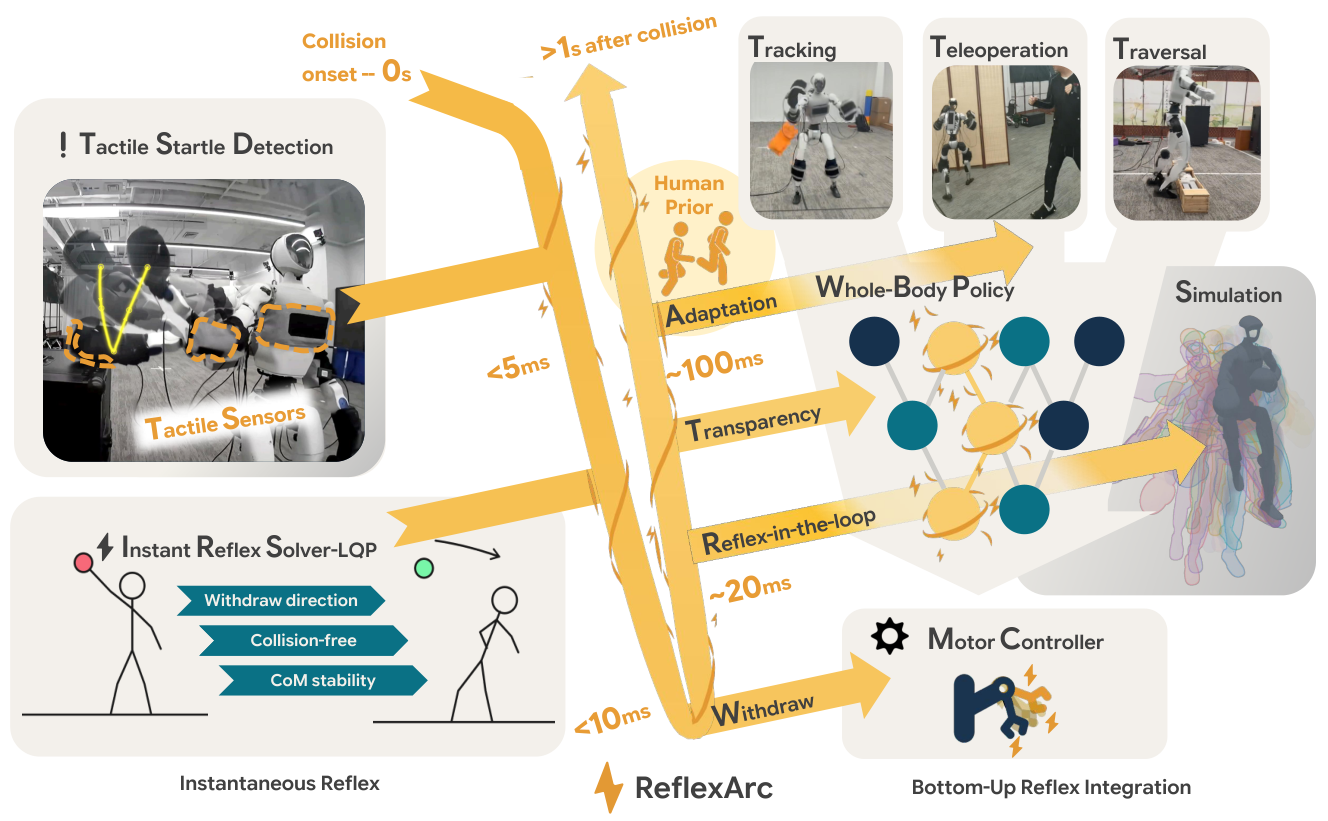
Authors / 作者: Mingyu Wang, Si Li, Ziqing Chen, He Wang, Li Yi
arXiv: 2611.04424 · PDF
ARC adds an instantaneous reflex pathway that detects hazardous full-body tactile contacts, solves a whole-body withdrawal pose and commands motors within 10 ms, combined with reflex-in-the-loop policy learning, reflex-transparent alignment and reflex-informed adaptation so the learned 50 Hz WBC sustains withdrawal while keeping balance. On a Unitree G1 it reduces the first force peak by 34.1% and contact impulse by 2.15x versus a 20 ms-delayed reflex, and enables protected tracking and vision-free tactile obstacle traversal.
中文摘要: 针对学习式全身策略 50 Hz 运行带来的策略周期延迟以及可能把保护性回缩误判为跟踪误差的问题,本文提出 ARC(上行反射控制)自底向上框架:瞬时反射通路基于全身触觉检测危险接触,求解全身回缩姿态并在 10 ms 内直接下发至电机;再通过反射在环的策略学习、反射透明对齐与反射知情自适应,使策略维持回缩、保持平衡并完成更长时域恢复。在 Unitree G1 上,相较延迟 20 ms 的同样反射,首次力峰值降低 34.1%,接触冲量由 0.2632 N·s 降至 0.1225 N·s(2.15 倍),并演示了受保护的跟踪、遥操作与仅靠足部触觉的无视觉越障。
💬 A convincing argument that sub-policy-rate reflex layers are needed on top of learned whole-body controllers, backed by real-robot tactile results.
💬 该工作以真实机器人触觉实验有力论证了在学习式全身控制器之上叠加亚策略周期反射层的必要性。
Why read it / 推荐理由: The reflex/learned-control layering and tactile sensing integration offer a concrete template for adding fast contact safety to modular legged robots. 其反射层与学习控制的分层及触觉集成方式,为模块化腿足机器人增加快速接触安全机制提供了具体范本。