Robotics Digest
Robotics Paper Digest — 2026-11-01
🤖 Scanned 105 papers from the last 7 days of arXiv announcements (cs.RO / eess.SY / cs.LG), picked 5 for modular & legged robotics — summarized by DeepSeek.
🤖 从近 7 天的 arXiv 新论文(cs.RO / eess.SY / cs.LG)中扫描 105 篇,围绕模块化与足式机器人精选 5 篇 — 由 DeepSeek 生成双语摘要。
1. HumanoidNDM: Closing the Training-Deployment Gap of Motion Tracking via Humanoid Neural Dynamics Model
HumanoidNDM:通过人形神经动力学模型弥合运动跟踪的训练-部署差距
Authors / 作者: Chao Chen, Zhenrong Wang, Jilong Wang, Yusen Feng, Jiangran Lyu, Li Yi et al.
arXiv: 2610.34126 · PDF
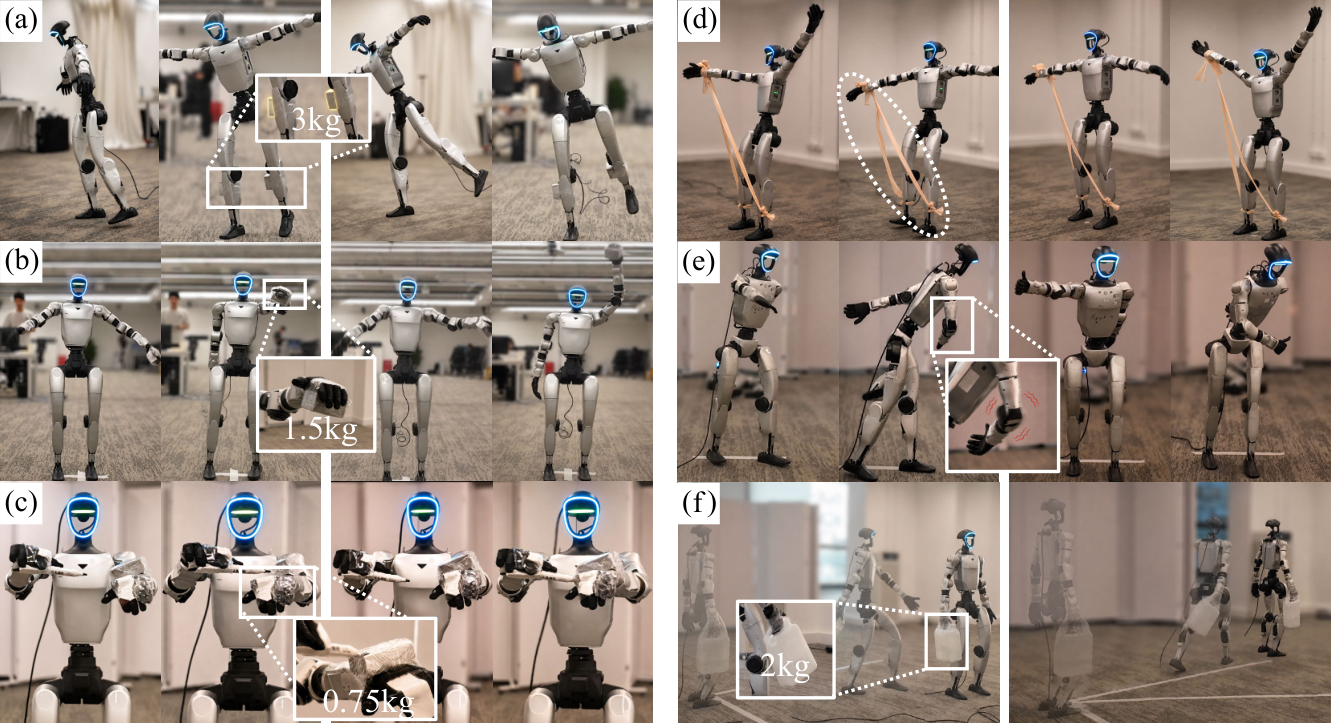
HumanoidNDM introduces an online fine-tuning framework for humanoid motion tracking that uses a learned, history-based proprioceptive neural dynamics model trained on real-world data, combined with differentiable forward kinematics, to eliminate the need for motion capture. A low-frequency reference perturbation strategy with adaptive intensity balances exploration and deployability. Physical experiments on the Unitree G1 show rapid adaptation to various disturbances and perturbations, achieving the first online, MoCap-free fine-tuning framework for humanoid tracking policies.
中文摘要: 本文提出HumanoidNDM,一种用于人形机器人运动跟踪的在线微调框架,旨在弥合仿真训练与真实部署之间的动力学差距。方法包括三部分:在数据采集阶段,引入带自适应强度的低频参考扰动策略,兼顾部署可行性与探索效率;在模型训练阶段,构建基于历史本体感知的鲁棒神经动力学模型,并在欧氏空间中结合可微前向运动学,从而摆脱对昂贵动捕系统的依赖;在策略微调阶段,利用模型梯度反向传播直接微调策略,实现高数据效率。在Unitree G1真机上验证表明,该框架能快速适应多种物理扰动,是首个无需动捕的在线人形运动跟踪策略微调框架。
💬 A practical sim-to-real fine-tuning recipe that replaces motion capture with a learned neural dynamics model, directly relevant to closing the reality gap in legged controllers.
💬 一种实用的sim-to-real微调方案,用学习到的神经动力学模型替代动捕,对缩小足式控制器现实差距具有直接参考价值。
Why read it / 推荐理由: If you work on sim-to-real transfer for legged locomotion, this offers a MoCap-free online adaptation pipeline validated on real hardware. 若你研究足式运动的sim-to-real迁移,该工作提供了在真机上验证的无需动捕的在线自适应流程。
2. Multi-Agent Reinforcement Learning of Co-Adaptive Hip Exoskeleton Control (MARL-Exo) for Metabolic Energy Reduction
面向代谢能耗降低的协同自适应髋关节外骨骼控制的多智能体强化学习(MARL-Exo)
Authors / 作者: Yifei Yuan, Jakob Wolf, Ghaith Androwis, Xianlian Zhou
arXiv: 2610.37441 · PDF
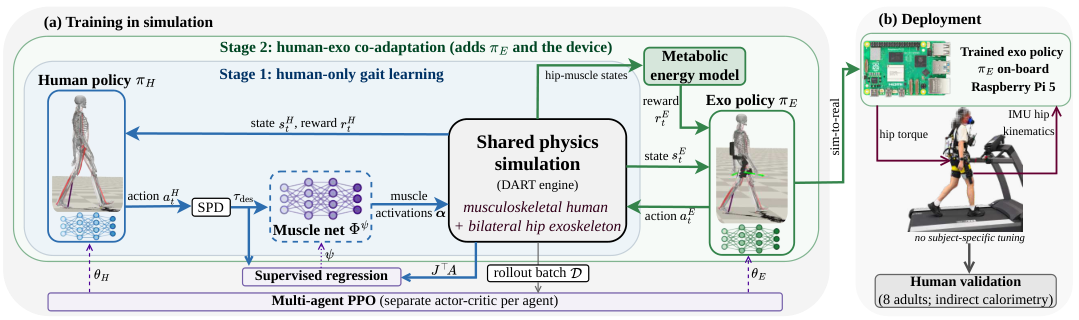
MARL-Exo trains a bilateral hip-exoskeleton policy concurrently with a 304-muscle musculoskeletal human model under a metabolic-energy reward, with the exoskeleton observing only delayed hip kinematics and past commands. A two-stage multi-agent RL formulation, optionally with mechanical-power shaping, yields a Metabolic policy that reduced modeled muscle metabolic power by 13.8% in simulation and, deployed without retraining, lowered net metabolic rate by 18.3±6.6% versus passive in all eight participants.
中文摘要: 本文提出MARL-Exo,一种多智能体强化学习框架,让全身肌肉骨骼人体模型(304个肌肉驱动器,随机化解剖、步态与速度)与双侧髋关节外骨骼策略在两阶段中协同训练。外骨骼只观测延迟的髋部运动学与历史指令,其奖励包含基于生理能量学模型的肌肉代谢功率,并可选加入机械功率整形。仿真中代谢策略相对无设备行走降低建模肌肉代谢功率13.8%,优于加入功率整形的8.8%。该策略未经再训练即部署到八名健康成人(1.25 m/s),相对被动外骨骼降低净代谢率18.3±6.6%,相对无外骨骼平均降低7.4±10.0%。
💬 Shows how a metabolic-energy reward over delayed proprioception can produce transferable, simulation-trained assistive control without per-user tuning.
💬 展示了基于延迟本体感知的代谢能量奖励如何产生无需逐用户调参、可迁移的仿真训练辅助控制策略。
Why read it / 推荐理由: Relevant for those interested in RL-based locomotion control with physiological cost objectives and zero-shot hardware deployment. 适合关注以生理代价为目标的强化学习运动控制与零样本硬件部署的研究者。
3. PrefO2O: Zero-Shot Preference-Based Reinforcement Learning via Offline-to-Online Latent Preference Transfer
PrefO2O:通过离线到在线潜在偏好迁移的零样本基于偏好的强化学习
Authors / 作者: Ruiqi Wang, Dezhong Zhao, Xuesu Xiao, Erdem Biyik, Byung-Cheol Min, Guohua Chen
arXiv: 2610.31812 · PDF
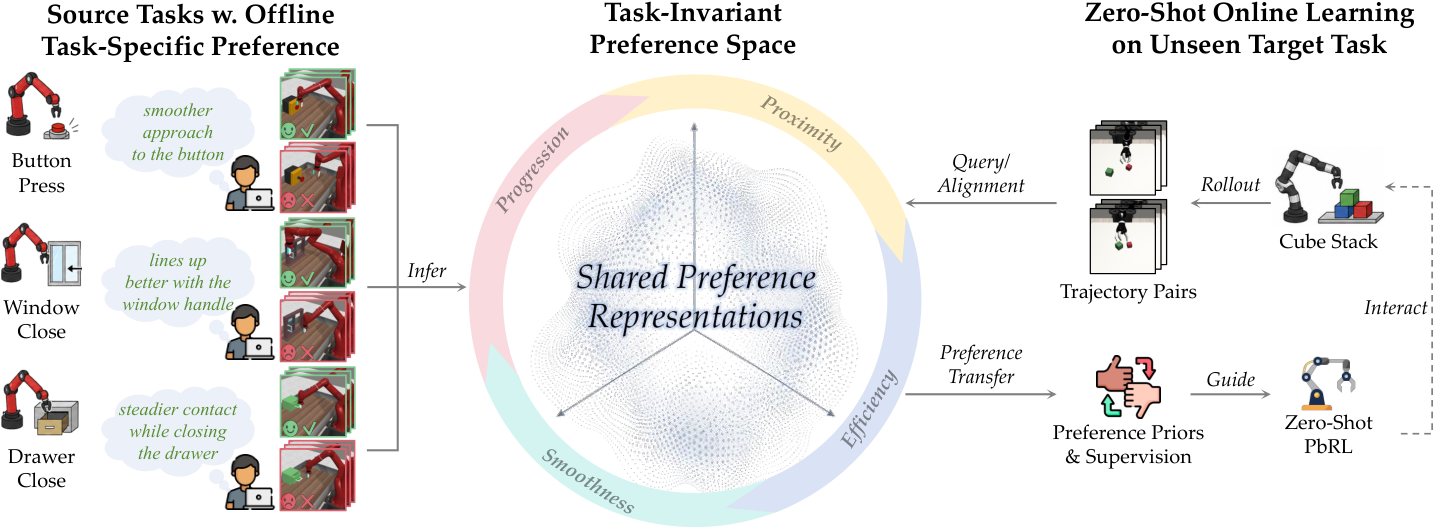
PrefO2O learns a task-invariant latent preference space from limited offline preference data on source tasks, disentangling transferable preference structure from task-specific variation, and then transfers reward priors to unseen target tasks without any new human feedback. Confidence-weighted optimal transport alignment generates pseudo-preference supervision for online reward adaptation. Experiments on manipulation and locomotion benchmarks show it matches or exceeds PbRL methods trained with real human feedback and generalizes across transfer settings and embodiments.
中文摘要: 本文提出PrefO2O,一种离线到在线的潜在偏好迁移框架,旨在无需新任务人类反馈的情况下实现零样本基于偏好的强化学习。核心思想是从少量源任务离线偏好数据中学习任务不变的潜在偏好空间,将可迁移的偏好结构与任务特定变化解耦,并借助置信度加权的最优传输对齐生成伪偏好监督,实现跨分布偏移的在线奖励自适应。在机器人操作与运动基准上,该方法显著优于现有偏好迁移基线,并可匹配甚至超越使用真实人类反馈训练的PbRL方法,且在多种迁移设置与不同机器人本体间具有泛化性。
💬 A promising route to reduce human labeling cost in RL reward design, with locomotion benchmarks suggesting applicability to legged motion controllers.
💬 为降低强化学习奖励设计中的人工标注成本提供了有前景的途径,其运动基准结果暗示可应用于足式运动控制器。
Why read it / 推荐理由: Useful if you want reward learning for locomotion without continuous human preference queries during deployment. 若你希望在部署阶段无需持续人类偏好查询即可为运动任务学习奖励,此文值得一读。
4. OWLS: Open-world Language-conditioned Speed Fields for Zero-Shot Rover Navigation
OWLS:面向零样本漫游车导航的开世界语言条件速度场
Authors / 作者: Chahyon Ku, Erica Tevere, Georgios Georgakis, Rudra Mukherjee, Bernadette Bucher
arXiv: 2610.32596 · PDF
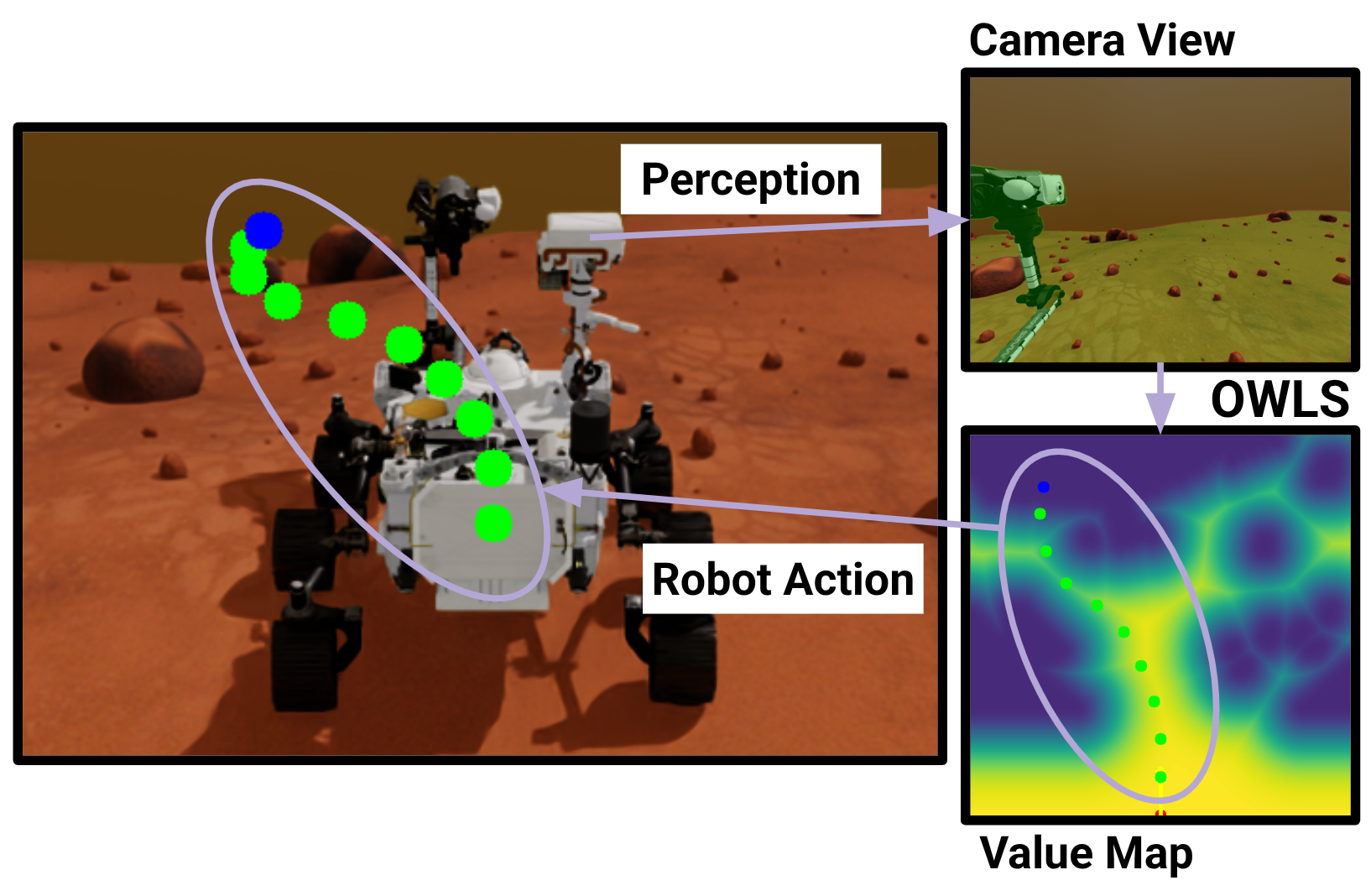
OWLS uses an open-vocabulary vision-language model, prompted with a description of traversable terrain, to score every pixel of a single camera image, then projects and morphologically adapts these scores onto the ground to form a speed field for a minimum-time planner. It requires no task-specific training, terrain annotation, persistent map, or sensor beyond the camera. It is evaluated on a physical rover indoors and off-road, on simulated Mars and Moon rovers over 200 procedurally generated terrains, and on real planetary imagery.
中文摘要: 本文提出OWLS,利用开放词汇视觉-语言模型(VLM)进行零样本地形可通行性推理。给定可通行地形描述作为提示,VLM对单张相机图像的每个像素打分,OWLS将这些分数投影到地面,并经两步形态学操作适配平台特性,作为最小时间规划器的速度场,使地形外观与障碍间距共同塑造单条轨迹。该方法无需任务特定训练、地形标注、持久地图或额外外感知传感器。在室内与越野真实漫游车、200个程序化生成的模拟火星/月球地形以及真实行星图像上进行了评估。
💬 Turns open-vocabulary VLM semantics into a traversability-aware speed field, nicely linking perception-driven traversability with motion planning.
💬 将开放词汇VLM语义转化为可通行性感知的速度场,良好地衔接了感知驱动的可通行性与运动规划。
Why read it / 推荐理由: Directly relevant to traverse-capability-aware path planning, offering a training-free perception-to-planner interface you could adapt to legged platforms. 与可通行性感知路径规划直接相关,提供无需训练即可用于足式平台的感知到规划器接口。
5. MOTIO: Agentic Skill Engineering for Reality-Grounded Humanoid Loco-Manipulation
MOTIO:面向现实落地的人形移动操作智能体化技能工程
Authors / 作者: SpatialtemporalAI
arXiv: 2610.33446 · PDF
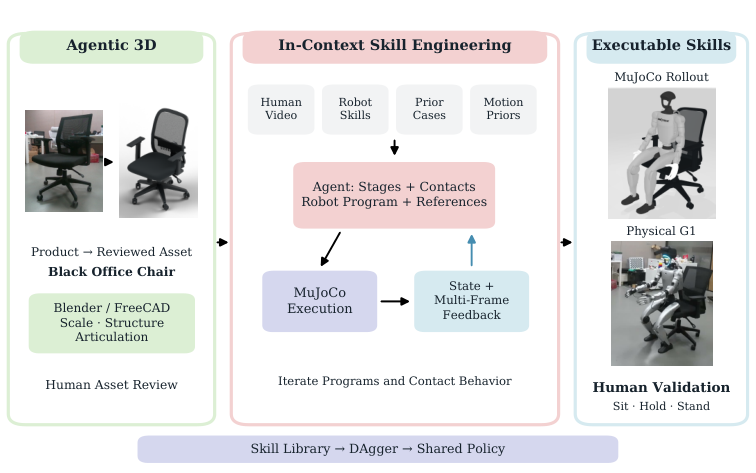
MOTIO is an agentic skill-engineering system that converts human-action videos, 3D assets, motion references, and reusable robot skills into executable humanoid loco-manipulation programs through in-context task and contact reasoning, refined by physics execution and human validation. It demonstrates a 101.75-second physical G1 bottle-disposal execution and a 76.0% reduction in screw-tightening thread residual, and uses agent-generated skills to supervise BC/DAgger distillation into a shared reference policy completing 18 simulated tasks.
中文摘要: 本文提出MOTIO,一种智能体化技能工程系统,将普通人类动作视频、具现实尺度的3D资产、运动参考与可复用机器人技能,通过上下文任务与接触推理转化为可执行的人形移动操作程序,并借助物理执行、多帧反馈与人工验证进行改进,无需任务特定遥操作或机器人示教采集。系统在扫描办公室中对Unitree G1完成连续101.75秒的瓶子处理长时程技能,物理精修使拧螺丝螺纹残差降低76.0%。智能体生成的技能还可监督BC/DAgger蒸馏为共享参考策略,在单检查点下完成18个仿真任务。
💬 Demonstrates an agentic pipeline that composes whole-body IK and dexterous-hand interfaces into long-horizon loco-manipulation on real humanoid hardware.
💬 展示了将全身逆运动学与灵巧手接口组合为真实人形硬件上长时程移动操作的智能体化流程。
Why read it / 推荐理由: Interesting for its whole-body loco-manipulation composition and skill distillation, though less directly about modular legged locomotion. 其全身移动操作组合与技能蒸馏值得关注,尽管与模块化足式运动关系稍间接。