Robotics Digest
Robotics Paper Digest — 2026-10-24
🤖 Scanned 80 papers from the last 3 days of arXiv announcements (cs.RO / eess.SY / cs.LG), picked 5 for modular & legged robotics — summarized by DeepSeek.
🤖 从近 3 天的 arXiv 新论文(cs.RO / eess.SY / cs.LG)中扫描 80 篇,围绕模块化与足式机器人精选 5 篇 — 由 DeepSeek 生成双语摘要。
1. A2I-Calib++: A Kinematics-Driven Anti-noise Active Calibration Framework for Whole-Body Multi-IMU Systems on Legged Robots
A2I-Calib++:面向腿足机器人全身多IMU系统的运动学驱动抗噪主动标定框架
Authors / 作者: Fangyu Jiang, Chaoran Xiong, Kehui Ma, Zhen Sun, Zeyu Zhang, Ling Pei
arXiv: 2610.29438 · PDF
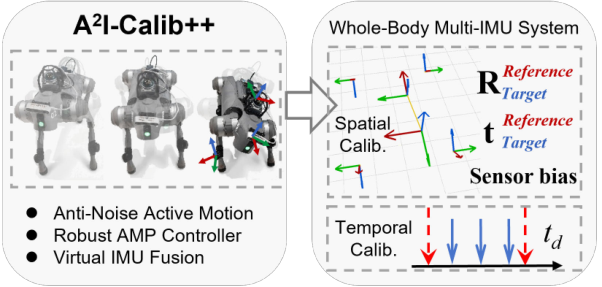
A2I-Calib++ calibrates body-mounted multi-IMU systems on legged robots by combining a noise-isotropy-inspired excitation trajectory validated by a finite-horizon conditioning analysis, an AMP controller with rolling-contact reward, and a contact-constrained virtual IMU fusing calf IMUs with joint kinematics. The framework estimates temporal offsets, extrinsics, and inertial biases without artificial targets, handling foot slips, impacts, and vibration noise that degrade conventional calibration.
中文摘要: 该文针对腿足机器人多IMU融合中的时空标定难题提出A2I-Calib++:常规运动激励不足,且足端滑移、冲击与振动引入噪声。框架由三个模块组成:基于有限时域条件数命题的噪声各向同性激励轨迹生成、带滚动接触奖励的约束感知对抗运动先验控制器,以及融合小腿IMU与关节运动学的接触约束虚拟IMU。方法先做时间偏移相关搜索,再解析估计外参旋转、平移与惯性偏置,无需人工标定目标或复杂调参。
💬 A rare calibration method that exploits the legged robot’s own gait as active excitation, directly useful for robust state estimation in modular multi-legged platforms.
💬 少见地将腿足机器人自身步态作为主动激励的标定方法,对模块化多足平台的鲁棒状态估计有直接价值。
Why read it / 推荐理由: If you plan to add distributed IMUs across modular leg segments, this gives a concrete anti-noise pipeline tied to the kinematic model. 若计划在模块化腿部安装分布式IMU,本文提供了与运动学模型绑定的抗噪标定流程。
2. Motion Retargeting with Spatiotemporal Preferences for Humanoid Loco-Manipulation
面向人形机器人移动操作的空时偏好运动重定向
Authors / 作者: Xiongbo Shi, Shihang Du, Zongyou Yu, Ao Zhou, Xudong Zhang, Ziyu Lin et al.
arXiv: 2610.30540 · PDF
The paper proposes Spatiotemporal Retargeting (STR), which uses a VLM to select relevant motion signals and body parts and identifies keyframes from signal changes, allocating extra solver iterations and interaction weights to critical moments. Mechanics-Aware Contact Anchoring refines object-surface contact, and Spatiotemporal RL with adaptive key-stage sampling and contact-force rewards trains downstream control.
中文摘要: 针对人形机器人移动操作中人体动作重定向的局部精度需求,提出空时重定向STR:利用视觉语言模型选取相关运动信号与身体部位,并依据信号变化检测关键帧,为关键帧分配更多求解迭代、为选定部位赋予更高交互权重。进一步引入力学感知接触锚定,利用近似物体力旋量模型修正接触位置。在下游控制中使用带自适应关键阶段采样与接触力奖励的空时强化学习。
💬 The keyframe/key-part budget allocation is a clean idea reusable for retargeting human gaits onto modular leg configurations.
💬 关键帧与关键部位的计算预算分配思路清晰,可复用于将人体步态重定向到模块化腿部构型。
Why read it / 推荐理由: Useful if you plan to bootstrap modular legged locomotion from human demonstration data rather than pure RL exploration. 若打算以人体示范数据而非纯RL探索来初始化模块化腿足运动控制,本文有参考价值。
3. SMR: Learning streaming motion retargeting for humanoids from human semantic
SMR:基于人类语义的人形机器人流式运动重定向学习
Authors / 作者: Chun Gu, Juntong Zhang, Jingyu Li, Li Zhang
arXiv: 2610.29169 · PDF
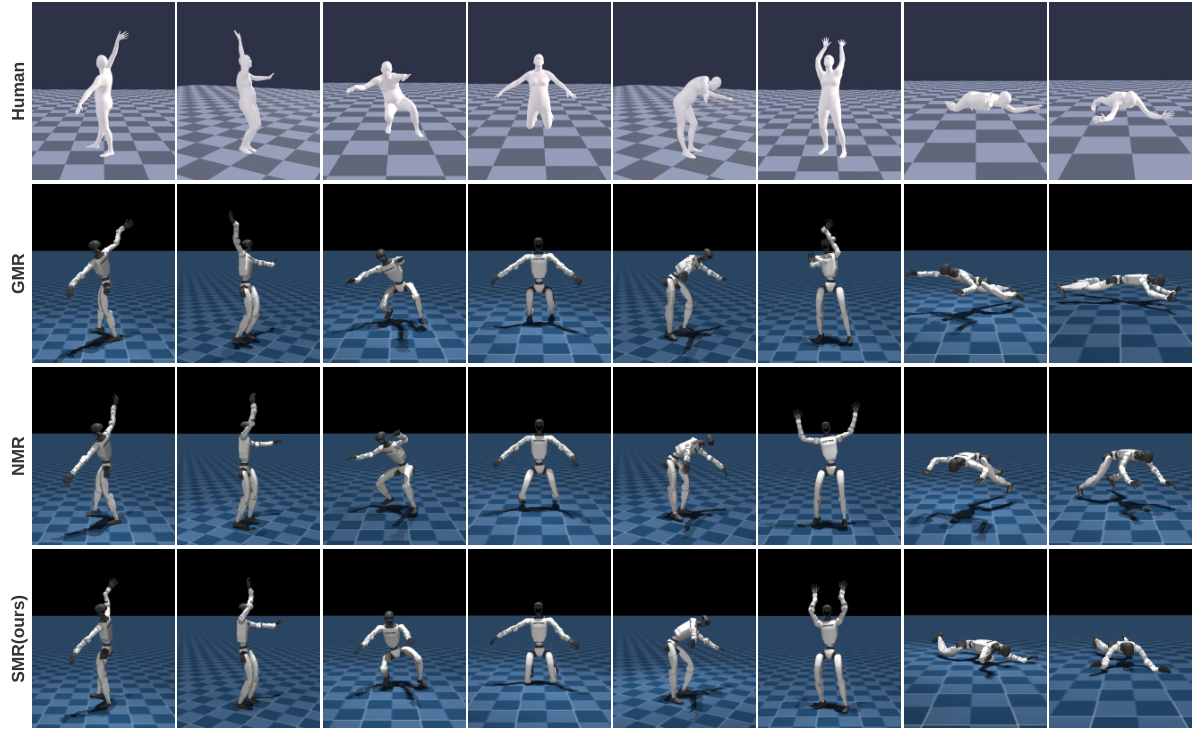
SMR converts human motion into robot-aware task-space targets and trains semantic-conditioned physics experts that track these targets in simulation under contact, dynamics, and actuator constraints. A single strictly causal Transformer is then distilled on the experts’ executed trajectories to produce a streaming retargeter whose references feed a downstream whole-body controller, improving closed-loop performance over optimization-based retargeting.
中文摘要: SMR将人体运动转换为机器人感知的任务空间目标(部位位置、姿态、速度),由语义条件下的物理专家在仿真中于接触、动力学与执行器约束下跟踪这些目标,再用严格因果的Transformer从专家实际执行轨迹中蒸馏出流式重定向器。每帧仅使用当前与历史人体观测生成机器人运动参考,供下游全身控制器使用;相比直接优化式重定向,语义保真度与物理可行性更高,闭环性能更优。
💬 Causal streaming retargeting with a WBC backend is architecturally close to how one would drive a reconfigurable multi-legged robot from high-level references.
💬 因果流式重定向加WBC后端,其架构与由高层参考驱���可重构多足机器人的方式相近。
Why read it / 推荐理由: Valuable as a template for the perception-to-WBC pipeline structure, independent of the humanoid embodiment. 其从感知到全身控制器的流水线结构可作为模板,与具体人形本体无关。
4. TRACE: Traversability-aware Reactive Navigation via VLM-driven Adaptive Constraints Estimation
TRACE:基于VLM驱动自适应约束估计的可通行性感知反应式导航
Authors / 作者: Mario A. V. Saucedo, Midhun Edatharam Kunnath, Elias Small, Akash Patel, Shruti Kotpalliwar, Christoforos Kanellakis et al.
arXiv: 2610.30994 · PDF
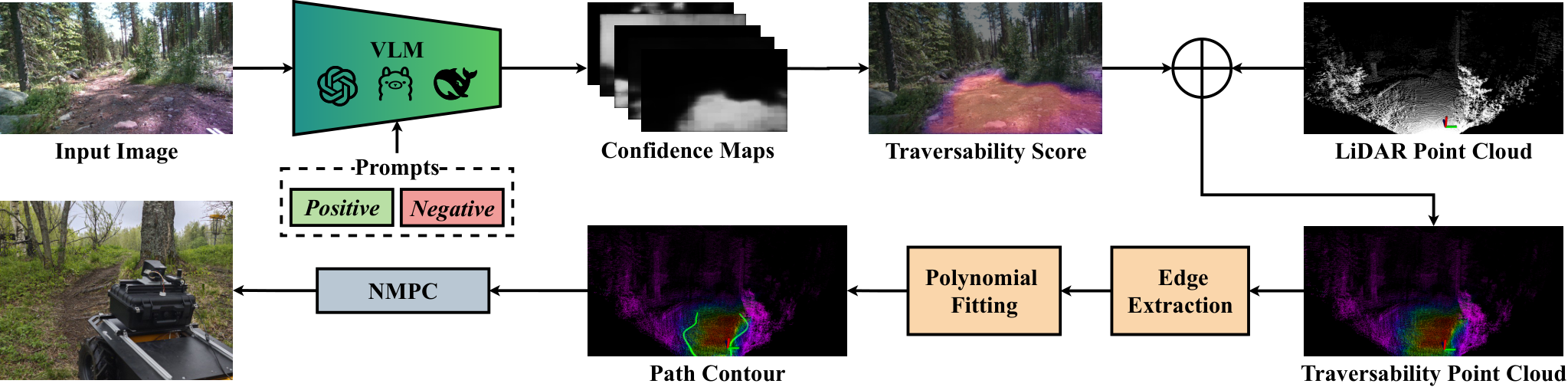
TRACE builds a dense traversability map from positive and negative natural-language prompt sets via a VLM and evidential fusion, then extracts traversable-path boundaries using percentile binning plus spline/polynomial fitting. These boundaries enter an NMPC formulation as soft barrier constraints, and real forest trials show smooth navigation over cluttered, deformable, and visually ambiguous terrain.
中文摘要: TRACE面向非结构化森林环境中的地面机器人,利用正负自然语言提示集由视觉语言模型生成置信度图,经证据融合得到强调已通过路径特征的稠密可通行性地图。随后提取可通行点,通过分位数分箱与样条/正则多项式拟合得到左右边界,并作为软约束障函数嵌入NMPC,实现安全自适应路径跟踪。真实森林实验验证了其在杂乱、可变形与视觉歧义地形下的平滑导航能力。
💬 Directly targets the reader’s traversability-aware planning thread by coupling VLM semantics with NMPC barrier constraints.
💬 将VLM语义与NMPC障函数约束耦合,直接对应读者关注的通行能力感知规划方向。
Why read it / 推荐理由: Relevant if you aim to extend leg-level traversability cost into a predictive controller for multi-legged platforms. 若要把腿部通行代价扩展进多足平台的预测控制器,本文直接相关。
5. Do Earth-Trained Humanoid Controllers Walk on the Moon? Gravity, Terrain, and Soil Transfer
地球训练的人形控制器能在月球上行走吗?重力、地形与土壤迁移
Authors / 作者: Guillem Casadesus Vila, Sri Aditya Deevi, Grace X. Gao
arXiv: 2610.30080 · PDF
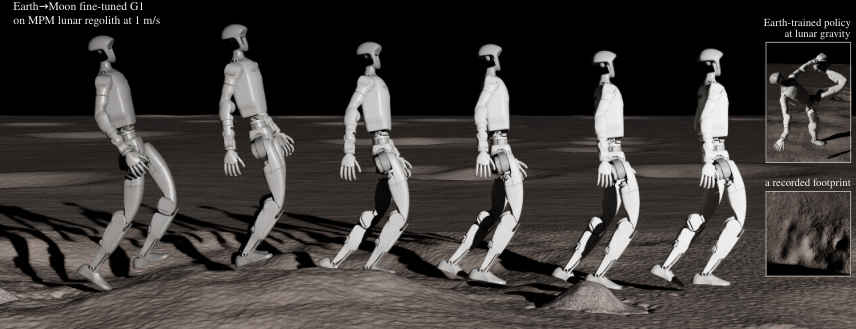
The study trains 12 Unitree G1 policies with one recipe while varying gravity, terrain geometry, and rigid-vs-3D-RFT ground contact, plus Earth-to-Moon fine-tuning and gravity randomization. It finds strongly asymmetric gravity transfer (Earth-trained policies retain 0.64-0.75 survival at lunar gravity, Moon-trained ones cannot stand on Earth), rough-terrain training lifting combined-tile survival to 0.98, and limited benefit of soil training on stiff lunar regolith.
中文摘要: 该文在仿真Unitree G1上以同一配方训练12个策略,系统变化重力、地形几何与地面接触模型(刚性或三维阻力理论3D RFT),并考察地月微调与重力随机化。结果显示重力迁移高度不对称:地球训练策略在月球重力下保持0.64–0.75存活率,而月球训练策略无法在地球站立;粗糙地形训练将组合瓦片存活率从0.53提升至0.98;土壤训练对较硬月壤收益有限。
💬 The cleanest recent empirical study of how contact-model and gravity assumptions break sim-to-real transfer in learned locomotion.
💬 近期最清晰的学习型运动控制迁移实证研究,揭示接触模型与重力假设如何破坏仿真到现实迁移。
Why read it / 推荐理由: Read it before setting up sim-to-real for a new modular platform, since the failure modes transfer beyond humanoids. 在为新型模块化平台搭建仿真到现实流程前值得一读,其失效模式不限于人形机器人。