Robotics Digest
Robotics Paper Digest — 2026-10-18
🤖 Scanned 38 papers from the last 3 days of arXiv announcements (cs.RO / eess.SY / cs.LG), picked 5 for modular & legged robotics — summarized by DeepSeek.
🤖 从近 3 天的 arXiv 新论文(cs.RO / eess.SY / cs.LG)中扫描 38 篇,围绕模块化与足式机器人精选 5 篇 — 由 DeepSeek 生成双语摘要。
1. Persistent Profile-Guided Reset-Free Recovery Improves Final Gait Selection after Irreversible Leg Damage
持久轮廓引导的无重置恢复改进不可逆腿部损伤后的最终步态选择

Authors / 作者: Minjoong Kim
arXiv: 2610.20838 · PDF
The paper introduces Persistent Profile-Guided Reset-Free Recovery (PGRR), which predicts multiple outcomes over repeated gait executions and uses conservative, uncertainty-aware estimates to guide short online probes without resetting the robot. Across 108 matched MuJoCo tasks covering leg amputation, distal fracture and joint lock, PGRR improves final gait quality by 0.106 and slot-averaged recovery quality by 0.044 over a Gaussian-process baseline, while cutting low-quality failures by 27.8 percentage points.
中文摘要: 本文提出持久轮廓引导的无重置恢复方法 PGRR,针对腿部不可逆损伤后的步态恢复问题。该方法在机器人持续运行、不进行重置的条件下,利用保守的不确定性估计对多次步态执行的多种结果进行预测,并据此引导短时在线探测,从而选出更优的最终步态。在涵盖腿部截肢、远端骨折和关节锁死的 108 个匹配 MuJoCo 任务中,PGRR 相比高斯过程基线将最终步态质量提升 0.106,槽平均恢复质量提升 0.044,并将低质量失败率降低 27.8 个百分点;最终质量提升在三种损伤类型中均出现。消融实验表明保守不确定性处理是主要增益来源。
💬 Damage-adaptive gait selection that explicitly accounts for the persistent physical state inherited across trials is directly relevant to fault-tolerant control of modular legged platforms.
💬 该工作显式考虑试验间继承的持久物理状态的损伤自适应步态选择,对模块化足式平台的容错控制具有直接参考价值。
Why read it / 推荐理由: It offers a concrete reset-free formulation for re-selecting gaits after leg module failure, a core resilience scenario for reconfigurable multi-legged robots. 它为腿模块失效后重新选择步态提供了具体的无重置建模方法,是可重构多足机器人核心的韧性场景。
2. Compliant GMT: Making General Motion Tracking Compliant via Residual Reference Adaptation
柔顺 GMT:通过残差参考自适应实现通用运动跟踪的柔顺性
Authors / 作者: Venki Parsuram, Michelle Wang, Jin-Hyuk Hong, Pulkit Agrawal
arXiv: 2610.22119 · PDF
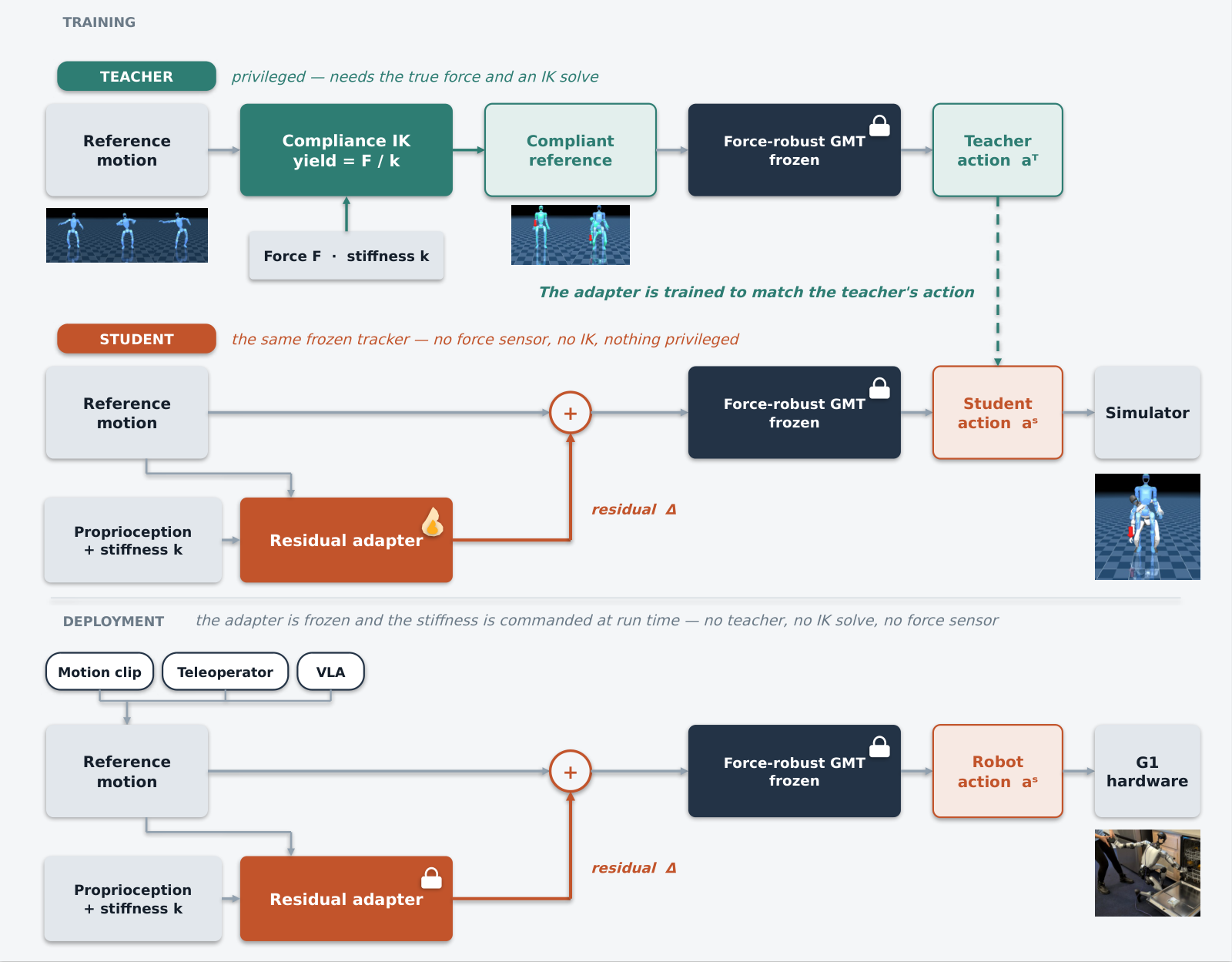
C-GMT adds a proprioception-history-conditioned residual adapter on top of a pretrained general motion tracking policy, decoupling compliance from motion imitation. This modular design retains the generality of large mocap-trained trackers while producing full-body compliant responses, and shows competitive tracking accuracy plus improved safety and robustness in simulation and real-world Unitree G1 experiments.
中文摘要: 本文提出 Compliant GMT(C-GMT),一种用于全身柔顺响应的模块化框架。现有通用运动跟踪策略虽能模仿多样动作,但训练得过于僵硬,受扰动时行为不安全;而单动作柔顺策略又缺乏通用性。C-GMT 的关键思路是在预训练通用运动跟踪器之上叠加一个以本体感受历史为条件的残差适配器,从而同时获得通用运动跟踪与全身柔顺响应。与最先进的通用跟踪器和单动作柔顺策略相比,C-GMT 在跟踪精度与柔顺性上均具竞争力,并在仿真和真实 G1 实验中展示出更好的安全性、鲁棒性与误差容忍度。
💬 Decoupling compliance from imitation via a residual adapter is a clean modular pattern that could map well onto whole-body control of reconfigurable legged platforms.
💬 通过残差适配器将柔顺性与模仿解耦是一种简洁的模块化范式,可很好地映射到可重构足式平台的全身控制中。
Why read it / 推荐理由: The residual-adapter architecture is a transferable template for layering safety/compliance onto existing RL locomotion or whole-body policies without retraining from scratch. 残差适配器架构是一种可迁移的模板,可在无需从头训练的情况下为现有 RL 运动或全身策略叠加安全性与柔顺性。
3. Modular Inverse Dynamics and Wrench Recovery for Closed-Chain Mechanisms Using Path Assembly
基于路径装配的闭链机构模块化逆动力学与力旋量恢复
Authors / 作者: Mohammad Dastranj, Jouni Mattila
arXiv: 2610.21400 · PDF
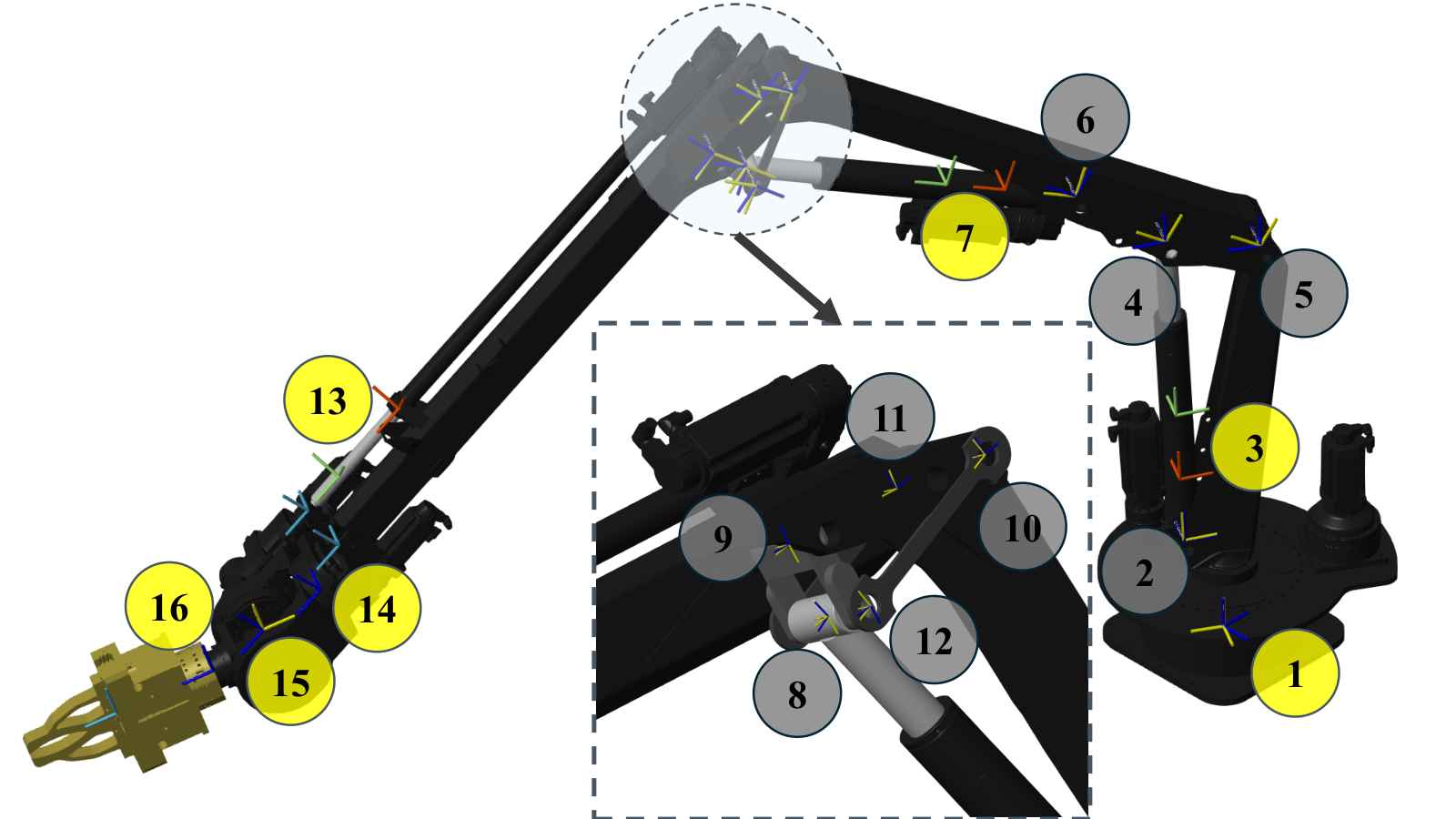
The paper develops a modular inverse-dynamics workflow for rigid closed chains, combining path-based second-order motion reconstruction with spatial Newton-Euler balancing over the physical body-and-joint graph. Nullspace and dual criteria recover uniquely determined actuator efforts and constraint wrenches, while diagnostics flag non-unique reactions; results agree closely with Simscape Multibody on a 7-DoF hybrid serial-parallel manipulator.
中文摘要: 刚性闭链在运动完全确定时仍可能存在不定的内部反力。本文提出一种模块化逆动力学流程,将基于路径的运动重建与唯一确定的执行器及关节力旋量输出恢复相结合。通过对装配变换路径进行解析二阶微分,在规则闭合分支上得到被动速度与加速度,再在物理刚体-关节图上组装空间牛顿-欧拉平衡方程;利用零空间与对偶判据识别并恢复唯一输出,同时用平衡、理想关节容许性和仿射族诊断评估非唯一参考反力。在 7 自由度重型混联机械臂上,该方法与 Simscape Multibody 参考结果在被动位置、执行器力和可唯一恢复的约束力旋量分量上高度一致。
💬 A rigorous modular formulation for closed-chain dynamics and wrench recovery that is directly applicable to parallel or closed-loop leg module designs.
💬 该工作为闭链动力学与力旋量恢复提供了严谨的模块化公式,可直接应用于并联或闭环腿模块设计。
Why read it / 推荐理由: Modular leg designs often close kinematic loops; this gives a principled way to compute actuator efforts and internal wrenches for such modules. 模块化腿部设计常形成闭环运动链,该文为这类模块提供了计算执行器力与内部力旋量的严谨方法。
4. MR-MPCC: Model Predictive Contouring Control for Robotic Manipulator Tracking under Moving Reference Frames
MR-MPCC:运动参考系下机械臂跟踪的模型预测轮廓控制
Authors / 作者: Chonghao Cheng, Tiancheng Li, Jonathan Woolfrey, Liang Zhao, Shoudong Huang
arXiv: 2610.21292 · PDF
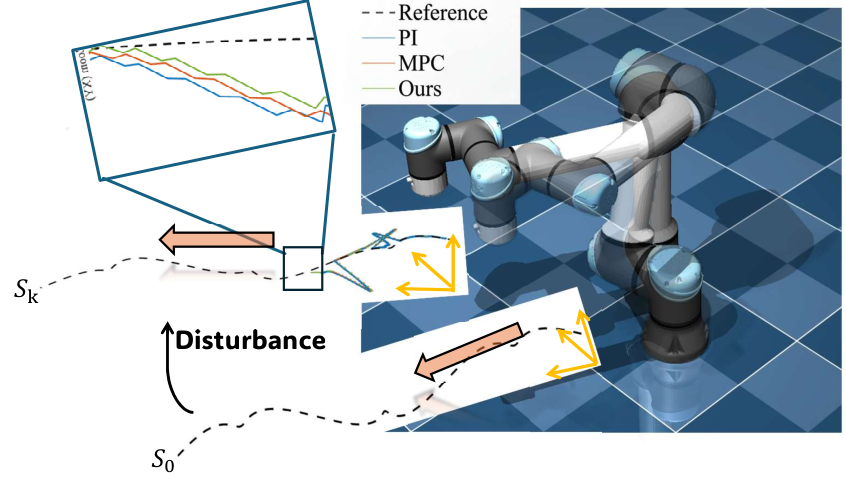
MR-MPCC is a hierarchical Model Predictive Contouring Control framework in which an upper-level MPCC optimizes path progress while penalizing contouring and orientation errors, and a constrained RMRC layer maps the commanded Cartesian twist to feasible joint velocities. Validated on a UR5e in a ROS2-MuJoCo pipeline under moving-reference disturbances, it achieves lower geometric path-following error and smaller frame deviations than PI control and time-indexed tracking MPC.
中文摘要: 在具有严格执行公差的机械臂任务(如加工和手术自动化)中,运动参考系下保持小路径跟踪误差至关重要。传统时间索引控制器(包括跟踪 MPC)依赖与参考轨迹固定的时间对应,在参考系突变或时序失配时易累积路径相对误差。本文提出 MR-MPCC,一种面向速度控制 6 自由度机械臂的模型预测轮廓控制框架:上层 MPCC 优化路径进度并惩罚轮廓与姿态误差,下层约束 RMRC 将笛卡尔速度映射为满足关节与安全约束的可行关节速度。该方法在 ROS2-MuJoCo 平台上于 UR5e 验证,在运动参考扰动下相比 PI 控制和时间索引跟踪 MPC 取得更低的几何路径跟踪误差和更小的运动路径系偏差。
💬 Contouring-based MPC with a hierarchical velocity-resolved lower layer is a practical, well-validated template for path-precise control on constrained robotic platforms.
💬 基于轮廓的 MPC 配合分层速度分解下层,是受限机器人平台上精确路径控制的实用且经过充分验证的模板。
Why read it / 推荐理由: The MPCC-plus-RMRC hierarchy shows how to combine predictive path tracking with joint-level feasibility constraints, a pattern useful for legged whole-body MPC. MPCC 加 RMRC 的分层结构展示了如何将预测性路径跟踪与关节级可行性约束结合,对足式全身 MPC 具有借鉴意义。
5. Sim-to-Real Reinforcement Learning for Path-Safe Target Reaching in Robotic Harvesting of Hydroponic Lettuce
面向水培生菜机器人采收中路径安全目标到达的仿真到真实强化学习
Authors / 作者: Al Bashir, Partho Ghose, Yibin Wang, Robert G. Hardin, Joshua Peeples, Genhua Niu et al.
arXiv: 2610.22337 · PDF
PSA-PPO is a target-conditioned local reaching framework that augments clipped PPO with corridor-aware spatial constraints, trajectory-history safety encoding and harvesting-specific success criteria. Trained entirely in Isaac Lab and transferred to a UR10e without real-world fine-tuning, it reached 94.7% of 150 physical targets, beating Cartesian+TOTG (86.0%), RRTConnect (88.0%) and RRT* (80.0%) while cutting median RMS jerk by 39.8-73.0%.
中文摘要: 机器人采收需要在受限工作空间内精确控制末端执行器位置。本文提出 PSA-PPO,一种面向温室营养液膜水培生菜采收的目标条件局部到达框架:在标准裁剪 PPO 目标基础上,引入目标条件观测、走廊感知空间约束、基于轨迹历史的安全编码以及任务特定成功判据。该策略完全在 Isaac Lab 中训练,无需真实世界微调即迁移到 UR10e 机械臂。在 150 个物理目标的基准中,PSA-PPO 达到 94.7% 的到达率,优于笛卡尔+TOTG(86.0%)、RRTConnect(88.0%)和 RRT*(80.0%),并在最终接近段将中位 RMS 加加速度降低 39.8% 至 73.0%。消融显示路径安全与侧向走廊塑形是性能的主要驱动因素。
💬 A clean demonstration that shaping safety constraints inside the PPO objective yields zero-shot sim-to-real transfer with smoother motion than classical planners.
💬 该工作清晰表明,在 PPO 目标中塑造安全约束可实现零样本仿真到真实迁移,且运动比经典规划器更平滑。
Why read it / 推荐理由: Although manipulation-focused, its constraint-shaping and zero-shot sim-to-real recipe is directly reusable for RL locomotion policy training pipelines. 尽管面向操作任务,其约束塑形与零样本仿真到真实的方案可直接复用于 RL 运动控制策略的训练流程。