Robotics Digest
Robotics Paper Digest — 2026-10-13
🤖 Scanned 40 papers from the last 3 days of arXiv announcements (cs.RO / eess.SY / cs.LG), picked 5 for modular & legged robotics — summarized by DeepSeek.
🤖 从近 3 天的 arXiv 新论文(cs.RO / eess.SY / cs.LG)中扫描 40 篇,围绕模块化与足式机器人精选 5 篇 — 由 DeepSeek 生成双语摘要。
1. ATHLETE: Learning Reactive Humanoid Tennis via Trajectory-Guided Motion Matching
ATHLETE:通过轨迹引导运动匹配学习反应式人形机器人网球
Authors / 作者: Zhihao Tian, Zifan Wang, Enzheng Zhu, Xun Yang, Jialong Qin, Mengbo Wang et al.
arXiv: 2610.13572 · PDF
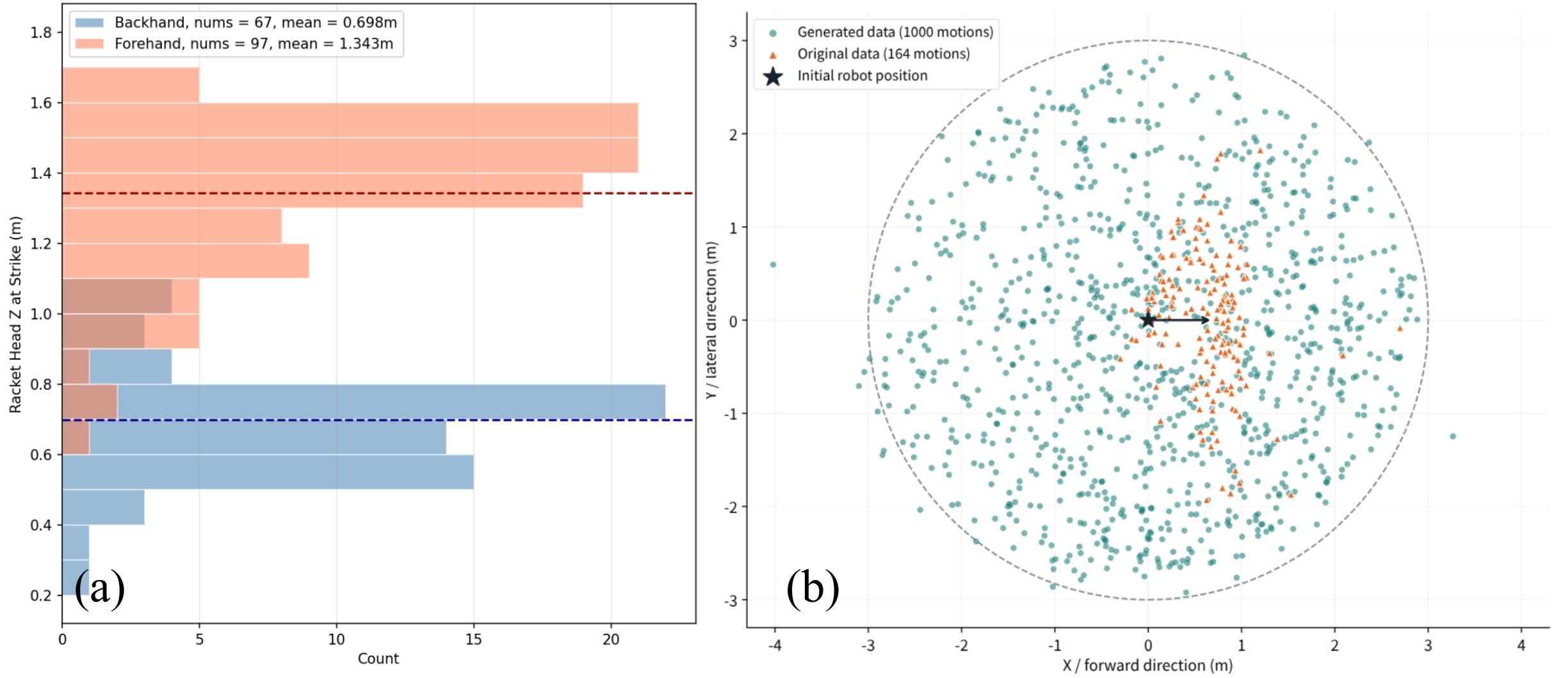
ATHLETE learns reactive humanoid tennis by combining generic locomotion data (LAFAN1) with video-derived striking motions through Trajectory-Guided Motion Matching (TGMM), which builds diverse task-conditioned whole-body references. These references train a reactive policy via physics-based teacher-student learning with online DAgger distillation and PPO fine-tuning, requiring no reference-motion inputs at deployment. On a real humanoid, it achieves 90.00% forehand and 86.67% backhand hit rates and enables multi-shot rallies with human players.
中文摘要: 人形机器人网球需要在快速变化的球动态下进行反应式全身协调,但采集覆盖多种接近状态、接触位置和时序条件的任务特定动捕演示成本高昂。受人类通过组合可复用运动经验与任务特定演示来习得新技能的启发,本文提出 ATHLETE 框架,从通用运动数据(LAFAN1)和普通网球视频中学习反应式人形机器人网球。ATHLETE 采用轨迹引导运动匹配(TGMM)构建多样化的任务条件全身参考轨迹,并通过基于物理的教师-学生学习与在线 DAgger 蒸馏转化为反应式策略,随后用 PPO 针对网球任务微调。所得策略在部署时直接响应机器人和球的观测,无需参考运动输入。在真实人形机器人上,正手和反手击球率分别达到 90.00% 和 86.67%,并能与人类选手进行多回合对打,表明可从可复用运动数据和视频演示中学习动态人形技能。
💬 This work is a strong demonstration that reusing generic locomotion priors plus video-derived task motions can yield a deployable, reactive whole-body policy on real hardware.
💬 该工作有力证明了复用通用运动先验并结合视频衍生的任务动作,能够在真实硬件上产生可部署的反应式全身策略。
Why read it / 推荐理由: It offers a concrete recipe for teacher-student plus DAgger distillation of dynamic whole-body skills with real-robot validation, directly relevant to legged control pipelines. 它提供了教师-学生加 DAgger 蒸馏动态全身技能并完成真机验证的具体方案,与足式控制流程高度相关。
2. TAME-Nav: Temporal Asymmetric Mixture-of-Experts Distillation for Agile and Versatile Robot Navigation
TAME-Nav:面向敏捷通用机器人导航的时间非对称专家混合蒸馏
Authors / 作者: Lingjie Zhang, Jun Xue, Shanze Wang, Haoyu Xi, Xinming Zhang, Xiaoyu Shen et al.
arXiv: 2610.12877 · PDF
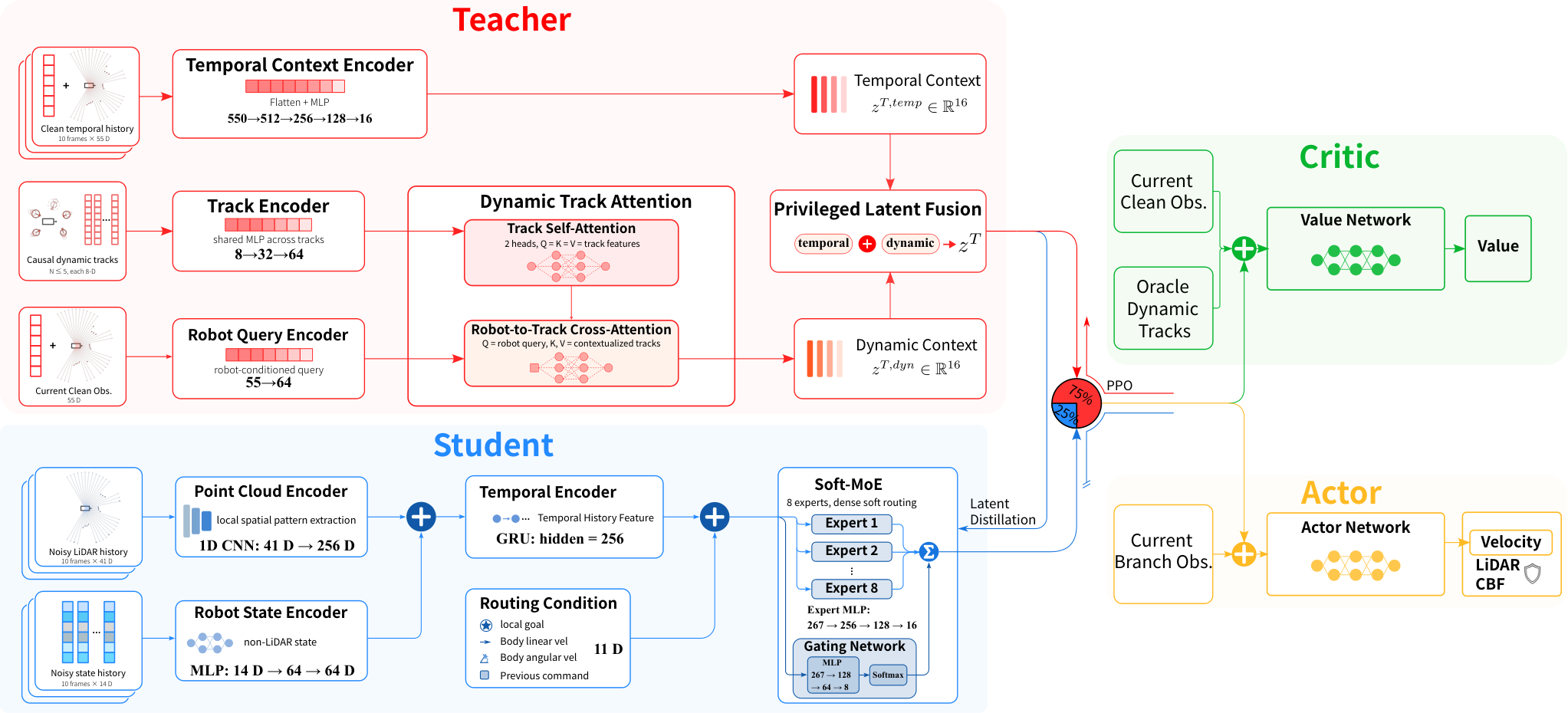
TAME-Nav is an asymmetric teacher-student navigation framework built around a temporal soft mixture of experts, where the teacher uses clean observations and causally maintained dynamic-obstacle tracks while the student learns from corrupted observation histories via temporal encoding, soft expert routing, and latent distillation. Procedural scenario generation, parallel task-level simulation, and deployment-informed asymmetric domain randomization broaden coverage and support sim-to-real. On a real quadruped, it completes all twenty local-trap-escape and narrow-passage trials with sudden dynamic obstacles, incurring only one minor contact.
中文摘要: 敏捷可靠的导航是具身机器人在复杂空间约束和动态交互中运行的核心能力,但单一策略往往难以适应不同场景的决策需求。本文提出 TAME-Nav,一个围绕时间软专家混合(Soft-MoE)构建的非对称教师-学生导航框架。教师网络结合干净观测与因果维护的动态障碍物轨迹构建特权表示;学生网络则通过时间编码、软专家路由和潜在蒸馏,从带噪声的观测历史中学习互补的导航特征。程序化场景生成与并行任务级仿真拓宽了训练覆盖,面向部署的非对称域随机化支持仿真到现实迁移。在分布内和未见过的组合场景中,TAME-Nav 相比代表性基线取得更高的成功率、更低的碰撞率和更高的导航分数。在真实四足机器人上,它在局部陷阱逃脱和狭窄通道导航中全部二十次试验成功,仅发生一次轻微接触。
💬 A well-engineered teacher-student MoE distillation with real quadruped validation, particularly useful for the sim-to-real aspects of navigation policies.
💬 一个工程实现扎实的教师-学生 MoE 蒸馏方案,并在真实四足机器人上验证,对导航策略的仿真到现实迁移方面尤其有用。
Why read it / 推荐理由: The temporal MoE distillation and asymmetric domain randomization offer transferable ideas for robust sim-to-real policy learning on legged platforms. 其时间 MoE 蒸馏与非对称域随机化为足式平台的鲁棒仿真到现实策略学习提供了可迁移的思路。
3. PartiGen: Part-Aware Representations for Language-Conditioned Humanoid Motion Generation
PartiGen:面向语言条件人形运动生成的部件感知表示
Authors / 作者: Chuxuan Huang, Zhanxiang Cao, Tianyue Zhan, Haoyang Li, Yang Zhang, Liyun Yan et al.
arXiv: 2610.13373 · PDF
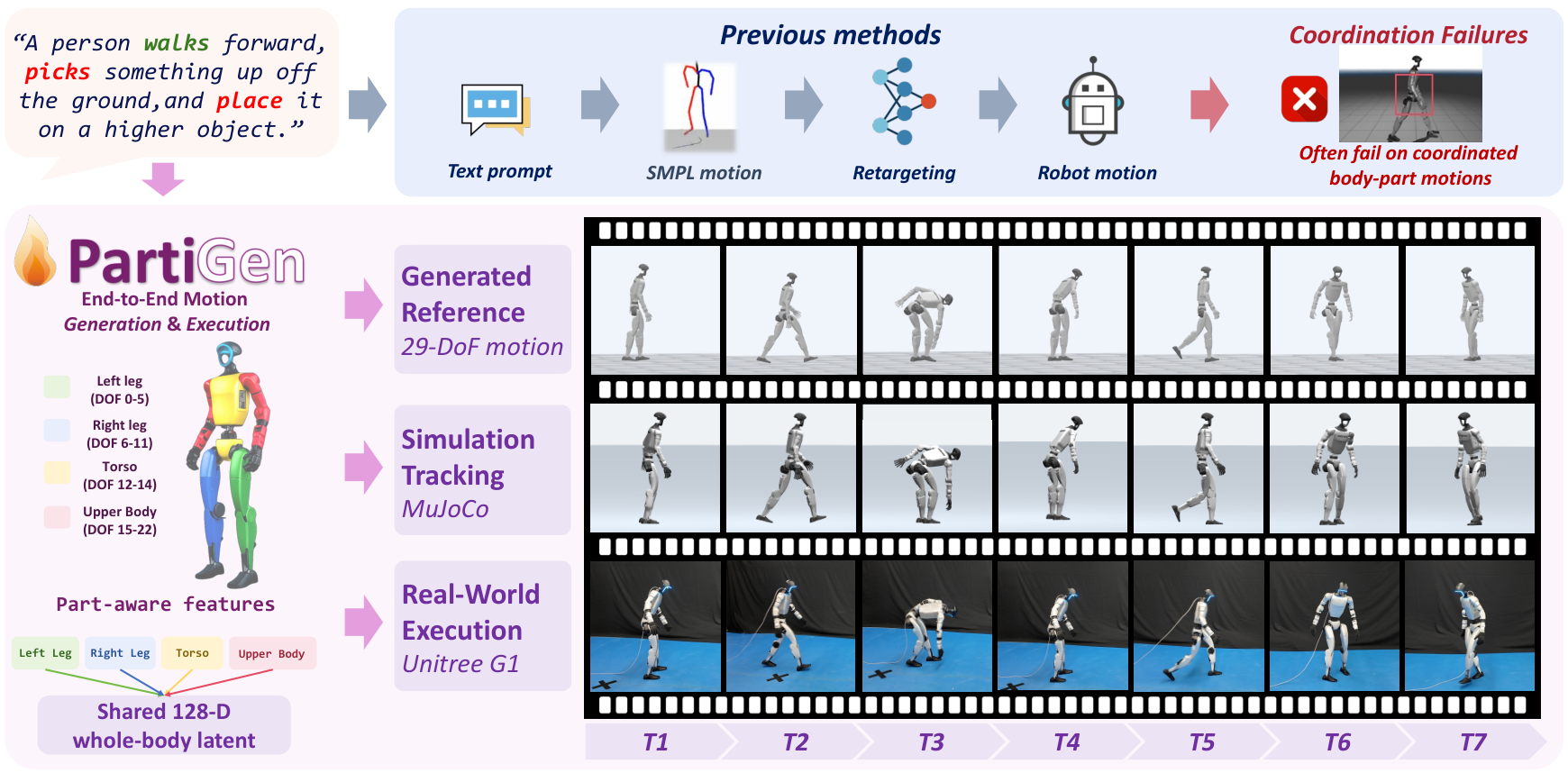
PartiGen is a part-aware latent diffusion framework that injects anatomical structure into a shared whole-body motion representation via part-specific attention on anatomically masked frame features, fusing limb-local information with whole-body context. Conditioned on text and motion history, it autoregressively generates motion primitives, with forward-kinematics supervision and a learned end-of-sequence predictor for duration selection. On HumanML3D retargeted to the Unitree G1 it achieves a segment-level FID of 3.165 (16.8% better than TextOp), and 26 of 27 attempted motions are judged successful on the real G1 after simulation screening.
中文摘要: 将语言转化为人形机器人动作需要协调各身体部位、确定运动时长,并生成适合机器人执行的参考轨迹。本文提出 PartiGen,一个部件感知的潜在扩散框架,将解剖结构信息融入共享的全身运动表示中。部件特定的注意力机制处理按解剖结构掩码的帧特征,其输出被融合以结合局部肢体信息与全身上下文。模型以文本和运动历史为条件,自回归地生成运动基元;前向运动学监督促进运动学一致性,学习到的序列结束预测器在生成后选择帧级端点。在重定向到 Unitree G1 的 HumanML3D 上,PartiGen 取得 3.165 的片段级 FID,比 TextOp 降低 16.8%,R@1 提升 1.4 个百分点。在 16 帧基元的时长研究中,端点预测将平均绝对时长误差从 12.471 帧降至 3.080 帧。使用预训练冻结的 GRIT 跟踪器评估机器人执行:500 条生成参考中有 409 条(81.8%)通过 MuJoCo 中的姿态稳定性筛选,经仿真筛选和人工挑选后,27 个尝试动作中有 26 个在真实 G1 上被判定成功。
💬 Part-aware diffusion with FK supervision and learned endpoint prediction is a neat way to generate executable, duration-aware humanoid motion from language.
💬 结合部件感知扩散、前向运动学监督与学习式端点预测,是从语言生成可执行且时长感知的人形运动的一种巧妙方法。
Why read it / 推荐理由: Its part-aware representation and endpoint prediction address duration and limb-coordination issues that also matter for modular legged gait generation. 其部件感知表示与端点预测所解决的时长与肢体协调问题,同样对模块化足式步态生成有参考价值。
4. Graph-Based Heuristics for Minimum Constraint Removal in Cluttered Robot Motion Planning
基于图启发式的杂乱环境中机器人运动规划最小约束移除
Authors / 作者: Antony Thomas, Fulvio Mastrogiovanni, Marco Baglietto
arXiv: 2610.12609 · PDF
This work addresses the NP-hard Minimum Constraint Removal (MCR) problem, where the goal is to find the fewest movable objects whose removal enables a collision-free path in cluttered human environments. The authors propose a graph-based heuristic pipeline combining bidirectional feasible-set generation with fixed-length searches over reduced MCR graphs, plus an extended feasible-set generator for cases where the first generator misses part of an optimal removal set. Across six benchmarks the pipeline matches exact solutions in three cases and otherwise selects at most 31.25% more obstacles than optimal while being 3.4 to 33.7 times faster; in a cluttered manipulation benchmark it reduces combined MCR, IK, and motion planning time from 84.72 s to 30.59 s.
中文摘要: 在人机混杂环境中作业的人形与服务机器人可能遇到将所有周围物体视为固定障碍物时无解的运动规划问题。最小约束移除(MCR)问题通过识别最少数量的可移动物体,使其移除后存在无碰撞路径来解决该情形,但求解最优 MCR 是 NP 难问题。本文提出一种基于图的启发式流程,将双向可行集生成与在约简 MCR 图上的定长搜索相结合。作者进一步推导了扩展可行集生成器,用于第一生成器产生的候选未包含完整最优移除集的情形。在六个基准上,该流程在三种情况下与精确解一致,其余情况下所选障碍物最多比最优多 31.25%,同时比精确搜索快 3.4 到 33.7 倍。在涉及杂乱环境中操作任务的基准中,选择两个而非七个阻挡物体,将 MCR、逆运动学与运动规划的合计时间从 84.72 秒降至 30.59 秒,表明该方法在计算效率与解质量之间提供了实用折中。
💬 A practically oriented planner for clutter where not everything can be assumed static, with clear runtime gains and bounded suboptimality guarantees.
💬 一种面向杂乱环境的实用规划方法,不再假设所有物体静止,具有明显的运行时间收益和有界次优性保证。
Why read it / 推荐理由: Traverse-capability-aware planning in cluttered spaces is core to leg locomotion, and this MCR heuristic offers a tractable formulation with quantified trade-offs. 杂乱空间中的可通过性感知规划是足式运动的核心问题,该 MCR 启发式提供了可处理的形式化方法与量化权衡。
5. Low-Latency Mapless ESDF Queries for MAV Reactive Collision Avoidance
面向 MAV 反应式避障的低延迟无地图 ESDF 查询
Authors / 作者: Leonard Freißmuth, Cedric Le Gentil, Helen Oleynikova, Stefan Leutenegger
arXiv: 2610.13158 · PDF
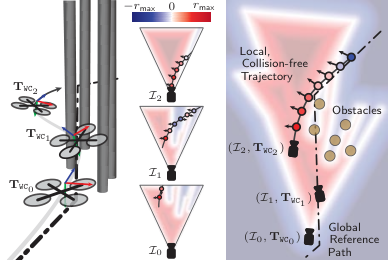
The paper proposes a mapless, GPU-accelerated Euclidean Signed Distance Field query that operates directly on posed depth images with negligible preprocessing, where resolution is set by pooling the image rather than by a voxel size. On an embedded GPU it is simultaneously more accurate and lower in total latency than every measured voxel-grid configuration between 2 cm and 20 cm, using one to two orders of magnitude less memory at matched resolution. Integrated into an MPC, simulated forest runs at up to 9 m/s collide 0.4% of the time versus 5.9% for the best voxel grid, and the system is deployed onboard at two forest sites.
中文摘要: 在未知杂乱环境中的反应式避障必须在毫秒级内感知障碍并修正运动。现有方法依赖地图进行高频碰撞查询,但其加速结构需要预处理。这种开销在长时程规划中可被摊销,因为一张地图可服务数百万次查询;然而反应式规划是近场、短时程问题,每次测量可能仅有数百次查询,构建地图可能并不划算。本文提出一种无地图、GPU 加速的欧氏符号距离场(ESDF)查询,几乎无需预处理,直接作用于带位姿的深度图像,其分辨率由图像池化而非体素尺寸决定。在嵌入式 GPU 上,它比所测 2 厘米到 20 厘米之间所有体素网格配置同时更精确且总延迟更低,并在相同分辨率下节省一到两个数量级的显存。将查询集成到模型预测控制器(MPC)后,在激光扫描森林中以最高 9 m/s 速度进行的仿真运行碰撞率为 0.4%,而最佳体素网格为 5.9%,最佳无地图基线为 5.5%;该系统还在两个森林站点进行了机载部署。
💬 A clean example of mapless, GPU-accelerated distance queries feeding directly into an MPC at high speed, with real deployment evidence.
💬 一个简洁的无地图、GPU 加速距离查询直接馈入高速 MPC 的实例,并具备真实部署验证。
Why read it / 推荐理由: The mapless ESDF query and MPC integration are directly transferable to reactive avoidance and MPC on legged robots in unknown terrain. 无地图 ESDF 查询与 MPC 集成可直接迁移到足式机器人在未知地形上的反应式避障与 MPC 中。