Robotics Digest
Robotics Paper Digest — 2026-10-07
🤖 Scanned 505 papers from today’s arXiv announcement (cs.RO / eess.SY / cs.LG), picked 5 for modular & legged robotics — summarized by DeepSeek.
🤖 从今日 arXiv 新论文(cs.RO / eess.SY / cs.LG)中扫描 505 篇,围绕模块化与足式机器人精选 5 篇 — 由 DeepSeek 生成双语摘要。
1. Magnet-Aware Control of Legged Robots
面向腿式机器人的磁场感知控制
Authors / 作者: J. Playan Garai, S. B. Djuve, C. McGreavy, M. Khadiv
arXiv: 2610.08653 · PDF
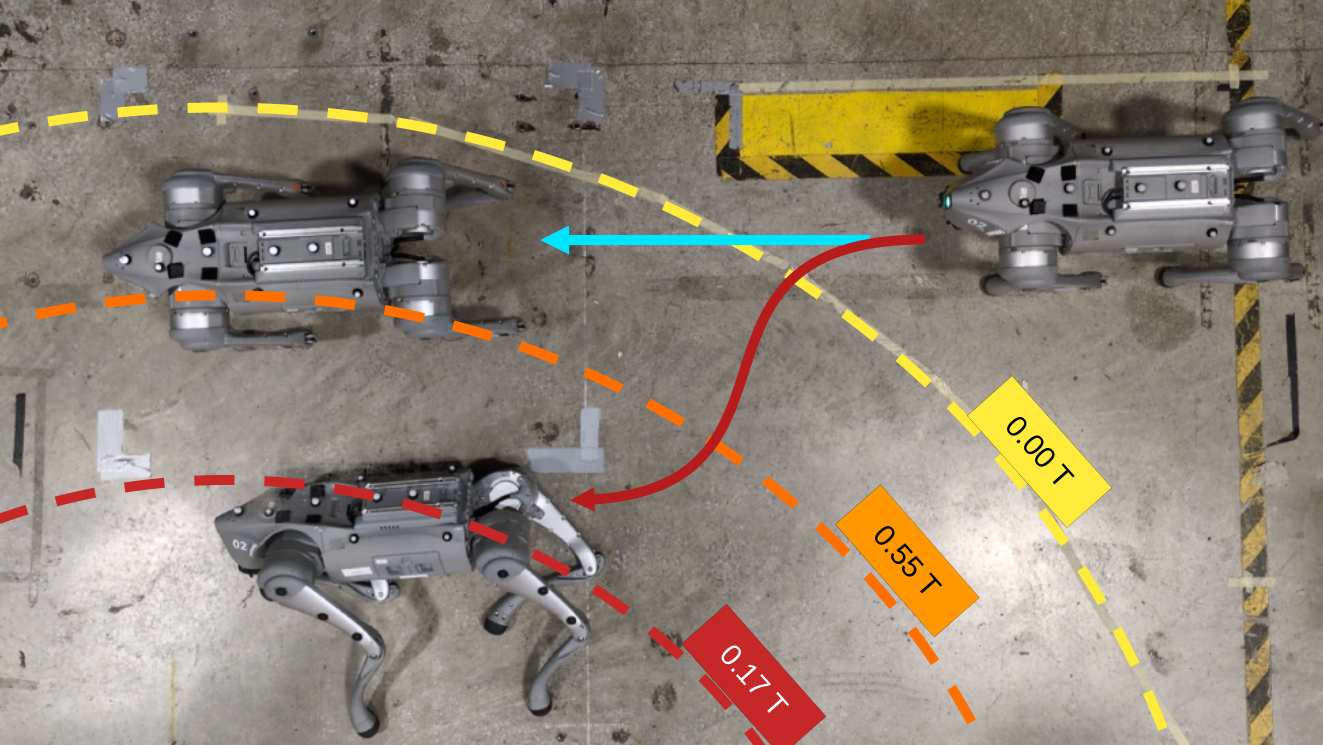
This paper presents a control framework that models, estimates, and dynamically compensates for spatially varying magnetic wrenches acting on legged robots in strong magnetic fields. A custom MuJoCo physics plugin simulates magnetic forces, an inverse field-estimation framework infers the latent field from quadruped dynamic responses and sensor readings, and a Magnet-Aware MPC/WBC architecture predicts and counteracts magnetic perturbations. Hardware and simulation experiments show a 2.5x increase in the maximum rejectable magnetic force disturbance and 1.6-2x in torque space compared to a non-compensated system.
中文摘要: 本文针对强磁场环境下腿式机器人传感器失效与磁力扰动问题,提出一套磁场感知控制框架。作者开发了MuJoCo磁场物理插件,可对刚体元素所受磁力进行建模;同时构建逆向磁场估计框架,仅利用四足机器人动力学响应和若干传感器读数推断潜在磁场分布。在此基础上,设计了磁场感知模型预测控制(MPC)与全身控制(WBC)架构,能在运动过程中预测并抵消磁扰动。仿真与硬件实验表明,相比未补偿系统,该方法在力空间将最大可抑制磁场扰动提高2.5倍,在力矩空间提高1.6-2倍,显著扩大了机器人可运行的磁场范围。
💬 A rare and rigorous combination of physics-based magnetic-wrench modeling with MPC/WBC compensation, validated on real hardware.
💬 该工作罕见地将基于物理的磁力建模与MPC/WBC补偿相结合,并在真实硬件上完成验证。
Why read it / 推荐理由: It offers a complete sim-to-real pipeline for estimating and rejecting an unusual external disturbance using MPC and whole-body control, directly relevant to robust legged locomotion. 它提供了一套完整的仿真到现实流程,利用MPC与全身控制估计并抑制特殊外部扰动,对鲁棒腿式运动控制极具参考价值。
2. Robust Nonprehensile Object Transport with Quadruped Robots
四足机器人鲁棒非抓握物体运输
Authors / 作者: Ainoor Teimoorzadeh, Riccardo Pretto, Mario Selvaggio, Gokhan Alcan, Sami Haddadin
arXiv: 2610.07245 · PDF
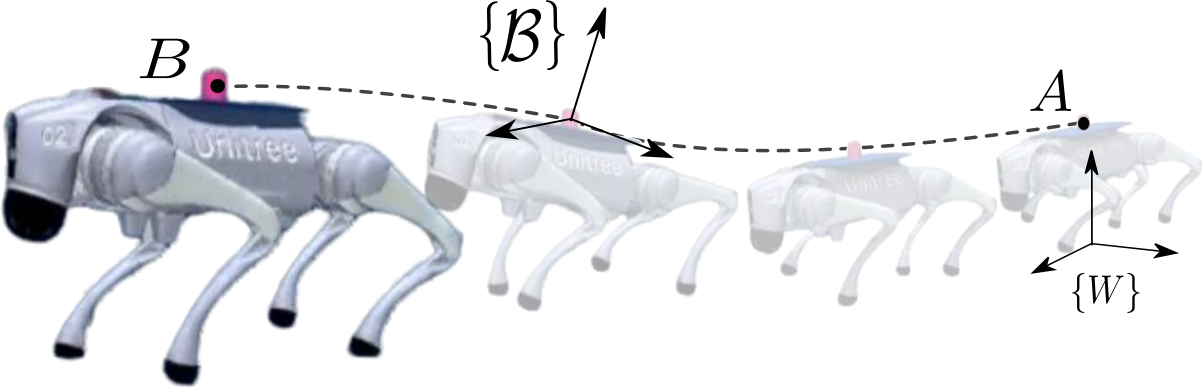
This paper presents a robust nonprehensile object transportation framework for quadruped robots. An uncertainty-aware trajectory optimization generates object motions with minimal closed-loop sensitivity to uncertain inertial parameters, tracked by a coupled convex MPC over the quadruped CoM and payload dynamics, followed by a whole-body QP enforcing ground reaction constraints. Simulations and real-world experiments show approximately 50% less sliding than a fixed-orientation baseline and 30% less than a straight-line baseline, with lower CoM tracking errors.
中文摘要: 本文提出面向四足机器人的鲁棒非抓握物体运输框架。作者采用不确定性感知轨迹优化,生成对物体惯性参数不确定性具有最小闭环敏感性的参考轨迹;随后使用耦合凸模型预测控制器,联合预测四足机器人质心与负载动力学,并通过全身二次规划施加地面反作用力约束。在大量仿真和真实实验中,该方法相比固定姿态基线减少约50%的滑动,相比直线运动基线减少约30%,同时机器人质心跟踪误差更低,验证了其在负载参数变化下的鲁棒性。
💬 A well-integrated uncertainty-aware trajectory optimization plus coupled MPC and whole-body QP pipeline, with convincing real-robot comparisons.
💬 该研究将不确定性感知轨迹优化与耦合MPC及全身QP有机结合,并在真实机器人对比实验中取得令人信服的结果。
Why read it / 推荐理由: It demonstrates how MPC and whole-body control can be jointly designed for dynamic object transport under parametric uncertainty, a useful reference for quadruped loco-manipulation. 它展示了如何联合设计MPC与全身控制以应对参数不确定性下的动态物体运输,对四足移动操作研究具有重要参考价值。
3. Safe Multi-Robot Collaborative Transport Using Density Functions
基于密度函数的多机器人安全协同运输
Authors / 作者: Jagannath Prasad Sahoo, Sriram S. K. S. Narayanan, Umesh Vaidya
arXiv: 2610.08441 · PDF
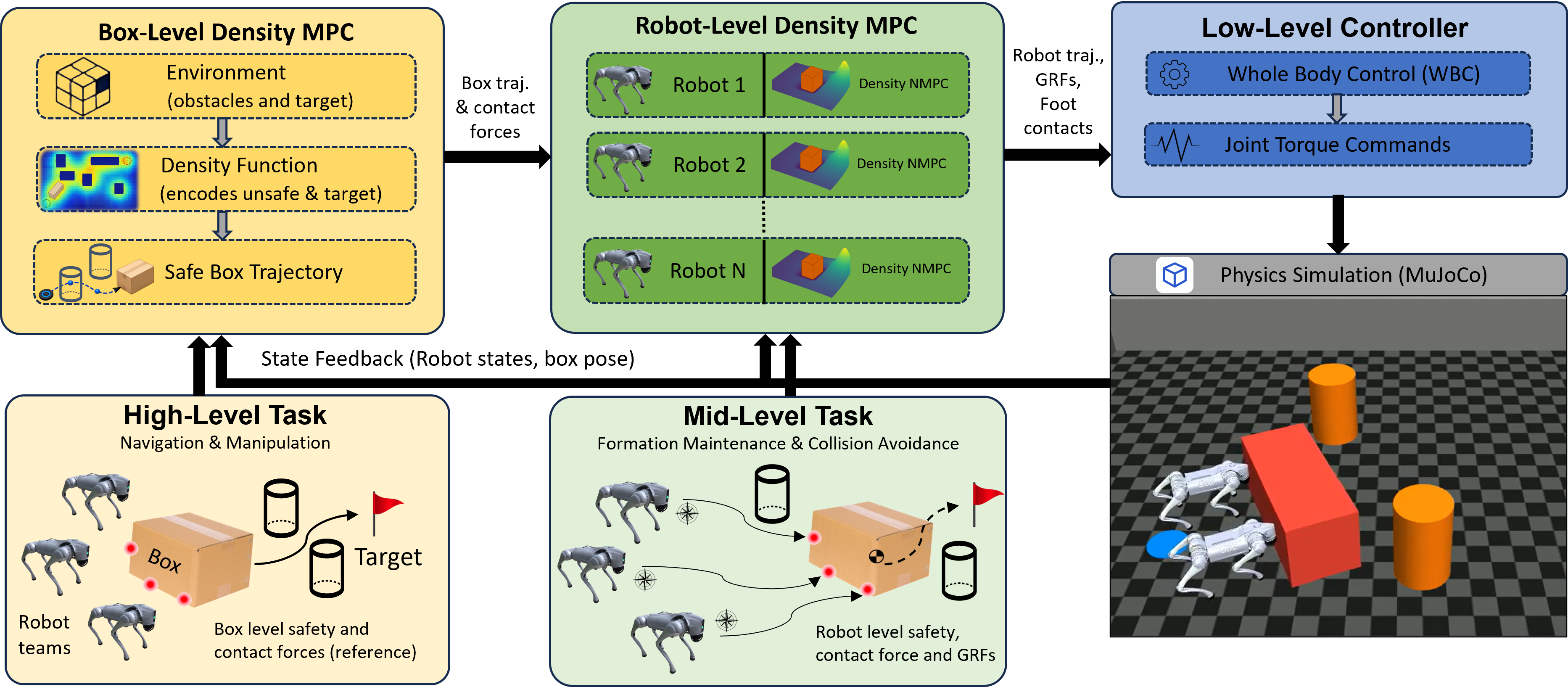
This paper presents a hierarchical density-based MPC framework for safe collaborative manipulation by multiple quadrupedal robots. A centralized box-level MPC optimizes contact forces while enforcing a control-density constraint for goal convergence and obstacle avoidance, and each robot solves a distributed whole-body MPC to track its moving contact location while avoiding static obstacles and neighboring robots. Evaluations in MuJoCo with two and three Unitree Go2 quadrupeds pushing rigid objects through narrow passages show advantages over CBF and RRT* baselines.
中文摘要: 本文提出一种基于密度函数的分层模型预测控制框架,用于多四足机器人安全协同操作。该框架无需预计算参考轨迹,仅依赖物体初始与目标位姿:集中式箱体级MPC优化接触力,并通过控制密度函数约束保证目标收敛与避障;每个机器人再求解分布式全身MPC,在满足共享信息假设下跟踪移动接触点,同时规避静态障碍与邻近机器人。在MuJoCo中使用两台和三台Unitree Go2通过窄通道协同推动刚体的实验中,与基于控制屏障函数和RRT*的跟踪基线相比,该密度函数方法在纯推及力/力矩耦合操作任务上表现更优,并提供了实现视频。
💬 An elegant density-function formulation that unifies guidance and safety in a hierarchical multi-quadruped MPC stack, extensively evaluated in simulation.
💬 该研究以优雅的密度函数形式在分层多四足MPC架构中统一了引导与安全性,并在仿真中得到充分评估。
Why read it / 推荐理由: It provides a scalable and safety-certified MPC architecture for multi-robot collaborative transport, highly relevant to modular multi-legged systems and distributed whole-body control. 它为多机器人协同运输提供了可扩展且具备安全保证的MPC架构,对模块化多足系统与分布式全身控制具有高度相关性。
4. RACER: Residual-Adaptive Closed-Loop Estimation for Sampling-Based Planning in Wheeled-Quadruped Racing
RACER:轮足赛车中基于采样规划的残差自适应闭环估计
Authors / 作者: Yuxiang Liu, Marla Eisman, Lizhi Yang, Aaron Ames, Francesco Borrelli
arXiv: 2610.07409 · PDF
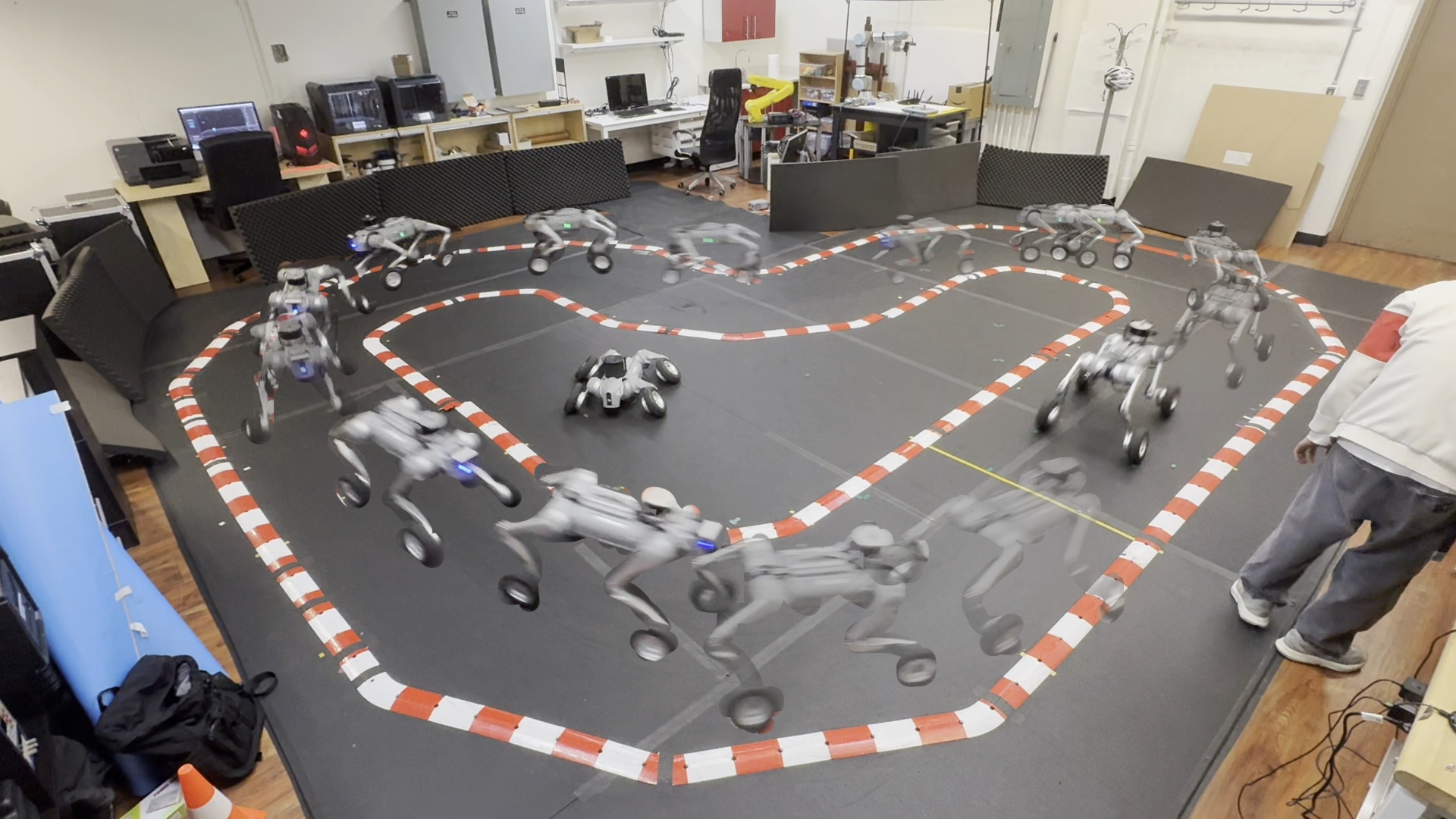
RACER is a hierarchical control framework for wheel-based quadruped racing that combines an MPPI planner with a learned residual dynamics model and a low-level RL velocity tracker. The planner augments a unicycle kinematic model with a neural residual term that captures the closed-loop tracking behavior of the RL policy. Low-Rank Residual Adaptation (LoRRA) pre-trains on large-scale simulation data and fine-tunes on a small real-world dataset with a low-rank constraint, empirically showing improved high-speed cornering and domain adaptation.
中文摘要: RACER是面向轮式四足机器人竞速的分层控制框架,将MPPI规划器与学习得到的残差动力学模型以及底层强化学习速度跟踪器相结合。规划器在单轨运动学模型基础上引入神经残差项,以捕捉RL策略的闭环跟踪行为。为缓解真实数据稀缺问题,作者提出低秩残差自适应方法LoRRA,先在大规模仿真数据上预训练,再利用小规模真实数据在低秩约束下微调。仿真实验从经验上验证了残差动力学在高速度过弯时能弥补RL跟踪误差,源域与目标域联合训练显著优于仅用目标域训练,低秩约束在接地系数或关节增益域差距增大时比全量微调和从头训练获得更高成功率与性能。
💬 A practical sim-to-real recipe that learns the closed-loop residual of an RL tracker to improve sampling-based planning for a wheeled quadruped.
💬 该工作提出一种实用的仿真到现实方案,通过学习RL跟踪器的闭环残差来改进轮足机器人的采样规划性能。
Why read it / 推荐理由: It shows how to bridge RL velocity tracking and MPPI planning through a learned residual model with low-rank adaptation, directly relevant to sim-to-real motion control of legged robots. 它展示了如何通过低秩自适应学习残差模型来桥接RL速度跟踪与MPPI规划,对腿式机器人仿真到现实运动控制有直接参考意义。
5. Model-Based Geometry-Aware Generative Optimization for Constrained Locomotion Planning
面向约束运动规划的模型驱动几何感知生成优化
Authors / 作者: Zhilin He, Xinyuan Wang, Changliu Liu
arXiv: 2610.07772 · PDF
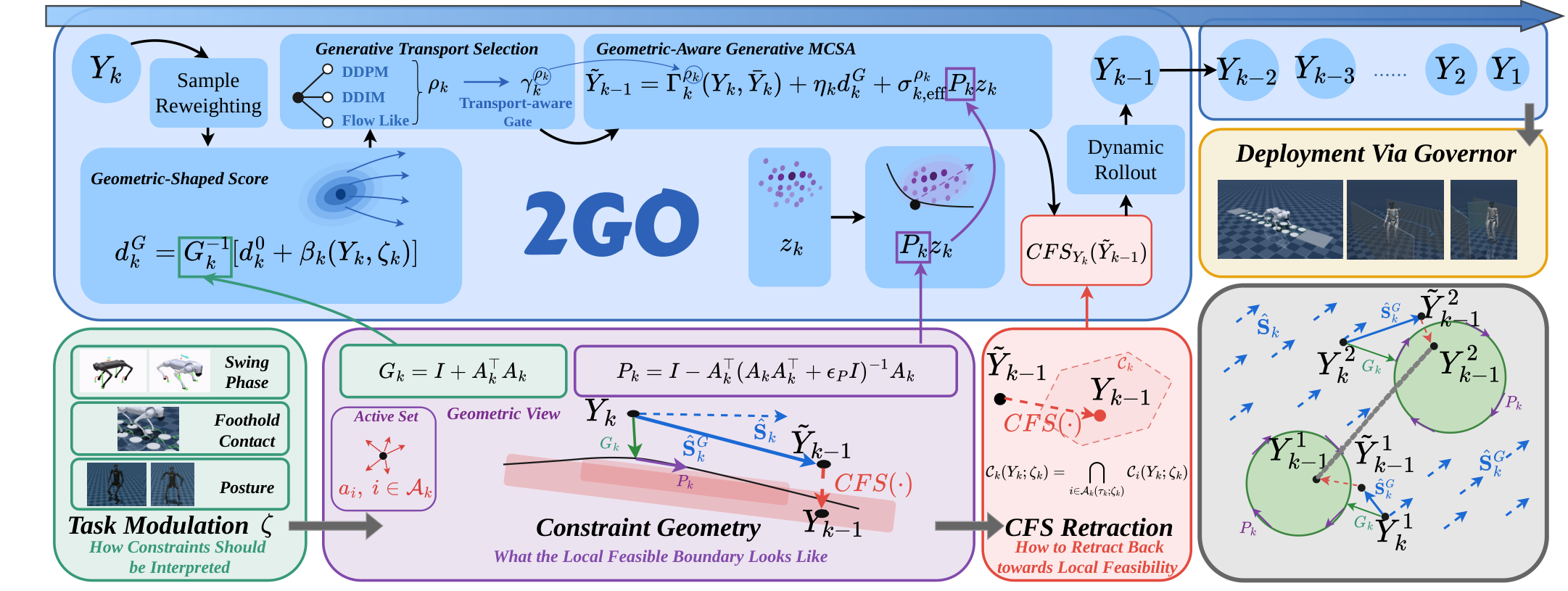
This paper introduces Model-Based Geometry-Aware Generative Optimization (2GO) for constrained locomotion planning of quadrupeds and humanoids. 2GO converts active constraint geometry into executable denoising operators via normal-induced metric shaping, tangent-space stochastic filtering, and CFS-based retraction, and decouples generative transport from reverse stochasticity with an adaptive diffusion and flow-like schedule. Experiments on constrained quadruped and humanoid locomotion show strong performance.
中文摘要: 本文针对四足与人形机器人约束运动规划(CLP)中的高维动力学与强非凸环境问题,提出模型驱动几何感知生成优化(2GO)。该方法扩展了基于模型的扩散(MBD)框架,通过法向诱导度量塑形、切空间随机滤波和基于CFS的回缩,将主动约束几何转化为可执行的去噪算子,从而赋予分数方向与逆向随机性任务调制能力;同时利用自适应扩散与类流调度,将生成传输与逆向随机性解耦。在约束四足和人形运动规划实验中,2GO表现出强劲性能。
💬 A novel geometry-aware generative optimization scheme that turns constraint geometry into denoising operators, advancing model-based diffusion for locomotion planning.
💬 该工作提出新颖的几何感知生成优化方案,将约束几何转化为去噪算子,推进了基于模型扩散的运动规划。
Why read it / 推荐理由: It offers a principled way to incorporate constraint geometry into generative trajectory optimization, a promising direction for contact-rich and constrained locomotion planning. 它提供了一种将约束几何融入生成式轨迹优化的严谨方法,对接触丰富与约束运动规划具有前景。