Robotics Digest
Robotics Paper Digest — 2026-10-06
🤖 Scanned 813 papers from today’s arXiv announcement (cs.RO / eess.SY / cs.LG), picked 5 for modular & legged robotics — summarized by DeepSeek.
🤖 从今日 arXiv 新论文(cs.RO / eess.SY / cs.LG)中扫描 813 篇,围绕模块化与足式机器人精选 5 篇 — 由 DeepSeek 生成双语摘要。
1. I-BFM: Reward-Conditioned Robust Humanoid Interaction via Unsupervised Reinforcement Learning
I-BFM:通过无监督强化学习实现奖励条件化的鲁棒人形机器人交互
Authors / 作者: Ziqi Han, Yitang Li, Junhan Sun, Fanrong Dong, Yaojie Shen, Lei Ye et al.
arXiv: 2610.06129 · PDF
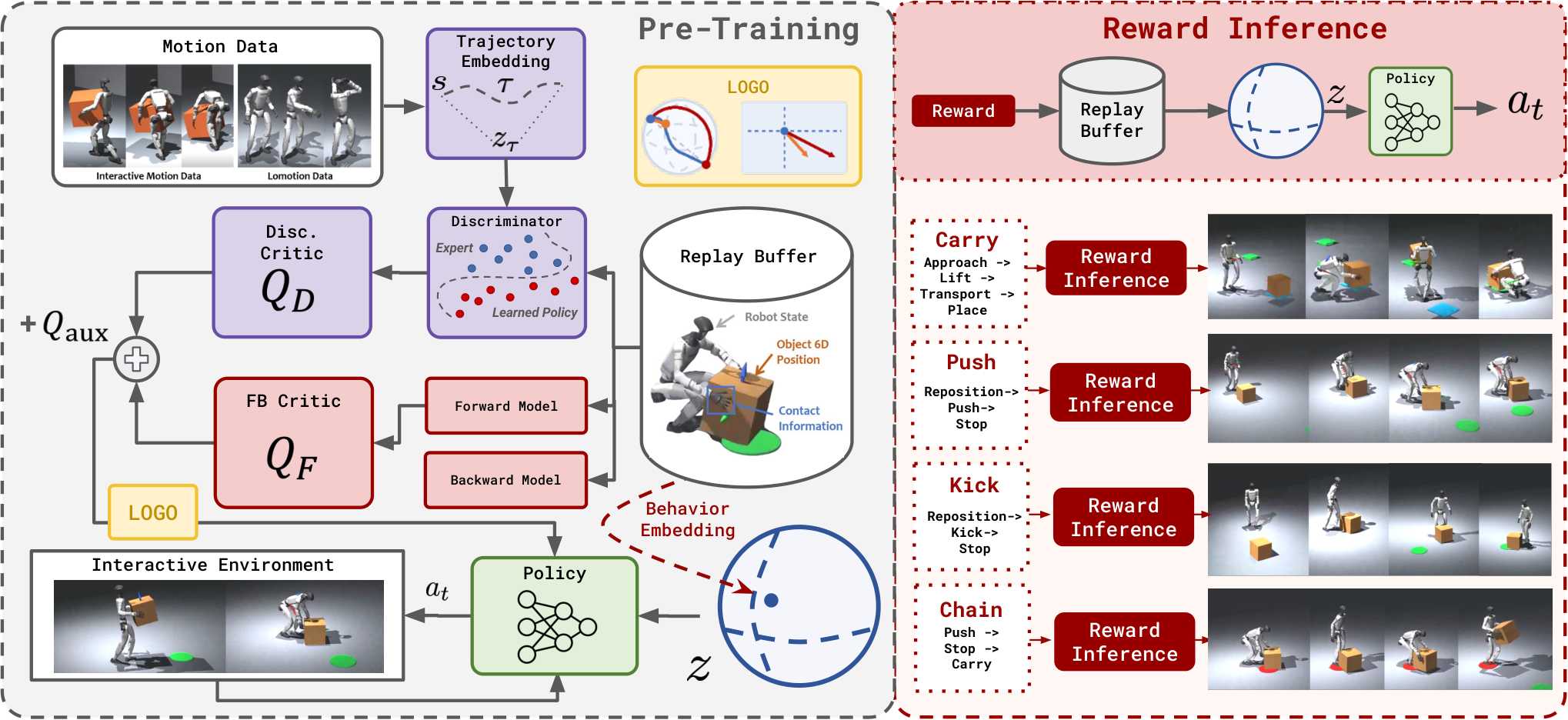
I-BFM introduces the first behavior foundation model for humanoid-object physical interaction, learning a shared representation of coupled humanoid-object-contact dynamics via forward-backward representations and unsupervised RL. A single reward-conditioned policy performs carrying, pushing, and kicking, and on the Carry task it retains 89.3% success after robot falls versus 1.3% for a planning baseline, with real-world loco-manipulation demonstrations on a Unitree G1.
中文摘要: 本文提出I-BFM,这是首个面向人形机器人-物体交互的行为基础模型。该方法不依赖任务特定策略或参考轨迹跟踪,而是利用前向-后向表征与无监督强化学习,学习人形机器人、物体及其接触之间耦合动力学的共享表征。给定下游任务奖励后,同一策略可直接以潜在指令为条件执行闭环交互,无需任务特定的策略优化;同时结合短时域交互目标与长时域目标训练,提升不同时间尺度上的控制能力。单一策略可完成搬运、推动和踢击,并支持目标到达、运动跟踪、风格控制与长时域任务链。在Carry任务上,其标称成功率为94.3%,机器人跌倒后仍保持89.3%成功率,而基于规划的基线仅为1.3%。Unitree G1实机实验验证了多样化移动操作行为与交互后的快速恢复能力。
💬 The fell-recovery result is striking and directly speaks to the robustness demands of contact-rich legged whole-body control, though the humanoid morphology differs from modular multi-legged platforms.
💬 其跌倒后恢复的成功率结果非常突出,直接回应了接触丰富型腿足全身控制对鲁棒性的需求,不过其人形构型与模块化多足平台存在差异。
Why read it / 推荐理由: It demonstrates a generalist whole-body interaction policy with real-robot recovery behavior that is highly relevant to robust legged control under unexpected contact and failure. 该工作展示了一种通用全身交互策略,并在真实机器人上实现了意外接触与失效后的恢复行为,对鲁棒腿足控制具有很高参考价值。
2. Humanoid Rickshaw Pulling: Whole-Body Locomotion under Coupled Wheeled Loads
人形机器人拉人力车:轮式耦合负载下的全身运动控制
Authors / 作者: Yangzhi Yang, Xiansheng Lin, Zhaoming Xie, Xiaobin Xiong
arXiv: 2610.04238 · PDF
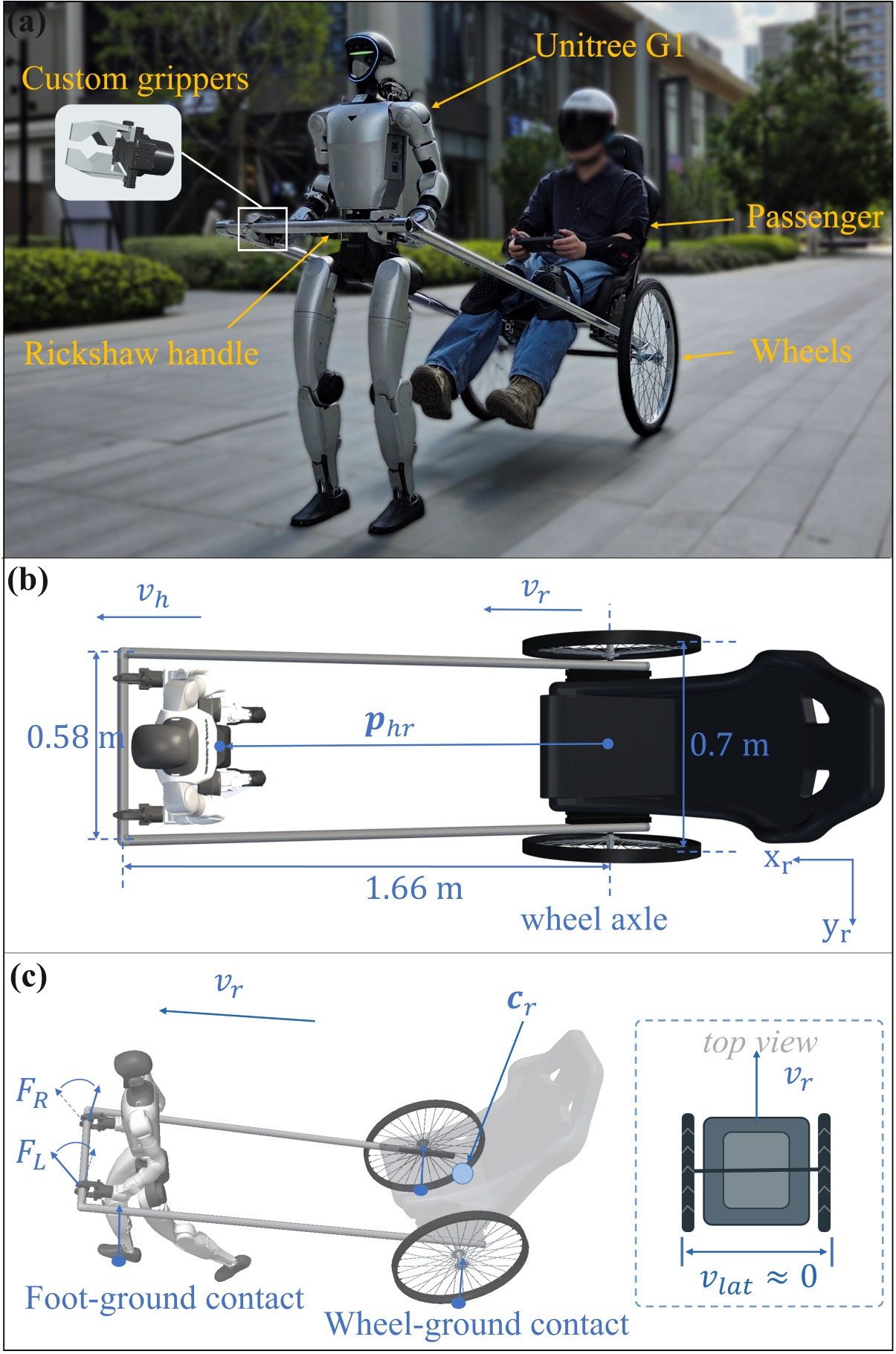
This paper presents a whole-body control framework for a humanoid pulling a passive wheeled rickshaw, where the robot must maintain upper-body contact while adapting to unknown configuration-dependent forces. A privileged teacher is distilled into a history-conditioned student with RL fine-tuning, and on a Unitree G1 the policy tracks vehicle motion with reduced oscillation, torso tilt, and actuation cost while achieving a lower cost-of-transport proxy than unloaded walking.
中文摘要: 本文研究人形机器人拉动被动轮式人力车这一耦合运动问题:机器人需在保持上身持续接触的同时,适应由负载、车辆与地形引起的未知且随构型变化的作用力。方法采用全身控制框架,训练阶段由特权教师利用车辆状态、交互力与负载特性,将其动作与潜在表征蒸馏到仅依赖本体感知历史的学生策略中,再进行强化学习微调。与无历史和有历史基线的对比表明,所得策略能准确跟踪车辆运动,并降低车辆振荡、躯干倾斜与驱动代价。行为分析显示Unitree G1能通过步态同步的全身反应稳定侧向与横滚运动,且在多数负载-速度条件下,拉车时的机器人归一化运输代价代理低于空载行走。硬件实验验证了该方法的有效性。
💬 The privileged-to-history-conditioned distillation for inferring coupled load dynamics is methodologically clean and transferable to modular legged platforms carrying or towing payloads.
💬 通过特权教师到历史条件学生策略的蒸馏来推断耦合负载动力学,方法清晰且可迁移到承载或拖拽负载的模块化腿足平台。
Why read it / 推荐理由: It offers a concrete recipe for whole-body locomotion under persistent external coupling, a setting close to loaded modular legged robot operation. 该文为持续外部耦合作用下的全身运动控制提供了具体方案,与承载状态下的模块化腿足机器人运行场景相近。
3. Transporting Unsecured Stacked Payloads with a Quadrupedal Robot via Multi-Objective Reinforcement Learning
基于多目标强化学习的四足机器人无固定堆叠负载运输
Authors / 作者: Nobuo Namura, Masayuki Hiromoto, Kento Uemura, Hironobu Sasaki, Kanata Suzuki
arXiv: 2610.05819 · PDF
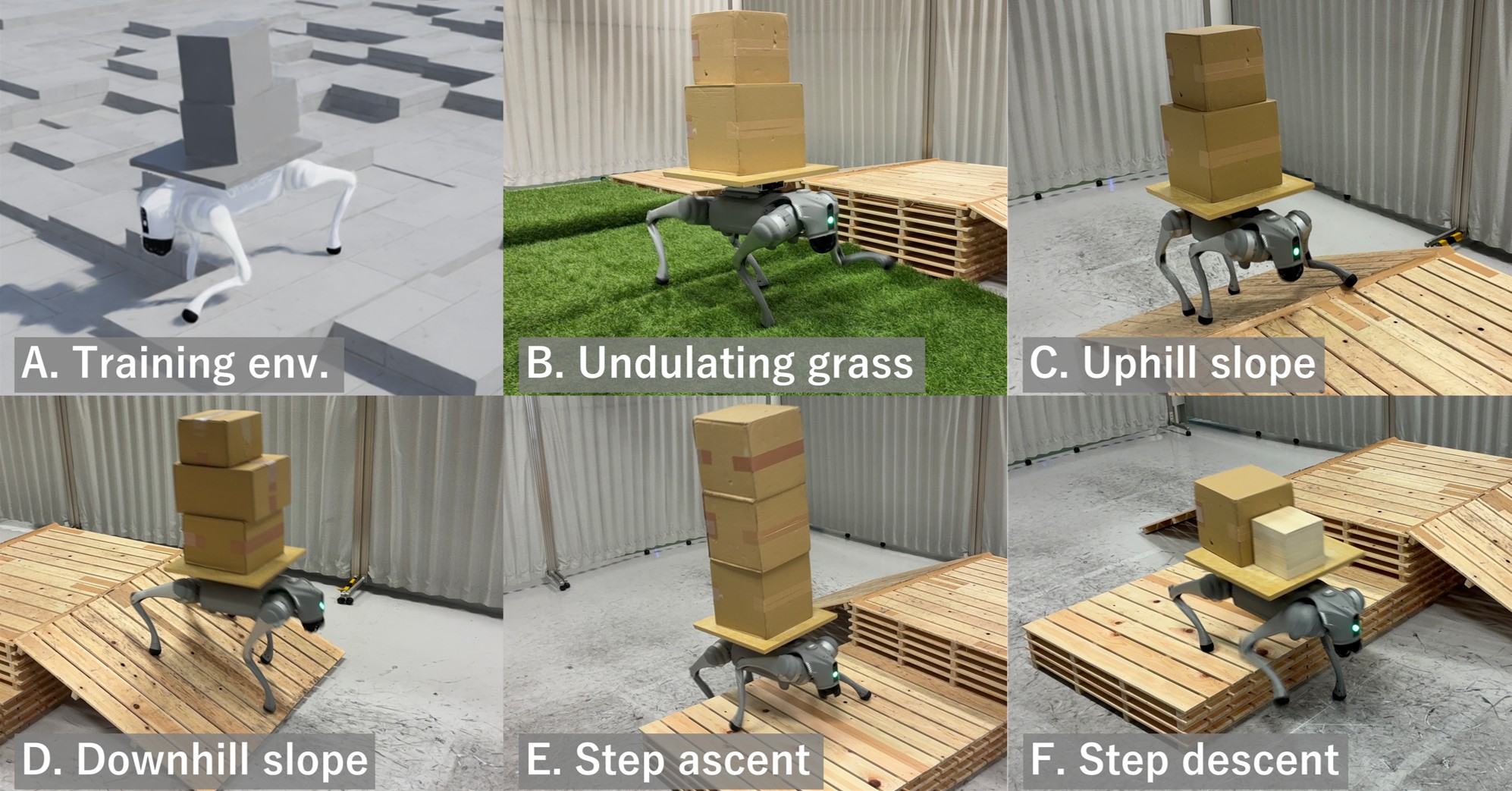
PAMORT trains a multi-objective RL policy conditioned on a preference vector that trades off locomotion and payload-stability rewards, then learns a weight adjuster on the frozen policy to adapt the preference online from proprioception. On a Unitree Go2 it achieves zero-shot transfer to slopes and steps with 0.850 mean success across eight tasks versus 0.675 for the baseline, including an unseen three-box stack.
中文摘要: 本文研究四足机器人在崎岖地形上运输未固定堆叠箱体的问题:机器人自身稳定并不意味着负载稳定,因此需要权衡运动性能与负载稳定性。作者提出PAMORT,一种负载自适应多目标强化学习方法。它首先训练一个以偏好向量为条件的多目标基础策略,该向量对运动奖励组与负载稳定奖励组进行加权;随后在冻结策略上训练权重调节器,依据本体感知在线调整偏好,无需专用负载传感器或主动承载机构。仿真中,PAMORT在多种负载构型下取得与单目标基线相当或更优的整体运输成功率,并能泛化到未见过的三层箱堆。在Unitree Go2实机上实现零样本迁移,可在达到或超过训练难度的斜坡与台阶上运行,八项任务平均成功率为0.850,基线为0.675。
💬 Online proprioceptive preference adaptation is a practical answer to unknown payload dynamics and maps naturally onto modular legged platforms with reconfigurable payloads.
💬 基于本体感知的在线偏好自适应是应对未知负载动力学的实用方案,可自然迁移到带可重构负载的模块化腿足平台。
Why read it / 推荐理由: It tackles an under-explored locomotion-stability trade-off with real quadruped experiments and zero-shot terrain transfer relevant to payload-carrying modular legged robots. 该文以真实四足实验和零样本地形迁移,研究了载荷承载场景下运动与稳定性之间的权衡,对模块化腿足机器人具有参考意义。
4. Terrain-Dependent Intra-Cycle Leg Timing for Effective Locomotion on Granular Slopes
面向颗粒斜坡有效运动的周期内腿时序地形依赖性研究
Authors / 作者: Long Zhao, Xingjue Liao, Feifei Qian
arXiv: 2610.04144 · PDF
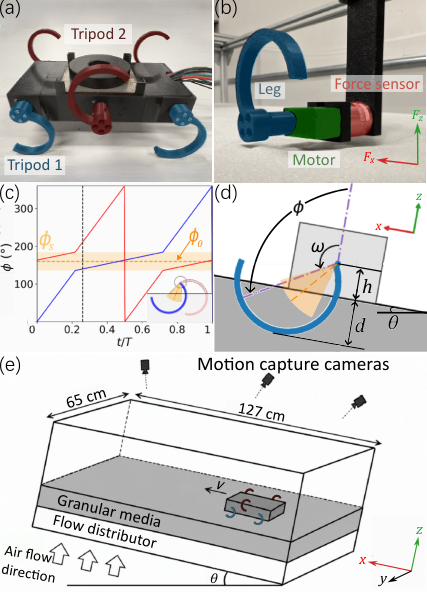
Using a hexapedal robot on a tiltable granular bed, this work measures slope-dependent normal and shear granular resistive forces and develops a robot-terrain interaction model that predicts anchoring timing, step length, and speed. It shows that slope-induced performance loss is governed by delayed anchoring and increased backward slip rather than excessive sinkage, and constructs failure phase diagrams for risk estimation on deformable inclines.
中文摘要: 在沙丘等颗粒斜坡上运动对腿足机器人是根本性挑战,原因在于颗粒介质剪切强度降低且随重力产生各向异性屈服。本文使用六足机器人在可倾斜颗粒床上系统测量运动速度以及随坡度变化的法向与剪切颗粒阻力。结果表明,法向穿透阻力随倾角几乎不变,而剪切阻力随坡度显著下降。基于测量,作者建立了简单的机器人-地形交互模型,可预测锚定时序、步长与机器人速度,并发现坡度导致的性能损失主要源于锚定延迟与后滑增加,而非过度下陷。将模型推广到一般地形条件后,作者构建了失效相图,识别下陷失效与滑移失效区域,从而实现对颗粒斜坡运动风险的定量估计。该物理信息框架为可变形斜坡上更安全鲁棒的机器人运行提供了预测性指导。
💬 The measured shear-versus-normal asymmetry and the intra-cycle timing model offer concrete gait-design insight for hexapod and modular multi-legged platforms on yielding terrain.
💬 剪切与法向阻力的不对称性测量及周期内时序模型,为六足和模块化多足平台在松软地形上的步态设计提供了具体洞见。
Why read it / 推荐理由: It connects terrain physics to leg timing and failure prediction, directly informing gait generation for multi-legged robots on deformable ground. 该文将地形物理与腿时序及失效预测联系起来,可直接指导多足机器人在可变形地面上的步态生成。
5. Exploiting Hierarchical Controller Structure in Contextual Parameter Learning for Humanoid Loco-Manipulation
利用分层控制器结构进行人形机器人移动操作的情境参数学习
Authors / 作者: Sebastian Hirt, Lukas Theiner, Jan Peters, Rolf Findeisen
arXiv: 2610.04609 · PDF
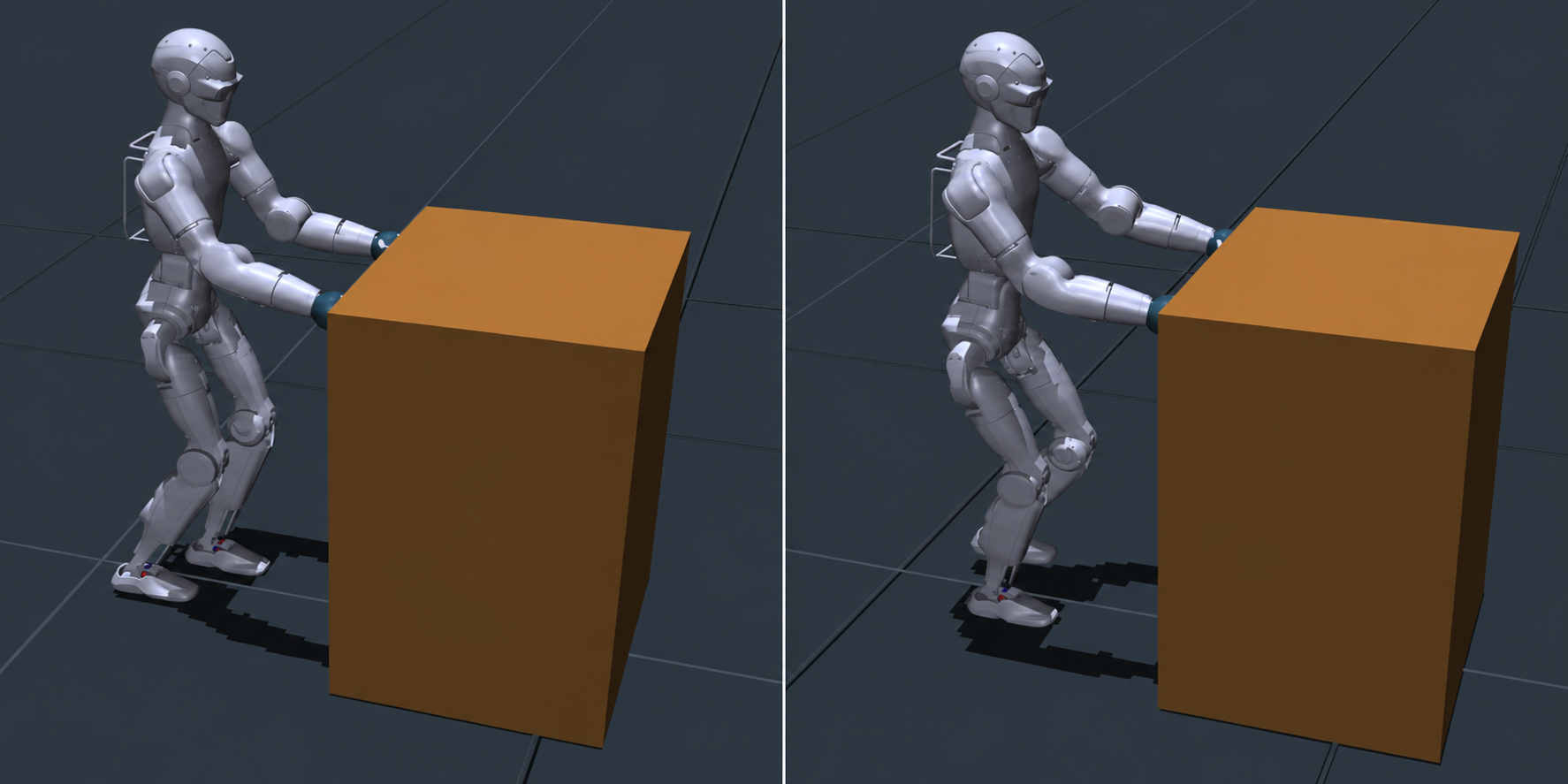
This paper proposes a contextual Bayesian optimization framework for joint parameter learning across hierarchical control layers, retaining separate observations of task performance, realization quality, and control effort, and modeling them with a correlated multi-output Gaussian process. It jointly tunes a centroidal predictive controller and a whole-body controller for humanoid loco-manipulation, exploiting cross-layer coupling rather than tuning levels independently.
中文摘要: 分层控制架构广泛用于将复杂控制问题分解为相互作用的控制层级,在机器人中尤为重要,因为规划、全身运动与底层控制必须在不同抽象层级和时间尺度上协调。然而,其整体闭环性能强烈依赖于分布在各层级上的参数,独立调节各层控制器可能忽略关键的跨层交互。本文提出一种情境贝叶斯优化框架,用于分层控制系统中的联合参数学习。方法不将闭环性能仅视为标量黑箱函数,而是分别保留任务性能、实现质量与控制代价的观测,并用相关多输出高斯过程建模这些性能分量,同时解析地评估它们到整体闭环目标的已知聚合关系。该形式化利用了分层控制的三点互补特性:层级暴露的信息性性能量、不同控制层参数间的耦合,以及这些关系随工况的变化。作者在人形机器人移动操作任务上联合调节质心预测控制器与全身控制器,验证了方法的有效性。
💬 Joint cross-layer tuning of MPC-style centroidal control and WBC is directly applicable to modular legged platforms where control hierarchies must be co-tuned.
💬 对MPC式质心控制与全身控制进行联合跨层调节,可直接应用于必须协同整定控制层级的模块化腿足平台。
Why read it / 推荐理由: It provides a principled way to co-tune hierarchical MPC/whole-body controllers, a recurring pain point in modular legged robot design. 该文提供了协同整定分层MPC/全身控制器的原则性方法,这正是模块化腿足机器人设计中反复出现的难点。