Robotics Digest
Robotics Paper Digest — 2026-10-03
🤖 Scanned 80 papers from the last 3 days of arXiv announcements (cs.RO / eess.SY / cs.LG), picked 5 for modular & legged robotics — summarized by DeepSeek.
🤖 从近 3 天的 arXiv 新论文(cs.RO / eess.SY / cs.LG)中扫描 80 篇,围绕模块化与足式机器人精选 5 篇 — 由 DeepSeek 生成双语摘要。
1. Locomotion-Grounded Humanoid Soccer: Task-Gated Reinforcement Learning of a Multi-Directional Kicking Library
以运动为核心的人形足球:多向踢球技能库的任务门控强化学习
Authors / 作者: Abu Hanif Muhammad Syarubany, Jaehyun Jang, Hwanhee Kim, Kyuwon Kim, Seungyeon Ryu, Chang D. Yoo
arXiv: 2609.38852 · PDF
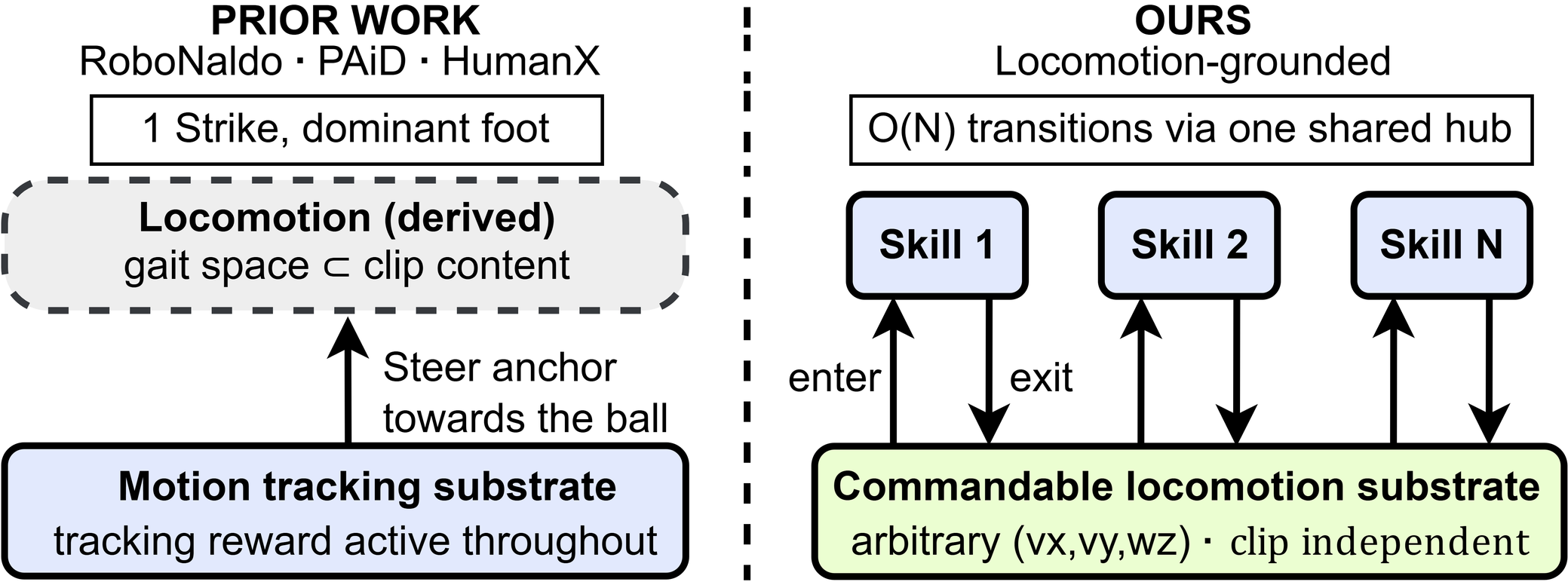
This work inverts the standard humanoid soccer stack by training a general command-conditioned locomotion policy first, then adding N motion-guided kicking skills as task-gated layers, making locomotion a composition hub with O(N) transitions and returning post-strike stabilization to the controller. On a 29-DoF Unitree G1, seven retargeted kicking skills spanning 259.5 degrees of aim direction are validated on hardware, with command-tracking, terrain, and push-recovery results reported alongside shooting accuracy.
中文摘要: 该工作颠覆了传统人形足球的控制堆栈:先训练一个通用的、以命令为条件的运动策略作为基础,再在其上叠加N个运动引导的踢球技能作为任务门控层,使得可及步态空间由运动课程决定而非参考动作片段,并且由于每个技能都从同一可命令状态出发并返回,运动成为组合中心(O(N)而非O(N^2)转移),击球后稳定也交还给训练好的控制器而非逐片段脚本化。在29自由度Unitree G1上实例化了七个重定向踢球技能,覆盖259.5度标称瞄准方向,包括侧向、后向和弱脚踢球,报告了射击精度以及命令跟踪、地形和推力恢复结果,并在硬件上验证了技能库。
💬 The paper’s decomposition of locomotion as substrate and kicking as task-gated skills offers a modular, scalable architecture highly relevant to modular legged robot design and RL-based motion control.
💬 该论文将运动作为基底、踢球作为任务门控技能进行分解,提供了一种模块化、可扩展的架构,与模块化腿式机器人设计和基于强化学习的运动控制高度相关。
Why read it / 推荐理由: It presents a novel hierarchical RL framework for complex loco-manipulation that emphasizes modular skill composition and real-robot validation, directly applicable to modular legged systems. 它提出了一种新颖的分层强化学习框架,用于复杂的运动-操作任务,强调模块化技能组合和真实机器人验证,可直接应用于模块化腿式系统。
2. Draft: A Parametric Tool for Robot Design Exploration
Draft:用于机器人设计探索的参数化工具
Authors / 作者: David Nguyen, Marcelo Coelho, Sangbae Kim
arXiv: 2609.38405 · PDF
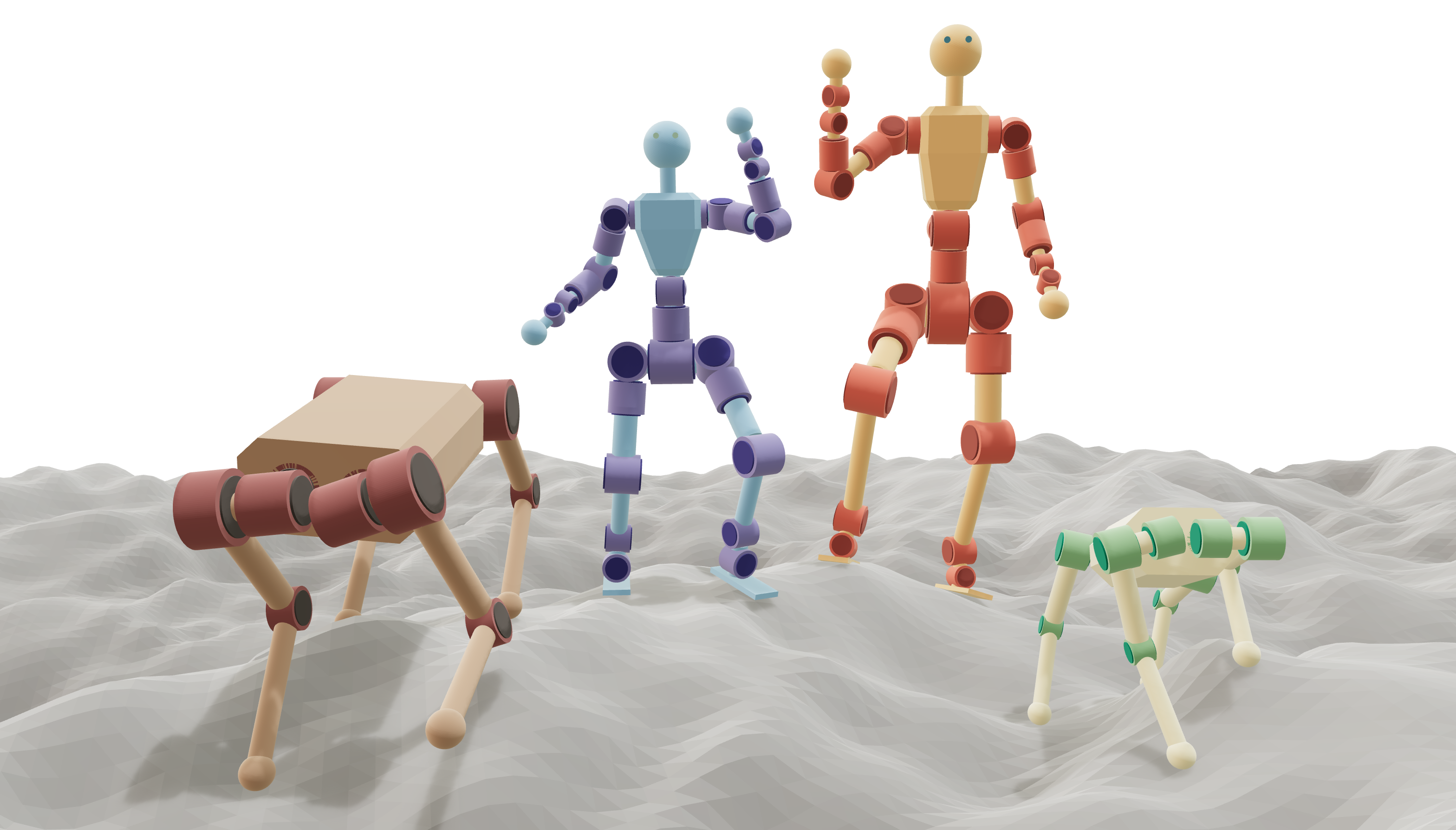
Draft is a parametric generation tool that compiles any parametric tree of serial chains into a simulation-ready MJCF model without CAD, allowing rapid exploration of design tradeoffs and evaluation of controller performance. It grounds free parameters using trends fitted to a survey of 114 actuators and 49 published robot descriptions, validated by building twins of four off-the-shelf robots with 1.10x geometric mean fold error, and demonstrates tradeoff analysis on three quadrupeds using a two-stage RL curriculum.
中文摘要: Draft是一个参数化生成工具,能够将任意串联链的参数化树编译成可直接用于仿真的MJCF模型,无需CAD,从而快速探索设计权衡并评估控制器性能。它通过拟合114个执行器和49个已发表机器人描述的调查趋势来为每个设计的自由参数提供依据,确保生成的机器人锚定于真实硬件;通过构建四个现成机器人的数字孪生验证了这些趋势,质量误差为1.10倍几何平均倍数误差。最后,通过两阶段强化学习课程评估三个四足机器人,展示了Draft如何揭示设计权衡。
💬 This tool directly supports modular legged robot design by enabling rapid co-design of morphology and control, with real-world grounding and validation on quadrupeds.
💬 该工具通过支持形态与控制的快速协同设计,直接支持模块化腿式机器人设计,并在四足机器人上进行了真实世界锚定和验证。
Why read it / 推荐理由: It offers a practical, simulation-ready pipeline for exploring modular leg designs and evaluating control performance, essential for reconfigurable legged robots. 它提供了一种实用的、可直接用于仿真的流程,用于探索模块化腿部设计并评估控制性能,对于可重构腿式机器人至关重要。
3. MASkillBlender: Decentralized Whole-Body Coordination for Multi-Humanoid Loco-Manipulation via Skill Blending
MASkillBlender:基于技能融合的多人类机器人全身协调分散式运动-操作
Authors / 作者: Yifan Hu, Luhang Hong, Mingkang Long, Danning Wang, Chengfeng Jia, Rong Su et al.
arXiv: 2610.01102 · PDF
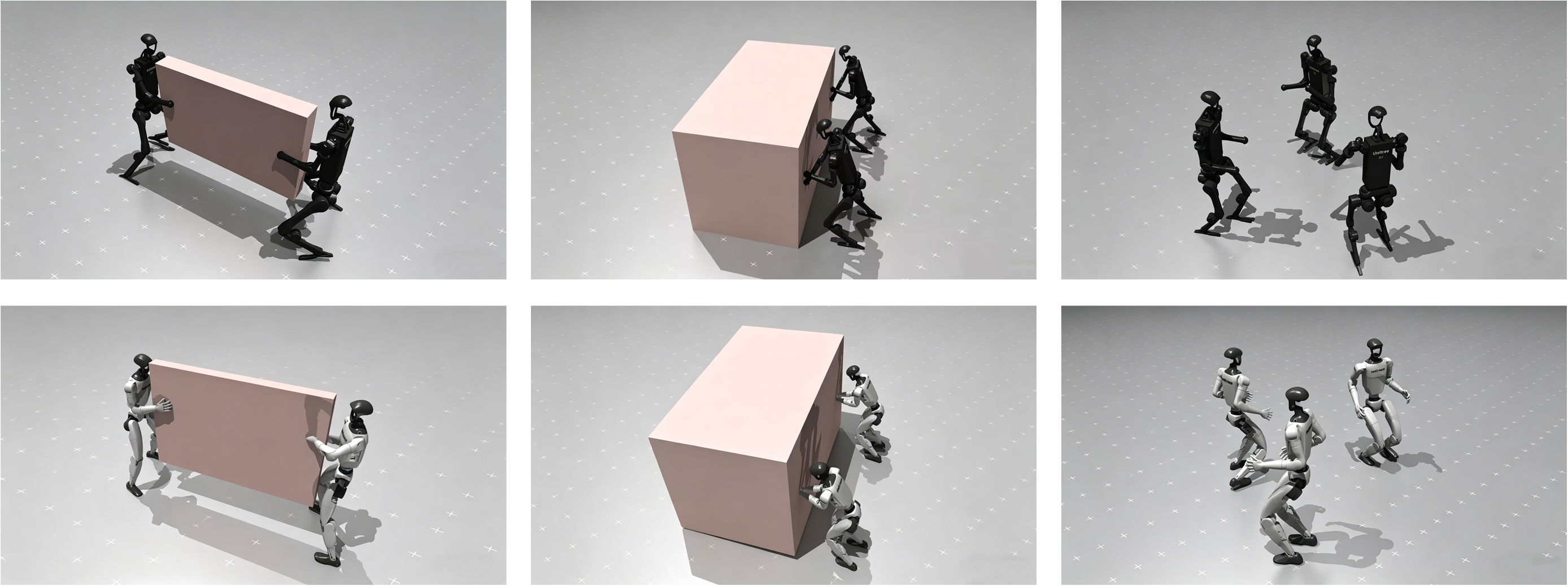
MASkillBlender is a multi-agent RL framework for decentralized multi-humanoid loco-manipulation that learns a shared high-level policy over reusable pre-trained single-humanoid skills, enabling coordination with only task-level rewards and no task-specific motion references. It introduces permutation-based data augmentation with theoretical policy-gradient preservation, evaluated on multiple coordination tasks across two humanoid embodiments in simulation.
中文摘要: MASkillBlender是一个多智能体强化学习框架,用于实现分散式的多人类机器人全身协调运动-操作。通过在可重用的预训练单人类机器人技能上学习共享的分散式高层策略,仅使用任务级奖励即可实现协调行为,无需任务特定的运动参考。为提高学习效率,引入了基于排列的数据增强策略,并在同质多人类机器人马尔可夫博弈公式下从理论上证明了排列样本保留了原始样本的策略梯度方向。在两种人类机器人实体上的多个协调任务中评估,仿真结果表明该框架在不同任务和实体上均能持续实现强任务性能和协调行为。
💬 The skill-blending approach with decentralized control is highly relevant to modular multi-legged platforms, where reconfigurable modules can be treated as reusable skills for coordinated locomotion.
💬 技能融合方法和分散式控制与模块化多足平台高度相关,其中可重构模块可被视为可重用的技能,用于协调运动。
Why read it / 推荐理由: It provides a scalable RL framework for coordinating multiple legged robots through skill reuse, directly applicable to multi-legged modular systems and decentralized WBC. 它提供了一种可扩展的强化学习框架,通过技能重用协调多个腿式机器人,直接适用于多足模块化系统和分散式全身控制。
4. CEER2: Directional and Tunable End-Effector and Root Compliance for Humanoid Loco-Manipulation
CEER2:用于人形机器人运动-操作的方向性和可调末端执行器与根部柔顺控制
Authors / 作者: Xinyuan Luo, Chunyuan Yang, Boyuan Chen, Xianyi Cheng
arXiv: 2609.38709 · PDF
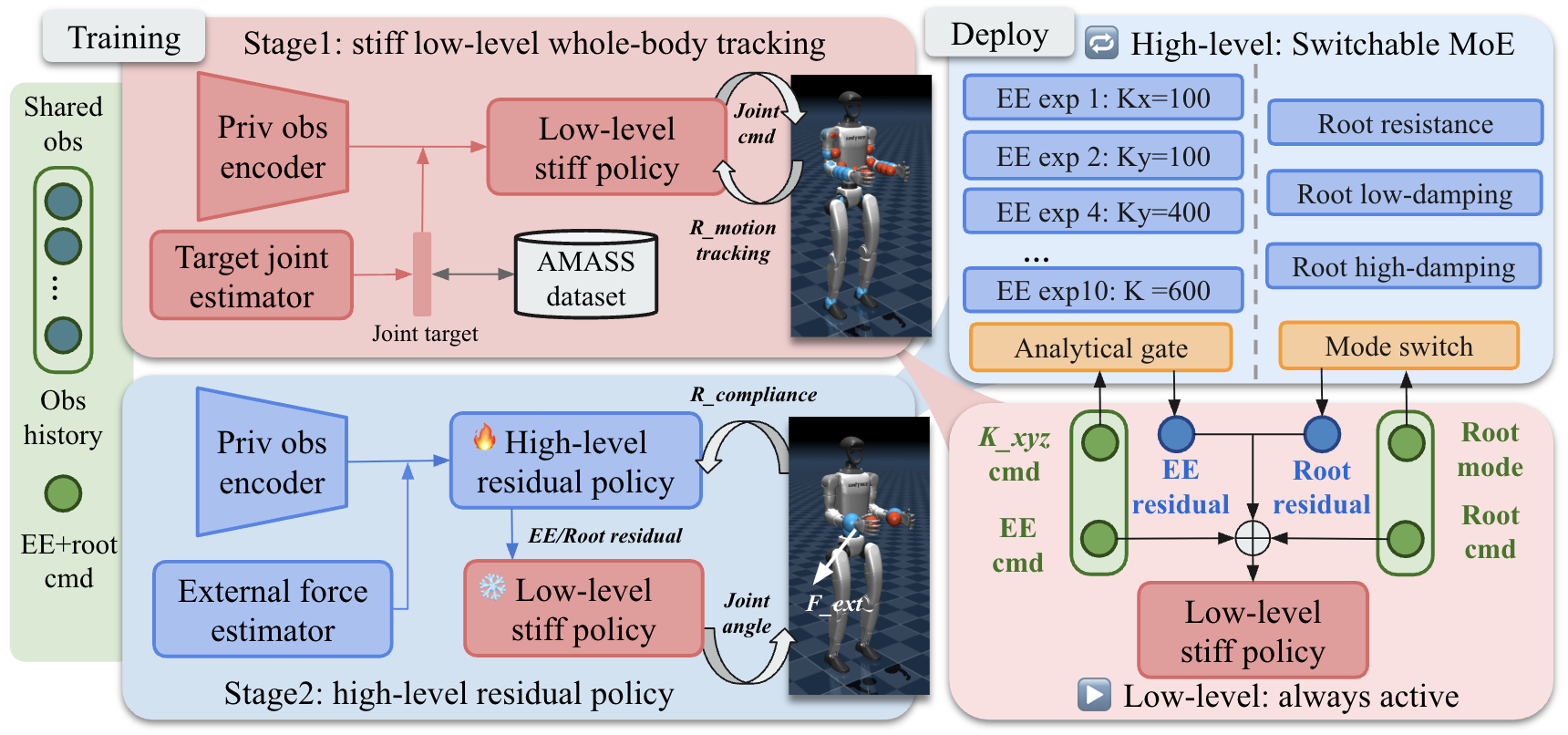
CEER2 presents a compliance framework for humanoid loco-manipulation that combines directional and tunable end-effector compliance with selectable root compliance for external force rejection or following. A hierarchical RL controller modulates a fixed whole-body tracking policy via high-level commands, with interaction forces estimated from proprioceptive history, demonstrated in simulation and real-world experiments on a humanoid for compliant manipulation and collaborative carrying.
中文摘要: CEER2提出了一种用于人形机器人运动-操作的柔顺框架,结合了方向性和可调末端执行器(EE)柔顺性与可选的根部柔顺性,用于外部力抑制或力跟随。分层强化学习控制器通过高层EE和根部命令调节固定的全身跟踪策略,而交互力则从本体感觉历史中估计。在仿真和真实世界实验中对人形机器人进行了验证,展示了方向刚度控制、在线刚度调整、不同的根部柔顺性、柔顺操作和协作搬运。
💬 The hierarchical RL approach for tunable compliance in whole-body control is relevant to modular legged robots for adaptable interaction and robust locomotion.
💬 用于全身控制中可调柔顺性的分层强化学习方法与模块化腿式机器人相关,可实现自适应交互和鲁棒运动。
Why read it / 推荐理由: It introduces a method for directional compliance control that enhances whole-body control in legged robots, useful for modular designs requiring adaptable physical interaction. 它引入了一种方向性柔顺控制方法,增强了腿式机器人的全身控制,适用于需要自适应物理交互的模块化设计。
5. NEXUS: Perceptive Whole-Body Control for Terrain-Adaptive Teleoperation
NEXUS:用于地形自适应遥操作的感知全身控制
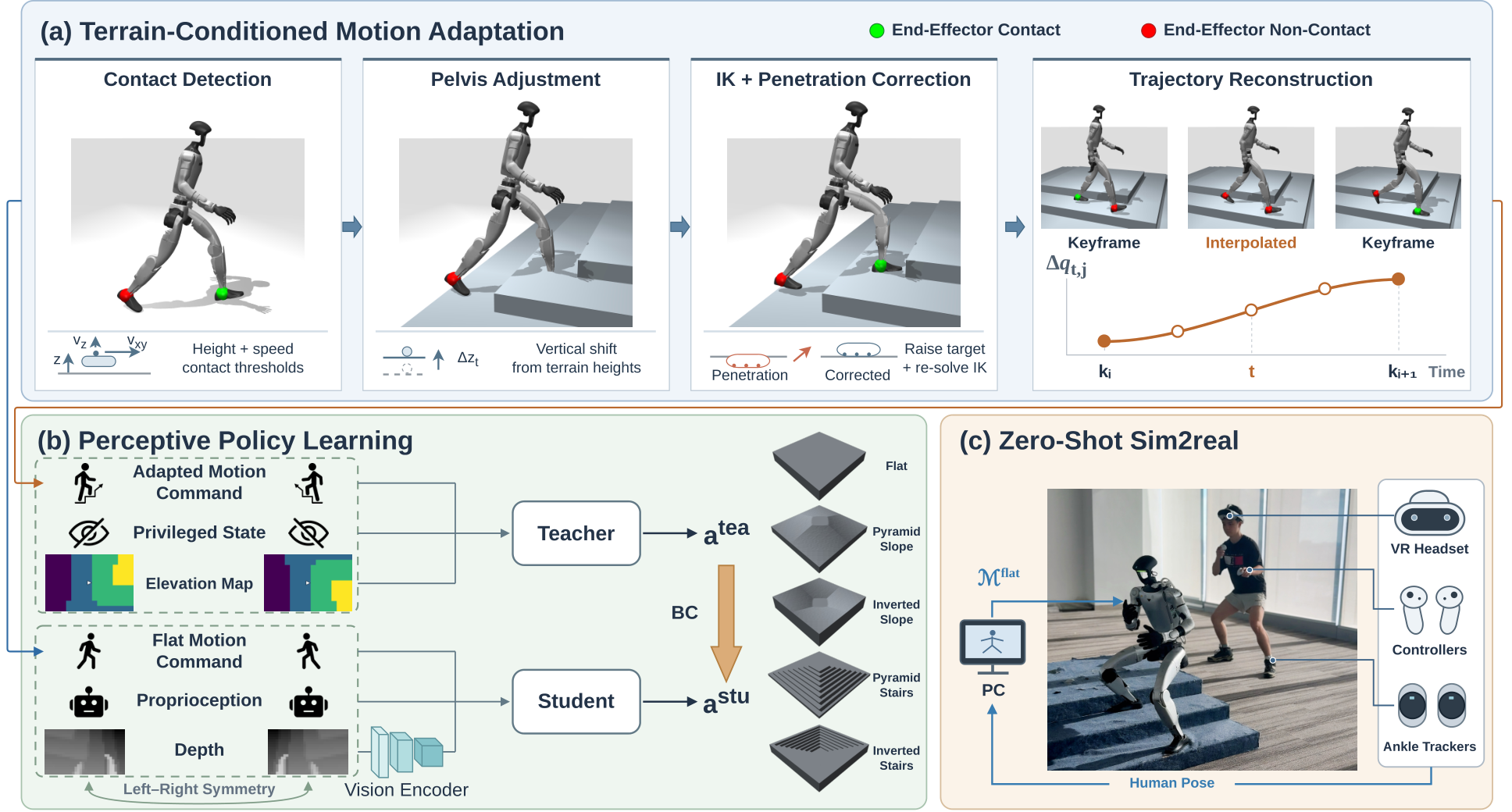
Authors / 作者: Xiangyu Miao, Junsong Wu, Jiyuan Shi, Weiji Xie, Jinrui Han, Xingyi Wang et al.
arXiv: 2609.39000 · PDF
NEXUS is a perceptive whole-body control framework for humanoid teleoperation that combines human motion commands with onboard sensory feedback to adapt to terrain differences. It uses a scalable terrain-aware adaptation algorithm to generate paired motion data across terrains, trains a perceptive controller via teacher-student learning on nearly 1000 hours of paired motions, and achieves zero-shot real-world deployment for real-time whole-body teleoperation on unseen terrains.
中文摘要: NEXUS是一种用于人形机器人遥操作的感知全身控制框架,将人类运动命令与机载传感器反馈相结合,以适应地形差异。它首先开发了一种可扩展的地形感知适应算法,能够高效生成跨运动和地形的高质量运动对,无需针对每个运动或地形进行调整;然后利用总计近1000小时的配对运动语料库,通过教师-学生学习训练了一个感知全身控制器,以在不同地形上复现命令行为。实验证明了高效、可扩展地生成高质量运动数据,并表明NEXUS结合了广泛的行为覆盖、地形适应性和跟踪保真度,在评估基准上优于现有的全身控制器。零样本真实世界部署实现了在多样化的 unseen 地形上的实时全身遥操作。
💬 The terrain-adaptive whole-body control with teacher-student learning and sim-to-real transfer is directly applicable to legged robots navigating complex terrains.
💬 具有教师-学生学习的地形自适应全身控制和仿真到现实的迁移,可直接应用于在复杂地形中导航的腿式机器人。
Why read it / 推荐理由: It provides a method for terrain-aware whole-body control that can be adapted to modular legged robots for enhanced traverse capability and sim-to-real transfer. 它提供了一种地形感知全身控制方法,可适用于模块化腿式机器人,以增强穿越能力和仿真到现实的迁移。