Robotics Digest
Robotics Paper Digest — 2026-10-02
🤖 Scanned 551 papers from today’s arXiv announcement (cs.RO / eess.SY / cs.LG), picked 5 for modular & legged robotics — summarized by DeepSeek.
🤖 从今日 arXiv 新论文(cs.RO / eess.SY / cs.LG)中扫描 551 篇,围绕模块化与足式机器人精选 5 篇 — 由 DeepSeek 生成双语摘要。
1. ReCo: Response-Consistent Locomotion with Policy-Aware MPC for Legged Manipulation
ReCo:面向腿足操作的一致响应运动策略与策略感知模型预测控制
Authors / 作者: Kuankuan Sima, Yichao Gao, Chenxi Gu, Kefan Zhao, Lin Zhao
arXiv: 2610.01612 · PDF
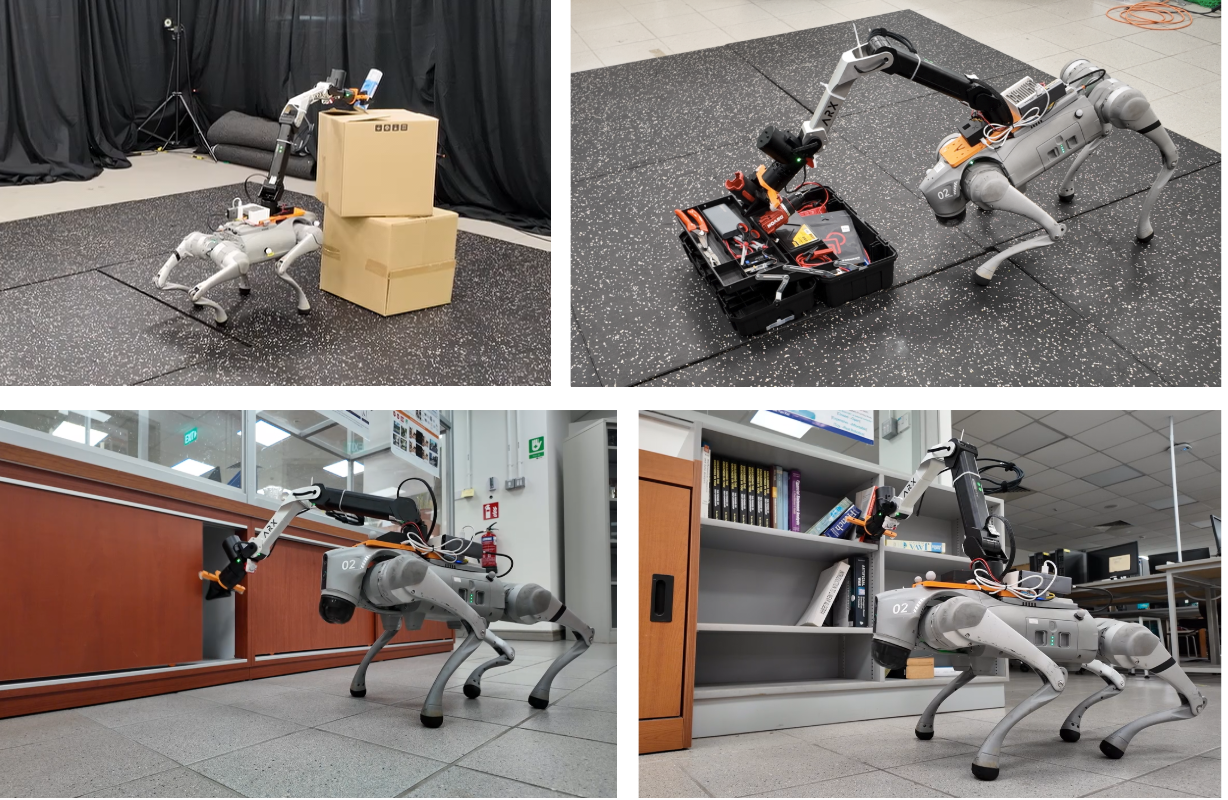
ReCo couples response-consistent locomotion training with policy-aware MPC for legged manipulation. It shapes a learned policy to respond consistently to commands and identifies a closed-loop response model so MPC can jointly plan base locomotion commands and arm motion. Simulation results reduce position and orientation RMSE by 28.7% and 27.4%, and real-world experiments demonstrate onboard continuous legged manipulation.
中文摘要: 面向连续腿足操作中需要同时保持行走与末端执行器精确跟踪的问题,本文提出ReCo框架,将响应一致的运动策略与策略感知模型预测控制(MPC)相结合。为了让MPC能够预测并补偿策略产生的基座运动,作者对强化学习策略进行响应塑形训练,使其在随机化动力学下对指令具有一致且可重复的响应,并辨识闭环响应模型,由MPC联合规划基座运动指令与机械臂动作。在仿真基准上,该方法相比最优基线将位置与姿态均方根误差分别降低28.7%和27.4%;真实机器人实验验证了机载连续腿足操作中基座与机械臂的协调运动,为腿足操作系统的控制架构提供了新思路。
💬 A well-motivated modular RL+MPC architecture for legged manipulation: it identifies and exploits the policy’s closed-loop response, which is directly relevant to WBC/MPC control of reconfigurable legged platforms.
💬 该工作提出动机清晰、模块化的RL+MPC腿足操作架构,通过辨识并利用策略闭环响应实现基座与机械臂协同,对可重构腿足平台的全身控制与MPC设计具有直接参考价值。
Why read it / 推荐理由: It offers a practical recipe for making MPC robust to learned locomotion policy behavior, a core challenge for whole-body control of modular legged robots. 它给出了让MPC适应学习型运动策略行为的实用方案,这正是模块化腿足机器人全身控制面临的核心挑战。
2. PROMO: Preference-conditioned Multi-Objective Reinforcement Learning for Quadrupedal Robots
PROMO:面向四足机器人的偏好条件多目标强化学习
Authors / 作者: Amr Mousa, Rifny Rachman, Neil Karavis, Michele Caprio, Richard Allmendinger
arXiv: 2610.01260 · PDF
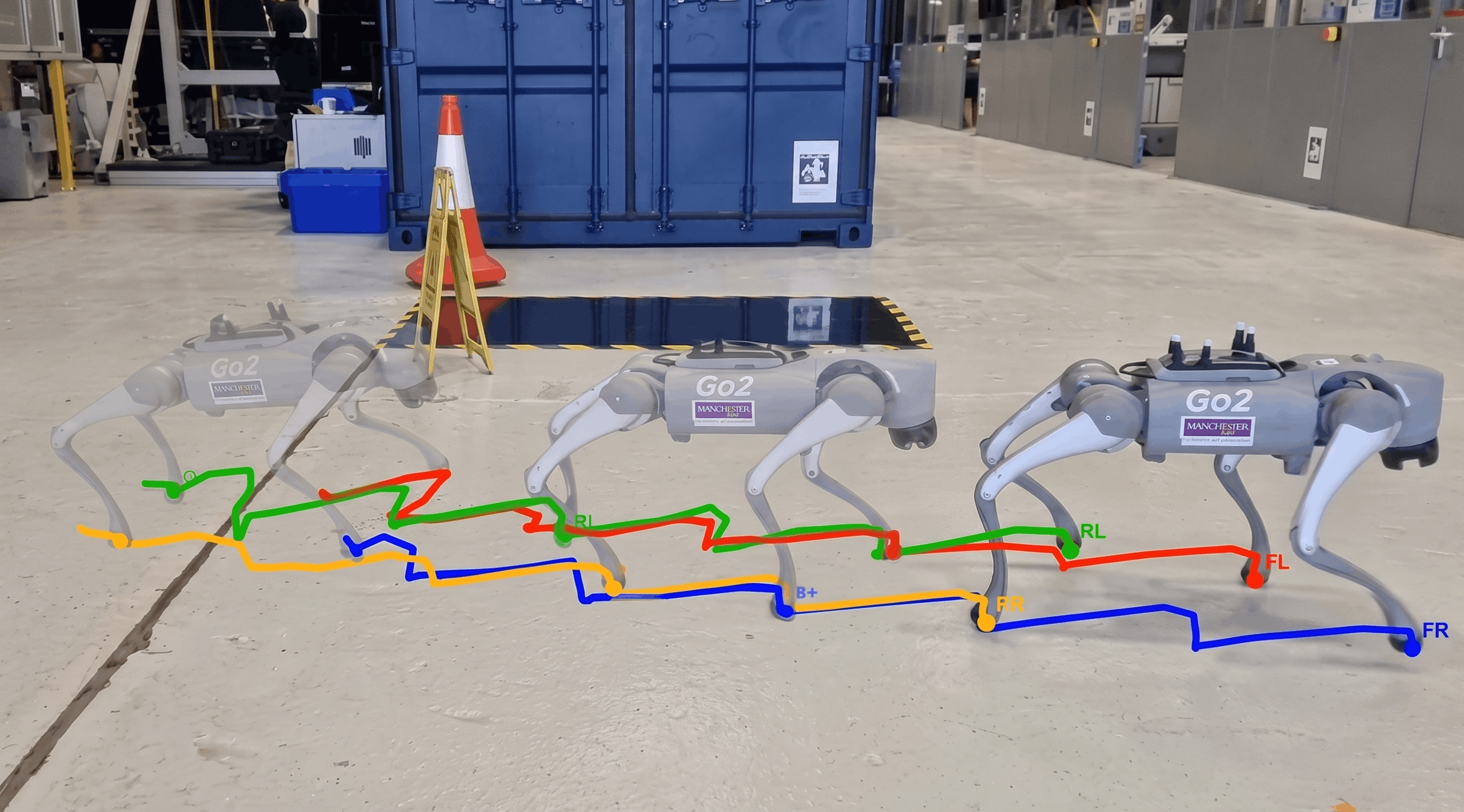
PROMO conditions a single quadruped locomotion policy on deployment-time preferences, separating operator intent from embodiment-specific gait priors and avoiding a fixed scalar reward. Across 100 sampled preferences it produces broad Pareto coverage with a mean preference-objective correlation of 0.843 and transfers zero-shot to a Unitree Go2. Preference changes reduce energy by up to 30.4%, position error by 38.7%, and body-attitude deviation by 59.0% versus the balanced preference.
中文摘要: 四足运动需要在指令跟踪、稳定性与能效等冲突目标之间折衷,而传统强化学习将优先级固化在训练时的标量奖励中。本文提出PROMO,一种语义多目标强化学习方法,将部署时操作者偏好作为单一运动策略的运行时输入,从而把操作意图与实现特定步态的运动先验分离。作者在仿真中采样100个偏好,得到67个严格Pareto非支配行为,偏好与目标相关系数均值达0.843;同一策略零样本迁移至Unitree Go2真机,相比均衡偏好,偏好切换可使特定能耗降低30.4%、位置误差降低38.7%、机身姿态偏差峰值降低59.0%,展示了可预测的Pareto覆盖与语义化行为调制能力。
💬 A clean multi-objective RL formulation that lets one deployed policy trade off speed, stability, and energy at runtime, which is attractive for modular platforms with changing configurations.
💬 该工作提出清晰的多目标强化学习形式,使单一部署策略可在运行时权衡速度、稳定性与能耗,对构型可变的模块化平台尤为有吸引力。
Why read it / 推荐理由: It directly addresses runtime gait-objective trade-offs in quadruped locomotion with real-robot validation, useful for reconfigurable leg modules and multi-legged platforms. 它直接研究四足运动运行时步态目标折衷并完成真机验证,对可重构腿模块与多足平台具有实用参考价值。
3. Experience-Based Feasibility-Aware Generative Adversarial Imitation from Observation under Embodiment Mismatch
本体差异下基于经验可行性感知的生成对抗式观察模仿学习
Authors / 作者: Yoshiki Takebayashi, Giovanni Perantoni, Hikaru Sasaki, Matteo Saveriano, Takamitsu Matsubara
arXiv: 2610.01171 · PDF
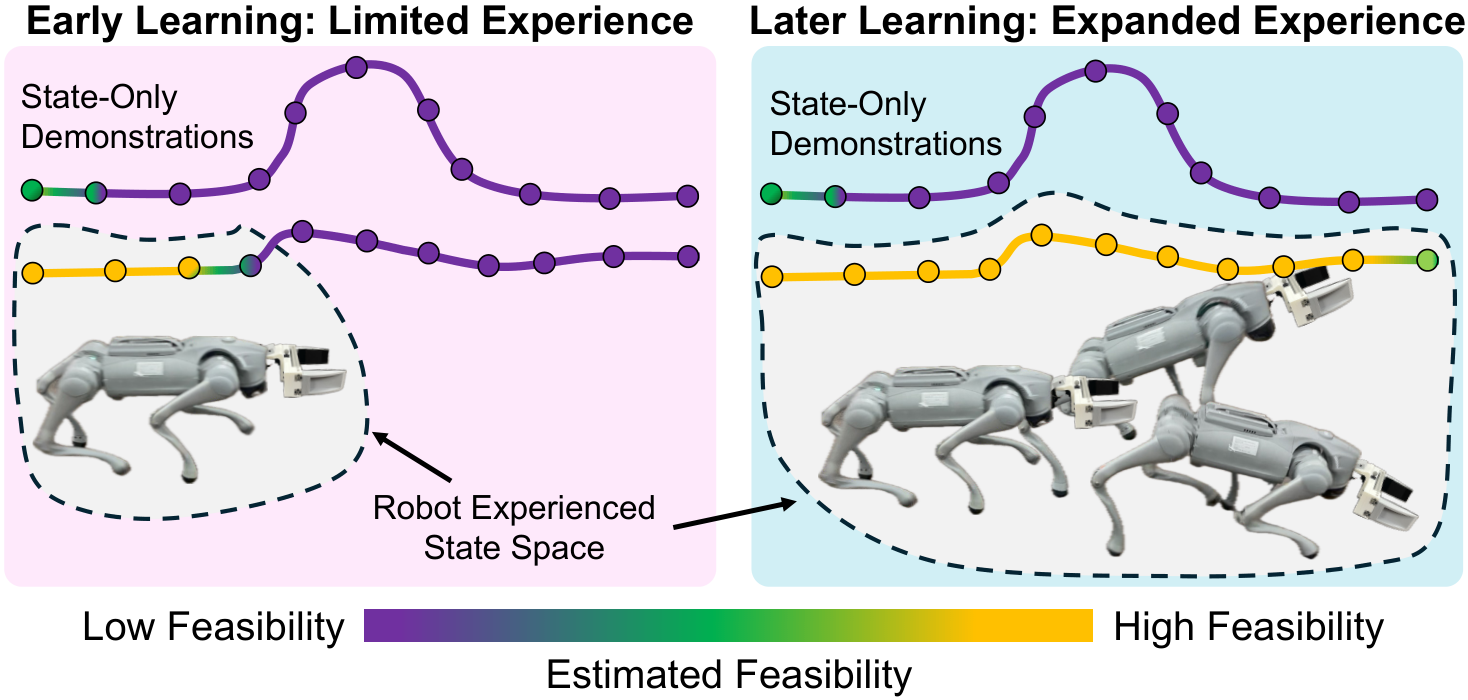
EF-GAIfO learns robot policies from state-only human demonstrations while estimating which demonstrations are feasible using the robot’s own experience rather than a dynamics model or large prior dataset. The feasible region expands as policy learning progresses, enabling adaptive feasibility-aware imitation. It is validated on a simulated locomotion task and a real quadruped performing object reaching and grasping.
中文摘要: 针对无动作标签的观察模仿学习中,人类与机器人本体及动力学差异导致演示动作对机器人不可行的问题,本文提出EF-GAIfO方法。该方法不依赖显式动力学模型或大规模先验探索数据,而是利用机器人自身经验估计纯状态演示的可行性,并将可行性概念与策略学习过程耦合:随着策略改进、状态转移覆盖范围扩大,可行域逐步扩展,使更多演示被纳入学习,形成随学习阶段自适应的可行性感知模仿。作者在仿真运动任务与真实四足机器人抓取任务上验证了方法有效性,为跨本体演示迁移提供了新途径。
💬 Feasibility-aware imitation that evolves with the policy is a neat answer to embodiment mismatch, with a real quadruped result that makes sim-to-real claims credible.
💬 随策略演化的可行性感知模仿为跨本体差异提供了巧妙解法,且在真实四足平台上验证,使仿真到现实的结论更具可信度。
Why read it / 推荐理由: It tackles embodiment mismatch in learning locomotion, a practical issue when transferring gaits across different modular leg configurations or hardware platforms. 它解决学习型运动控制中的本体差异问题,对跨模块化腿构型或硬件平台迁移步态具有实际意义。
4. Reactive Humanoid Multi-Contact Using Learned Stability Models
基于学习稳定性模型的类人机器人反应式多点接触
Authors / 作者: Stephen McCrory, Beomyeong Park, Nicholas Kitchel, Nehar Poddar, Robert Griffin
arXiv: 2610.00823 · PDF
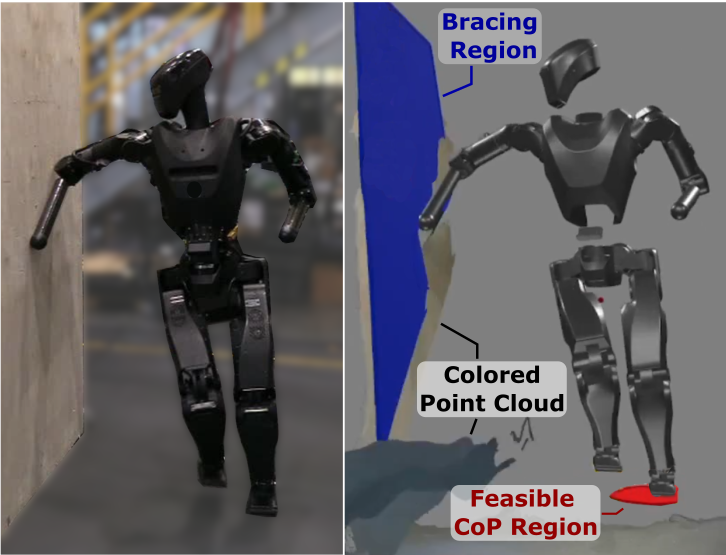
This paper presents a planning and control approach that reactively uses hand contacts to stabilize a humanoid when foot contacts alone would lead to a fall. Candidate contacts are sampled in the reachable workspace, previewed through centroidal dynamics across pre-impact, impact, and post-impact phases, and scored with a learned model of the post-impact CoP region for fast evaluation. Simulation shows 89% average impulse resilience improvement over no-hand-contact recovery and 17% over naive planning; hardware push tests show 43% faster stabilization while standing and 18% improvement while walking.
中文摘要: 针对仅依靠足部接触难以稳定、可能跌倒的低稳定性场景,本文提出一种可反应式利用手部接触的规划与控制方法。系统在机器人可达工作空间内采样候选接触点,通过质心动力学对碰撞前、碰撞中与碰撞后阶段进行前向推演,并利用学习得到的碰撞后压力中心(CoP)区域模型快速评估候选点,从而避免耗时的优化求解。规划器分两阶段:先选择最优支撑区域,再在区域内确定最优支撑点。仿真中,该方法相较无手部接触的恢复策略平均提升89%的冲量鲁棒性,比朴素规划策略提升17%;真机站立推扰实验平均缩短43%稳定时间,行走实验相对无手部接触基线提升18%。
💬 A fast learned CoP model enables reactive multi-contact bracing on a real humanoid, an approach that could naturally extend to extra limbs or reconfigurable leg modules.
💬 学习型CoP模型实现了真机类人机器人的反应式多点支撑,其思想可自然扩展到附加肢体或可重构腿模块的稳定控制。
Why read it / 推荐理由: It provides a real-robot planning/control method for using additional contacts in low-stability scenarios, relevant to whole-body control when a modular robot reconfigures its limbs. 它给出低稳定性场景下利用附加接触点的真机规划与控制方法,对模块化机器人重构肢体时的全身控制具有参考价值。
5. Continue, Abort, or Fall: Viability-Aware Policy Selection (VAPS) for Safe Humanoid Acrobatics
继续、中止或跌倒:面向安全类人机器人特技动作的可行性感知策略选择
Authors / 作者: Siwei Ju, Lu Liu, Jan Peters, Oleg Arenz
arXiv: 2610.01397 · PDF
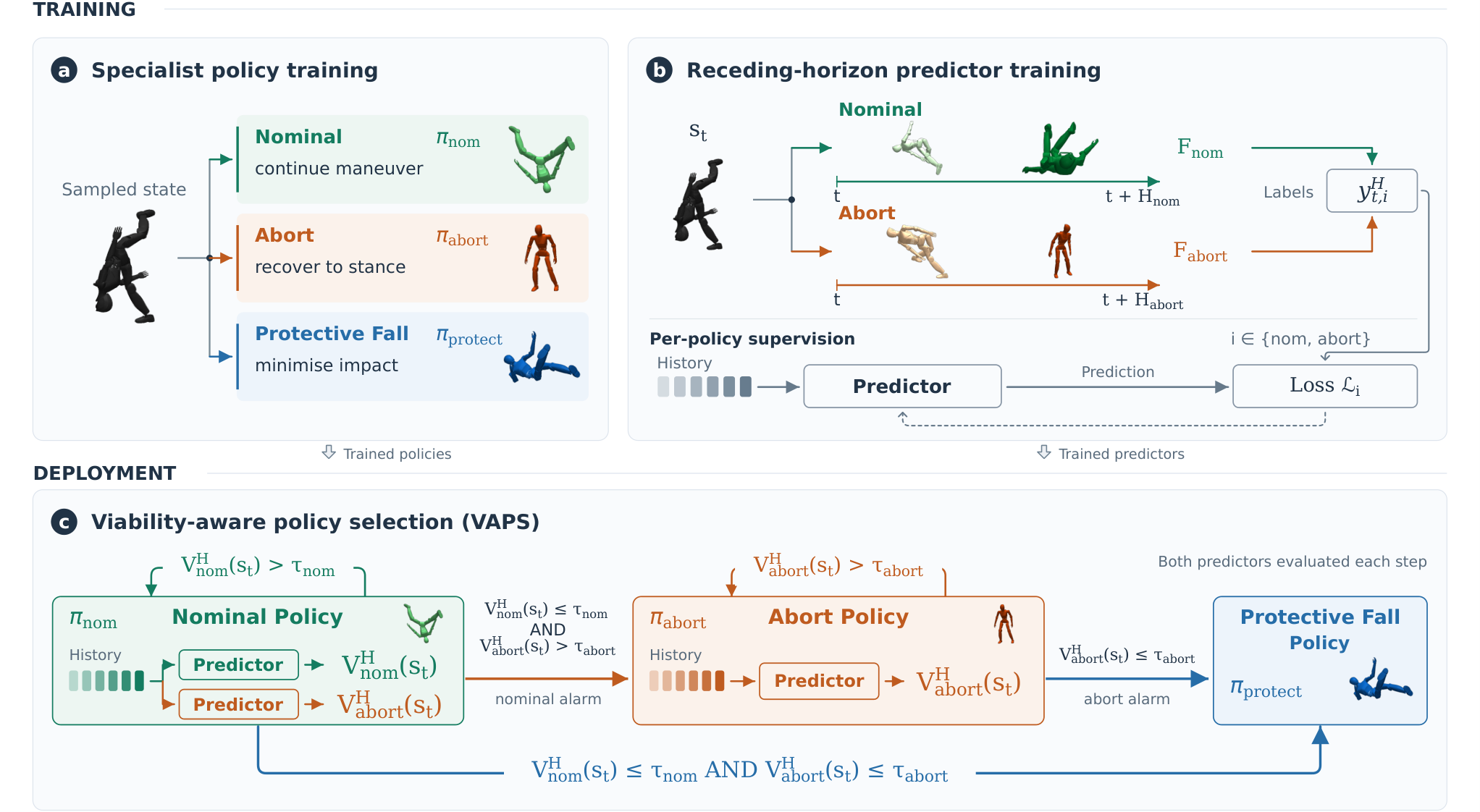
VAPS treats safety during dynamic humanoid maneuvers as a policy-conditioned, receding-horizon decision rather than a single tracking policy. Alongside a protective fall policy, it trains an abort policy that can terminate the motion and land on its feet, and uses learned predictors each control step to check whether the nominal or abort policy remains viable over a short horizon. A least-sacrificial hierarchy keeps the most task-ambitious viable behavior; on a Unitree G1 and LimX Oli it sharply reduces head and hand contact, and on the LimX Oli the full controller is validated for side-flip motions.
中文摘要: 动态类人动作如空翻,在策略次优、受到扰动或存在仿真到现实差距时可能损坏硬件;一旦动作偏离参考轨迹,动作跟踪策略本身无法提供安全退路。本文提出VAPS,将安全性建模为受策略条件约束的滚动时域决策问题。除保护性跌倒策略外,作者训练了可在任意时刻中止动作并双脚落地的中止策略;每个控制步内,学习型预测器估计标称跟踪策略与中止策略在未来短时域内是否可行,并按照最小牺牲层级保留仍可行的最具任务进取性的行为。在Unitree G1与LimX Oli随机扰动仿真中,VAPS显著降低作为主要硬件损伤来源的头部与手部接触;并在LimX Oli真机上验证了可行性预测器与完整控制器执行侧空翻动作的表现。
💬 Viability-aware policy selection is a principled safety layer for aggressive motion, transferable to any high-DoF legged system that needs graceful recovery from failed gaits.
💬 可行性感知策略选择为高动态动作提供了有原则的安全层,可迁移至任何需要从失败步态中优雅恢复的高自由度腿足系统。
Why read it / 推荐理由: It introduces a receding-horizon safety arbitration scheme with real hardware validation, valuable for making RL-based locomotion on modular legged robots reliable. 它提出滚动时域安全仲裁方案并完成真机验证,对提升模块化腿足机器人强化学习运动控制的可靠性很有价值。