Robotics Digest
Robotics Paper Digest — 2026-09-25
🤖 Scanned 350 papers from today’s arXiv announcement (cs.RO / eess.SY / cs.LG), picked 5 for modular & legged robotics — summarized by DeepSeek.
🤖 从今日 arXiv 新论文(cs.RO / eess.SY / cs.LG)中扫描 350 篇,围绕模块化与足式机器人精选 5 篇 — 由 DeepSeek 生成双语摘要。
1. DAWN: Noise-Robust Quadruped Parkour via Depth-Denoising World Models
DAWN:通过深度去噪世界模型实现抗噪声四足跑酷
Authors / 作者: Yohan Choi, Min-Jun Kim, Jin-Sung Kim, Yong-Jae Kim, Youn-Hee Han
arXiv: 2609.29092 · PDF
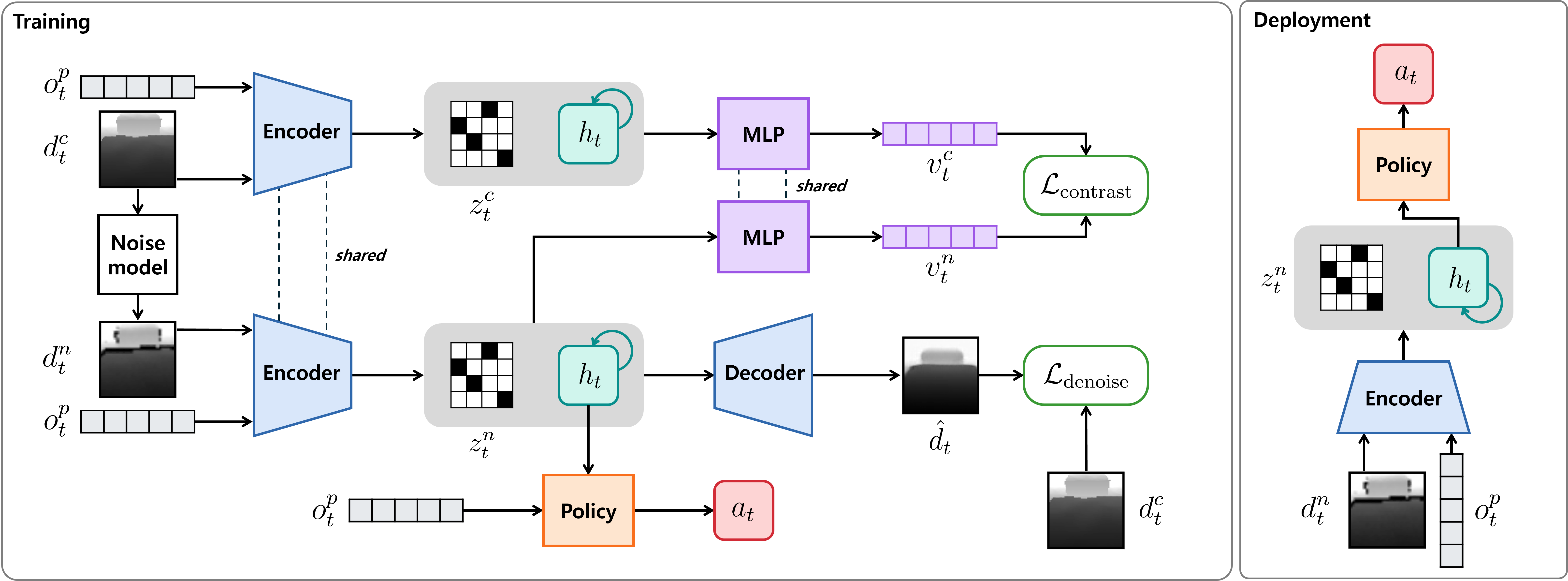
DAWN builds noise robustness directly into a latent world model for legged locomotion by feeding noisy depth to the encoder while reconstructing clean depth, and by aligning noisy/clean latents with contrastive learning. It requires no hand-tuned depth filters or explicit noise model, adds no inference cost, and enables zero-shot quadruped parkour on a Unitree Go1 over stairs and other difficult terrain.
中文摘要: 本文提出DAWN,一种面向腿足运动的抗噪声感知框架,将噪声鲁棒性直接嵌入世界模型,而非依赖部署时手工调节的深度滤波后处理。其核心包含两项改进:一是把含噪深度输入编码器,同时以干净深度作为重建目标,迫使模型隐式去噪;二是采用对比学习对齐含噪与干净深度的隐状态。该方法不绑定特定噪声模型,无需针对实际噪声分布手动调参,且相比现有世界模型方法不增加推理开销。在Unitree Go1四足机器人上,仅依靠学习到的鲁棒表征,无需任何滤波标定,即实现零样本跑酷,可攀爬阶梯等复杂地形。
💬 A clean example of embedding sensor-noise robustness into the world-model training objective rather than patching it with hand-tuned filters at deployment.
💬 该工作把传感器噪声鲁棒性内嵌到世界模型训练目标中,而非在部署阶段用人工滤波器补救,思路干净且实用。
Why read it / 推荐理由: Directly relevant to depth-based RL locomotion and sim-to-real on quadrupeds, with a filter-free recipe you can reuse for your own modular legged platform. 与基于深度的强化学习运动控制和四足sim-to-real高度相关,其免滤波方案可直接迁移到你的模块化腿足平台。
2. Contact as a Decision Variable: Capability-Tradeoff Contact Selection for Legged Loco-Manipulation
接触作为决策变量:面向腿足移动操作的能力权衡接触选择
Authors / 作者: Al Jaber Mahmud, Shuai Li, Xuan Wang
arXiv: 2609.30140 · PDF
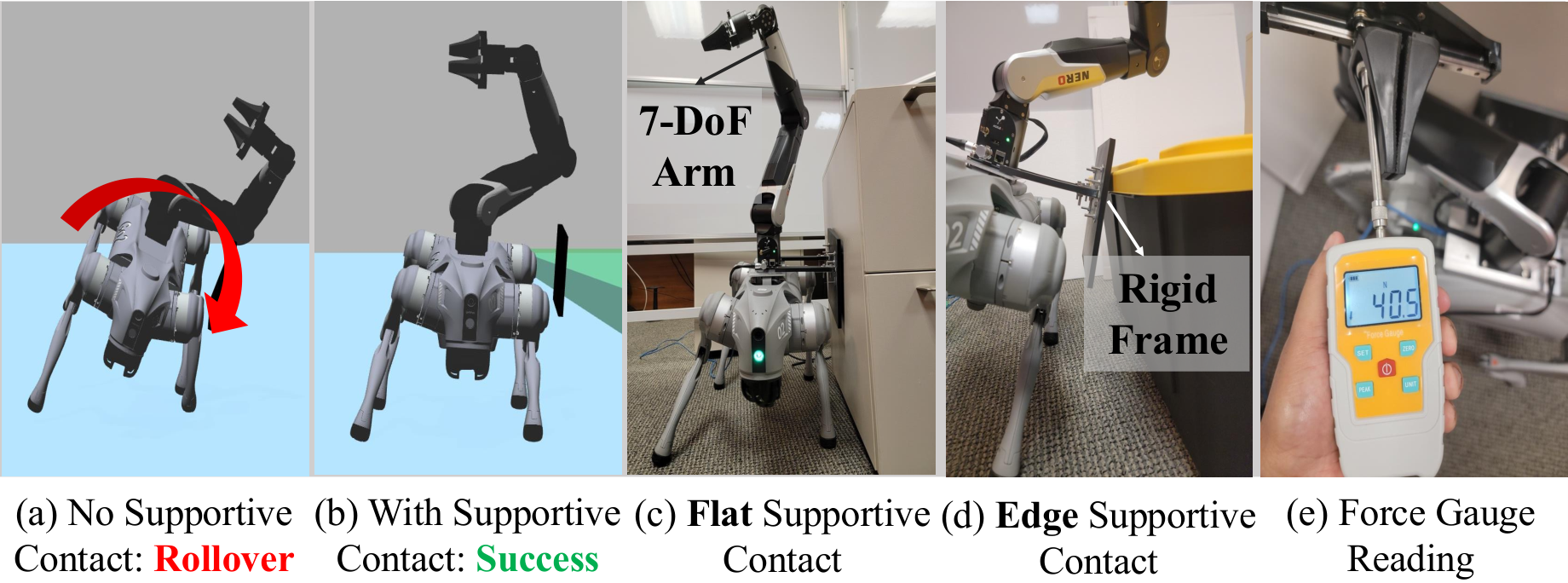
The paper formulates support-contact and whole-body configuration selection jointly for loco-manipulation, scoring candidates by residual wrench, end-effector reach, and base mobility against contact acquisition cost. CTCS screens and clusters candidates, predicts capabilities via local sensitivity analysis with selective exact checks, and is validated on a Unitree Go2 with an AgileX NERO arm over 392 task conditions and nine surfaces, outperforming ground-only and fixed-contact baselines.
中文摘要: 本文研究腿足移动操作中环境支撑接触点与全身构型的联合选择问题:接触点提供更强物理支撑,却可能限制完成任务所需的运动。作者用三个能力指标刻画候选接触——剩余力旋量、末端可达性与基座机动性,并与接触获取代价进行权衡。由于逐一致评估需反复求解全身优化,成本极高,因此提出能力权衡接触选择CTCS:先筛选接触与任务可行性,按表面聚类候选,借局部灵敏度分析从少量精确锚点预测能力,再选择性精确校验、排序并对候选短名单精确评估。在Unitree Go2四足加AgileX NERO机械臂上,于392种任务条件和9个支撑面上验证,优于仅地面支撑与固定接触方案。
💬 Turns contact selection into an explicit capability trade-off, which is exactly the kind of reasoning needed when a legged platform must choose among footholds and support surfaces.
💬 将接触点选择显式建模为能力权衡,正是腿足平台在立足点与支撑面之间取舍时所需的推理方式。
Why read it / 推荐理由: Highly relevant to whole-body control and contact-rich decision making on a quadruped, and the hierarchical screening/prediction scheme is a reusable computational recipe. 与四足全身控制及富接触决策高度相关,其分层筛选与预测机制是可复用的计算方案。
3. Fly, Drive, Reconfigure: A Modular Reconfigurable Aerial-Ground Platform for Field Operations
飞行、行驶、重构:面向野外作业的模块化可重构空地平台
Authors / 作者: Li-Yu Lo, Yanbaihui Liu, Chengchuan Shu, Tyler Harris, Jonathan Ryan, Boyuan Chen
arXiv: 2609.28887 · PDF
HARP is a heterogeneous aerial robotic platform where independently flying scout, fly-drive rover, and payload modules physically dock to compose a cooperative ground vehicle for energy-efficient transport. An energy-aware planner jointly selects routes and air-ground mobility modes, and the system is validated in field experiments including module-level deployment tests on the Greenland Ice Sheet.
中文摘要: 本文提出HARP,一种异构空中机器人模块平台,由可独立部署的飞行模块组成,包括带传感器的侦察模块、飞行-行驶漫游模块以及任务专用载荷模块。侦察模块先测绘环境,为能耗感知规划器提供信息,该规划器联合选择路径与空-地移动模式。漫游与载荷模块可飞越地面难以通行的地形,随后自主对接组装成协作地面车辆,实现高能效载荷运输。研究面向偏远、难以通行区域的环境采样任务,通过涵盖感知、规划、重构、空地移动、载荷运输与任务执行的野外实验评估系统,并在格陵兰冰盖开展模块级部署测试,展示了异构机器人团队不仅可调整行为,还能在任务过程中改变物理能力的组合方式。
💬 A rare full-system demonstration of physical reconfiguration where module docking changes the locomotion mode, closely paralleling modular legged-robot assembly.
💬 难得的全系统物理重构演示,模块对接直接改变移动模式,与模块化腿足机器人的组装思路高度平行。
Why read it / 推荐理由: Its energy-aware mode-selection planner and module-docking workflow offer concrete design lessons for reconfigurable multi-module locomotion platforms. 其能耗感知模式选择规划与模块对接流程,为可重构多模块移动平台提供了具体的设计经验。
4. TactileStep: Sole Tactile Learning for Regulating Foot-Terrain Interaction in Humanoid Locomotion
TactileStep:用于调节人形机器人足-地交互的足底触觉学习
Authors / 作者: Zizhuo Wang, Ming-ju Lee, Shaoting Zhu, Haozhe Lou, Hang Zhao, Yiming Li
arXiv: 2609.28959 · PDF
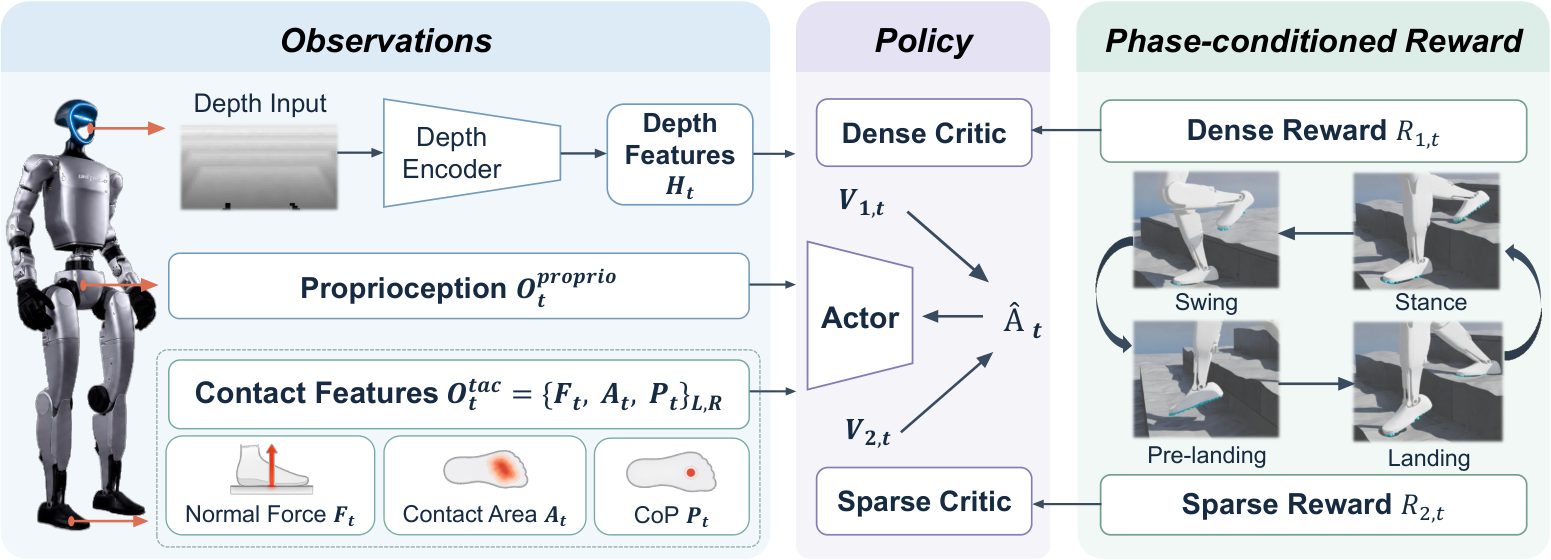
TactileStep brings sole pressure sensing into humanoid locomotion control by aligning tactile simulation with a real pressure insole, then using tactile and motion cues to identify foot-contact phases with phase-aware rewards. On a Unitree G1 across diverse terrains, it cuts peak touchdown force by up to 48.8%, reduces A-weighted impact noise by up to 30.1 dB, and increases stance contact area by up to 23.8% over a perceptive baseline.
中文摘要: 现有人形跑酷策略虽能通过多种地形,却掩盖了硬着陆、边缘接触与支撑不稳等问题;人类依靠足底触觉按地形刚度调节接触柔顺性,而多数人形机器人缺乏丰富触觉感知。本文提出TactileStep,一种可部署的触觉学习框架,将足底压力传感引入人形运动控制,以获得更柔和的着地与更稳定的支撑。其关键在于将触觉仿真与真实压力鞋垫对齐,使策略从硬件上同样可得的接触特征中学习;训练时结合触觉与运动线索识别不同足接触相位,并施加相位感知奖励,鼓励安全着地与稳定支撑。在Unitree G1上跨多种地形验证,峰值着地力最多降低48.8%,A计权冲击噪声峰值最多降低30.1 dB,支撑接触面积最多提升23.8%。
💬 Whereas most legged RL treats contact implicitly, this makes contact quality an explicit, sensor-grounded learning signal with clear real-robot metrics.
💬 多数腿足强化学习隐式处理接触,而本文将接触质量显式建模为由传感器支撑的学习信号,并给出清晰的真机指标。
Why read it / 推荐理由: If you plan to add foot contact sensing to a modular leg, this shows how to align tactile simulation with hardware and shape rewards around contact phases. 若你计划为模块化腿足加装足端接触传感,本文展示了如何对齐触觉仿真与硬件并围绕接触相位设计奖励。
5. Echo in the Steps: Learning Perceptive Humanoid Parkour with Gated Memory
步中回声:基于门控记忆的感知型人形机器人跑酷学习
Authors / 作者: Ming-Ju Lee, Zizhuo Wang, Shaoting Zhu, Haozhe Lou, Hang Zhao, Yiming Li
arXiv: 2609.28960 · PDF
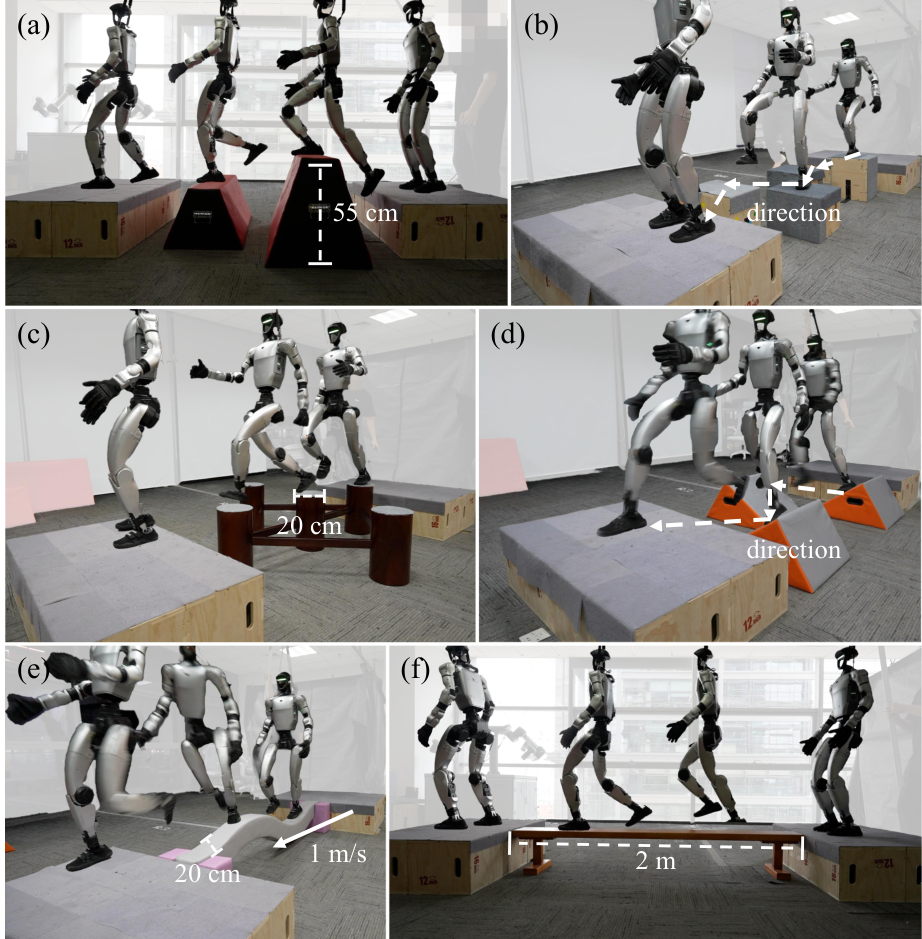
The paper presents a perceptive humanoid parkour framework that traverses sparse-foothold and narrow-support terrain using only onboard depth, via a saliency-guided temporal perception module combining a saliency prior with gated memory. An alternation loss regularizes symmetric alternating gait, and experiments in simulation and the real world show improved success rate and foothold accuracy.
中文摘要: 尽管感知型运动控制已使机器人能穿越结构化地形,但在高度不连续环境中的敏捷跑酷仍是难题:跨越稀疏立足点和狭窄支撑区需要精确的落足选择、有效利用视觉观测,并在快速过渡中保持稳定的左右交替落足。本文提出一种感知型人形跑酷框架,仅用机载深度观测即可在立足点稀缺的地形上稳定通行。其核心是显著性引导的时序感知模块,将显著性先验与门控记忆结合,跨帧保留有信息的深度特征,从而在部分观测下实现可靠落足;同时引入交替损失作为对称性正则,鼓励交替步态模式,提升通行鲁棒性。仿真与真实世界实验表明,该方法在困难地形上的成功率与落足精度显著提升。
💬 Gated memory over depth features plus an explicit gait-alternation loss is a neat combination for maintaining foot placement under partial observability.
💬 深度特征上的门控记忆加上显式步态交替损失,是在部分可观测下维持落足精度的一套巧妙组合。
Why read it / 推荐理由: Useful for anyone working on perceptive locomotion over sparse footholds, with an alternation regularizer that could transfer to hexapod or modular gaits. 对研究稀疏立足点感知运动的人很有价值,其交替正则化思想可迁移到六足或模块化步态生成。