Robotics Digest
Robotics Paper Digest — 2026-09-19
🤖 Scanned 80 papers from the last 3 days of arXiv announcements (cs.RO / eess.SY / cs.LG), picked 5 for modular & legged robotics — summarized by DeepSeek.
🤖 从近 3 天的 arXiv 新论文(cs.RO / eess.SY / cs.LG)中扫描 80 篇,围绕模块化与足式机器人精选 5 篇 — 由 DeepSeek 生成双语摘要。
1. RecMorph: Topology-Guided Spatial Recurrence for Generalized Morphology Control
RecMorph:面向通用形态控制的拓扑引导空间递归架构
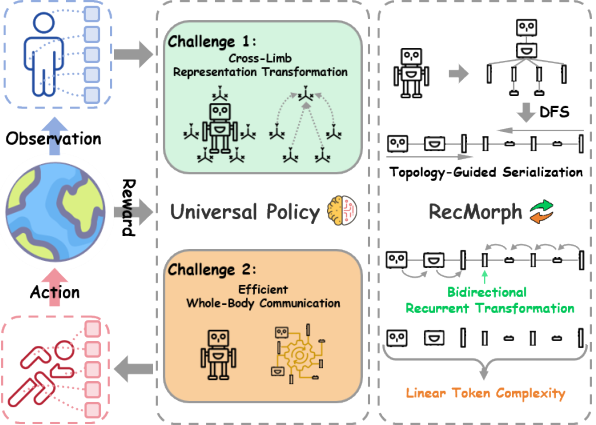
Authors / 作者: Quanrui Rao, Yong Liu, Xueming Xiao, Yingbo Luo, Kun Wu, Zhenyu Xu et al.
arXiv: 2609.18359 · PDF
RecMorph introduces a topology-guided spatial recurrent architecture that turns the kinematic tree into a depth-first sequence, enabling cross-limb communication and representation transformation within a single policy. It achieves strong generalized morphology control across five UNIMAL tasks and transfers to a four-platform quadruped setting with linear token complexity.
中文摘要: RecMorph 提出一种拓扑引导的空间递归网络,将机器人运动学树通过深度优先遍历转化为形态序列,并利用共享双向递归单元沿序列逐步传递和变换肢体信息,再解码为关节动作。该架构通过残差保留、RMS 归一化和输入相关通道调制保证重复空间变换的稳定性,在固定宽度和深度下实现线性复杂度。在五个 UNIMAL 任务上,RecMorph 取得最佳平均最终训练性能,并可泛化到最多 30 条肢体的未见形态与变体。作者进一步将代表性通用形态控制器迁移到四平台四足场景,在名义摩擦和高摩擦条件下取得最佳宏观平均性能,相比专用 MLP 将速度 RMSE 降低 43.5%。
💬 Topological recurrence is a promising and directly relevant route to reconfigurable modular legged platforms, since a single policy can handle varying limb counts and arrangements.
💬 拓扑递归对可重构模块化足式平台很有前景,因为同一策略可适应不同肢体数量和连接方式。
Why read it / 推荐理由: Directly addresses generalized morphology control and is one of the few candidates that explicitly targets varying multi-limb bodies, which is central to modular legged robot design. 该工作直接面向通用形态控制,且是少数明确针对多肢体变体身体结构的方法之一,对模块化足式机器人设计非常核心。
2. ViLoMan: Learning Visual-Proprioceptive Whole-Body Loco-Manipulation Skills for Humanoid Robots
ViLoMan:面向人形机器人的视觉-本体感知全身移动操作技能学习
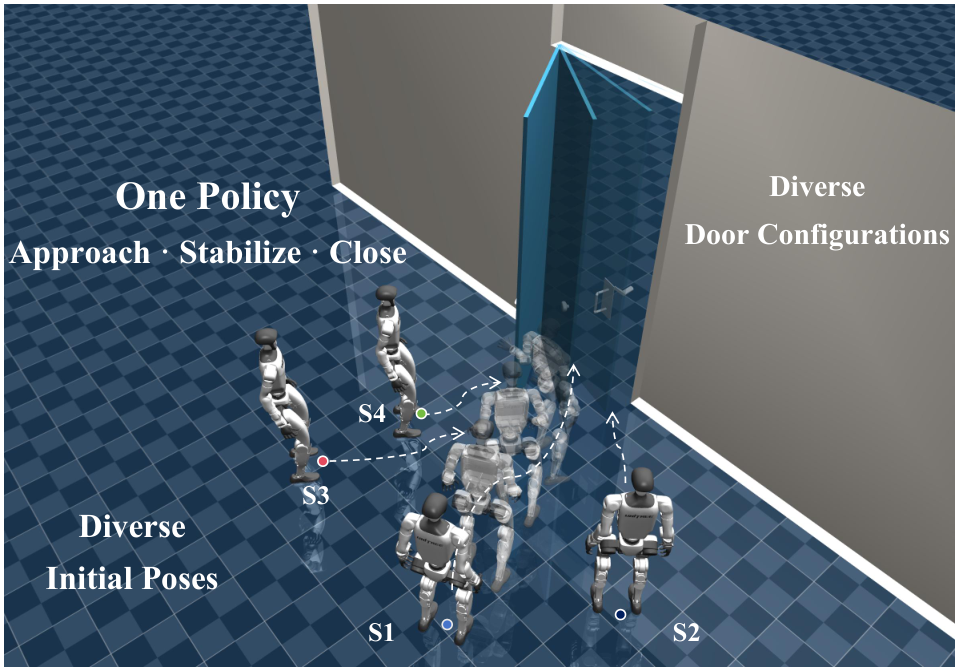
Authors / 作者: Zejie Tian, Ruibing Hou, Bingpeng Ma, Börje F. Karlsson, Shiguang Shan
arXiv: 2609.19340 · PDF
ViLoMan converts partial human demonstrations into physically executable robot trajectories and uses them in a teacher-student distillation framework to learn a unified whole-body loco-manipulation policy from egocentric depth and proprioception. A single policy enables a Unitree G1 to complete door-closing tasks across varied configurations and transfers from simulation to reality without reference motions or intermediate commands.
中文摘要: ViLoMan 针对人形机器人全身移动操作提出一种可扩展学习框架。该方法首先将部分人类-物体交互运动学演示转化为完整且物理可执行的机器人轨迹;随后利用这些轨迹构建教师-学生蒸馏框架,学习从以自我为中心的深度观测和本体感知直接映射到关节级全身动作的统一策略。部署时策略不需要参考运动或中间指令。作者在多种门配置和机器人初始条件下进行仿真与真机实验,结果表明单一策略即可让 Unitree G1 仅凭机载深度感知和本体感知完成关门任务,并能在任务变化中鲁棒泛化,实现有效的仿真到现实迁移。
💬 Strong whole-body loco-manipulation result with real-robot sim-to-real transfer, though focused more on manipulation than modular legged locomotion.
💬 全身移动操作结果扎实,并具有真机仿真到现实迁移,但更偏操作而非模块化足式运动。
Why read it / 推荐理由: It demonstrates a unified vision-proprioceptive whole-body control policy with real-robot deployment, which aligns with the reader’s interest in WBC and sim-to-real. 该工作展示了统一的视觉-本体感知全身控制策略并完成真机部署,与读者对全身控制和仿真到现实迁移的兴趣契合。
3. Learning Safe Humanoid Navigation from Reduced Order Models
基于降阶模型的安全人形机器人导航学习
Authors / 作者: William D. Compton, Zachary Olkin, Ryan Bena, Aaron D. Ames
arXiv: 2609.19272 · PDF
The paper decomposes humanoid navigation into a reduced-order dynamics policy trained with full 3D LiDAR for complex multi-story terrain, then transfers this knowledge to a full-order humanoid policy with a frozen locomotion controller. A Poisson safety filter recovers safety under out-of-distribution obstacles, and the resulting RoM-Nav policy is demonstrated on a Unitree G1 for mapless multi-floor navigation over 10 m vertical and 100 m path length.
中文摘要: 该工作指出标准单阶段强化学习导航管线难以扩展到多层级、多层楼地形,其瓶颈在于人形机器人与复杂地形交互(如楼梯)的难度。作者将导航问题分解为两部分:首先在降阶动力学上训练策略,但使用完整三维 LiDAR 观测来导航复杂多层地形;然后利用该导航知识启动基于全阶人形动力学且冻结运动策略在环的策略。此外,作者在导航策略输出上应用泊松安全滤波器,在分布外障碍物存在时恢复安全性而不降低导航成功率。最终 RoM-Nav 策略在 Unitree G1 上实现了无地图多层导航,试验覆盖超过 10 米垂直位移和 100 米路径长度。
💬 The reduced-order-to-full-order transfer and safety filter are directly applicable to hierarchical control of legged robots, including modular multi-legged platforms.
💬 降阶到全阶的迁移与安全滤波器可直接用于足式机器人分层控制,包括模块化多足平台。
Why read it / 推荐理由: It combines RL, frozen locomotion control, safety filtering, and real-robot navigation on complex terrain, making it highly relevant to traverse-capability-aware control. 该方法结合强化学习、冻结运动控制、安全滤波与真机复杂地形导航,与通行能力感知控制高度相关。
4. LEAP: Learning Emergent Active Perception for Quadruped Navigation
LEAP:面向四足导航的涌现式主动感知学习
Authors / 作者: Ü. Bora Gökbakan (WILLOW), Stéphane Caron (ISIR), Philippe Souères (LAAS-GEPETTO)
arXiv: 2609.17628 · PDF
LEAP learns goal-oriented navigation over hazardous terrain where goals must be discovered visually, without adding proxy coverage or curiosity objectives. A gaze-invariant architecture integrates depth into egocentric belief maps, and task pressure alone yields active gaze control; the policy achieves 92.7% success and can steer quadruped locomotion policies in physics simulation.
中文摘要: LEAP 研究主动感知在自主导航中的作用,即智能体主动选择视角以降低环境不确定性,而不是被动处理给定视角。现有学习系统通常依赖人工设计的覆盖或好奇心奖励等代理目标,可能与任务目标冲突。本文提出不增加任务目标即可学习涌现式主动感知的方法,将问题建模为危险地形上目标需视觉发现的目标导向导航。其架构采用注视不变的表示,将深度图像整合为以自我为中心的信念地图,并在仅靠任务压力驱动下通过地形课程训练出注视控制。在留出评估场景中,LEAP 成功率达 92.7%,高于脚本式主动感知的 74.2% 和被动感知的 34.5%,并接近特权预言机的 4.6 个百分点以内。该导航策略无需修改即可直接用于物理仿真中引导四足运动策略。
💬 Emergent active perception without reward shaping is a clean contribution, and the direct coupling to quadruped locomotion makes it practically relevant.
💬 无需奖励塑形的涌现式主动感知是一项干净贡献,且与四足运动直接耦合,具有实际意义。
Why read it / 推荐理由: It bridges perception, navigation, and quadruped locomotion with a strong real-terrain-oriented evaluation protocol. 该方法在感知、导航与四足运动之间建立桥梁,并面向真实地形设计了有说服力的评估流程。
5. Characterizing Replay Retention Under Dynamics Shift in Model-Based Reinforcement Learning
基于模型强化学习中动力学变化下的回放保留特性分析
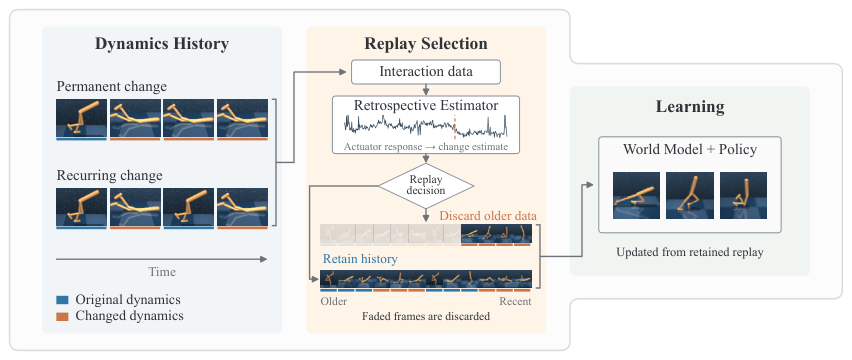
Authors / 作者: Everest Yang, Skye Thompson, George D. Konidaris
arXiv: 2609.18167 · PDF
This paper studies when recent transitions should be preferred over full replay history in continual model-based RL under robot dynamics shift. It introduces change magnitude and age-staleness AUC to characterize the trade-off, showing that forgetting stale data helps after large permanent shifts but hurts when dynamics recur, and evaluates whether an estimator from interaction data can guide replay strategy selection.
中文摘要: 在持续基于模型的强化学习中,机器人动力学变化后需要从新数据中学习,同时不能丢弃仍可能有用的旧经验。动力学变化前采集的回放数据可能拖慢适应,但直接删除又会不必要地减少训练数据,尤其当旧动力学再次出现时代价更大。本文研究何时近期转移优于完整回放历史,提出两个刻画该权衡的量:变化幅度,以及年龄-陈旧度曲线下面积(AUC),用于衡量转移年龄对陈旧与新鲜数据的区分能力。结果表明,遗忘陈旧数据在大的永久性变化后有益,但在动力学重现且旧数据再次有用时有害。由于部署机器人上无法获得真实陈旧标签,作者评估了基于交互数据构建的估计器能否在永久变化后提供选择回放策略所需的信息。
💬 A careful empirical characterization of replay retention under dynamics shift, with clear implications for sim-to-real and continual adaptation of legged controllers.
💬 对动力学变化下回放保留特性进行了细致实证分析,对足式控制器的仿真到现实与持续适应具有明确启示。
Why read it / 推荐理由: Replay retention and dynamics shift are central to sim-to-real and continual learning for legged robots, even though the paper is not locomotion-specific. 回放保留与动力学变化是足式机器人仿真到现实和持续学习的核心问题,尽管该文并非专门针对运动控制。