Robotics Digest
Robotics Paper Digest — 2026-09-17
🤖 Scanned 354 papers from today’s arXiv announcement (cs.RO / eess.SY / cs.LG), picked 5 for modular & legged robotics — summarized by DeepSeek.
🤖 从今日 arXiv 新论文(cs.RO / eess.SY / cs.LG)中扫描 354 篇,围绕模块化与足式机器人精选 5 篇 — 由 DeepSeek 生成双语摘要。
1. Adaptive-MHE : A Sampling-Based Adaptive MPC for Legged Loco-Manipulation via Moving Horizon Estimation
Adaptive-MHE:基于移动视界估计的采样自适应MPC用于腿式移动操作
Authors / 作者: Hossein Keshavarz, Alejandro Ramirez-Serrano, Majid Khadiv
arXiv: 2609.17832 · PDF
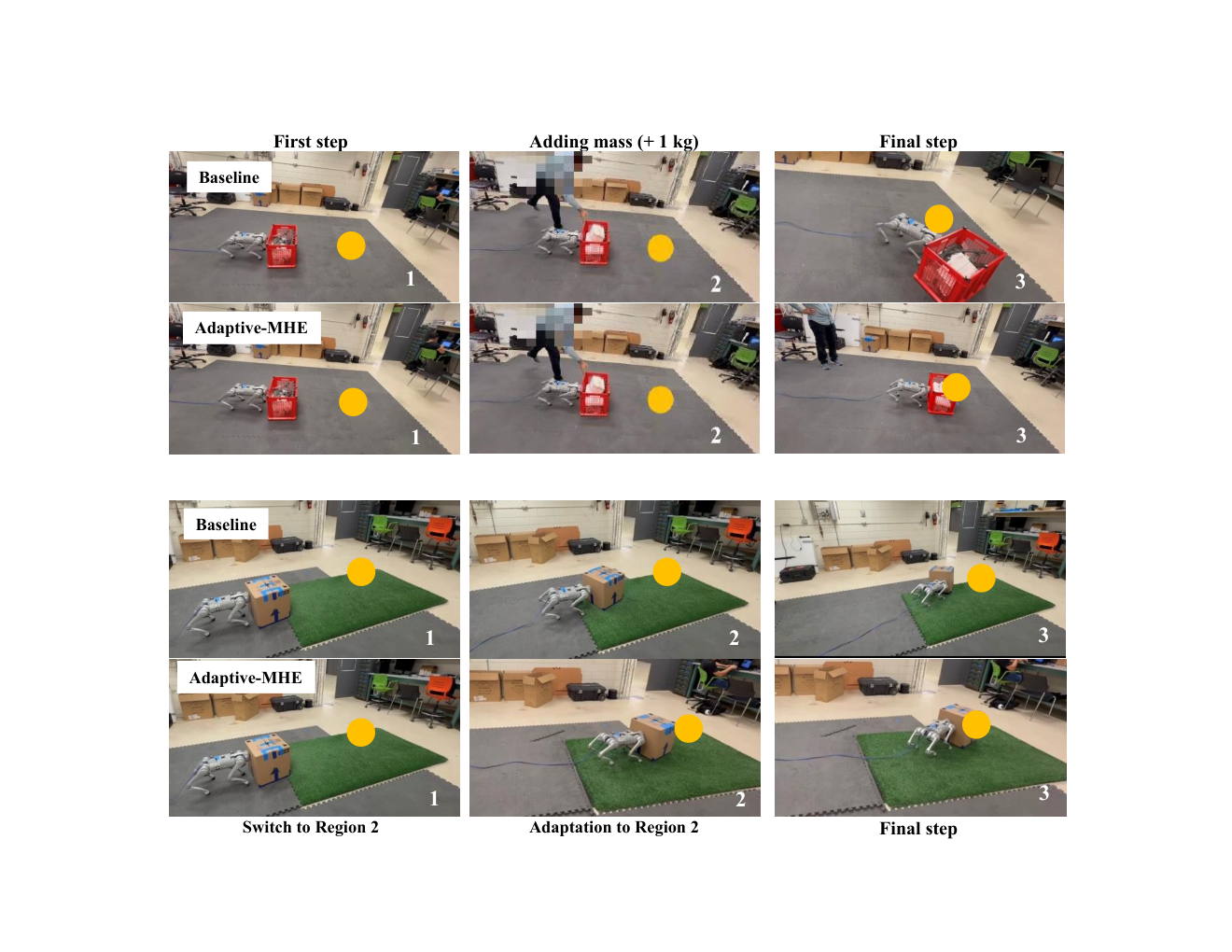
Adaptive-MHE is an online sampling-based system identification framework built on moving horizon estimation (MHE) that estimates object and terrain parameters (e.g., mass, friction) and couples them with a sampling-based model predictive controller. It avoids differentiable-dynamics assumptions, adapts online to changing environments, and in both simulation and hardware experiments matches a controller with ground-truth parameters while outperforming baselines.
中文摘要: 该工作提出Adaptive-MHE,一种基于移动视界估计(MHE)的在线采样式系统辨识框架,用于腿式机器人的移动操作。与传统依赖可微动力学的系统辨识不同,该方法通过大规模并行仿真 rollout 直接匹配仿真与实测状态轨迹,在线估计物体与地形的物理参数(如质量、摩擦系数),并将其与采样型模型预测控制器耦合,从而在环境变化时实现自适应控制。在仿真和硬件实验中,该方法持续优于基线,并达到与已知真实参数控制器相当的性能,有效缩小了sim-to-real差距。
💬 A principled online sampling-based Sys-ID that closes the loop with a sampling MPC — directly relevant to contact-rich legged control under parameter uncertainty.
💬 该工作将在线采样式系统辨识与采样MPC闭环结合,直接针对接触丰富的腿式系统在参数不确定性下的控制问题,方法严谨且实用。
Why read it / 推荐理由: It bridges sim-to-real parameter mismatch and sampling-based MPC in a way that transfers to modular legged platforms with changing payloads and terrain. 它弥合了sim-to-real参数失配与采样MPC之间的鸿沟,可直接迁移到负载与地形变化的模块化腿式平台。
2. Loco-Loco-RL: Low-Cost Terrain Mapping for Humanoid Locomotion with Reinforcement Learning
Loco-Loco-RL:基于低成本地形建图的强化学习人形机器人运动
Authors / 作者: Jordan Dowdy, Gryffin Reizian, Jean Chagas Vaz
arXiv: 2609.19041 · PDF
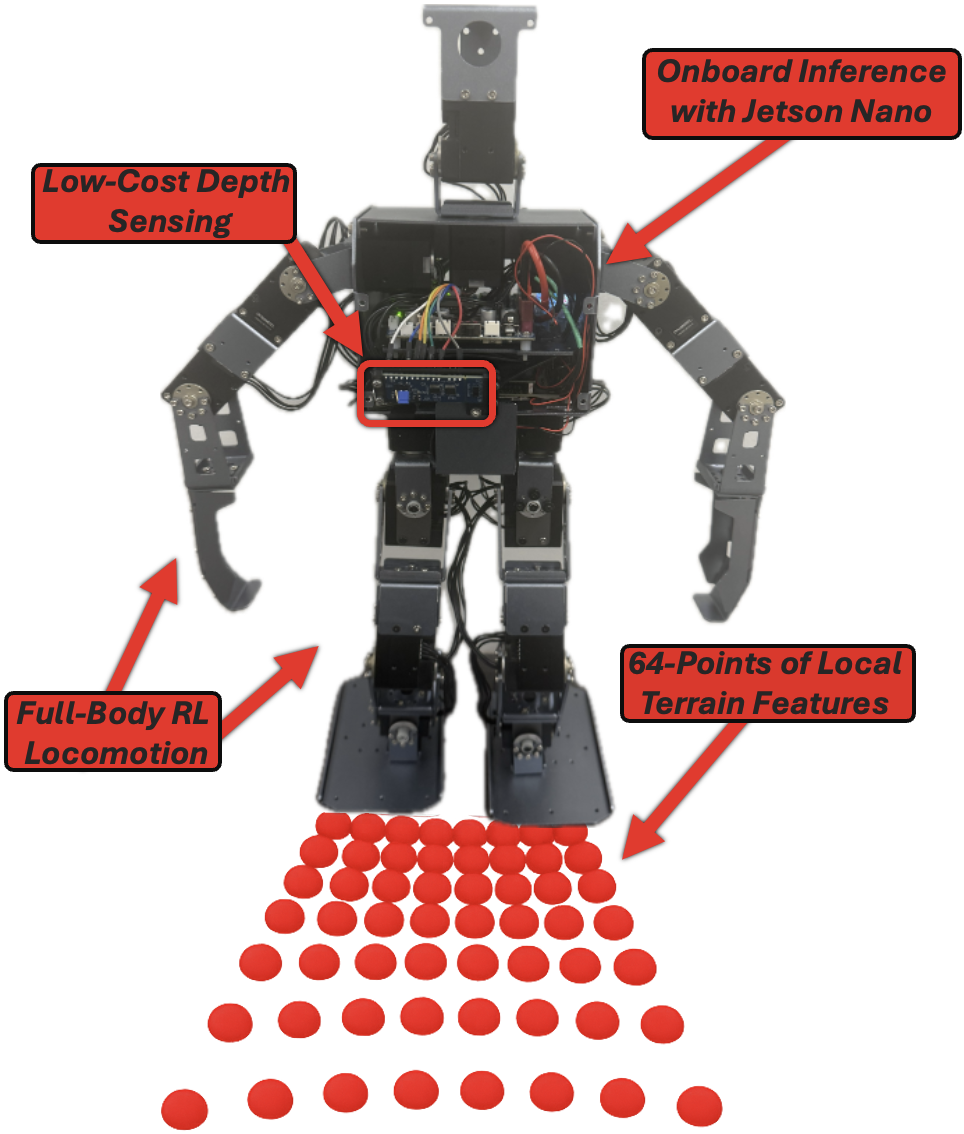
This work uses a low-cost time-of-flight sensor to build a compact 3D local terrain representation for humanoid locomotion, processed by a token-compressed temporal transformer policy. Proprioceptive and terrain observations are tokenized and self-attended, compressed via an MLP, stored in a 15-step rolling history, and aggregated by cross-attention; sim-to-real experiments on hardware demonstrate robust terrain walking with low-cost sensing.
中文摘要: 该工作针对人形机器人运动,采用低成本飞行时间(ToF)传感器构建紧凑的局部3D地形表示,以替代昂贵的深度相机和LiDAR。为高效利用稀疏外部感知输入,提出token压缩的时序Transformer策略:将本体感知与地形观测token化后经多头自注意力建模同时间步关系,再由MLP压缩至潜在空间并存入15步滚动历史,最后通过交叉注意力提取时序运动特征。通过地形行走基准的sim-to-real迁移实验,验证了低成本局部感知下鲁棒的人形地形行走能力。
💬 Shows that cheap ToF sensing plus token-compressed temporal attention can achieve robust sim-to-real humanoid terrain locomotion without depth cameras or LiDAR.
💬 该工作证明低成本ToF传感结合token压缩时序注意力,无需深度相机或LiDAR即可实现鲁棒的sim-to-real人形地形运动。
Why read it / 推荐理由: The token-compression temporal architecture and low-cost sensing pipeline are directly reusable for exteroceptive control of modular legged robots. 其token压缩时序架构与低成本感知流程可直接复用于模块化腿式机器人的外部感知控制。
3. Learning Holistic Whole-Body Loco-Manipulation with a Bipedal Mobile Manipulator
双足移动操作机器人的整体全身移动操作学习
Authors / 作者: Zhongyu Chen, Yuxuan Nai, Qian Chen, Yidong Zhu, Chen Jing, Qihan Wang et al.
arXiv: 2609.18930 · PDF
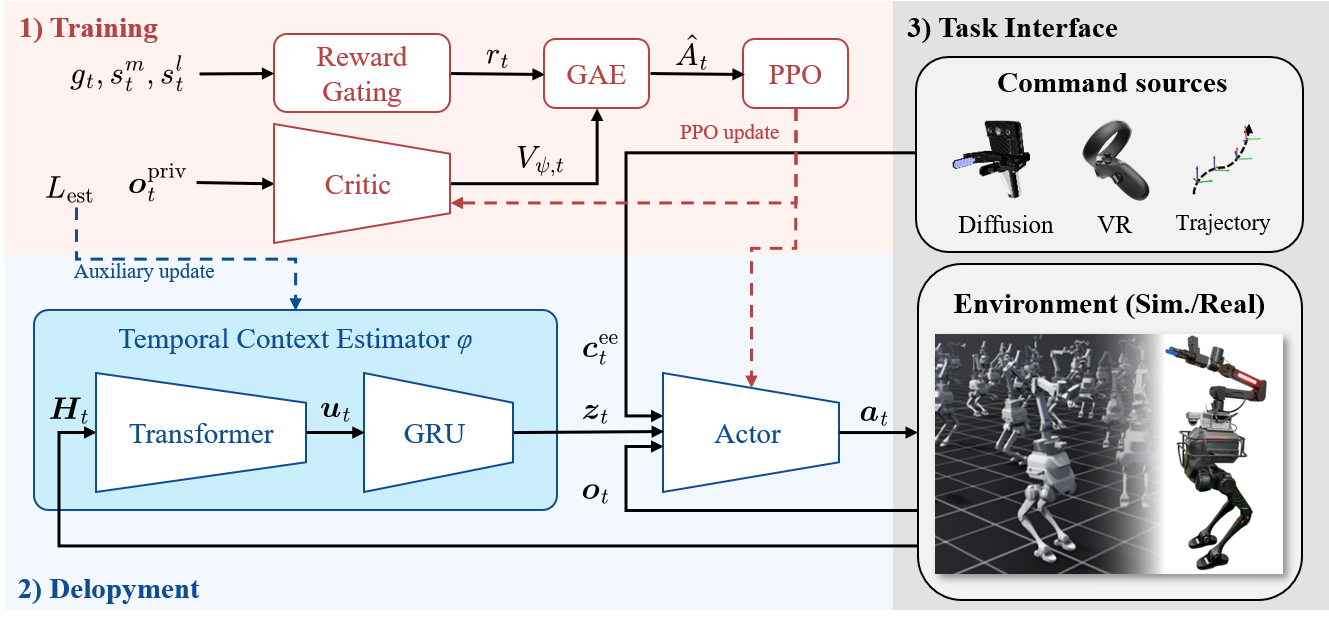
The paper presents a unified RL-trained whole-body controller that maps 6-DoF end-effector targets directly to coordinated biped base and arm actions, autonomously coordinating reaching, posture adaptation, and stepping without explicit base-velocity or footstep commands. A reward-gating strategy balances tracking, locomotion, and balance, while a temporal context estimator combines Transformer encoding, GRU memory, and auxiliary dynamics prediction. Real-robot experiments support VR teleoperation, diffusion-policy, and scripted commands.
中文摘要: 该工作提出一种统一的强化学习全身控制器,将6自由度末端执行器目标直接映射为双足基座与机械臂的协调动作,无需显式基座速度或步态指令即可自主协调伸展、姿态调整与迈步。训练中采用奖励门控策略调节末端跟踪、移动与平衡之间的权衡;时序上下文估计器结合窗口Transformer编码、GRU循环记忆与辅助动力学预测,从观测历史中提取动力学相关信息。真机实验表明,同一控制器可支持VR遥操作、学习到的扩散策略及脚本轨迹等多种命令源,为多样化操作任务提供统一的末端接口。
💬 A clean end-effector-space whole-body controller that unifies reaching, posture control, and stepping — highly relevant to modular legged whole-body control.
💬 该工作提出简洁的末端空间全身控制器,统一了伸展、姿态控制与迈步,对模块化腿式全身控制具有高度参考价值。
Why read it / 推荐理由: Its reward-gated RL whole-body formulation and temporal context estimator offer a reusable blueprint for modular legged loco-manipulation controllers. 其奖励门控RL全身控制框架与时序上下文估计器,为模块化腿式移动操作控制器提供了可复用的设计蓝本。
4. KINO: A Keyframe Interface for VLM Planning and Whole-Body Control in Humanoid Loco-Manipulation
KINO:面向人形移动操作中VLM规划与全身控制的关键帧接口
Authors / 作者: Sitong Chen, Fatemeh Zargarbashi, Jin Cheng, Tianxu An, Stelian Coros
arXiv: 2609.18869 · PDF
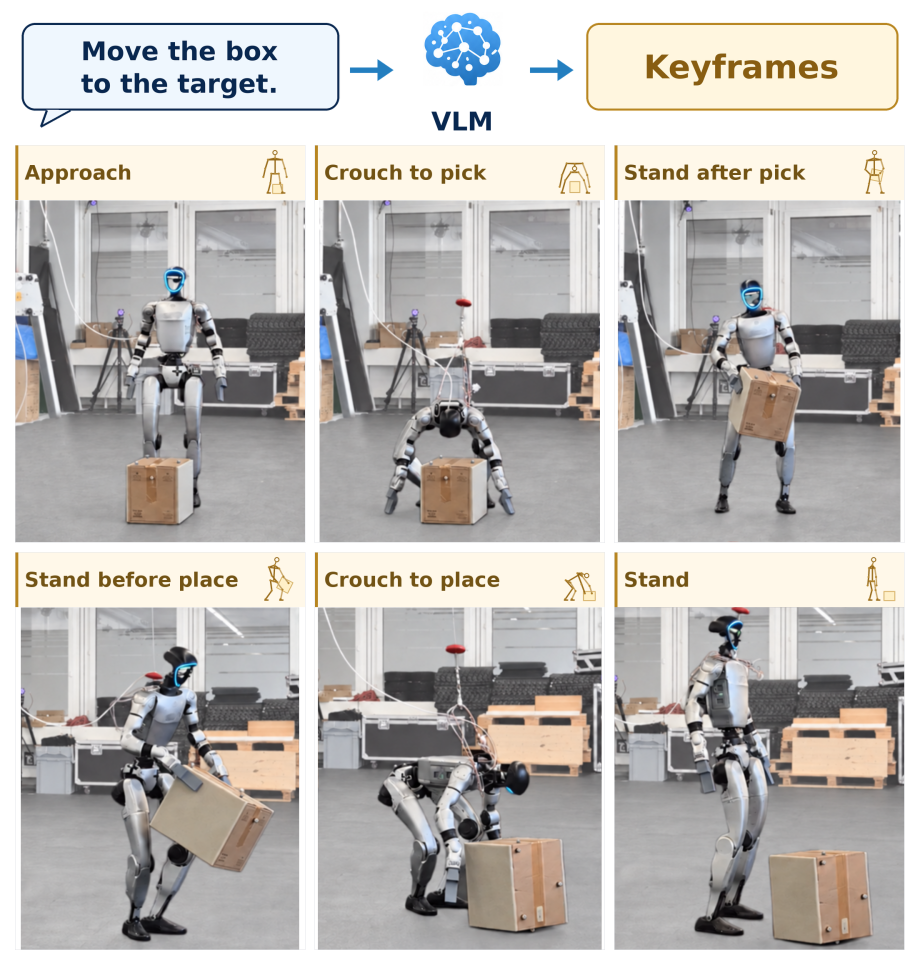
KINO uses motion keyframes as an intermediate representation between VLM planning and RL whole-body control: each keyframe specifies a target whole-body and object pose, selected by the VLM from a library and retargeted to the scene, then executed by a keyframe-conditioned whole-body policy. A saliency-based keyframe sampling strategy improves end-to-end task success from 44% to 92%, with validated pickup, transport, and placement on a Unitree G1 humanoid.
中文摘要: KINO提出以运动关键帧作为视觉语言模型(VLM)规划与强化学习全身控制之间的中间表示。每个关键帧指定目标全身姿态及(如适用)物体姿态;VLM根据语言指令、场景观测与执行反馈,从预定义关键帧库中选择后续任务关键帧,并将其重定向到当前场景以适配物体位姿与尺寸。关键帧条件化的全身策略生成关节级动作以达成目标。作者引入基于显著性的关键帧采样策略用于底层策略训练,将端到端任务成功率从44%提升至92%。在仿真与Unitree G1人形机器人上验证了物体拾取、搬运与放置,并支持单手与双手操作及训练参考数据之外的放置位置泛化。
💬 Keyframes as a VLM-RL interface elegantly decouple semantic planning from whole-body control, with a large measured success-rate gain on real hardware.
💬 以关键帧作为VLM与RL的接口,优雅地解耦了语义规划与全身控制,并在真机上取得显著成功率提升。
Why read it / 推荐理由: The keyframe abstraction is directly adaptable to hierarchy design in modular legged locomotion and manipulation stacks. 该关键帧抽象可直接适配模块化腿式运动与操作系统的分层架构设计。
5. Feedback-Modulated Harmonic Policies for Quadruped Locomotion
反馈调制的四足运动谐波策略
Authors / 作者: Yixuan Jia, Steven Roche, Jonathan P. How
arXiv: 2609.17946 · PDF
This work represents each joint trajectory as a command-conditioned Fourier series modified online by state feedback; a context network generates Fourier coefficients and per-step feedback weights that adjust offsets, harmonic gains, frequency, and phase. Dynamic mode decomposition of MLP rollouts reveals implicit harmonic structure, and on a Unitree Go2 the harmonic controller reaches a provisional 3.67 m/s peak speed and carries up to 5.883 kg.
中文摘要: 该工作研究四足运动的替代表示:将每条关节轨迹表达为指令条件化的傅里叶级数,并利用机器人状态反馈在线调制。上下文网络生成傅里叶系数以及逐步反馈网络权重,在线调整关节偏置、谐波增益、频率与相位。仿真中对比了显式频率结构与直接输出关节目标的MLP策略,发现谐波波形随指令速度改变频率与形状;对MLP rollout的动态模式分解揭示其主激活模式出现在足高振荡频率及其二次谐波附近,表明周期性结构可隐式涌现。在Unitree Go2上,仿真训练的谐波控制器录得约3.67 m/s的机载估计峰值速度,并可承载最高5.883 kg负载。
💬 An interpretable Fourier-series policy with online feedback modulation that shows periodic gait structure can be made explicit — valuable for modular gait generation.
💬 该工作提出可解释的傅里叶级数策略并引入在线反馈调制,表明周期步态结构可被显式建模,对模块化步态生成很有价值。
Why read it / 推荐理由: Explicit harmonic gait representations with feedback modulation are a natural fit for parameterizing gaits of reconfigurable multi-legged platforms. 带反馈调制的显式谐波步态表示,天然适合用于可重构多足平台的步态参数化。