Robotics Digest
Robotics Paper Digest — 2026-09-14
🤖 Scanned 229 papers from today’s arXiv announcement (cs.RO / eess.SY / cs.LG), picked 5 for modular & legged robotics — summarized by DeepSeek.
🤖 从今日 arXiv 新论文(cs.RO / eess.SY / cs.LG)中扫描 229 篇,围绕模块化与足式机器人精选 5 篇 — 由 DeepSeek 生成双语摘要。
1. Decentralized Evolution of Hexapod Gaits with Independent Leg Controllers
具有独立腿控制器的六足机器人步态去中心化演化
Authors / 作者: Gary B. Parker, John Asaro, Jim O’Connor
arXiv: 2609.12400 · PDF
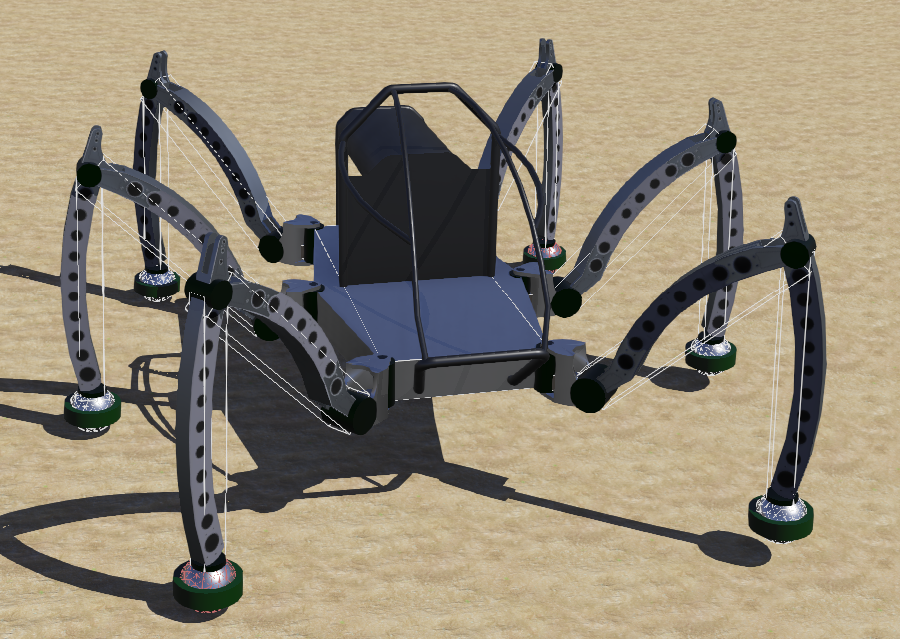
The paper evolves each leg controller independently using a decentralized evolutionary algorithm and tests it on the Mantis hexapod in Webots. It benchmarks against cooperative coevolution and reports improved efficacy in generating stable, adaptive gaits through emergent inter-leg coordination. It suggests decentralized strategies can simplify gait optimization and scale to adaptive robotic systems.
中文摘要: 本文提出一种六足机器人运动控制方法:不设计集中式协调器,而是用去中心化进化算法独立优化每条腿的控制器,并在Webots仿真中的Mantis六足平台上验证。该方法与协同协同进化对比,能够通过腿间涌现协调生成更稳定、自适应的步态。作者指出,让腿控制器独立进化可降低步态优化复杂度,并为可扩展、自适应的机器人系统提供新思路。
💬 Promising decentralized approach for modular legged robots, though validation is simulation-only and lacks real-robot transfer.
💬 该去中心化方法对模块化腿式机器人很有启发性,但目前仅在仿真中验证,尚缺实机迁移。
Why read it / 推荐理由: Directly addresses independent leg control and emergent hexapod gait generation, central to modular legged design. 直接讨论独立腿控制与六足步态涌现生成,是模块化腿式机器人设计的核心问题。
2. DWMP: Leveraging Dual World Models for Humanoid Obstacle Traversal
DWMP:利用双世界模型实现人形机器人越障
Authors / 作者: Rongjun Jin, Jianming Ma, Yue Gao
arXiv: 2609.12347 · PDF
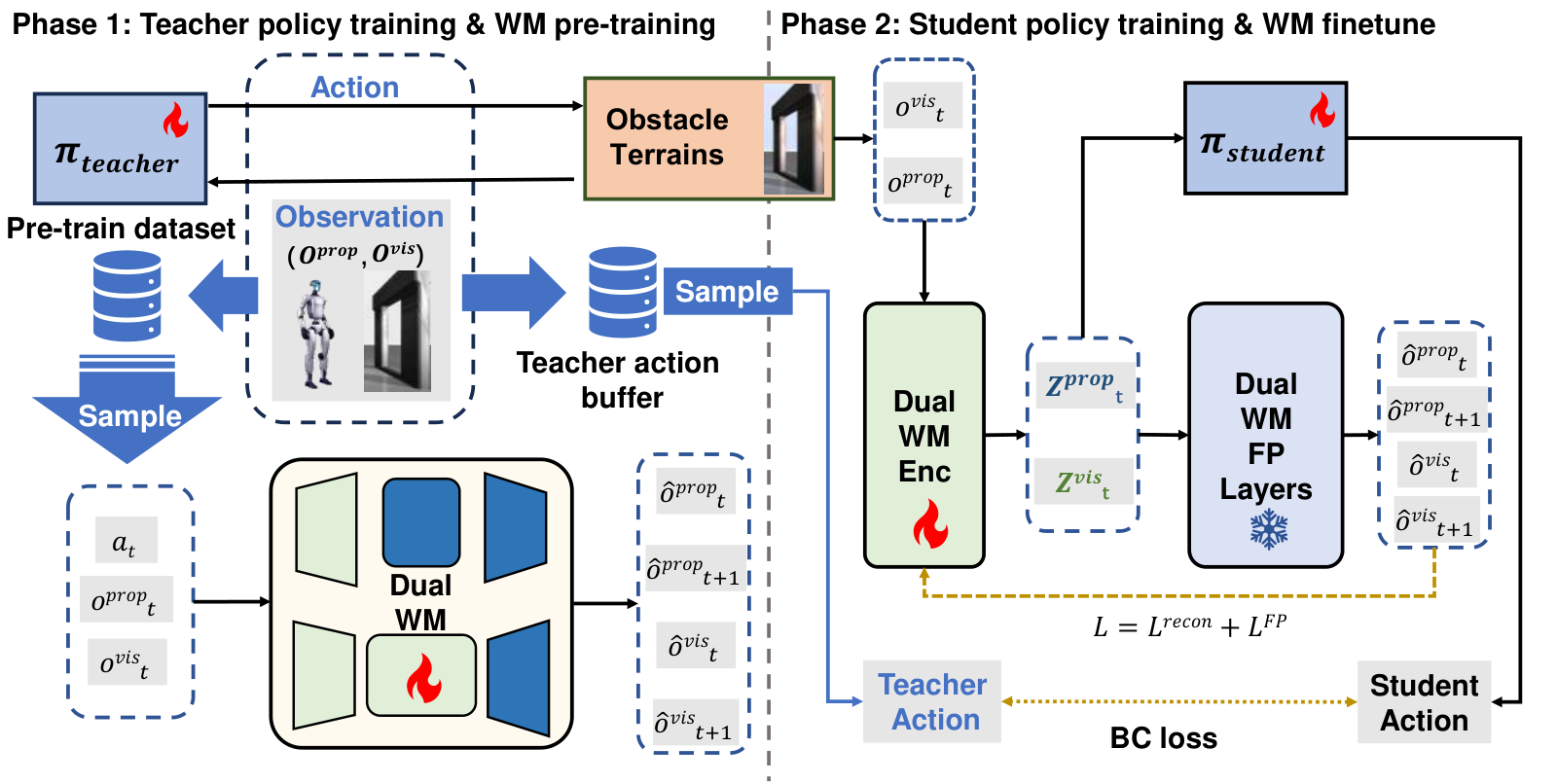
DWMP uses separate world models for proprioceptive and visual observations: a Koopman-based dynamics model linearizes proprioceptive latent evolution, and an RSSM-based visual model compresses depth images. A student policy fuses these latents for obstacle traversal, validated in simulation and on a Unitree G1 humanoid under randomized layouts. It improves traversal over baselines and supports real-world deployment.
中文摘要: 本文提出DWMP(双世界模型策略),针对人形机器人越障中本体感知与视觉观测特性差异,分别构建互补世界模型。Koopman动力学世界模型将本体感知提升到近似线性的潜在空间,RSSM视觉世界模型压缩自中心深度观测并保留障碍几何。学生策略融合两类潜在表示生成动作,在仿真和Unitree G1人形机器人上验证,在随机障碍布局下优于基线并实现真实部署,为腿式机器人感知-控制融合与sim-to-real提供新思路。
💬 Strong legged locomotion work with real humanoid deployment, though its focus is humanoid rather than modular reconfigurable legs.
💬 该工作具有真实人形机器人部署结果,但重点是人形而非模块化可重构腿。
Why read it / 推荐理由: Offers a practical dual-world-model recipe for robust legged obstacle traversal and real-robot sim-to-real transfer. 提供实用的双世界模型方案,用于鲁棒腿式越障与真机sim-to-real迁移。
3. Global Path Planner with Multi-Model Switching
具有多模型切换的全局路径规划器
Authors / 作者: Pietro Gori, Francesco Iotti, Eduard Zelenay, Rastislav Marko, Michele Pierallini, Franco Angelini et al.
arXiv: 2609.13015 · PDF
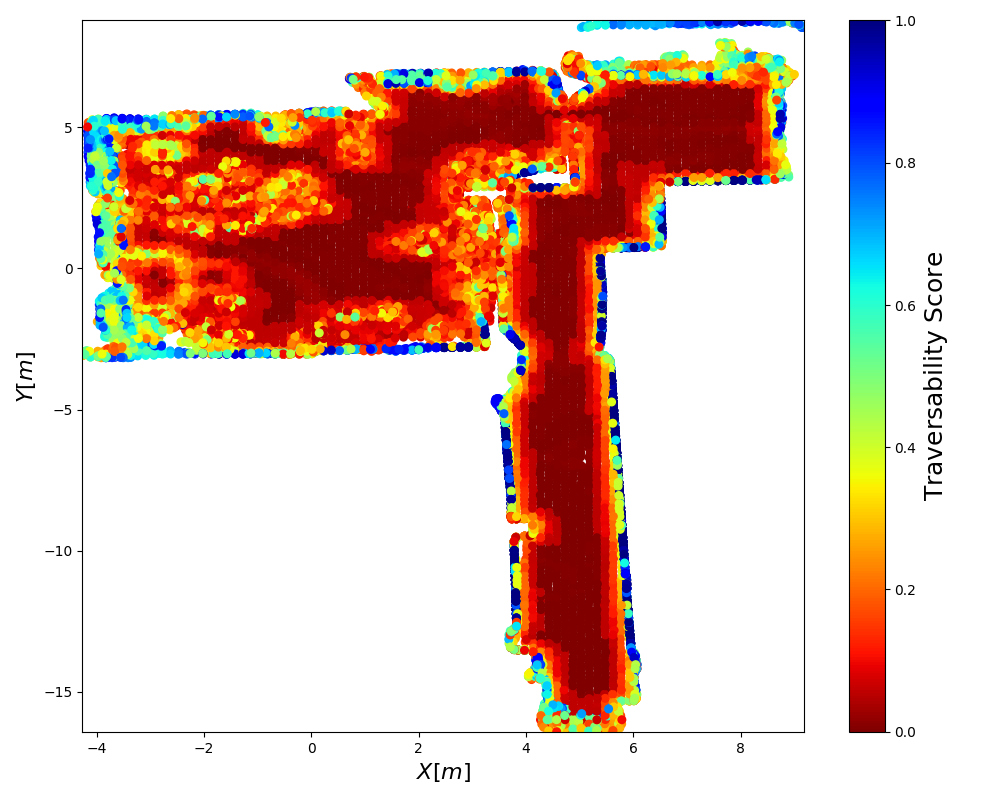
The work enhances global path planning by integrating a traversability graph, Heading-Aware A*, and a multi-model Pure Pursuit controller that switches kinematic models based on terrain and robot state. It is validated in simulation on the Artaban quadruped and X3 quadrotor, showing improved efficiency, robustness, and adaptability over standard baselines. The core idea is adaptive kinematic modeling for sustained plan fidelity across heterogeneous terrains.
中文摘要: 本文提出一种面向复杂地形的全局路径规划框架,包含可通行性图、Heading-Aware A* 全局规划器以及多模型Pure Pursuit控制器。核心创新是自适应运动学建模,可根据地形特征与机器人状态实时切换运动学模型,从而在挑战性场景中优化路径效率与能耗。方法在仿真中于Artaban四足机器人和X3四旋翼无人机上验证,相比标准基线在性能、鲁棒性和适应性上有提升,为四足机器人可通行性感知规划提供参考。
💬 Relevant to traverse-capability-aware planning on quadrupeds, but the kinematic switching is evaluated only in simulation.
💬 与四足机器人可通行性感知规划相关,但运动学切换仅在仿真中评估。
Why read it / 推荐理由: Connects traversability-aware global planning with adaptive kinematic tracking for quadruped and aerial platforms. 将可通行性感知全局规划与自适应运动学跟踪结合,适用于四足与空中平台。
4. ASTRIL-MPC: Autonomous Traversal Framework of Articulated Tracked Robots with Language-Guided Neural-Kinematic MPC
ASTRIL-MPC:铰接履带机器人语言引导神经-运动学MPC自主穿越框架
Authors / 作者: Zhenfeng Gan, Yanbo Chen, Lirong Che, Junbo Tan, Xueqian Wang
arXiv: 2609.13083 · PDF
ASTRIL-MPC combines a learned kinematics model, nonlinear MPC with multi-objective costs and feasibility constraints, and an LLM that proposes bounded weight/bound updates through a safety-checked interface. It targets articulated tracked robots in contact-rich stairwells and cluttered interiors, compiles the predictor for sub-100 ms cycles, and improves traversal quality by up to 71% over non-adaptive NMPC and 67% over PPO while eliminating descent collisions.
中文摘要: 本文提出ASTRIL-MPC,一种用于铰接式履带机器人自主穿越的语言引导神经运动学模型预测控制框架。学习到的运动学模型根据高度序列和近期轨迹预测短时任务状态增量,NMPC以多目标代价和严格可行性约束进行规划,大语言模型通过带范围裁剪、速率限制和一致性检查的安全接口调整选定权重与边界。编译后的预测器使完整控制周期低于100 ms;在三个穿越任务和多高度泛化中,穿越质量较非自适应NMPC提升最高71%、较PPO提升67%,并在下楼梯时消除碰撞冲击。该方法为接触丰富的机器人-地形交互提供数据高效、鲁棒的MPC自主穿越方案。
💬 A novel MPC-plus-LLM tuning pipeline with strong traversal results, although the platform is tracked rather than legged.
💬 提出新颖的MPC加LLM调参流程并取得强穿越结果,但平台是履带式而非腿式。
Why read it / 推荐理由: Methodologically relevant to learned-kinematics MPC and language-guided tuning that can inspire legged traverse control. 其学习运动学MPC与语言引导调参方法可启发腿式机器人穿越控制。
5. Amortized Low-Rank Adaptation for Model-Based Reinforcement Learning
面向基于模型强化学习的摊销低秩适配
Authors / 作者: Fernando Palafox, David Fridovich-Keil
arXiv: 2609.12278 · PDF
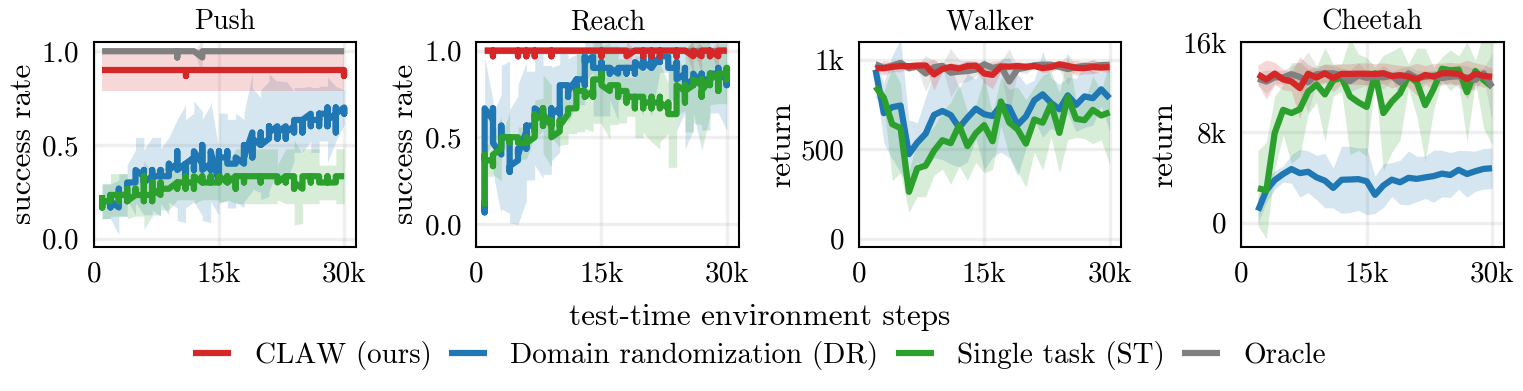
CLAW addresses test-time world-model adaptation by training a hypernetwork to generate low-rank adapters from a few episodes, avoiding expensive gradient adaptation and limited in-context learning. The base world model is frozen at test time, and the hypernetwork forward pass produces adapters for online adaptation. Across locomotion and manipulation families varying in dynamics, embodiment, and reward, CLAW outperforms baselines within seconds of data and reduces overfitting in data-scarce regimes.
中文摘要: 本文提出CLAW,用于基于模型强化学习中的世界模型快速测试时自适应。传统方法在计算代价与表达能力之间权衡:上下文学习便宜但表达有限,梯度自适应表达强但昂贵。CLAW在预训练阶段联合训练超网络和基础世界模型,模拟多种环境下的自适应;测试时冻结基础模型,仅通过超网络前向生成低秩(LoRA)适配器,从少量交互片段中快速适配。在动力学、形态和奖励变化的运动与操作环境族中,CLAW仅用数秒数据即优于梯度自适应和上下文学习,并在数据稀缺时避免过拟合,有助于腿式机器人运动控制的sim-to-real自适应。
💬 Useful for fast sim-to-real adaptation of locomotion policies, but it is a generic MBRL method without legged-specific validation.
💬 有助于运动策略的快速sim-to-real自适应,但属于通用MBRL方法,缺少腿式专项验证。
Why read it / 推荐理由: Introduces efficient world-model adaptation that could improve online RL locomotion control under embodiment and dynamics shifts. 提出高效世界模型自适应方法,可提升形态与动力学变化下的在线RL运动控制。