Robotics Digest
Robotics Paper Digest — 2026-09-10
🤖 Scanned 320 new arXiv papers (cs.RO / eess.SY / cs.LG, last 48 h), picked 5 for modular & legged robotics — summarized by DeepSeek.
🤖 扫描了近 48 小时 arXiv(cs.RO / eess.SY / cs.LG)的 320 篇新论文,围绕模块化与足式机器人精选 5 篇 — 由 DeepSeek 生成双语摘要。
1. Frame-Coded Legged Locomotion over Noisy Terrain
噪声地形上的框架编码腿式运动
Authors / 作者: Lav R. Varshney
arXiv: 2609.10273 · PDF
This paper reformulates open-loop multilegged locomotion over rough terrain as a quantized finite-frame expansion with erasures. A d-dimensional body-level command is mapped into N heterogeneous local contact commands, terrain erases or corrupts frame coefficients, and a contact-gated compliant morphology physically realizes a weighted active-subframe decoder. For a linear-Gaussian model, mechanical equilibrium, tangent stiffness, and compliance correspond to posterior mean, precision, and covariance; Parseval frames are minimax optimal against one missing contact, and a harmonic frame yields a directly realizable gait family.
中文摘要: 本文将崎岖地形上的开环多足运动重新表述为带擦除的量化有限框架展开。d维身体级指令被映射为N个异构局部接触指令,地形会擦除或破坏框架系数,而接触门控的柔顺形态可物理实现加权活动子框架解码器。在线性高斯模型下,机械平衡、切向刚度和柔顺性分别对应后验均值、后验精度和后验协方差。等范数Parseval框架在一次接触缺失下是极小极大最优的,双接触鲁棒性由框架相干性决定,谐波框架给出可直接实现的步态族。对于独立存活概率为q的接触,随机高斯步态框架在任意模拟维度速率R<q时可精确重建。
💬 Elegant information-theoretic formulation that links compliant morphology and gait design to frame-theoretic decoding, though experimental validation remains to be seen.
💬 该工作以优雅的信息论框架将柔顺形态与步态设计同框架理论解码联系起来,但实验验证仍有待展示。
Why read it / 推荐理由: Offers a novel theoretical lens for designing robust multi-legged gaits under contact loss, directly relevant to modular legged locomotion. 为接触丢失下的鲁棒多足步态设计提供了新颖的理论视角,与模块化腿式运动直接相关。
2. Actuator Dynamics Curricula for Narrow-Viability Tasks in Legged Robot Learning
腿式机器人学习中窄可行域任务的动作器动力学课程学习
Authors / 作者: Kousheek Chakraborty, Chandan K. Rajendra, Ayham Alharbat, Abeje Y. Mersha
arXiv: 2609.09492 · PDF
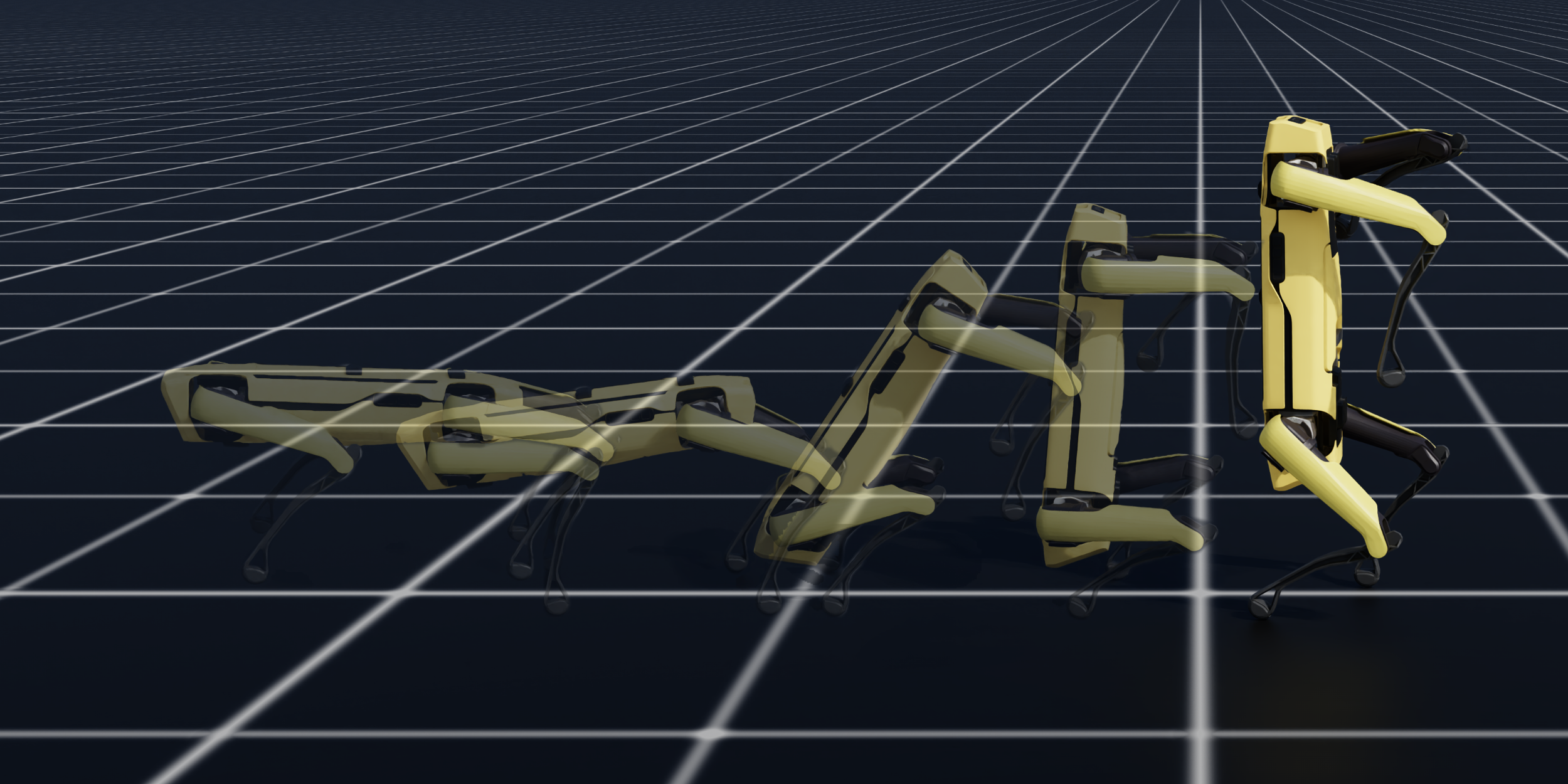
This work introduces an Actuator Dynamics Curriculum that initializes joint stiffness high and anneals it toward the system-identified value as completed episode lengths grow. Using cart-pole analysis, it shows that higher closed-loop joint natural frequency under critical damping enlarges the MDP viability kernel. Applied to a quadrupedal-to-handstand transition on Boston Dynamics Spot, the curriculum enables successful training in simulation and transfer to hardware where fixed identified stiffness plateaus at an incomplete policy.
中文摘要: 本文提出动作器动力学课程(Actuator Dynamics Curriculum),在训练初期将关节刚度设为较高值,并随着完成回合长度增加退火至系统辨识值。以小车-摆系统为例,作者证明在临界阻尼下提高闭环关节固有频率可扩大底层马尔可夫决策过程的生存核,从而增加可行初始状态比例。该方法应用于波士顿动力Spot四足机器人从四足站立到倒立的窄可行域任务:固定辨识刚度训练会陷入无法完成转换的策略,而所提课程在仿真中10个种子均能完成转换,并成功迁移到硬件。
💬 A practical curriculum that attacks exploration failure in legged RL by exploiting actuator stiffness, validated on a real quadruped.
💬 一种利用执行器刚度解决腿式强化学习探索失败问题的实用课程方法,并在真实四足机器人上得到验证。
Why read it / 推荐理由: Directly applicable to quadruped RL and sim-to-real for tasks where standard training fails due to narrow viability. 可直接应用于四足强化学习与Sim-to-Real,尤其适合因窄可行域导致标准训练失败的任务。
3. Learning Terrain-Adaptive Humanoid Locomotion on Granular Terrain
学习颗粒地形上的地形自适应人形机器人运动
Authors / 作者: Junnosuke Kamohara, Feiyang Wu, Andy Ningan Zong, Daniel I. Goldman, Yashwanth Nakka, Seth Hutchinson et al.
arXiv: 2609.10286 · PDF
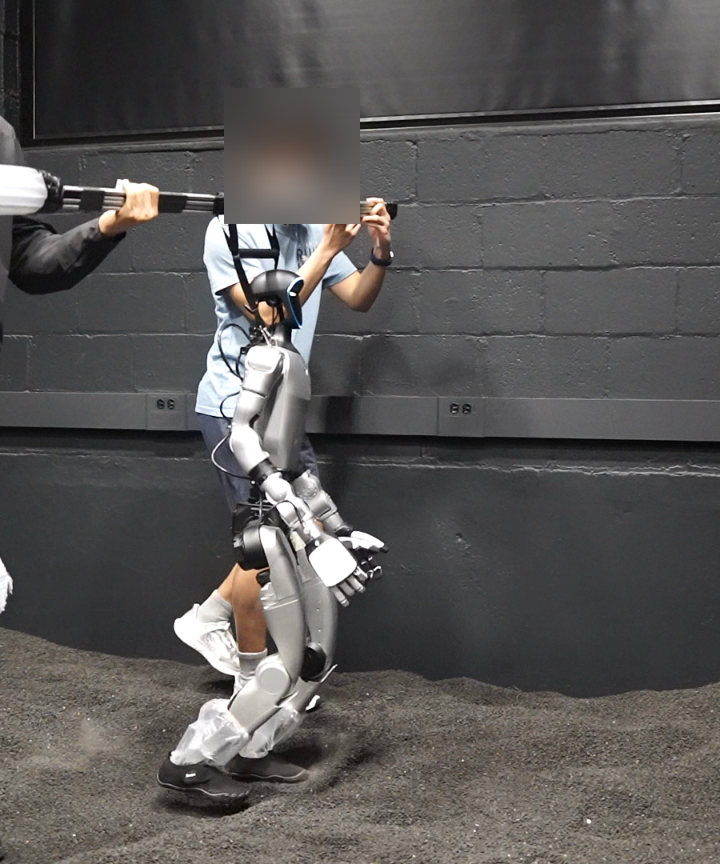
This paper presents a physics-grounded granular contact model based on three-dimensional resistive force theory (3D RFT) for efficient RL simulation, avoiding heuristic tangential components. A terrain-adaptive locomotion controller is trained via teacher-student RL with a VAE encoding terrain into a compact latent. MPM-based simulation with NVIDIA Newton shows generalization to unseen granular terrains, higher success than baselines, and zero-shot terrain identification and adaptation.
中文摘要: 本文提出基于三维阻力理论(3D RFT)的物理颗粒接触模型,用于高效仿真颗粒地形并训练强化学习策略。与刚性接触模型及带启发式切向分量的简化颗粒模型不同,该接触求解器无需启发式即可产生物理准确的颗粒侵入动力学,捕捉训练中的真实穿透与切向阻力。作者通过教师-学生强化学习训练地形自适应运动控制器,并用变分自编码器将地形信息编码为紧凑隐表示。基于物质点法(MPM)与NVIDIA Newton的仿真研究表明,该方法能泛化到未见颗粒地形,成功率显著高于基线,并实现零样本地形识别与适应。
💬 Grounds granular contact in 3D RFT for RL, offering a credible route to sim-to-real locomotion on deformable terrain.
💬 将颗粒接触建立在3D RFT之上用于强化学习,为可变形地形上的Sim-to-Real运动提供了可信路径。
Why read it / 推荐理由: Relevant for legged locomotion on deformable terrain and for integrating physics-based contact models into RL training. 对可变形地形上的腿式运动以及将物理接触模型融入强化学习训练具有参考价值。
4. ViBe: Visual Behavior Adaptation for Perceptive Humanoid Whole-Body Control
ViBe:面向感知型人形全身控制的视觉行为自适应
Authors / 作者: Lokesh Krishna, Sarvesh Venkatesan, An Zhang, Quan Nguyen
arXiv: 2609.09918 · PDF
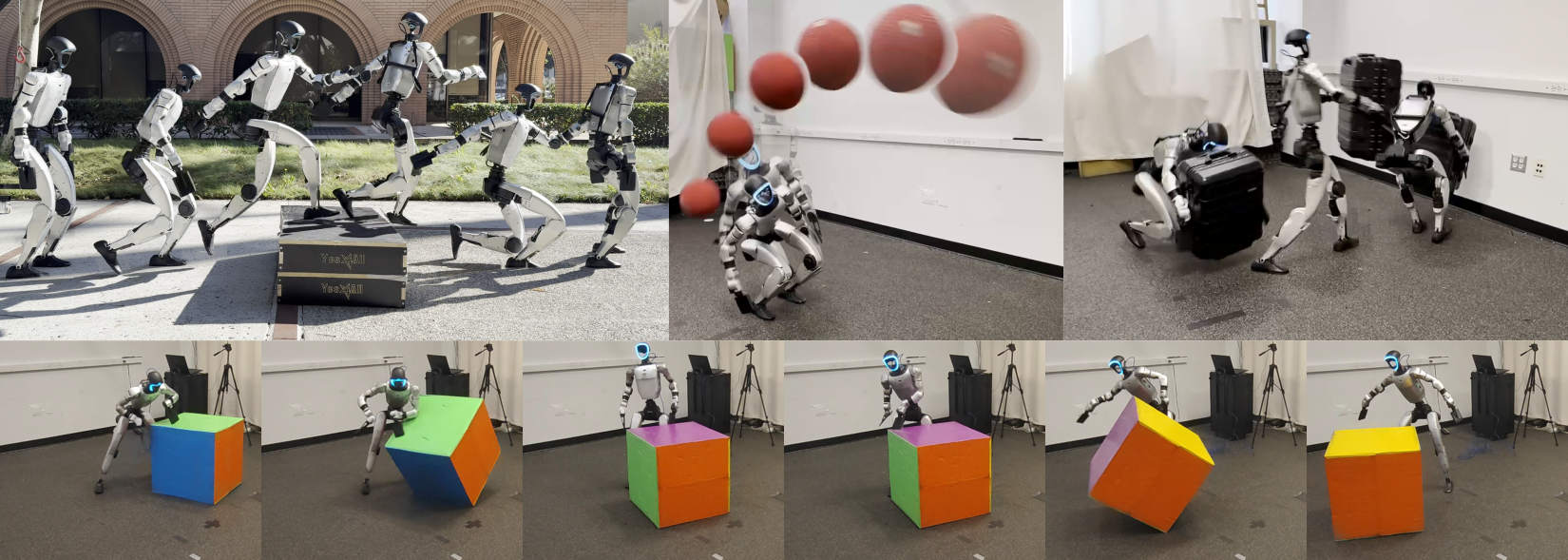
ViBe is a post-training framework that adapts motion trackers to perceptive control tasks. It uses pre-trained visual encoders with a multi-query extractor to learn task-relevant perceptual feedback, grafted onto tracker inputs via low-rank adapters for parameter-efficient fine-tuning. Across four tasks, it achieves zero-shot sim-to-real transfer for perceptive walking on curbs and parkour, Repose Cube, omni-object loco-manipulation, and dodgeball, with visual robustness across outdoor, low-light, and RGB distractor conditions.
中文摘要: ViBe是一种后训练框架,用于将运动跟踪器适配到感知型控制任务。它利用预训练视觉编码器和多查询提取器模块学习任务相关的感知反馈,并通过低秩适配器将反馈接入跟踪器输入,实现参数高效微调。给定任务奖励和参考数据集,该模块化控制器可直接通过策略优化进行适配。在四项任务中,ViBe实现了零样本Sim-to-Real迁移,涵盖路缘与跑酷感知行走、Repose Cube、全物体移动操作和躲避球,并在户外、低光和RGB干扰条件下表现出视觉鲁棒性。最后,作者用刻意简单的规划器求解了目标导向的Repose Cube任务。
💬 A modular and parameter-efficient way to add exteroception to humanoid whole-body trackers, with impressive zero-shot sim-to-real results.
💬 一种模块化且参数高效的人形全身跟踪器外感知增强方法,零样本Sim-to-Real结果令人印象深刻。
Why read it / 推荐理由: Shows how pre-trained visual representations and low-rank adaptation can enable perceptive whole-body control without retraining from scratch. 展示了如何利用预训练视觉表示与低秩适配实现感知型全身控制,而无需从零重训。
5. SwingBot: Learning Whole-Body Brachiation for Humanoid Robots
SwingBot:学习人形机器人的全身臂荡运动
Authors / 作者: Yujie Xiong, Peng Zhai, Taixian Hou, Quancheng Qian, Cunwang Liu, Kangmai Hu et al.
arXiv: 2609.10283 · PDF
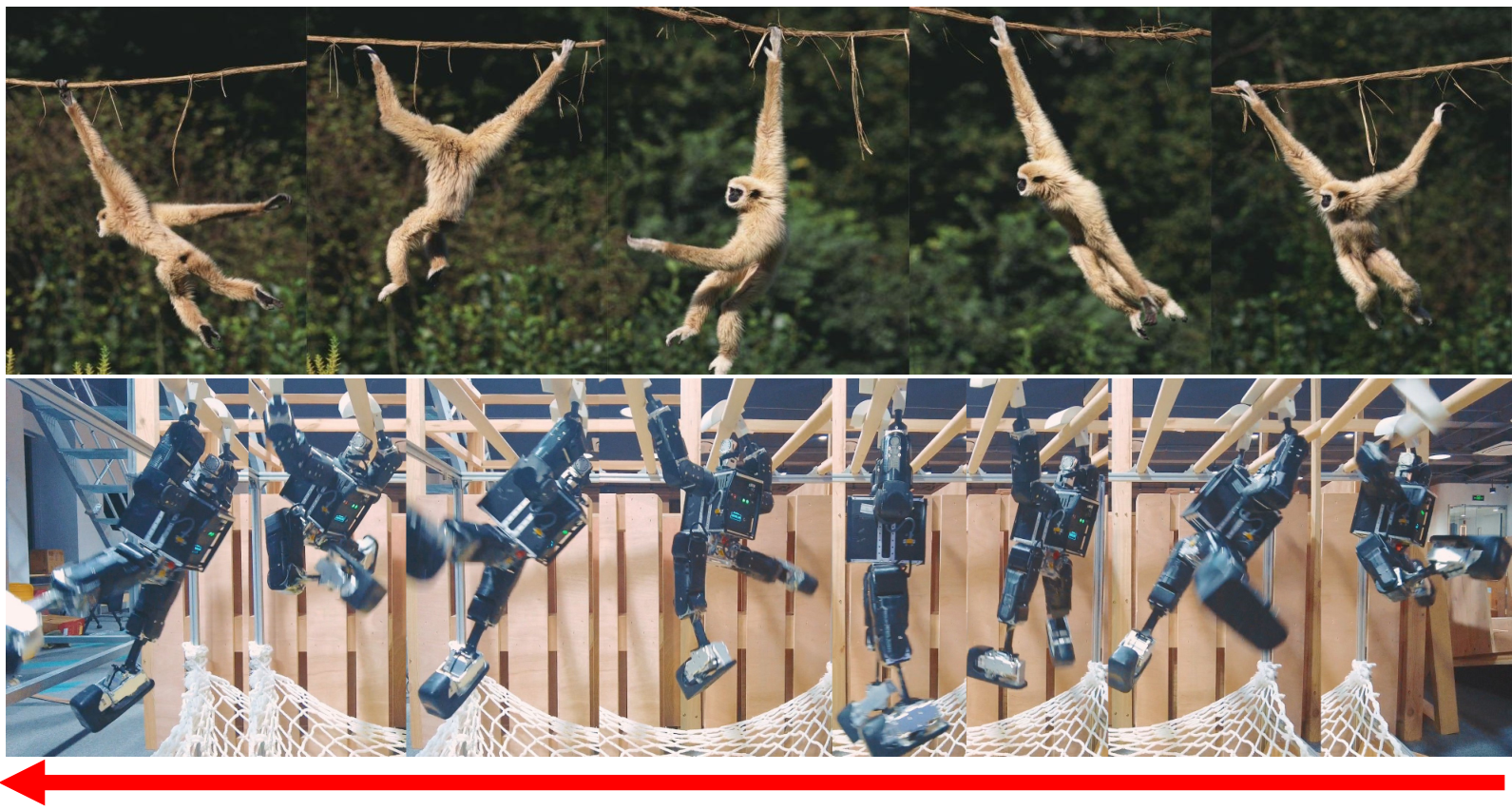
SwingBot is a learning framework for continuous humanoid brachiation with passive wrist hooks. It organizes learning around brachiation structure: biomimetic keyframes make rare release-swing-capture transitions reachable during early exploration, and recurrent privileged-state estimation provides compact position and contact latents for deployment. Hardware experiments demonstrate continuous bar traversal and robustness to payload, external disturbances, and different bar spacings.
中文摘要: SwingBot是一种用于带被动腕钩的人形机器人连续臂荡运动的学习框架。该方法围绕臂荡运动的结构组织学习:仿生关键帧使稀有的释放-摆动-抓握转换在早期探索中变得可达,递归特权状态估计则为部署提供紧凑的位置与接触隐变量。硬件实验表明,机器人能够连续穿越横杆,并对负载、外部干扰和不同横杆间距具有鲁棒性。该公式化方法为全身机器人臂荡运动提供了一条实用路径。
💬 A convincing demonstration of long-horizon whole-body dynamic locomotion on real humanoid hardware, with clever use of keyframes and privileged-state estimation.
💬 在真实人形硬件上令人信服地展示了长时程全身动态运动,并巧妙利用了关键帧与特权状态估计。
Why read it / 推荐理由: Offers transferable ideas for learning long-horizon, contact-switching whole-body locomotion on legged robots. 为腿式机器人学习长时程、接触切换的全身运动提供了可迁移的思路。