Robotics Digest
Robotics Paper Digest — 2026-09-09
🤖 Scanned 309 new arXiv papers (cs.RO / eess.SY / cs.LG, last 48 h), picked 5 for modular & legged robotics — summarized by DeepSeek.
🤖 扫描了近 48 小时 arXiv(cs.RO / eess.SY / cs.LG)的 309 篇新论文,围绕模块化与足式机器人精选 5 篇 — 由 DeepSeek 生成双语摘要。
1. Anti-Gravity Walking by a Flying Humanoid Robot via Thrust-Rate Input Whole-Body Model Predictive Control
通过推力率输入全身模型预测控制的飞行人形机器人反重力行走
Authors / 作者: Kazuki Sugihara, Kei Okada
arXiv: 2609.07544 · PDF
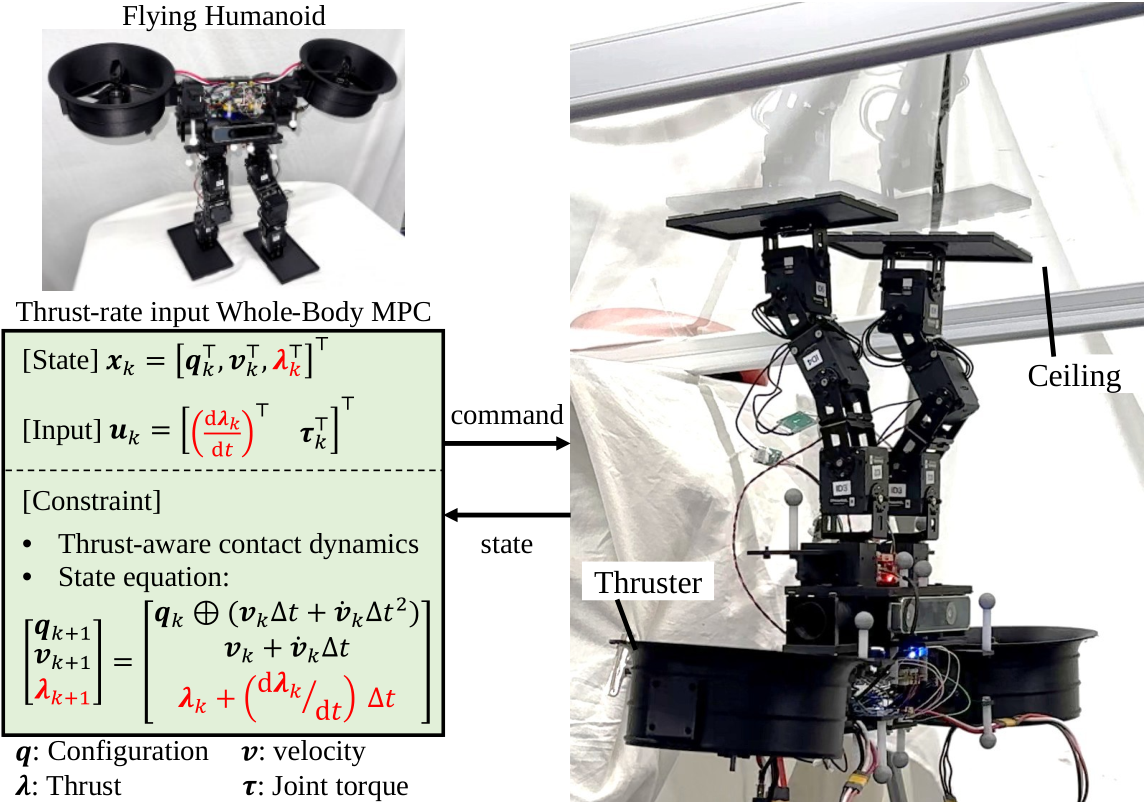
This paper presents a real-time whole-body MPC framework for anti-gravity bipedal walking of a flying humanoid robot. Using the thrust derivative (thrust-rate) as control input ensures thrust continuity at contact switches while retaining the sparse optimal-control structure. Contact-force lower bounds on the foot-normal direction are introduced and smoothly transitioned during double support. The framework is demonstrated in simulation and on hardware, giving the first multi-contact whole-body anti-gravity walking result.
中文摘要: 该工作针对飞行人形机器人在天花板等反重力环境中行走的问题,提出并实现了基于推力率输入的实时全身模型预测控制框架。将推力的时间导数即推力率作为控制输入,保证了接触切换过程中推力轨迹的连续性,同时保留了最优控制问题的稀疏结构以实现快速求解。由于反重力环境中缺乏自然支撑力,作者在脚部法向接触力上引入下界约束,并在双支撑阶段对其进行平滑过渡。仿真与硬件实验验证了该框架的有效性,展示了飞行人形机器人的反重力行走,这是多接触全身反重力行走的首次演示。该方法的推力连续化处理、接触力约束构造和实时全身优化策略,对非标准姿态下的足式运动控制以及需要连续动态接触的多足/模块化平台具有直接借鉴意义。
💬 Strong whole-body MPC methodology with an original thrust-rate regularization and hardware validation; directly relevant to contact-rich legged-locomotion control.
💬 全身MPC方法学扎实,推力率正则化思想新颖且经过实物验证;对接触丰富足式运动控制有直接参考价值。
Why read it / 推荐理由: Worth reading for its real-time whole-body MPC formulation and thrust-continuity handling in anti-gravity, contact-switching locomotion. 值得阅读,因为它给出了反重力切换接触场景下的实时全身MPC构造与推力连续处理方法。
2. CAST: Alternating State-Value Targets and Expanded Policy Gradients for Model-Based Reinforcement Learning
CAST:交替状态价值目标与扩充策略梯度的模型强化学习方法
Authors / 作者: Pietro Noah Crestaz, Mohamed Yassine Kabouri, Nicolas Mansard, Andrea Del Prete
arXiv: 2609.08853 · PDF
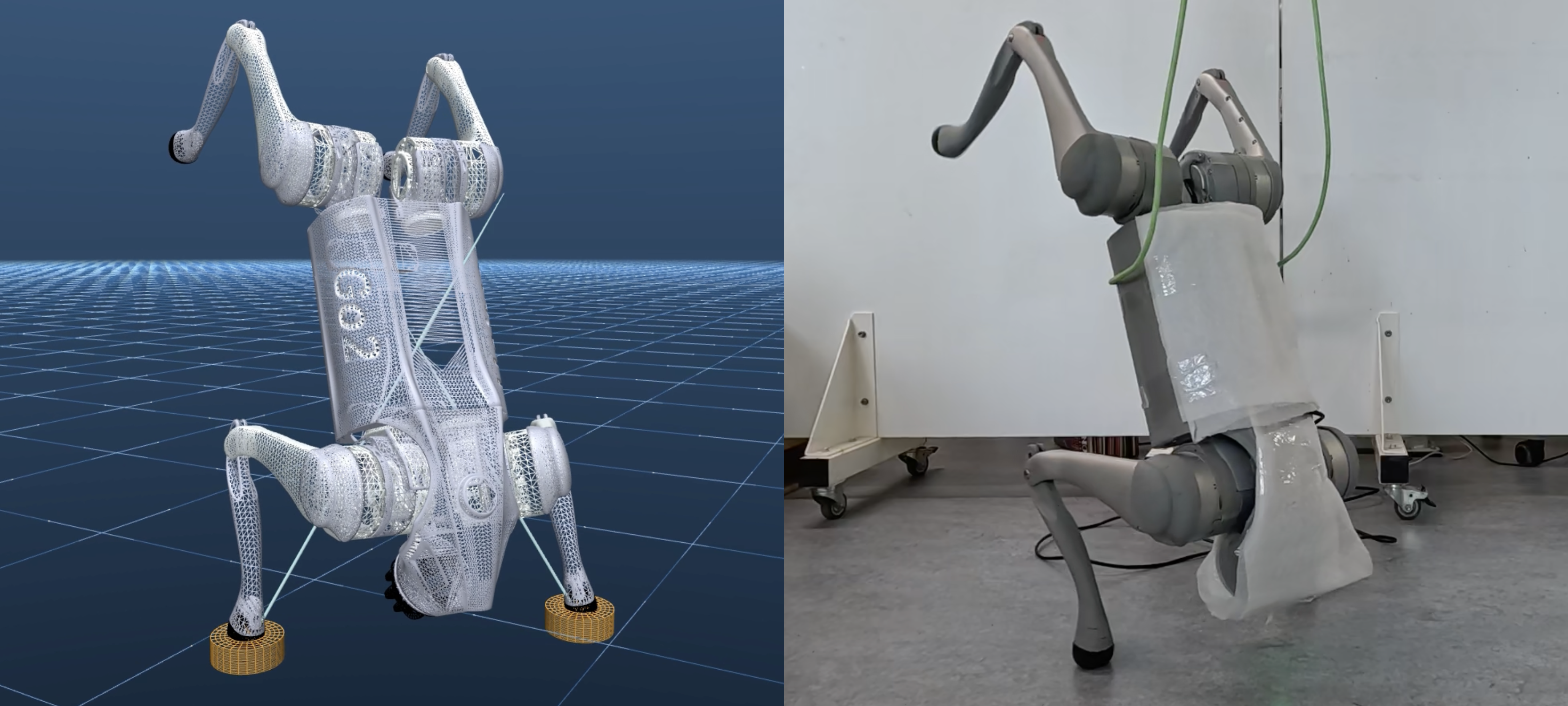
CAST is a model-based RL algorithm that uses planner-guided behavior to improve value learning while regularizing the value estimate with the current policy. It replaces the action-value critic with a state-value critic trained through alternating real planner-guided transitions and imagined policy transitions. CAST outperforms several state-of-the-art methods on DeepMind Control and HumanoidBench, and transfers successfully to a physical Unitree Go2 quadruped performing a dynamic handstand.
中文摘要: CAST(交替状态价值目标与扩充策略梯度的模型强化学习)针对足式机器人控制中的样本效率问题,在模型预测/在线规划引导下改进价值函数学习。该算法用一个状态价值批评器替代常用的动作价值批评器,训练目标交替结合真实规划引导转移与当前策略下的想象转移,使价值函数既能从更强的规划行为中获益,又受到当前学习策略的约束,从而提升训练稳定性和策略表现。在DeepMind Control和HumanoidBench等基准测试中,CAST超越了多种最先进方法,并成功迁移到物理Unitree Go2四足机器人上,使其完成动态倒立动作。该方法为复杂足式动力学下的强化学习与模型预测控制结合提供了新的理论框架和实际验证,对四足及模块化足式平台的运动控制算法设计具有重要参考价值。
💬 Elegant integration of online planner and learned value function for model-based RL, with a real quadruped dynamic-handstand experiment—highly relevant to RL-based legged control.
💬 将在线规划器与学习价值函数巧妙结合,为模型强化学习提供了新目标构造;真实四足机器人动态倒立验证使其对足式RL控制极具参考价值。
Why read it / 推荐理由: A practical way to inject MPC-style planning into policy/value learning for legged robots, backed by a rare real Go2 dynamic result. 它展示了将MPC式规划注入足式机器人策略/价值学习的可行途径,并有难得的Go2真机动态实验结果。
3. PGMT: Perceptive General Motion Tracking for Humanoid Robots
PGMT:人形机器人感知型通用运动跟踪
Authors / 作者: Hongyi Li, Li Peizhuo, Yucheng Tao, Ze Wang, Fangzhou Xu, Jinyi Chen et al.
arXiv: 2609.08511 · PDF
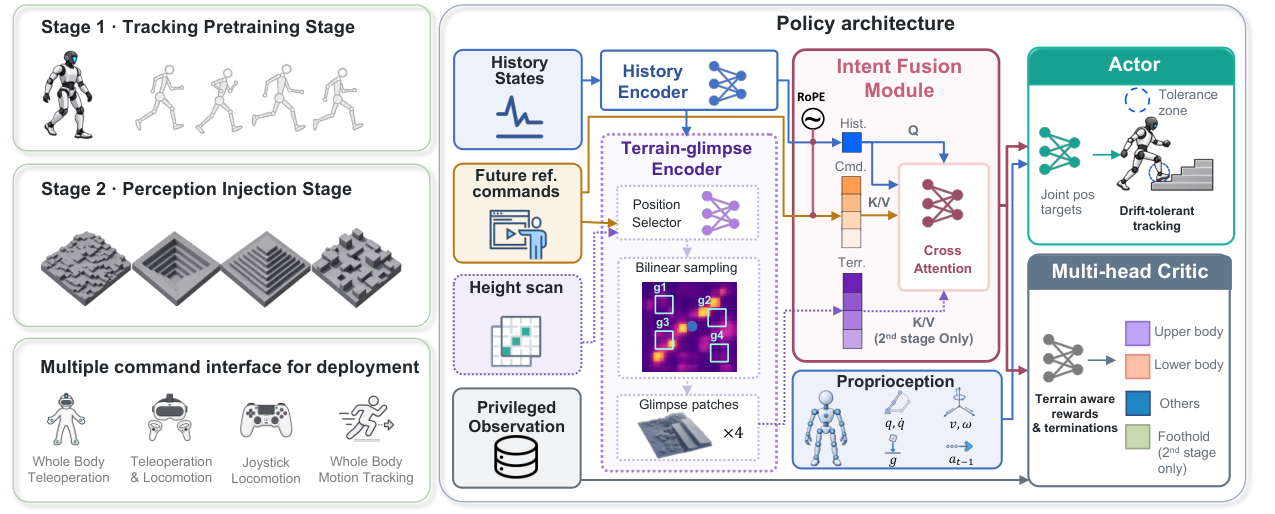
PGMT learns a perceptive whole-body motion-tracking policy that adapts to complex terrain by conditioning on motion-relevant terrain glimpses and allowing terrain-aware deviations from reference motions. It combines a general tracking/recovery prior with selectively encoded terrain perception. Zero-shot deployment on a Unitree G1 succeeds over real-world uneven terrain with obstacles up to 37 cm high, while also supporting teleoperation, dynamic motion tracking, and fall recovery.
中文摘要: PGMT提出了一种感知型全身运动跟踪管线,使人形机器人能够从任意运动参考中学习并适应复杂地形。该管线首先训练通用的运动跟踪与摔倒恢复先验,再通过运动条件地形片段感知地形,只编码与当前运动相关的局部区域;地形感知的跟踪松弛机制允许策略在保持运动意图的前提下合理偏离参考动作。在Unitree G1人形机器人上零样本部署后,PGMT可在包含最高37cm障碍的真实起伏地形上稳定完成全身运动跟踪与地形自适应行走,同时支持遥操作、动态动作跟踪和摔倒恢复。该方法将人形运动跟踪从平地拓展到复杂三维地形,用统一策略实现地形自适应运动、多样全身行为与复杂环境遥操作,其感知—松弛—恢复的框架对于多足及模块化腿足平台的地形适应控制同样具有借鉴意义。
💬 A robust terrain-perceptive whole-body tracking policy validated on real humanoid hardware; its perception-to-action design transfers naturally to modular legged platforms.
💬 一套经真实人形机器人验证的地形感知全身跟踪策略;其感知到动作的设计可自然迁移到模块化足式平台。
Why read it / 推荐理由: Provides a complete training and deployment pipeline for terrain-adaptive whole-body motion control on a real legged robot, connecting perception, RL, and recovery. 提供了在真实足式机器人上完成地形自适应全身运动控制的完整训练与部署流程,连接感知、强化学习与恢复策略。
4. TANGO: Humanoid Navigation in Cluttered Environments with a Whole-Body Vision-Language-Action Model
TANGO:基于全身视觉-语言-动作模型的杂乱环境人形导航
Authors / 作者: Anqi Li, Yuxin Chen, Zhaobo Li, Zhuo Cao, Junli Ren, Masayoshi Tomizuka et al.
arXiv: 2609.09158 · PDF
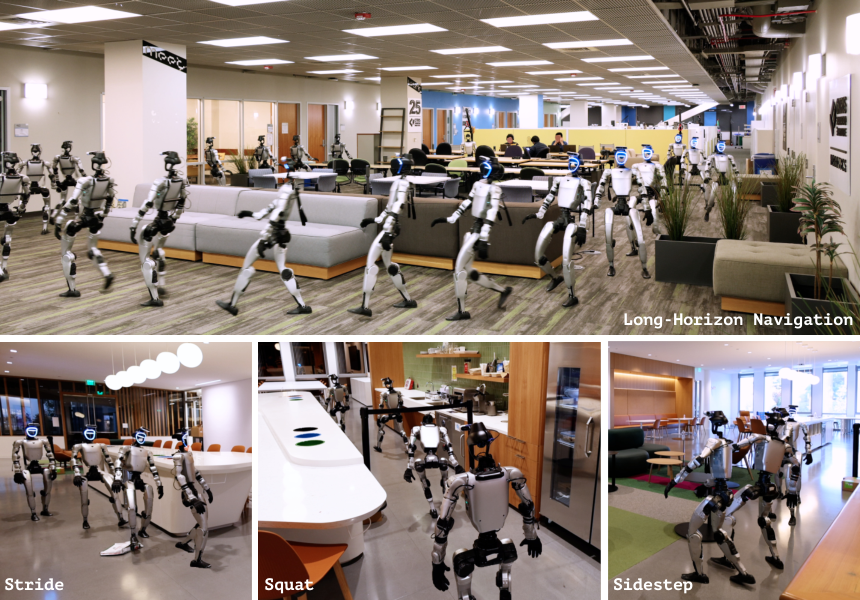
TANGO introduces a whole-body vision-language-action model that maps natural-language instructions and egocentric RGB observations directly to 29-DoF joint-space actions for navigating cluttered environments. It is trained entirely in simulation using global path planning, kinematic whole-body motion generation, obstacle-aware motion editing, and RL-based tracking. TANGO outperforms strong modular baselines in vision-language navigation benchmarks and is deployed zero-shot on a Unitree G1 in real-world cluttered settings.
中文摘要: 针对杂乱室内环境中人形机器人导航问题,TANGO提出了首个全身视觉-语言-动作导航框架。给定自然语言指令和第一视角RGB图像,模型直接输出29自由度关节空间动作,将导航视为需要连续几何感知的全身任务,而非简单2D路径规划;这也意味着需要协调手臂布置、躯干调整与步态变化来穿越复杂3D空间。TANGO完全在仿真中训练:通过全局路径规划、运动学全身运动生成、障碍感知运动编辑和强化学习跟踪合成多样化的无碰撞穿越数据,并提供动态可行的动作监督。在仿真中该模型取得最先进的视觉-语言导航性能,并在Unitree G1人形机器人上零样本部署,实现了真实杂乱场景中的鲁棒语言引导穿越。这一工作展示了端到端全身控制与大模型结合处理复杂足式机动的潜力。
💬 Notable step toward language-conditioned whole-body action control for legged robots, with zero-shot real-hardware deployment on a Unitree G1 in cluttered scenes.
💬 这是语言条件全身动作控制用于足式机器人的重要一步,并在Unitree G1上完成了杂乱场景的零样本实物部署。
Why read it / 推荐理由: Relevant for whole-body RL and sim-to-real policy learning on legged platforms, especially when navigation and obstacle negotiation must be coupled with locomotion. 对足式平台的全身强化学习与sim-to-real策略学习有参考价值,尤其是需将导航、避障与运动控制耦合的任务。
5. Ostrich: Taking Large Strides Through Stiff Contact in Differentiable Dynamics
Ostrich:在可微刚体动力学中以大步长穿越硬接触
Authors / 作者: Aleš Kučera, Karel Zimmermann
arXiv: 2609.08800 · PDF
Ostrich is a GPU-accelerated rigid-body simulator that resolves stiff contact and friction with non-smooth Newton iteration at large timesteps (~0.1 s) and differentiates the converged residual via the implicit function theorem with O(1) memory per timestep. It retains MuJoCo-level sim-to-real accuracy while allowing up to 50x larger timesteps, converges from random initializations where other differentiable simulators struggle, and scales to thousands of parallel worlds on a single GPU. Experiments on real-robot trajectories over a pallet obstacle demonstrate its value for contact-rich optimization.
中文摘要: Ostrich是一个GPU加速刚体仿真器,面向接触丰富且接触刚度高的动力学系统。它使用非光滑Newton迭代以大步长(约0.1秒)求解硬接触与摩擦,并通过隐函数定理对收敛残差进行反向传播,每个时间步的内存开销仅为O(1)。相比MuJoCo,Ostrich在保持sim-to-real精度的条件下可将仿真时间步长扩大约50倍;其梯度优化能从随机初始化收敛,而MJX和Newton Semi-Implicit等可微仿真器则难以成功。在真实机器人跨越托盘障碍的轨迹上验证后,Ostrich能在单张24GB GPU上同时微分8192个并行世界,优化吞吐量显著优于检查点式MJX,且避免了后者的显存爆炸问题。它为足式机器人的接触动力学系统辨识、步态/足迹优化和强化学习策略训练提供了高性能可微仿真工具。
💬 A powerful differentiable contact simulator with dramatically lower compute/memory cost; this can accelerate contact-rich MPC and RL pipelines for quadruped and modular legged robots.
💬 一种高效可微接触仿真器,大幅降低计算与内存开销;可加速四足/模块化腿足机器人的接触丰富MPC与RL流程。
Why read it / 推荐理由: Gradient-based optimization through hard contact is a bottleneck in legged-control learning; Ostrich’s large-timestep, memory-efficient differentiation can directly speed up system identification and policy search. 硬接触下的梯度优化是腿足控制学习的瓶颈;Ostrich的大步长、低内存微分方式可直接加速系统辨识与策略搜索。