Robotics Digest
Robotics Paper Digest — 2026-09-08
🤖 Scanned 75 new arXiv papers (cs.RO / eess.SY / cs.LG, last 96 h), picked 5 for modular & legged robotics — summarized by DeepSeek.
🤖 扫描了近 96 小时 arXiv(cs.RO / eess.SY / cs.LG)的 75 篇新论文,围绕模块化与足式机器人精选 5 篇 — 由 DeepSeek 生成双语摘要。
1. ToPos: Automated Optimal Positioning on Topographic Manifolds using Constrained Geodesic Voronoi Decomposition
ToPos:利用约束测地Voronoi分解在拓扑流形上自动优化布点
Authors / 作者: Rajesh Raveendran, Akseli Vanhamaa, Jaakko Suutala, Antti Tikanmäki, Juha Röning
arXiv: 2609.05084 · PDF
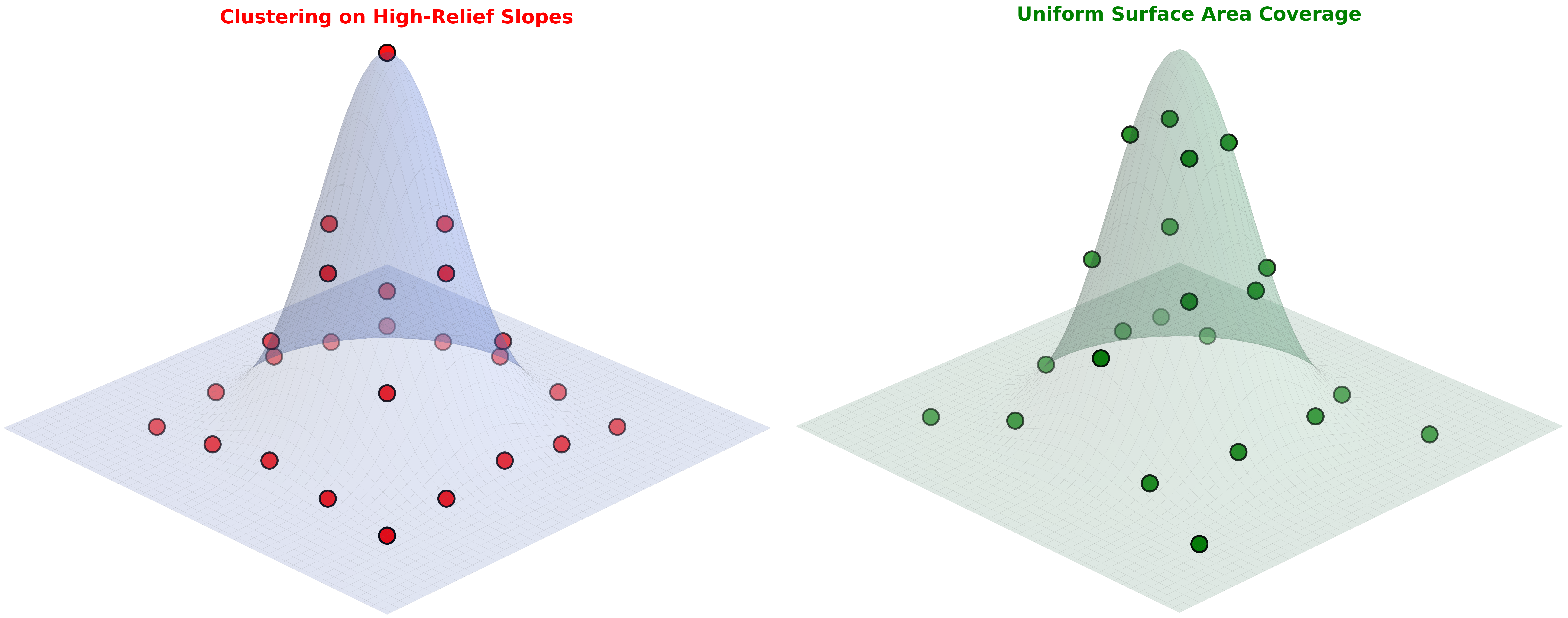
ToPos treats geography as a discrete 2D manifold embedded in 3D and uses geodesic distances along the surface instead of planar Euclidean metrics. Point placement is formulated as a constrained geodesic Voronoi decomposition solved by a Riemannian Nesterov accelerated gradient engine, with positions restricted to a feasible safe zone that excludes steep slopes and obstructions. Experiments on non-convex synthetic manifolds show about 74% improvement in surface area-balance and reduced planimetric distortion.
中文摘要: ToPos 面向高起伏地形中的空间参考点优化分布,把地形看作嵌入三维欧氏空间的二维黎曼流形,并采用沿真实表面的非欧几里得测地距离代替平面距离来计算点间关系。它将布点问题建模为约束测地Voronoi分解下的优化,用黎曼Nesterov加速梯度求解,同时把候选位置限制在由坡度过大、植被或遮挡等定义的安全区内。在非凸正弦流形上的实验表明,相比常规二维方法使面积均衡误差降低约74%,显著减小平面畸变。该框架可用于腿足机器人在复杂地形上的可达区域采样与路径规划,为地形感知的布站和越障评估提供数学工具。
💬 Directly useful for terrain-aware site/path planning, but validation is limited to synthetic manifolds without any robot embodiment.
💬 对地形感知布点/路径规划直接有用,但仅在合成流形上验证,未涉及具体腿足机器人平台。
Why read it / 推荐理由: It operationalizes geodesic terrain metrics and feasibility constraints, exactly the ingredients needed for rough-terrain leg traversal planning and foothold selection. 它将测地地形度量与可行性约束形式化,恰是崎岖地形腿足越障规划与落脚点选择所需的要素。
2. UniMate: One Unified Model to Animate Diverse Skeletons
UniMate:一个统一模型驱动多样骨骼动画
Authors / 作者: Linzhan Mou, Jiahui Lei, Zhiyang Dou, Chenyue Cai, Chaoyue Song, Adam Finkelstein et al.
arXiv: 2609.05415 · PDF
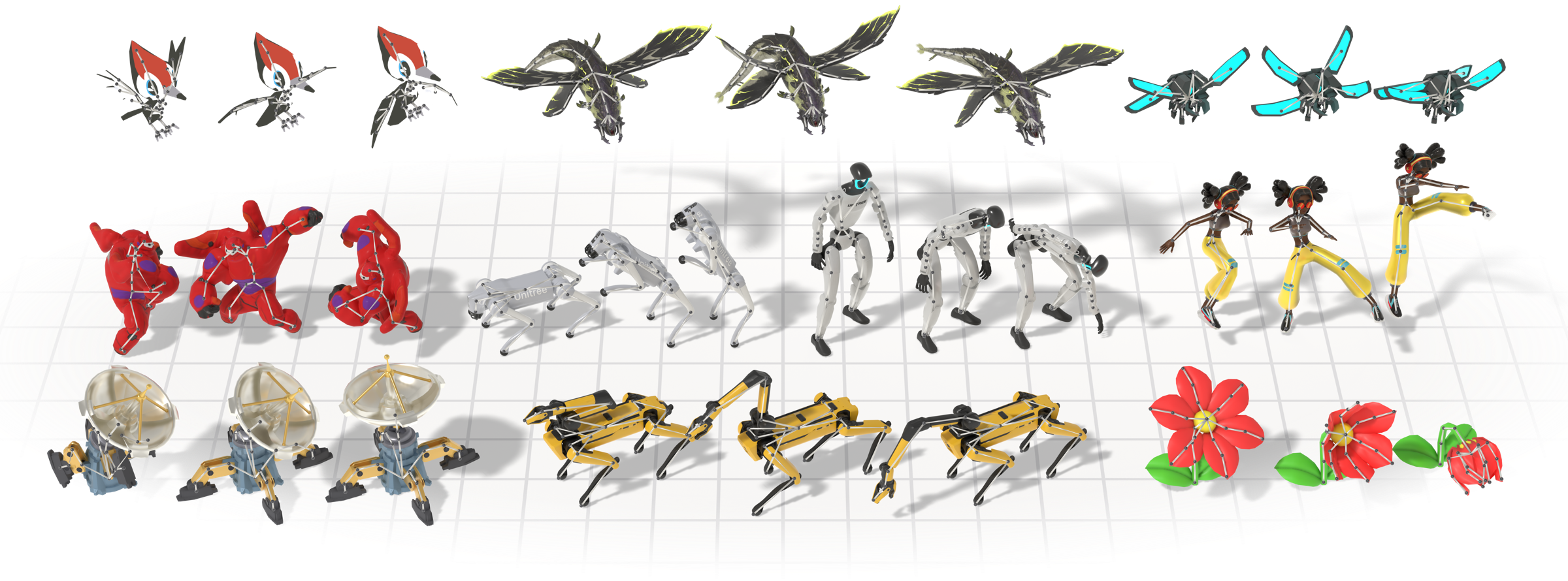
UniMate is a unified foundational model that synthesizes articulated motion for arbitrary rigged skeletons from a text prompt, without test-time optimization or per-skeleton retraining. It uses a topology-aware diffusion transformer integrating graph-aware attention bias, spectral rotary position embedding based on the graph Laplacian, and a global topology conditioner. Trained on the UniML3D dataset with over 13,000 quadrupedal, insectoid, bipedal, and other sequences, it outperforms baselines and supports zero-shot cross-topology transfer, in-betweening, and text-guided editing.
中文摘要: UniMate 提出一种统一运动生成基础模型,输入任意绑定的3D骨骼与文本提示即可合成关节运动,无需针对骨骼微调或测试时优化。其核心是拓扑感知的扩散Transformer,通过三类机制将骨骼拓扑引入注意力:由关节关系/测地距离导出的图注意力偏置、用图拉普拉斯把RoPE推广到任意运动树的谱旋转位置编码,以及用注意力池化从静止姿态提取的全局条件。作者收集了包含两足、四足、鸟类、水生、昆虫、蛇形和关节刚体的UniML3D数据集。实验表明UniMate在质量、泛化和效率上超过既有方法,并支持零样本跨拓扑迁移、补间、扩展和文本编辑,可为不同形态的模块化腿足机器人自动生成或迁移步态资源。
💬 Strong generative motion architecture, but the dynamics and actuation constraints of real modular legged robots are not addressed; treat it as a promising motion-source prior.
💬 生成式运动架构有亮点,但未考虑真实模块化腿足机器人的动力学与执行器约束,可将其作为有前景的运动来源先验。
Why read it / 推荐理由: A unified way to synthesize and transfer motion across arbitrary skeletal topologies is highly inspirational for rapid gait prototyping on reconfigurable leg modules. 一种跨任意骨骼拓扑合成与迁移运动的统一方法,对可重构腿模块的快速步态原型设计具有直接启发。
3. Human-Human & Human-Robot Interaction Transformer (H2INT) for Robot Navigation in Dense and Uncertain Crowds
H2INT:面向密集不确定人群机器人导航的人-人与人物交互Transformer
Authors / 作者: Ao Shen, Kaixi Chen, Shiwei Liu, Fang Deng, Chen Chen
arXiv: 2609.05300 · PDF
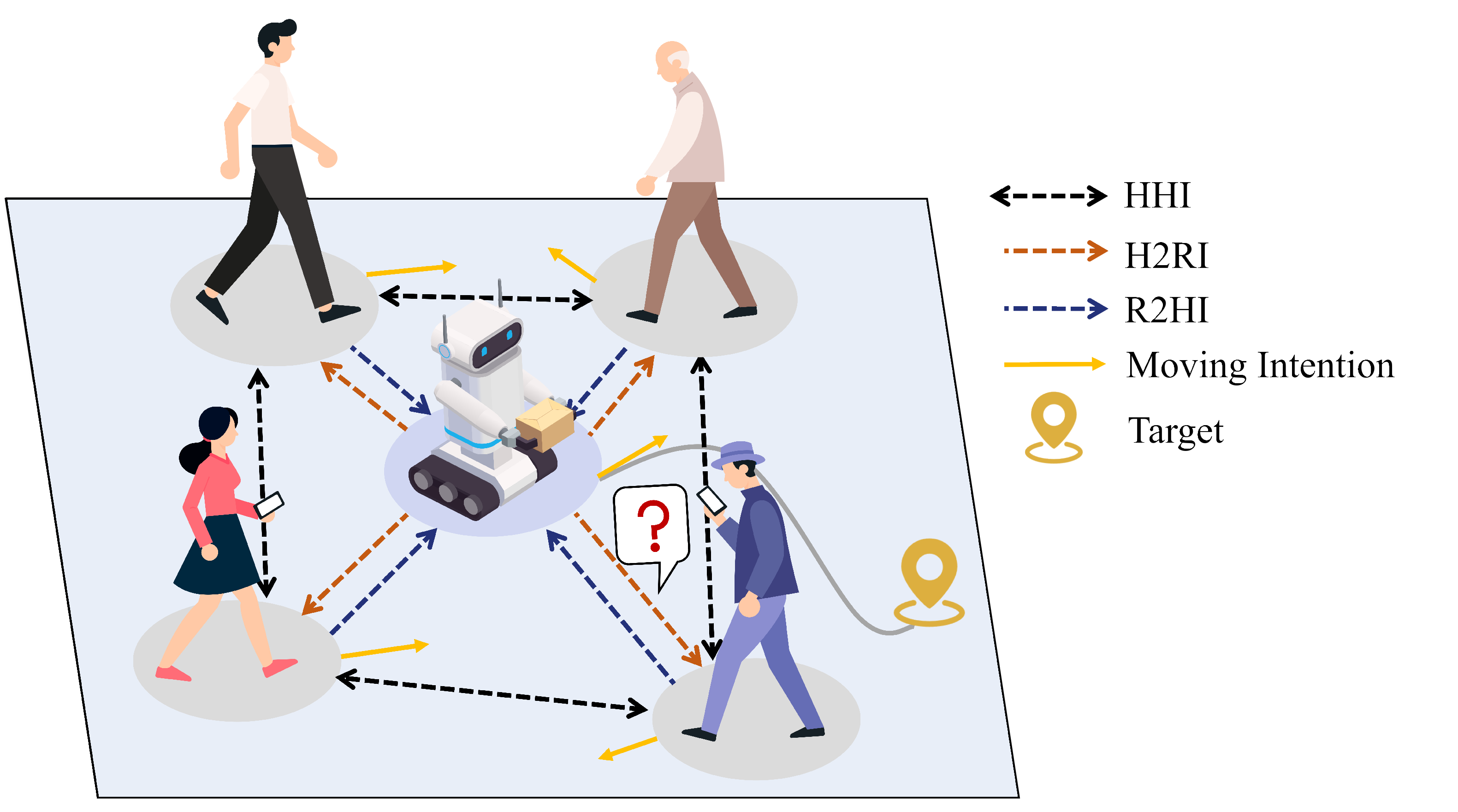
H2INT is an RL framework for safe robot navigation in dense crowds that retains robot-conditioned changes in pedestrian motion while allowing responsiveness to vary across pedestrians. It uses a two-stage gated Transformer to encode human-human and human-robot interactions and a recurrent policy to capture temporal evolution, with curriculum training that gradually reduces pedestrian responsiveness. Simulation experiments show improved safety and robustness over baselines and transfer without retraining to structurally distinct crowd-flow layouts, and real-robot deployment confirms operability with sparse observations.
中文摘要: 针对密集人群中的移动机器人导航,H2INT在强化学习策略中显式保留行人运动随机器人存在而变化的关系,并让每个行人对机器人的响应强度可以不同。模型用两阶段门控Transformer逐步编码人-人与机器人-人关系,用循环策略捕获其时间演变;课程学习逐步降低行人响应度,使策略适应更高交互难度。仿真显示,H2INT在多种人流密度与响应条件下都优于基准,且无需微调即可迁移到结构不同的人流布局。实物机器人实验验证了学习策略在稀疏局部观测下依然安全可行。该方法可迁移到腿足机器人的人机共融场景,作为运动规划或底层策略的导航先验。
💬 Solid sim-to-real evidence for socially-aware robot navigation, but leg-specific terrain interactions remain out of scope.
💬 在社交感知导航上有扎实的sim-to-real证据,但不涉及腿足地形间的相互作用。
Why read it / 推荐理由: It demonstrates sim-to-real transfer of an RL navigation policy under dense human interaction, a capability directly needed for legged robots operating in pedestrian environments. 它展示了密集人际交互下RL导航策略的sim-to-real迁移能力,这正是腿足机器人在行人环境中运行所需的能力。
4. Adaptation Needs in Robotic Systems: Assessing Behavior Trees and Their Enhancement
机器人系统中的自适应需求:行为树及其增强的评估
Authors / 作者: Mehran Rostamnia, Gianluca Filippone, Ricardo Caldas, Patrizio Pelliccione
arXiv: 2609.05331 · PDF
This paper derives a six-category classification of robotic adaptation needs from the literature and analyzes the capabilities and limitations of classical Behavior Trees with respect to these needs. It organizes existing BT-based adaptation approaches into generation, extension, evolution, and refinement families. The study shows that classical BTs are insufficient for runtime restructuring, reasoning under uncertainty, mission reinterpretation, learning, and integration with external knowledge and planning, while enhanced BTs address a number of these gaps.
中文摘要: 该文针对机器人动态环境提出自适应需求分类,通过文献归纳将需求分为知识、感知、执行、系统、任务与环境六类;分析经典行为树的能力边界,认为其模块性与反应性不足以支撑运行时的结构重构、不确定性推理、任务重解释、学习以及外部知识与规划机制的集成。进一步将BT增强方法归纳为生成、扩展、演化与精化四种及组合,并通过经验验证说明混合增强可以弥补部分限制。对于模块化腿足机器人,当腿模块重配置或任务变化时需要控制结构动态适应,该分类可用于评估行为树或其他控制架构是否满足自适应需求。
💬 Useful taxonomy for designing self-adaptive control architectures, though it is not legged-locomotion-specific.
💬 为自适应控制架构设计提供了有用的分类学,但与腿足运动控制本身关联较弱。
Why read it / 推荐理由: The adaptation taxonomy and enhanced-BT roadmap help in choosing control-architecture patterns for reconfigurable/modular legged robots that must reorganize at runtime. 其自适应分类与增强行为树路线图有助于为需要运行时重组的可重构/模块化腿足机器人选择控制架构模式。
5. Online Change-point Detection for Cooperative Multi-Agent Reinforcement Learning
面向合作多智能体强化学习的在线变点检测
Authors / 作者: Fatemeh Saberi Khomami, Julita Vassileva
arXiv: 2609.05298 · PDF
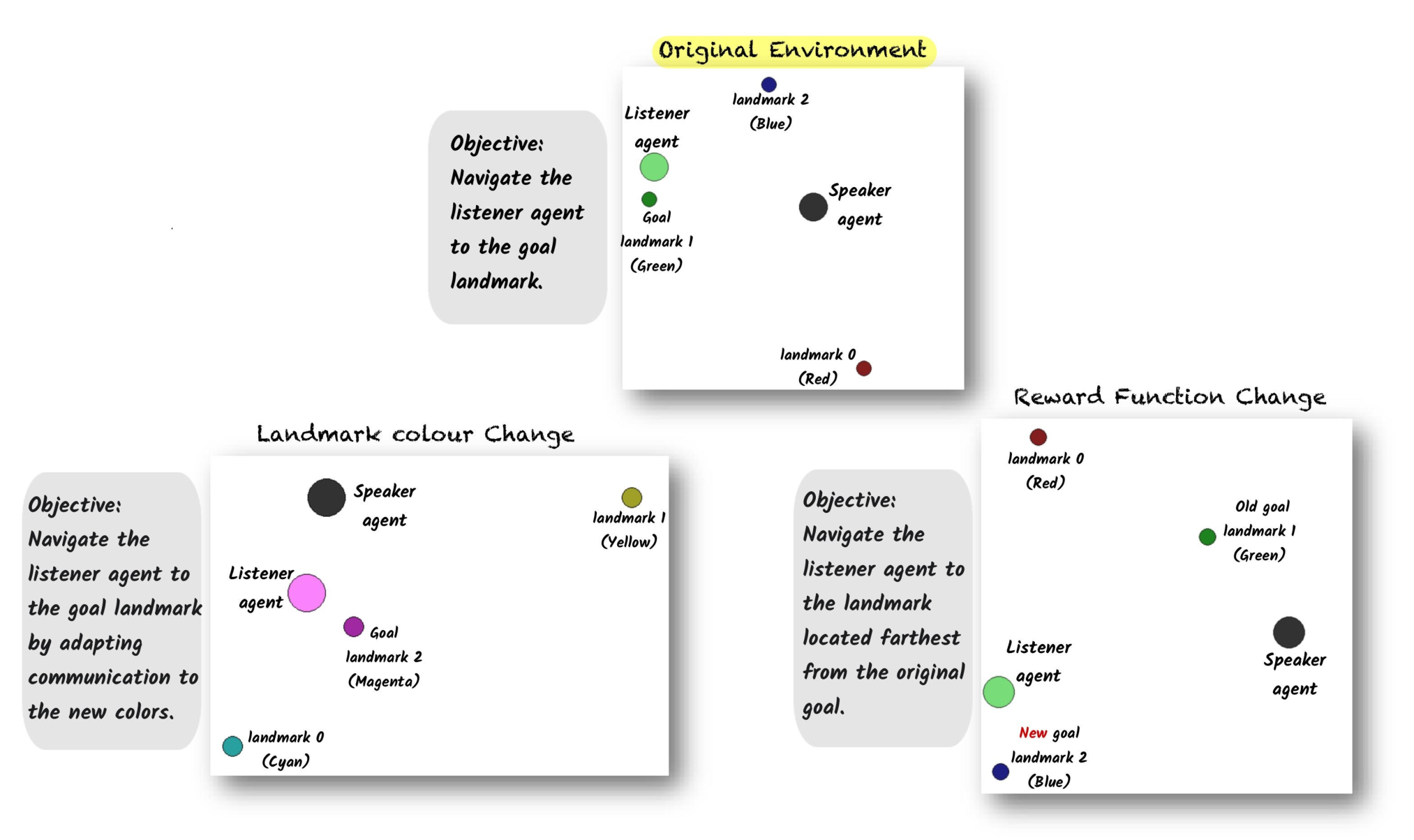
The paper proposes Patterns of Past Rewards (PPR), a lightweight, algorithm-agnostic detector that smooths reward streams, highlights recent changes, and applies a statistical drift detector to flag significant shifts in cooperative MARL. Evaluated in a Speaker-Listener environment under two controlled non-stationary scenarios, PPR balances detection speed, alarm stability, and missed-shift avoidance more effectively than using either raw or strongly smoothed returns. It serves as a monitoring tool that can trigger adaptation when environment or task objectives change during training.
中文摘要: 在合作多智能体强化学习中,训练环境或目标函数的突变会使历史经验变得不可靠。作者提出 PPR 轻量变点检测器:先对智能体回报序列进行平滑并强调近期变化,再利用统计漂移检测算法标记显著漂移。该方法与具体学习算法无关,可在线运行。在基于 Multi-Agent Particle 的 Speaker-Listener 定制环境中,作者设置了两种受控非平稳场景;结果显示直接使用原始回报检测容易漏检,过度平滑虽然检测较早但报警过多,PPR 则在检测速度、报警稳定性与减少冗余检测之间取得更好平衡。对由多个模块化腿足单元组成的分布式学习系统,PPR 可在联合训练时检测回报分布变化并触发适应机制。
💬 Lightweight and algorithm-agnostic, but demonstrated only in a toy MARL environment; the connection to legged multi-robot coordination is indirect.
💬 算法轻量且与算法无关,但仅在简易MARL环境验证;与腿足多机器人协调的关联是间接的。
Why read it / 推荐理由: For teams of modular legged robots learning cooperatively, reward-based change-point detection can flag non-stationarity that would otherwise destabilize shared policies. 对于协同学习的模块化腿足机器人团队,基于奖励的变点检测可以标记出会破坏共享策略稳定性的非平稳变化。