Robotics Digest
Robotics Paper Digest — 2026-09-04
🤖 Scanned 298 new arXiv papers (cs.RO / eess.SY / cs.LG, last 48 h), picked 5 for modular & legged robotics — summarized by DeepSeek.
🤖 扫描了近 48 小时 arXiv(cs.RO / eess.SY / cs.LG)的 298 篇新论文,围绕模块化与足式机器人精选 5 篇 — 由 DeepSeek 生成双语摘要。
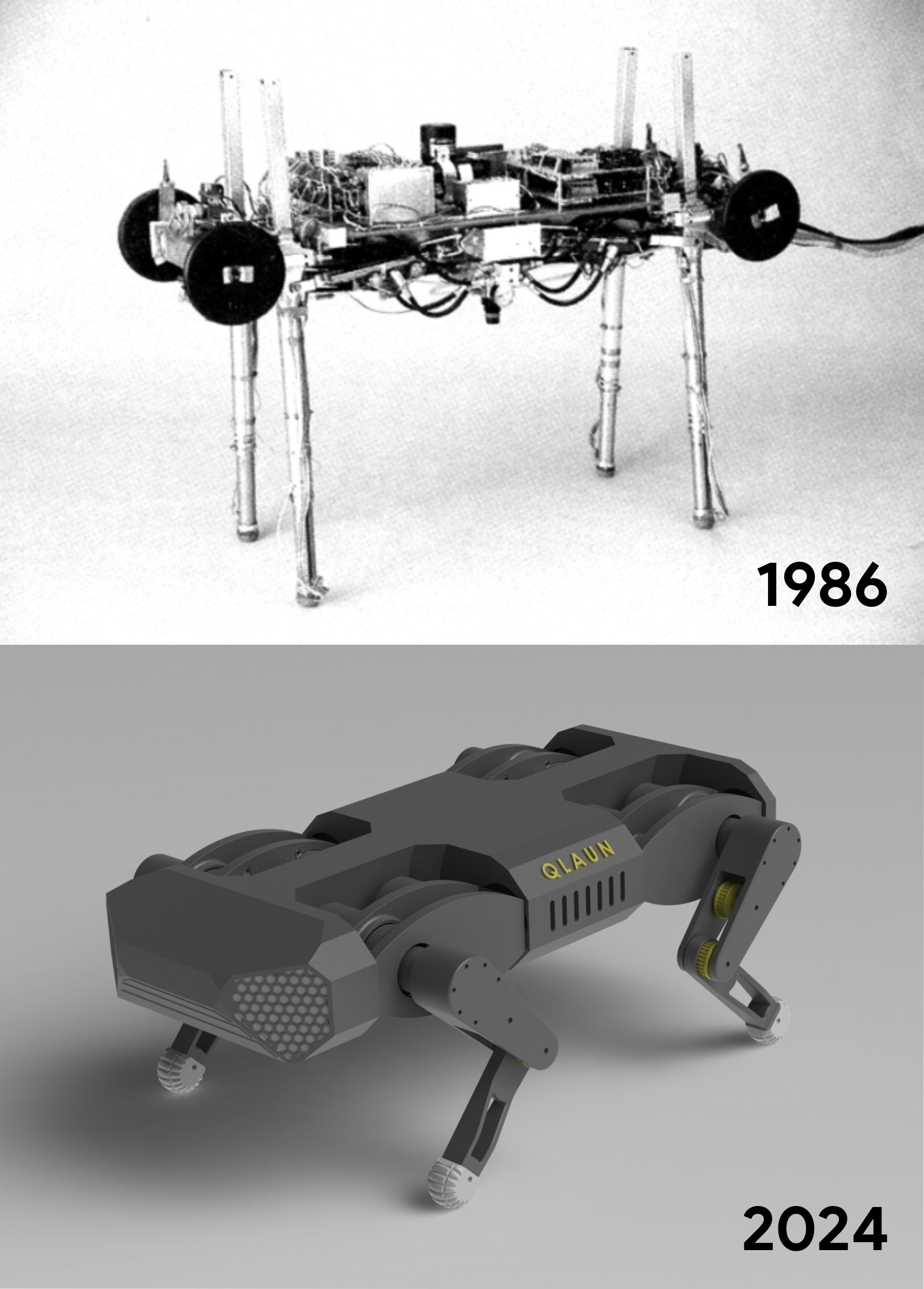
1. QLAUN: A Research-Oriented, Robust, Agile, Modular, and Affordable Torque-Controlled Quadruped Robot
QLAUN:研究导向、稳健、敏捷、模块化且经济实惠的力矩控制四足机器人
Authors / 作者: Mohamad S. Moudallal, Noel J. Maalouf
arXiv: 2609.03623 · PDF
QLAUN is a fully 3D-printed torque-controlled quadruped robot with 12 DoF, three per interchangeable electronics-free leg, actuated by quasi-direct-drive motors and belt transmissions. The modular design, wide joint ranges, and compliant TPU-95A feet target affordable and reproducible legged-locomotion research.
中文摘要: QLAUN是一款完全采用3D打印制造的力矩控制四足机器人,整机约15 kg,具备12个自由度,每条腿3个关节。该平台采用无电子器件的模块化腿部设计,实现腿部结构的可互换与快速更换。每条腿由完全3D打印的准直驱(QDD)执行器驱动,即无刷直流电机连接低减速比齿轮箱,再通过皮带传动显著提升关节输出力矩;髋关节屈曲/伸展关节可连续运动,扩大了腿部活动范围。机器人本体几乎全部由PLA打印,并采用标准现成零件装配,降低了成本,同时使用TPU-95A柔性足端以缓冲冲击并适应不平地形。作者旨在为黎巴嫩及中东北非地区大学和科研机构提供一种鲁棒、敏捷、经济且开放的四足机器人平台,以促进腿足运动控制与模块化硬件研究。该平台特别适合用于实现MPC、WBC和强化学习等运动控制算法。
💬 A highly relevant open-hardware quadruped whose interchangeable 3D-printed leg modules and QDD actuators make it a practical testbed for modular leg design and control.
💬 这是一项非常契合模块化腿部硬件设计的开放平台工作,可更换的3D打印腿和QDD执行器使其成为研究腿模块与运动控制的实用试验台。
Why read it / 推荐理由: Directly exemplifies the modular, torque-controlled quadruped design space and provides an affordable platform for deploying MPC/RL locomotion controllers. 直接呈现了模块化、力矩控制四足机器人的设计思路,并提供经济平台用于部署MPC/RL运动控制器。
2. MulDP: Multimodal Diffusion Policy for Autonomous Quadruped Parkour Navigation across Complex Terrains
MulDP:面向复杂地形四足自主越障奔跑导航的多模态扩散策略
Authors / 作者: Kangmai Hu, Yueqi Zhang, Peng Zhai, Xiaoyi Wei, Jiabin Hu, Zhixiang Liu et al.
arXiv: 2609.03984 · PDF
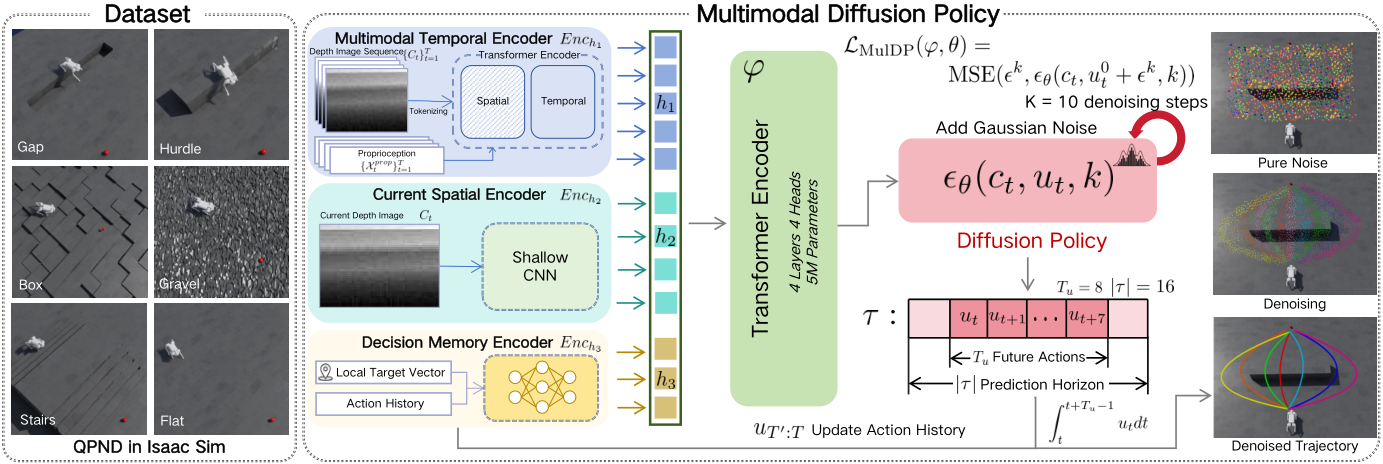
MulDP generates temporally coherent and anticipatory velocity commands by conditioning a diffusion policy on visual perception, robot proprioception, and goal information, coupling perception with quadruped locomotion. The authors construct the QPND multimodal dataset and show robust long-horizon autonomous navigation across complex terrains in simulation and real-world experiments.
中文摘要: 针对四足机器人在复杂地形上进行自主越障奔跑(parkour)导航仍依赖人工高层规划的问题,该文提出多模态扩散策略MulDP。它将视觉感知、机器人本体感觉和目标信息共同作为输入条件,利用扩散模型生成时间上连贯且具有前瞻性的速度指令,从而在感知与具身执行之间建立紧耦合,实现鲁棒的自主导航。为支持训练,作者构建了首个四足越障奔跑导航数据集QPND,涵盖多种复杂地形和导航行为。仿真与真实实验表明,MulDP能够完成长时自主导航,并有效穿越楼梯、斜坡和障碍等复杂地形。该方法避免了传统模仿学习中的分布偏移,同时借助扩散策略的多样性和多模态融合,使四足机器人具备更好的地形适应能力。相比分级规划方法,MulDP直接从感知生成运动指令,是腿足机器人自主导航控制的一种新范式。
💬 Quadruped-specific learning-based locomotion/navigation with real-robot experiments; a strong match for RL/diffusion-based motion control of multi-legged robots.
💬 面向四足机器人的学习式运动/导航方法并含真实实验,是与读者RL/扩散式运动控制兴趣高度吻合的工作之一。
Why read it / 推荐理由: Demonstrates a perception-to-velocity diffusion policy that enables autonomous long-horizon quadruped navigation beyond individual parkour skills. 展示了从感知到速度指令的扩散策略,使四足机器人能够在单个越障技能之外实现自主长时导航。
3. FWBC-VLA: Force-Aware Whole-Body Compensation for Contact-Rich Loco-Manipulation
FWBC-VLA:面向密集接触移动操纵的力感知全身补偿方法
Authors / 作者: Yutian Zhang, Siyuan Ma, Liwen Yang, Yang Li, Ce Hao, Haozhen Chi et al.
arXiv: 2609.03889 · PDF
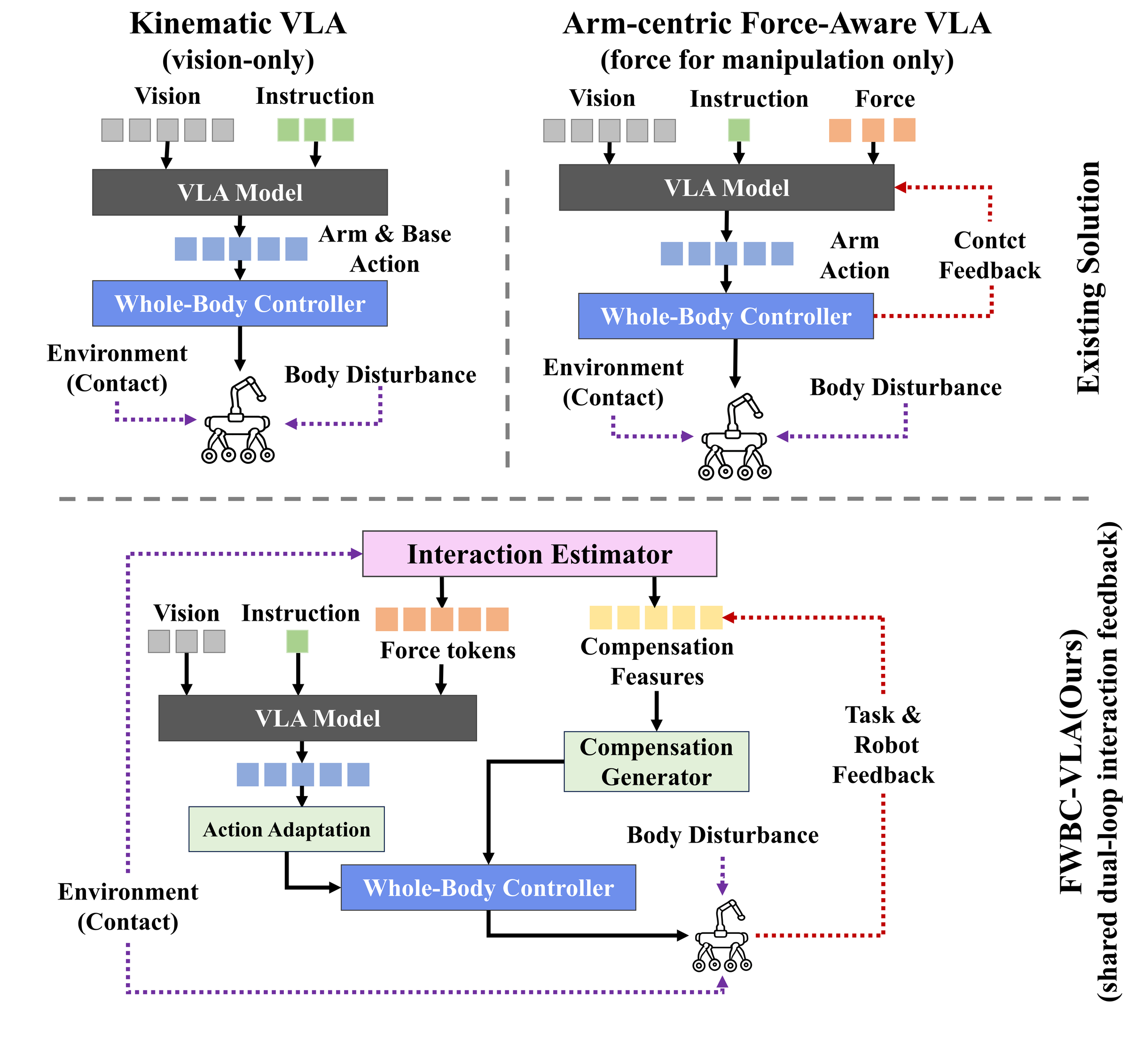
FWBC-VLA bridges task-level vision-language-action (VLA) generation and low-level whole-body control for wheeled-legged robots by encoding contact estimates into the action decoder. It introduces HSR-Force, a sensorless residual-torque estimator, and fine-tunes the VLA backbone on a 5,000-episode dataset so the policy can perceive contact onset, sustained loading, and release.
中文摘要: 本文针对轮腿式机器人在密集接触的移动操纵任务中,任务级语义动作与底层物理交互控制之间缺乏联系的问题,提出力感知全身补偿框架FWBC-VLA。VLA模型能够从视觉和语言生成高层动作,但无法解释动作所引发的接触力;底层全身控制(WBC)虽能稳定机器人,却难以区分任务相关的接触力和外部扰动。为避免额外安装力/力矩传感器的硬件成本和集成负担,作者首先设计了无传感器残差力矩估计器HSR-Force,利用关节状态与动力学模型推断接触强度及其时变特征。随后将接触估计编码为token并注入VLA动作解码器,使策略在解码过程中感知接触开始、持续加载和释放等阶段。基于包含超过5000条移动操纵轨迹的轮腿机械臂数据集微调预训练VLA主干,最终实现了任务级智能与底层力感知全身补偿的协同,提升接触丰富场景下的操纵鲁棒性。
💬 Interesting fusion of semantic VLA actions with low-level whole-body control and sensorless force estimation for wheeled-legged loco-manipulation.
💬 本文有趣地把VLA语义动作、底层全身控制和无力传感器接触估计融合,用于轮腿式移动操纵。
Why read it / 推荐理由: Offers a force-aware control architecture that can inspire robust whole-body interaction policies on modular legged platforms that lack dedicated force sensors. 提供了一种力感知控制框架,可为未配置专用力传感器的模块化腿足平台设计鲁棒的全身交互策略提供启发。
4. BRIDGE: An Open-Source Humanoid Platform via Morphology-Control Co-Design for Physical AI
BRIDGE:面向物理AI的开放人形机器人平台——形态与控制协同设计
Authors / 作者: Jianren Wang, Letian Qian, Zikai Wang, Weiwei Wu, Junjie Zong, Abhinav Gupta et al.
arXiv: 2609.03497 · PDF
BRIDGE presents a data-driven morphology-control co-design framework for humanoids and a joint metric measuring kinematic retargeting fidelity and dynamic tracking performance. The resulting open-source 88-cm humanoid and control policy outperform baseline humanoids in locomotion, balance, and dynamic maneuvers.
中文摘要: 传统人形机器人研发通常将硬件设计与全身控制分离,导致形态与控制策略不匹配,难以实现类人的流畅和敏捷运动。该文提出一种数据驱动的形态-控制协同设计框架,并引入一个同时考虑运动学重定向到人体动作的保真度与动态跟踪性能的新指标,从而在统一框架下优化人形机器人形态。与Bumi、K1和Toddlerbot等基线人形机器人相比,该框架在各项指标上均达到最优。基于该设计,作者实现了BRIDGE——一个88 cm高、完全开源的人形机器人平台,并一并发布其控制策略。实验表明,BRIDGE能够以更高保真度复现人体动作数据,在基础行走、鲁棒平衡和高动态动作中表现优异。这项工作展示了硬件形态与全身控制/强化学习策略联合优化的重要性,其协同设计思想与开源资源对腿足机器人设计具有借鉴价值。
💬 Although humanoid rather than modular-legged, its morphology-control co-design and open-source whole-body policy are relevant to designing and controlling multi-legged platforms.
💬 虽然是人形而非模块化腿足平台,其形态-控制协同设计和开源全身控制策略对多腿机器人的设计与控制具有参考价值。
Why read it / 推荐理由: Shows quantitative co-design of hardware morphology and WBC, a lesson applicable when optimizing reconfigurable leg modules. 展示了硬件形态与WBC定量协同设计的思路,对优化可重构腿模块具有借鉴意义。
5. Economic Model Predictive Control with Policy-Guided Terminal Ingredients
具有策略引导终端项的经济模型预测控制
Authors / 作者: Salim Msaad, Robert D. McAllister
arXiv: 2609.02628 · PDF
This paper proposes policy-guided MPC, which constructs terminal costs and constraints from a known sub-optimal control policy rollout instead of relying on a steady state. Closed-loop performance guarantees relative to the guiding policy are established for finite and infinite horizons and demonstrated in an energy-management simulation.
中文摘要: 标准模型预测控制(MPC)通常需要依赖稳态参考点来构造终端代价和终端约束,从而保证闭环稳定性。然而许多系统没有稳态点,或长期停留在稳态并不合适,这限制了MPC的应用范围。该文提出一种称为“策略引导MPC”的新框架:使用一个已知的次优控制策略的轨迹展开(rollout)来确定终端区域中心,并以对该中心的偏离惩罚作为终端代价,从而在没有稳态或参考轨迹的情况下也能构造有效的终端项。理论部分建立了相对于引导策略的闭环性能保证,且同时适用于有限时域和无限时域问题。数值仿真在能量管理系统上验证了该方法的有效性。该思想对腿足机器人MPC具有借鉴意义:当任务本身是周期行走、跳跃或越障而不存在固定稳态时,可以用强化学习策略或简化策略作为引导,改进MPC的终端稳定性与任务性能。
💬 An important MPC theory contribution that removes the steady-state terminal-condition assumption and can generalize terminal design in legged locomotion MPC.
💬 一篇重要的MPC理论工作,免除了稳态终端条件假设,或可推广到腿足运动MPC的终端设计。
Why read it / 推荐理由: Provides a principled way to construct terminal ingredients from any suboptimal policy, useful for embedding learned policies into legged-robot MPC. 为基于任意次优策略构造终端项提供了理论框架,便于将学习策略嵌入腿足机器人的MPC中。