Robotics Digest
Robotics Paper Digest — 2026-09-03
🤖 Scanned 288 new arXiv papers (cs.RO / eess.SY / cs.LG, last 48 h), picked 5 for modular & legged robotics — summarized by DeepSeek.
🤖 扫描了近 48 小时 arXiv(cs.RO / eess.SY / cs.LG)的 288 篇新论文,围绕模块化与足式机器人精选 5 篇 — 由 DeepSeek 生成双语摘要。
1. World-Model-Augmented Visual Locomotion for Humanoids on Foothold-Constrained Terrain
基于世界模型的仿人机器人在落足点受限地形上的视觉运动控制
Authors / 作者: Yuxi Liu, Lijun Han, Ziming Wang, Ao Zhang, Cong Yang, Wei Sui
arXiv: 2609.02542 · PDF
WM-LOCO jointly trains a recurrent world model and a PPO policy for foothold-constrained terrain like stepping stones, gaps, and stairs. Conditioned on proprioception and a single onboard depth image, the policy uses predictive recurrent features without explicit foothold labels. The same policy runs on a physical Unitree G1 with onboard sensing, achieving 93.3% average success across the three terrain classes.
中文摘要: WM-LOCO 提出联合训练循环世界模型与 PPO 策略,用于跨越踏脚石、间隙和狭窄楼梯等落足点受约束地形。策略以本体感觉和单张机载深度图像为条件,利用世界模型产出的预测性循环特征引导运动,无需显式足端标签。在仿真中,该方法在间隙和踏脚石上完全战胜基线,在楼梯上保持成功率的同时提高了步幅效率并降低了骨盆加速度。同一套策略被部署到实体 Unitree G1 人形机器人上,仅使用机载本体感觉和深度流,在三种地形上的平均成功率可达 93.3%。
💬 Directly relevant to RL-based legged locomotion with sim-to-real transfer and impressive real-robot validation on challenging terrain.
💬 与基于强化学习的腿式运动控制及仿真到真实迁移高度相关,并在挑战性地形上展示了出色的实体机器人验证结果。
Why read it / 推荐理由: Demonstrates a robust visual locomotion policy using learned world models, which can be directly applied or extended to modular legged platforms facing sparse footholds. 展示了利用学习到的世界模型的鲁棒视觉运动策略,可被直接应用或扩展到面临稀疏落脚点的模块化腿式平台上。
2. FOCUS: Foot Observation Confidence for Robust Humanoid Proprioceptive Odometry
FOCUS:用于鲁棒仿人机器人本体感知里程计的脚步观测置信度
Authors / 作者: Kaixin Feng, Angsong Li, Shaopeng Zhang, Enyu Li, Peiwen Lin, Chuang Wang et al.
arXiv: 2609.02222 · PDF
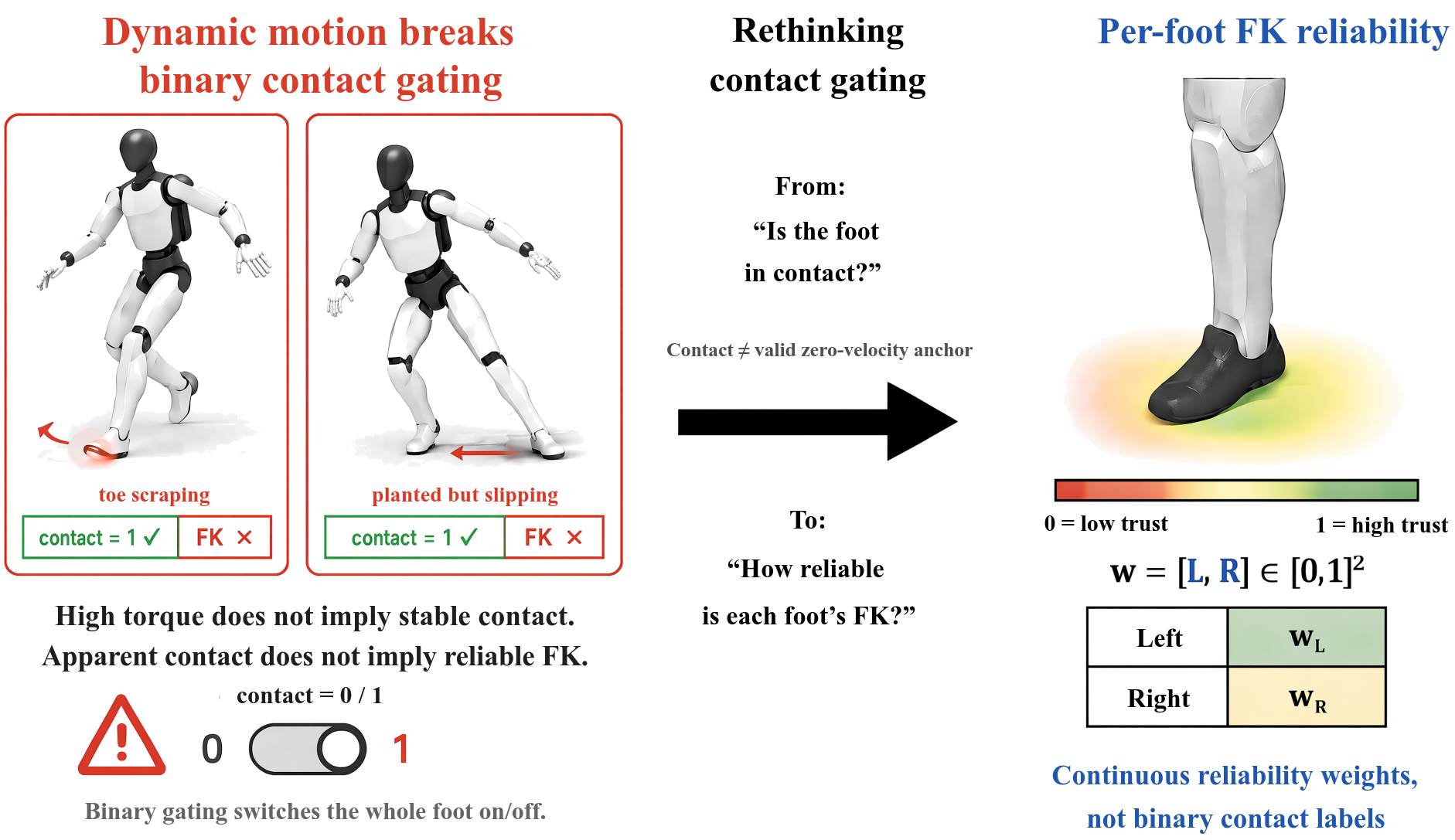
FOCUS predicts continuous foot observation reliability weights using a network trained from unannotated simulation via a forward-kinematics-weighted velocity consistency loss. These weights are used in an EKF to blend foot forward-kinematics velocity with IMU-propagated body velocity, replacing hard binary contact decisions. The method requires only IMU and joint measurements and is designed for hardware implementation.
中文摘要: FOCUS 提出一种无需人工标注连续标签的方法,从仿真数据中学习每只脚的连续观测置信度权重。网络通过前向运动学加权的速度一致性损失和轻量级接触正则化进行训练,代替传统二值接触假设。预测的置信度用于扩展卡尔曼滤波器,将脚的 FK 速度与 IMU 传播的身体速度平滑融合,并自适应调节观测协方差,无需硬接触切换。该方法仅依赖 IMU 和关节编码器,适合部署于硬件平台,有效缓解了动态运动中的部分支撑、脚趾拖地和滑动带来的漂移。
💬 A valuable state-estimation framework for legged robots, where contact uncertainty is common and accurate proprioception is critical for closed-loop control.
💬 为腿式机器人提供了一种有价值的状态估计框架,在接触不确定普遍存在且精确本体感知对闭环控制至关重要的场景下尤为有用。
Why read it / 推荐理由: Improves proprioceptive odometry for legged robots using learned continuous confidence, a key ingredient for reliable MPC/WBC and locomotion in the real world. 利用学习到的连续置信度来改善腿式机器人的本体感知里程计,是真实世界中实现可靠 MPC/WBC 与运动控制的关键要素。
3. Humanoid Safe Stop via Learned Stoppability Value
通过学习可停止性价值实现仿人机器人安全停止
Authors / 作者: Junfeng Long, Pieter Abbeel, Koushil Sreenath, Roberto Horowitz, Guanya Shi, C. Karen Liu
arXiv: 2609.02358 · PDF
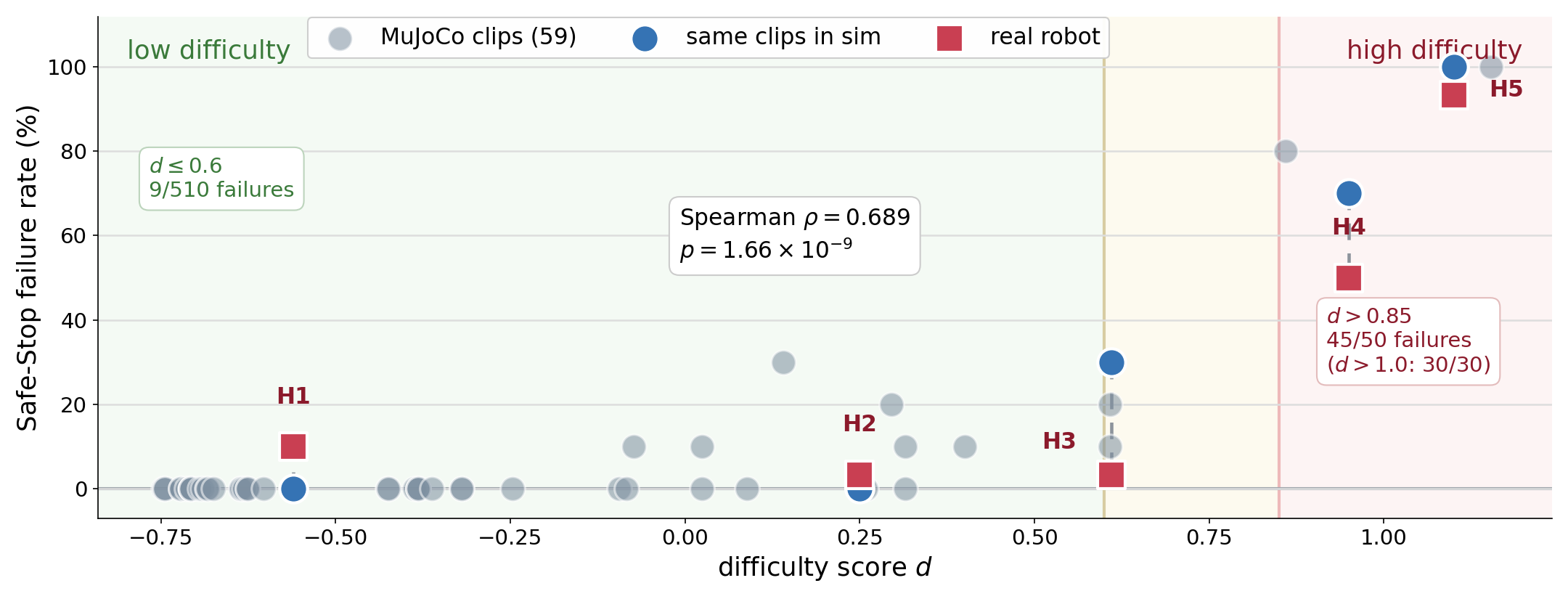
Safe-Stop casts emergency stopping as a reach-avoid problem and learns a stop policy paired with complementary stoppability estimators: one supervised by the actual stopping outcomes, and another based on Hamilton-Jacobi reachability over physical state. The estimates are task-agnostic and transfer across upstream behaviors. At deployment, the robot only commits to the stop when both estimators agree that stopping is feasible, otherwise it yields to a fall policy.
中文摘要: Safe-Stop 将紧急停止问题建模为可达-避碰问题,并提出与停止策略互补的两种可停止性估计器:一种由实际停止结果监督,另一种基于物理状态的 Hamilton-Jacobi 倒推可达性。两者不依赖停止命令之前的任务策略,因此可迁移到多种上游行为。运行时,系统只有在两个估计器同时判停可行时才执行紧急停止,否则切换至阻尼跌倒回退策略,从而在保证安全性的同时保持反应速度。该方法不针对特定上游运动任务,具有模块化和可迁移性。
💬 A novel safety layer for legged robots that reasons about whether a stop is feasible, rather than blindly executing a fixed maneuver, which is crucial during autonomous operation.
💬 为腿式机器人设计了一种新颖的安全层,它推理停止的可行性而非盲目执行固定动作,对自主运行至关重要。
Why read it / 推荐理由: Provides a learning-based emergency-stop mechanism with feasibility awareness, augmenting the reader’s toolkit for safe RL-based locomotion control. 提供了一种具有可行性感知的基于学习的紧急停止机制,丰富了读者在基于强化学习的运动控制中的安全工具包。
4. Contact-Constrained Lower-Limb Joint-Offset Calibration for Humanoid Robots
接触约束下仿人机器人下肢关节偏置校准
Authors / 作者: Kaixiang Lu, Haiyu Lan, Chunxiao Qiao, You Li, Chengyuan Luo, Enyu Li et al.
arXiv: 2609.02306 · PDF
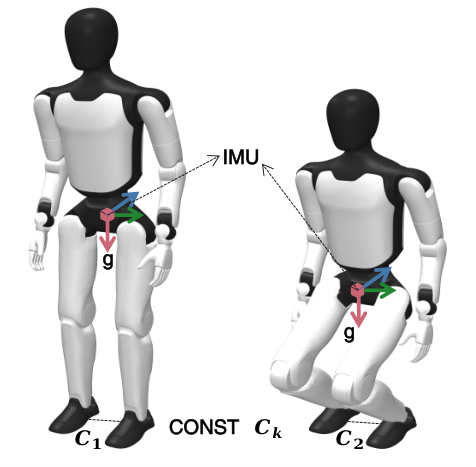
This paper presents a self-contained joint-offset calibration method for humanoid lower limbs that uses only joint encoders and a pelvis-mounted IMU during static double support. It minimizes the posture-dependent dispersion of the inter-foot transform derived from forward kinematics. Experiments on real A3 and A2 humanoids reduce foot-height RMS residuals from 4.26 to 2.20 mm and from 8.03 to 1.43 mm respectively.
中文摘要: 该工作提出了一种无需外部运动捕捉或靶标的自包含标定框架,用于人形机器人下肢关节编码器零位误差的校准。在校准过程中,机器人保持双脚接触地面,仅利用关节编码器和骨盆 IMU 数据;由于双脚固定在地面上,前向运动学得到的足间变换应保持恒定,最小化其随姿态变化的离散度构成了一个关于 12 维零位偏移向量的非线性最小二乘问题。通过 Hessian 特征结构分析和姿态激励,该方法能够可靠估计偏移,并利用站立姿态先验分解弱可观测链。在真实 A3 与 A2 机器人上,标定后足高残差 RMS 分别从 4.26 mm 降至 2.20 mm 和从 8.03 mm 降至 1.43 mm,并用 LiDAR-惯性基准验证了俯仰耦合通道的有效性。
💬 Accurate joint-offset calibration is essential for kinematic consistency in legged robots, especially modular systems after reconfiguration, and this work provides a practical, hardware-validated solution.
💬 精确的关节零位校准对于腿式机器人(尤其是重新配置后的模块化系统)的运动学一致性至关重要,该工作提供了一种经过硬件验证的实用解决方案。
Why read it / 推荐理由: Offers a fast, externals-free calibration method that directly supports the design and deployment of modular legged robots by ensuring precise actuator kinematics. 提供了一种快速、无外部设备的标定方法,通过确保执行器运动学精度,直接支持模块化腿式机器人的设计与部署。
5. Unified Motion Retargeting for Humanoids with Learned Point Cloud Correspondence
基于学习点云对应关系的仿人机器人统一运动重定向
Authors / 作者: Hanyang Cao, Yuetong Fang, Taesoo Kwon, Runyi Yu, Ji Ma, Jing Tan et al.
arXiv: 2609.02134 · PDF
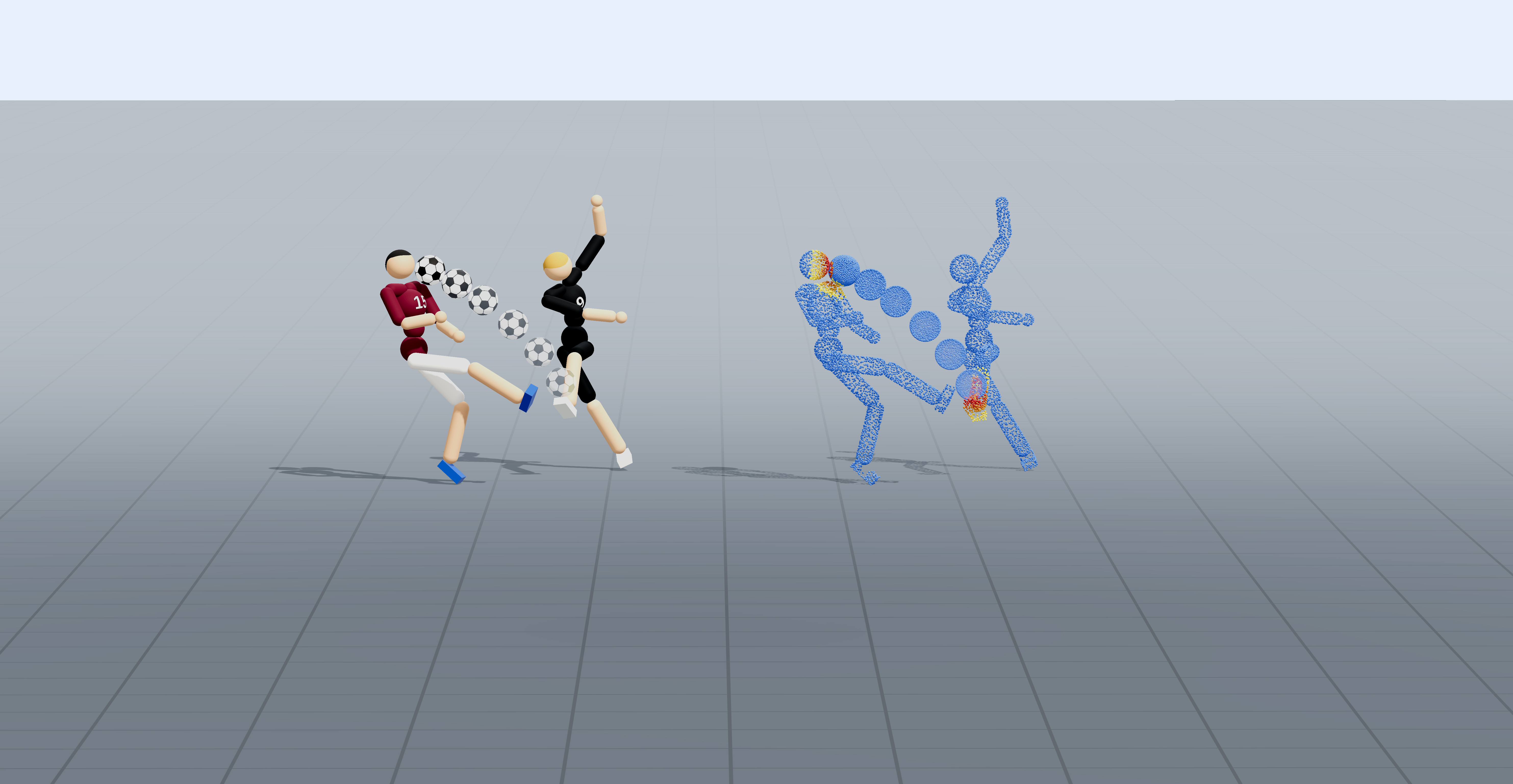
UMR learns dense point cloud correspondence between humans and robots without manual semantic mappings. By treating point clouds as a unified interface, it decouples retargeting from source-specific skeletal semantics and robot-specific topology. The dense correspondences enable fine-grained pose alignment and contact transfer across heterogeneous motion sources and robot embodiments.
中文摘要: 本文提出统一运动重定向框架 UMR,通过学习人体与人形机器人之间的稠密点云对应关系,避免手工设计稀疏关键点或身体部位配对。UMR 将人体与机器人表面点云作为统一接口,从源骨骼语义和机器人具体拓扑中解耦,从而支持跨异构动作来源和机器人形态的泛化。经过学习的稠密对应关系为约束点云匹配优化提供细粒度几何锚点,可在表面级对齐人体姿态并直接迁移交互接触。实验表明,UMR 统一了不同动作捕捉数据库和不同机器人平台间的重定向质量,无需针对每个源或目标单独修改。该工作为利用大规模人体动作数据来生成高质量腿式机器人参考轨迹提供了新途径。
💬 Although focused on humanoids, learning dense point-level retargeting is a powerful way to generate rich reference motions for training modular legged robots from human datasets.
💬 虽然专注于人形机器人,但学习稠密点级重定向是从人体数据集为模块化腿式机器人生成丰富参考运动的强大工具。
Why read it / 推荐理由: Enables more accurate and automated transfer of human motion to legged robots, which can significantly improve the variety and quality of RL training references. 可更精确、更自动地将人体运动迁移到腿式机器人,从而显著提高强化学习训练参考动作的多样性和质量。