Robotics Digest
Robotics Paper Digest — 2026-08-27
🤖 Scanned 311 new arXiv papers (cs.RO / eess.SY / cs.LG, last 48 h), picked 5 for modular & legged robotics — summarized by DeepSeek.
🤖 扫描了近 48 小时 arXiv(cs.RO / eess.SY / cs.LG)的 311 篇新论文,围绕模块化与足式机器人精选 5 篇 — 由 DeepSeek 生成双语摘要。
1. LAC: Linear and Angular Compliance for Humanoid Whole-body Control
面向人形机器人全身控制的线性和角向柔顺方法
Authors / 作者: Yang Liu, Zhongkai Gu, Wei Zhu, Mitsuhiro Hayashibe
arXiv: 2608.25405 · PDF
LAC is a general whole-body controller that simultaneously realizes commanded linear and angular compliance under external wrenches on the upper body. It synthesizes whole-body compliant responses into a large-scale augmented dataset, with sampled force and couple events imposed on contact frames extracted from human interaction data, and then trains a teacher-student RL policy to track compliant motions. Extensive simulation and real-world experiments demonstrate whole-body compliant responses, monotonic stiffness modulation, and applicability to teleoperated loco-manipulation.
中文摘要: LAC提出一种通用的全身控制器,可同时实现对人形机器人上肢所受外力/力矩指令的线性和角向柔顺响应。方法首先将全身柔顺响应合成为一个大规模增强数据集,从人机交互数据提取接触帧并施加采样的力与力偶事件;在每个接触连杆上,外力与被动屈服运动链产生的虚拟力矩在指定刚度下共同驱动虚拟导纳,从而生成期望的柔顺运动。随后采用教师-学生强化学习训练一个统一策略,在外部力旋量作用下跟踪这些柔顺运动。大量仿真与真实世界实验表明,该方法对上肢各处施加的外力均能产生全身柔顺响应,刚度指令在完整范围内可实现单调调节,并成功应用于遥操作移动操作任务。
💬 Strong WBC+RL compliance work with real humanoid validation; relevant to compliant control and physical interaction for legged robots.
💬 将全身控制与强化学习结合的柔顺控制工作,实物人形验证充分,对腿足机器人的柔顺交互控制有借鉴价值。
Why read it / 推荐理由: Provides a scalable teacher-student RL recipe for whole-body compliance that can transfer to modular legged platforms with stiffness modulation. 提供可扩展的教师-学生强化学习全身柔顺控制方案,可迁移到具有刚度调节能力的模块化腿足平台。
2. RAEM: Robust Autonomous Exploration for Multi-Floor Environments with a Quadruped Robot
RAEM:四足机器人多楼层环境的鲁棒自主探索框架
Authors / 作者: Zikang Yuan, Yuan Ren, Yian Wang, Yixue Wang, Enze Fang, Xuewei Zhang et al.
arXiv: 2608.25366 · PDF
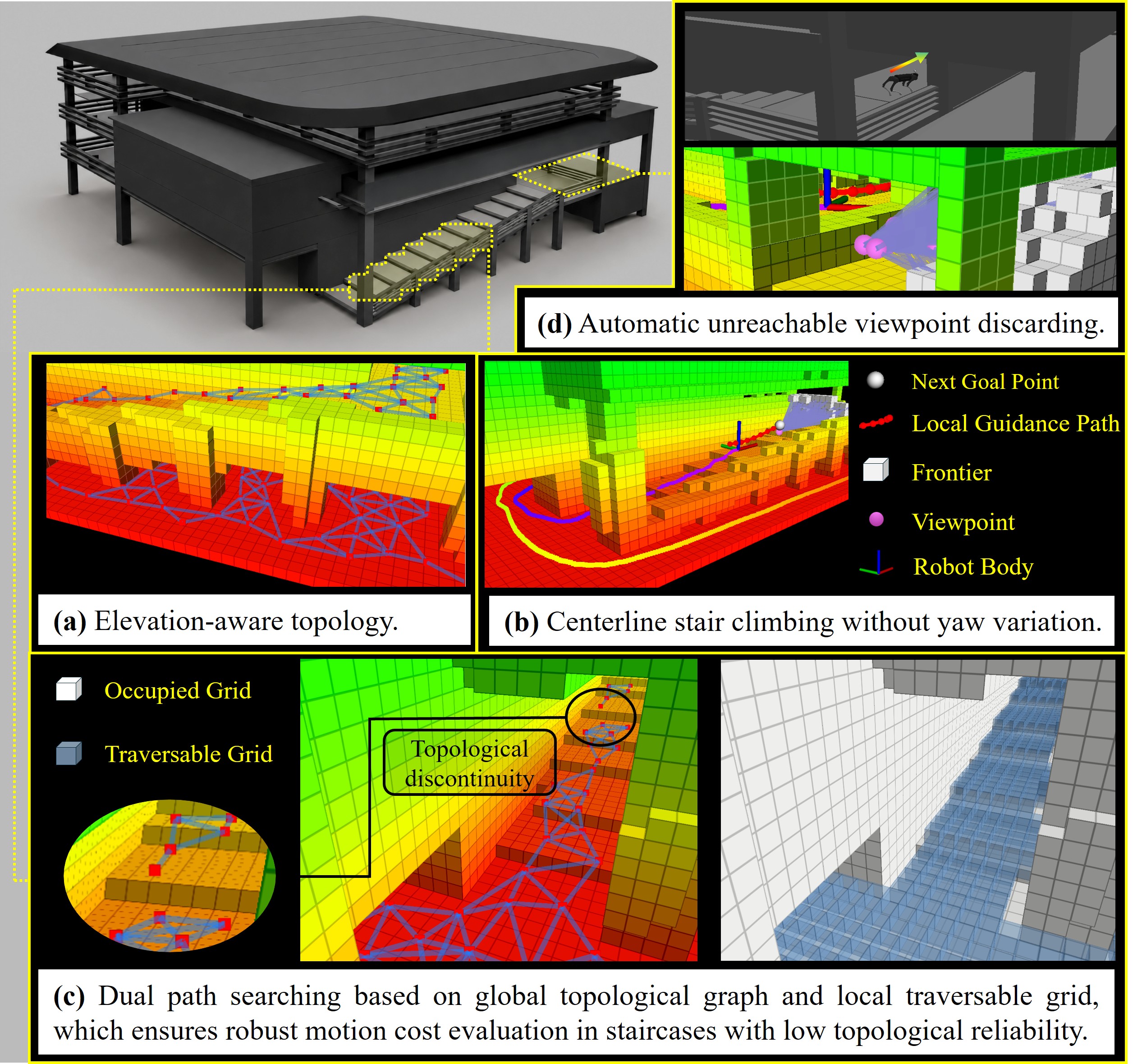
RAEM is an autonomous exploration framework for quadruped robots operating in multi-floor buildings. It adopts a hybrid local-global traversability representation: a local tomography map and a categorized 3D grid map for online terrain analysis and connectivity evaluation, plus an elevation-aware global topological graph for efficient cross-floor exploration planning. A staircase-center alignment strategy reduces yaw variation during climbing, and a dual path searching mechanism recovers guidance paths when the global topology is locally disconnected.
中文摘要: RAEM提出面向四足机器人在多楼层环境中自主探索的鲁棒框架。针对现有平面可通行性表示难以描述楼层重叠结构与跨楼层连通的问题,采用局部-全局混合可通行性表示:局部断层图和显式分类的3D栅格图用于在线地形分析与连通性评估,同时增量构建顾及高程的全局拓扑图,用于高效的跨楼层探索规划。该设计避免了维护全局断层图带来的计算开销。针对楼梯井中LiDAR观测稀疏、碎片化导致局部可通行性估计退化的问题,引入楼梯中心对齐策略以减少爬楼过程中的偏航突变,并设计双路径搜索机制,当全局拓扑局部断开时恢复引导路径,从而稳定拓扑连接并改善探索行为。
💬 Addresses traversal-aware planning for quadruped robots in multi-floor and confined environments, complementary to gait control for stair climbing.
💬 面向四足机器人在多楼层和受限环境中的通行能力感知规划,与爬楼梯步态控制形成互补。
Why read it / 推荐理由: Directly relevant to traverse-capability-aware path planning and stair locomotion for quadruped platforms. 与四足平台的通行能力感知路径规划和楼梯运动直接相关。
3. PRISM: Projection-Integrated Sampling-Based MPC with Bayesian Cost Tuning for Bimanual Manipulation
PRISM:融入投影的采样型模型预测控制及其贝叶斯代价调参用于双臂操作
Authors / 作者: Alinjar Dan, Iryna Hurova, Karl Kruusamäe, Arun Kumar Singh
arXiv: 2608.25666 · PDF
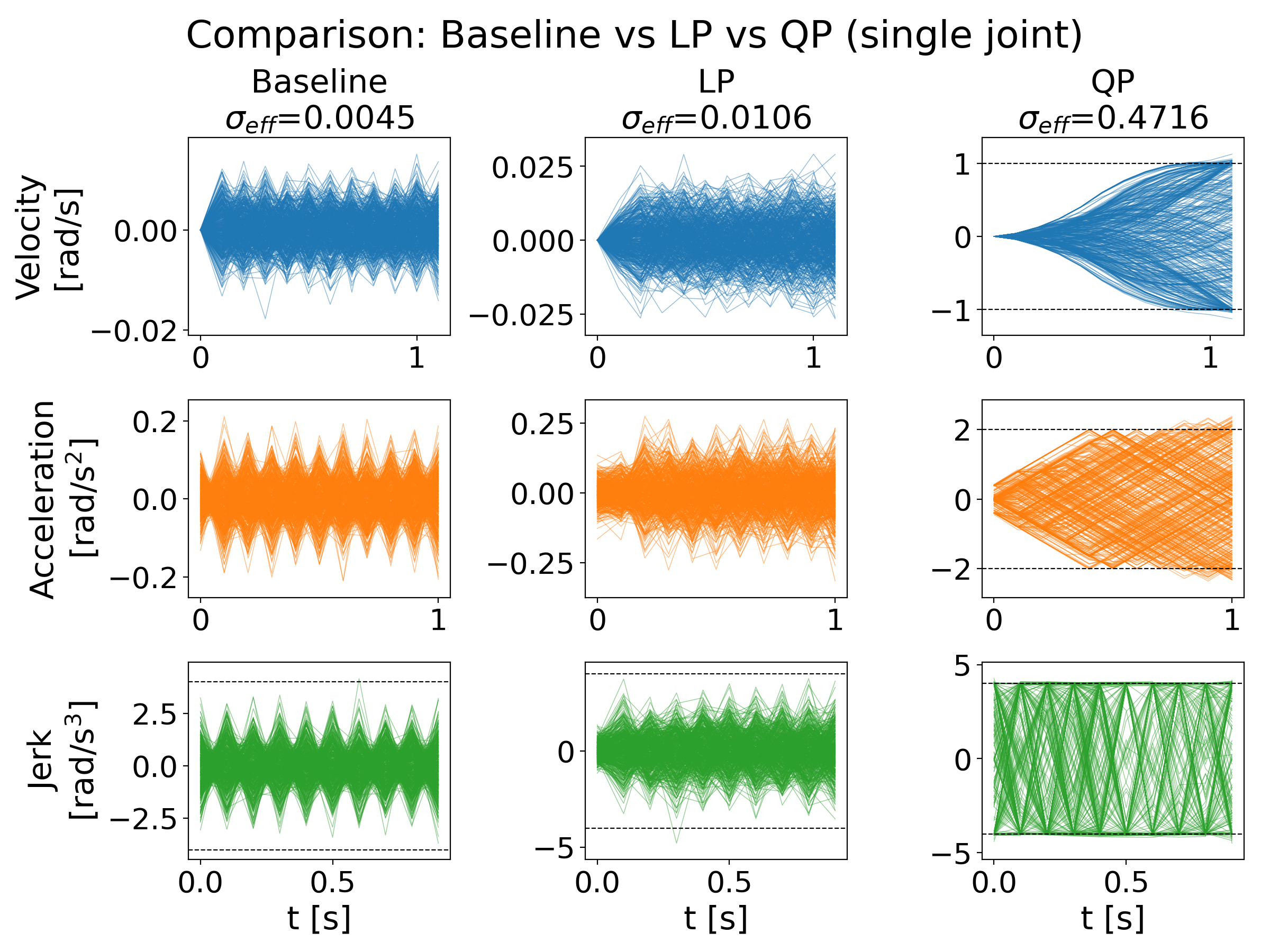
PRISM is a sampling-based Model Predictive Control framework that uses a GPU-accelerated physics simulator as an online world model for complex dual-arm manipulation. Its key contribution is a QP-guided control sampling strategy that projects sampled joint-velocity trajectories onto the set of motions satisfying kinematic bounds before rollout evaluation, using a custom ADMM/Bregman-splitting QP solver. Bayesian optimization is used to tune task-cost weights offline, and the method improves robustness and success rates in cluttered, contact-rich bimanual tasks.
中文摘要: PRISM提出一种采样型模型预测控制(MPC)框架,利用GPU加速物理仿真器作为在线世界模型,处理双臂在杂乱、接触丰富环境中的协调运动。主要创新是QP引导的控制采样策略:在每个MPC步中,将采样的关节速度轨迹投影到满足关节位置、速度、加速度及加加速度边界和初始速度边界条件的可行集合后再进行rollout评估,从而在保证运动学可行性的同时实现广泛探索。作者推导了基于ADMM/Bregman分裂的定制QP求解器,利用关节间可分离性和可复用矩阵分解加速在线计算,并用贝叶斯优化离线调整任务代价权重。在障碍约束的球搬运、托盘搬运、方块交接和箱子举升等任务上验证了鲁棒性和成功率提升。
💬 Novel MPC architecture with projection-based sampling and Bayesian weight tuning; transferable to legged locomotion contact-rich control.
💬 新颖的MPC架构,结合投影采样和贝叶斯权重调节,可迁移到腿足机器人接触丰富场景的运动控制。
Why read it / 推荐理由: The projection-integrated sampling scheme and ADMM solver are directly useful for whole-body MPC on legged robots. 投影采样方案与ADMM求解器对腿足机器人的全身MPC具有直接借鉴意义。
4. SUPER ODOMETRY 2.0: Resilient Odometry via Hierarchical Adaptation
超级里程计2.0:基于分层自适应的弹性里程计
Authors / 作者: Shibo Zhao, Sifan Zhou, Yuchen Zhang, Ji Zhang, Chen Wang, Wenshan Wang et al.
arXiv: 2608.25427 · PDF
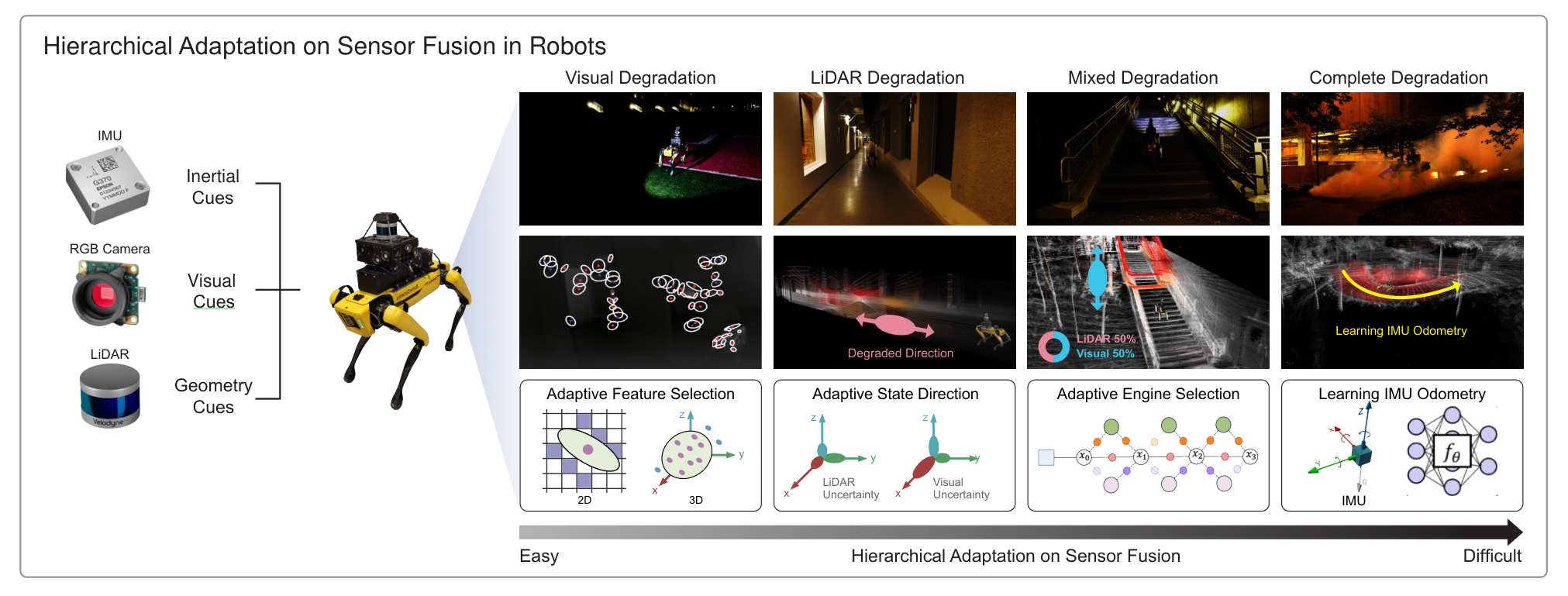
Super Odometry is a sensor-fusion framework that dynamically adapts to environmental degradation through hierarchical modules including adaptive feature selection, adaptive state direction selection, adaptive engine selection, and a learning-based inertial odometry. The inertial odometry is trained on over 100 hours of heterogeneous robot data, including legged platforms, and elevates the IMU to equal importance with camera and LiDAR. It has been validated across 200 kilometers and 800 operational hours on aerial, wheeled, and legged robots under diverse degradation and aggressive motion.
中文摘要: 超级里程计2.0提出一种分层传感器融合框架,通过自适应性特征选择、状态方向选择、引擎选择以及基于学习的惯性里程计,动态适应烟雾、沙尘暴、降雪、低光照等传感器退化环境。惯性里程计在超过100小时的异构机器人平台数据上训练,涵盖轮式、飞行器和腿足机器人,能够捕捉全面运动动态;框架将IMU与相机、LiDAR置于同等地位,在外感受传感器失效时提供可靠后备。系统已在空中、轮式和腿式机器人车队上累计200公里、800小时运行验证,支持多种传感器配置、环境退化和激进运动模式。
💬 Robust state estimation validated on legged robots; important for real-world legged autonomy and sim-to-real deployment.
💬 在腿足机器人上验证的鲁棒状态估计,对腿足机器人实际自主与sim-to-real部署很重要。
Why read it / 推荐理由: Provides resilient odometry and state feedback essential for closed-loop locomotion controllers in degraded environments. 为退化环境下的闭环运动控制器提供弹性里程计和状态反馈,是腿足机器人可靠控制的基础。
5. Control-Oriented Learning for Dynamic Tracking and Stability Analysis of Soft Pneumatic Actuators
面向软气动执行器动态跟踪与稳定性分析的控制导向学习
Authors / 作者: Nithin S. Kumar, Eric J. Barth
arXiv: 2608.25171 · PDF
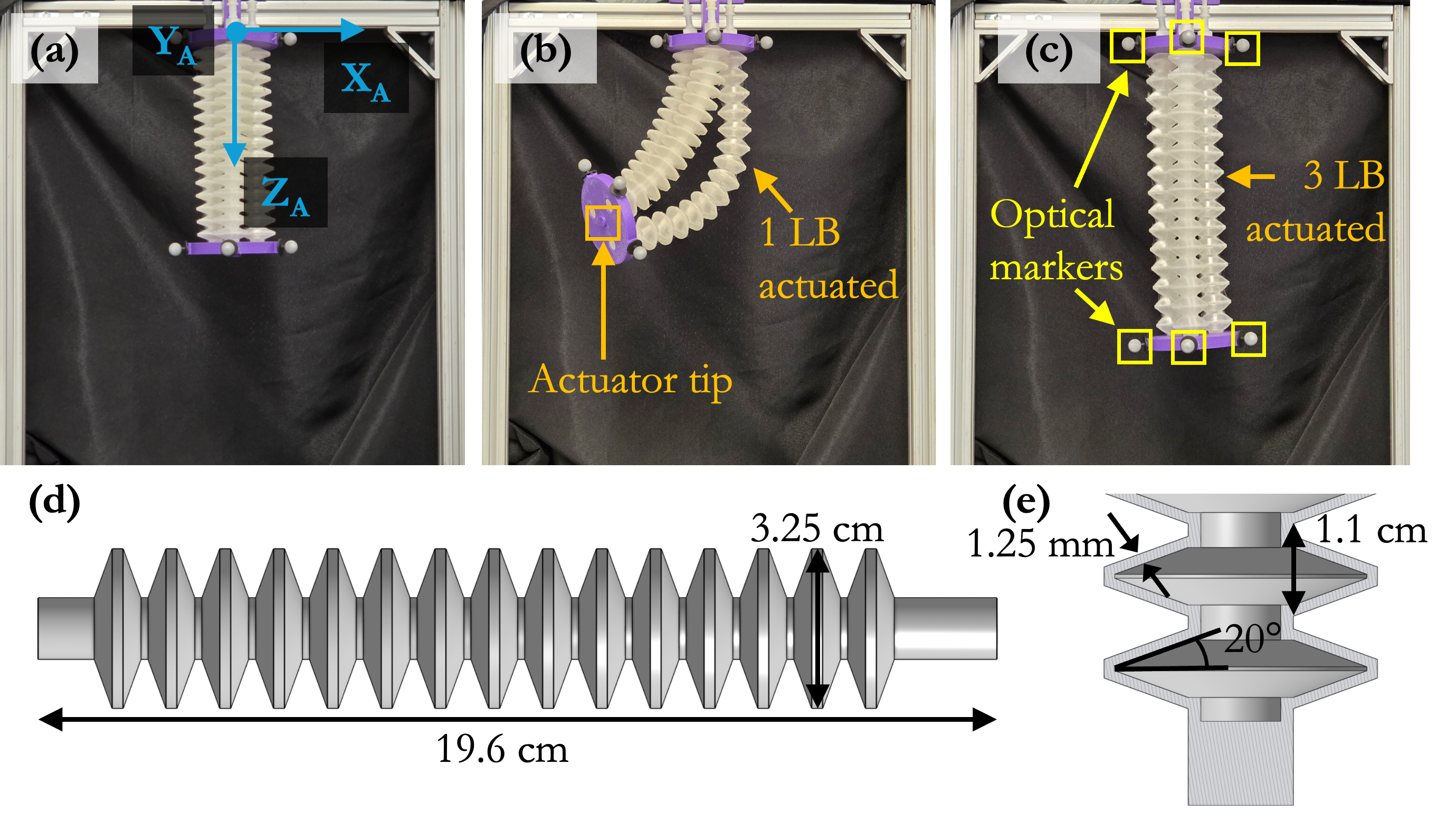
This paper presents a control-oriented data-driven modeling and control framework for soft pneumatic actuators, decomposing actuator behavior into a nonlinear static equilibrium model and a linear residual dynamics model identified using Extended Dynamic Mode Decomposition with control (EDMDc). This representation enables feedforward compensation, task-space feedback control, and local closed-loop stability analysis through an augmented linear model. Real experiments achieve approximately 1 mm RMSE at low speed, below 10 mm RMSE at higher speeds, and accurate prediction of stable, marginal, and unstable regimes.
中文摘要: 该文提出面向软气动执行器的控制导向数据驱动建模与控制框架,将执行器行为分解为非线性静态平衡模型和基于扩展动态模式分解(EDMDc)辨识的线性残差动力学模型。该表示支持前馈补偿、任务空间反馈控制以及通过增广线性模型进行局部闭环稳定性分析。实验在约10 mm/s低速轨迹跟踪时达到约1 mm RMSE,在约100 mm/s高速时误差低于10 mm,并能稳定跟踪峰值加速度超过25 m/s²的动态用户自定义参考轨迹,同时实时避障。稳定性分析准确预测了稳定、临界和不稳定运行区间。
💬 A structured data-driven control pipeline for compliant actuators; relevant to soft or modular legged legs with high compliance.
💬 面向柔顺执行器的结构化数据驱动控制方法,对高柔顺性的软体或模块化腿足具有参考价值。
Why read it / 推荐理由: Offers a practical control-oriented modeling and stability analysis recipe that could improve tracking and safety of compliant modular leg actuators. 提供实用的控制导向建模与稳定性分析方案,可改善柔顺模块化腿执行器的跟踪性能与安全性。