Robotics Digest
Robotics Paper Digest — 2026-08-26
🤖 Scanned 302 new arXiv papers (cs.RO / eess.SY / cs.LG, last 48 h), picked 5 for modular & legged robotics — summarized by DeepSeek.
🤖 扫描了近 48 小时 arXiv(cs.RO / eess.SY / cs.LG)的 302 篇新论文,围绕模块化与足式机器人精选 5 篇 — 由 DeepSeek 生成双语摘要。
1. CARO: Contact-Agnostic Residual Observation for Zero-Shot Robust Quadruped Locomotion
CARO:用于零样本鲁棒四足运动的接触无关残差观测方法
Authors / 作者: Zihan Yang, Shixuan Han, Kexin Guo, Xiang Yu
arXiv: 2608.24217 · PDF
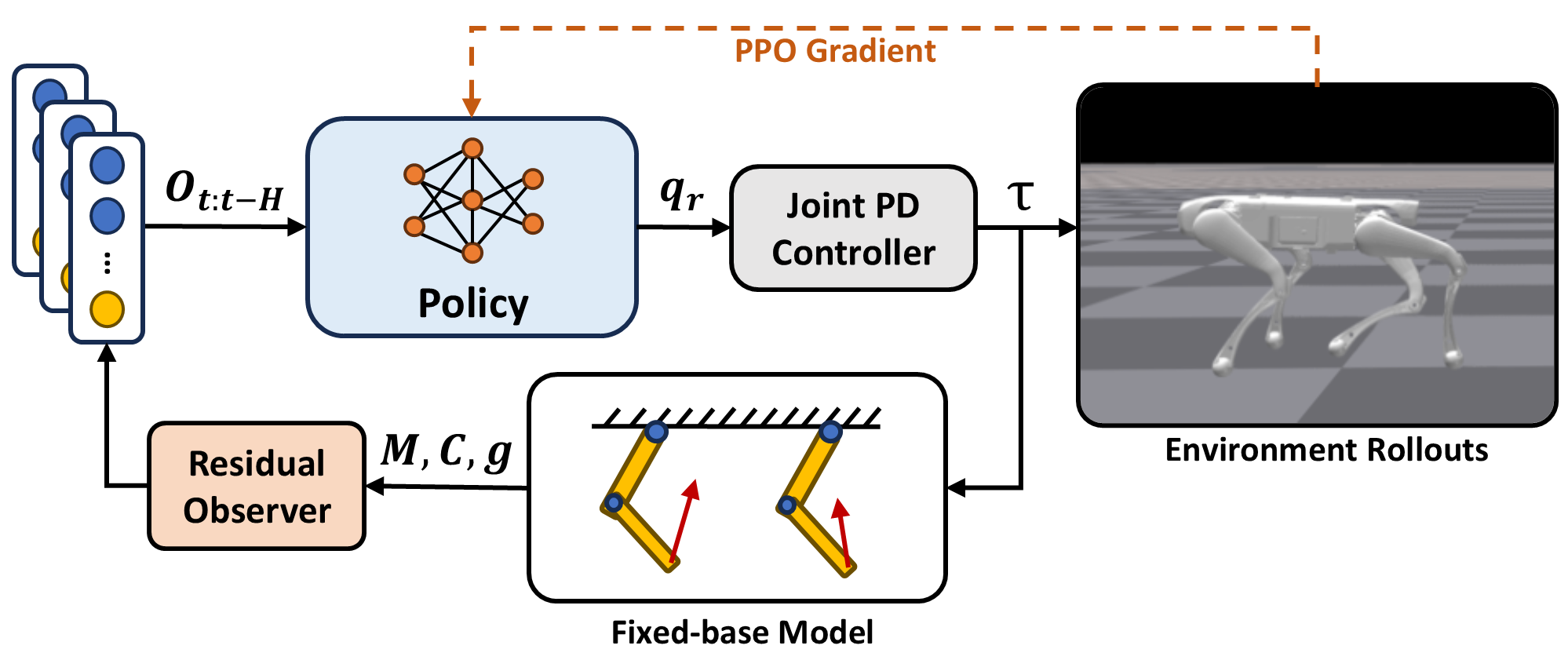
CARO introduces a contact-agnostic residual observation framework for policy adaptation in quadruped locomotion. It embeds a fixed-base Euler-Lagrange model into the RL loop, allowing torque-level residual observations without torque sensors or explicit contact estimation. A disturbance observer extracts dynamics mismatch, which the policy uses for online adaptation, achieving substantially improved zero-shot robustness in simulation and sim-to-real tasks with out-of-distribution payloads, terrain geometries, and abrupt dynamics changes.
中文摘要: CARO提出了一种接触无关的残差观测框架,用于四足运动中的策略自适应。该方法将固定基座的欧拉-拉格朗日模型嵌入强化学习控制环路,无需扭矩传感器或显式接触估计即可构造扭矩级残差观测。通过扰动观测器提取表示动力学不匹配的结构化信号,策略利用该反馈实现在线自适应。CARO在与名义策略相同的地形、命令和域随机化条件下训练,无需专门的扰动课程或额外的自适应监督,但在仿真和仿真到现实迁移任务中,针对分布外载荷、质心偏移、地形几何、突变动力学和平台着陆,零样本鲁棒性显著提升。该方法有效应对动力学变化,提高了四足机器人驱动的通用性和可靠性。
💬 Directly targets quadruped locomotion with a clever contact-agnostic adaptation mechanism that avoids reliance on torque sensors.
💬 直接针对四足运动,提出一种巧妙的接触无关自适应机制,避免对扭矩传感器的依赖。
Why read it / 推荐理由: This paper presents a highly practical robustness method for legged locomotion in the presence of unmodeled dynamics, with demonstrated sim-to-real success. 该论文提出了一种高度实用的鲁棒性方法,用于在未建模动力学存在下的腿部运动,并展示了仿真到现实的成功。
2. Safety-aware Model Predictive Path Integral Control with Signal Temporal Logic
基于信号时序逻辑的安全感知模型预测路径积分控制
Authors / 作者: Yiqi Zhao, Taekyung Kim, Hideki Okamoto, Bardh Hoxha, Jyotirmoy V. Deshmukh, Lars Lindemann et al.
arXiv: 2608.23972 · PDF
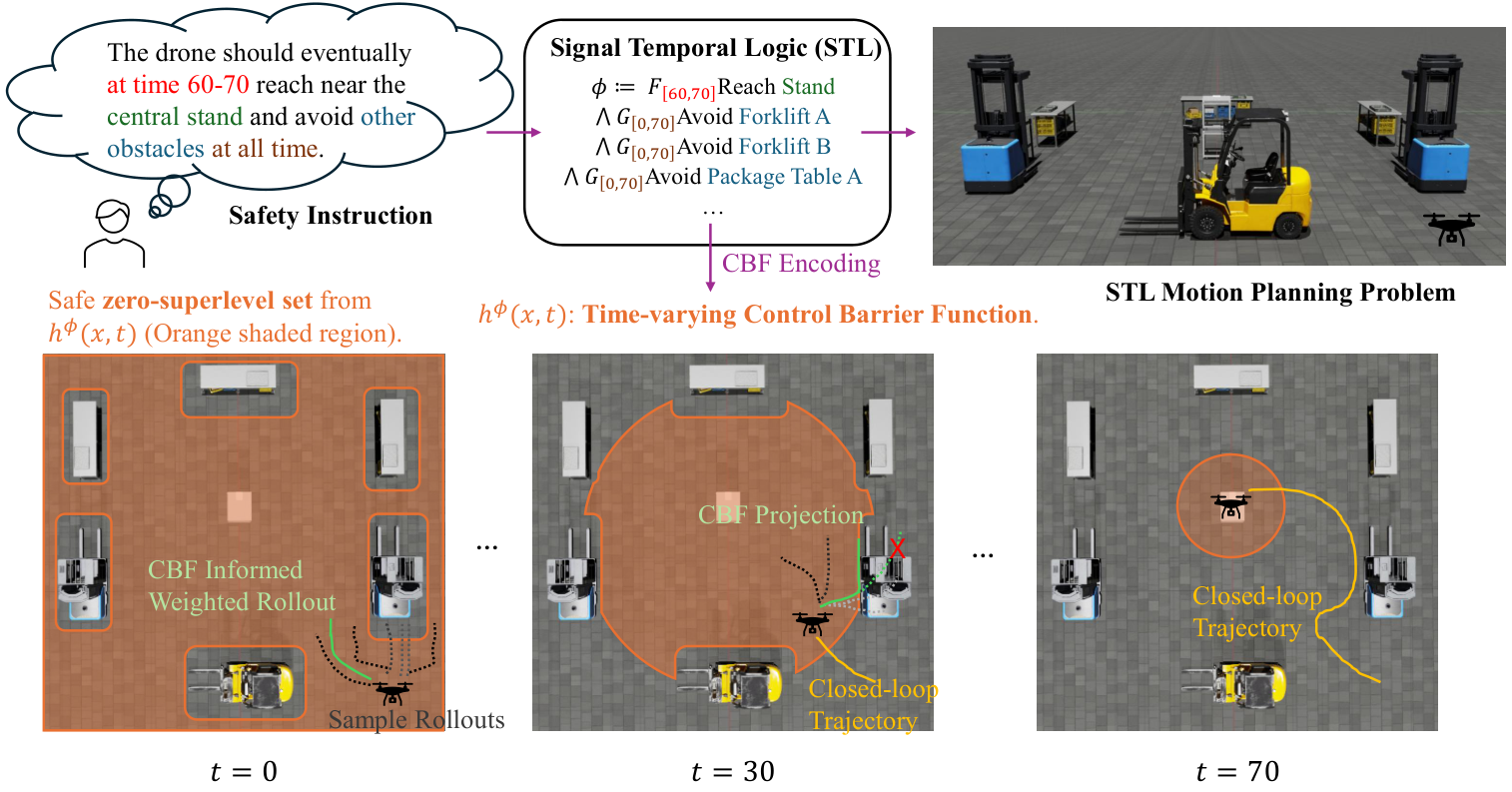
The paper proposes safety-aware-stl-mppi, a sampling-based receding-horizon planning framework that encodes discrete-time STL formulas into candidate time-varying control barrier functions, integrated into MPPI. It inherits low computational cost from parallelizable sampling and ensures STL constraint satisfaction, demonstrating consistent safety and efficiency in Mars Rover case studies and a quadcopter experiment in NVIDIA Isaac Lab.
中文摘要: 本文提出 safety-aware-stl-mppi,一种基于采样的滚动时域规划框架,将离散时间信号时序逻辑(STL)公式编码为候选时变控制障碍函数,并集成到模型预测路径积分(MPPI)控制器中。该方法继承了并行化采样的低计算成本,并利用CBF促进STL约束的满足。在四个人工火星车规划案例中,与多个MPPI基线相比,该方法持续实现了更高的安全性和效率;还在NVIDIA Isaac Lab中进行了四旋翼规划实验。该框架为时间关键型任务下的复杂规格约束提供了高效且安全的运动规划方案。
💬 Relevant to MPC for legged robots as MPPI is a popular control choice, and the STL-based safety constraints can be adapted to traversal-aware planning.
💬 与腿足机器人的MPC相关,因为MPPI是常用的控制选择,基于STL的安全约束可适用于穿越感知规划。
Why read it / 推荐理由: MPPI is widely used in legged locomotion, and this work shows how to explicitly enforce temporal-logic safety, useful for complex missions. MPPI广泛用于腿足运动,本工作展示了如何显式强制时序逻辑安全性,对复杂任务有用。
3. WarpSAC: Towards the Pinnacle of Scalable Off-policy RL by Rethinking Exploration and Exploitation
WarpSAC:通过重新思考探索与利用达到可扩展离策略强化学习的巅峰
Authors / 作者: Zihao Wu, Hongyao Tang, Yi Ma, Huizhong Song, Pengyi Li, Yifu Yuan et al.
arXiv: 2608.24479 · PDF
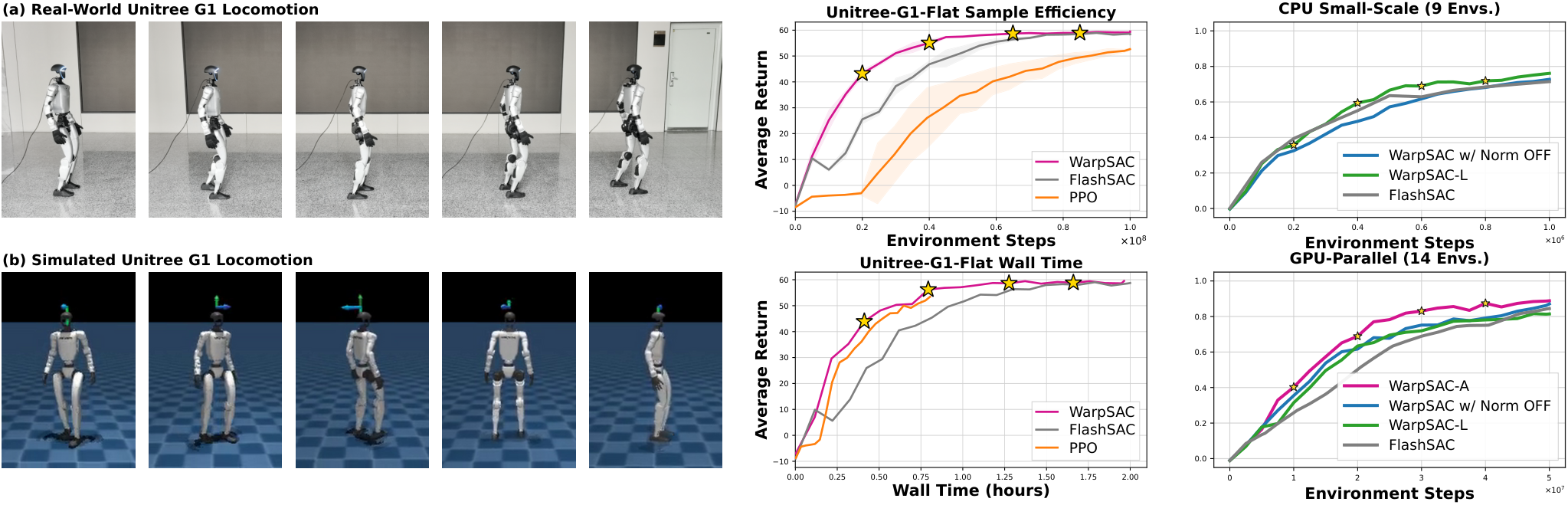
WarpSAC is a regime-aware family of off-policy RL algorithms that adapt stabilization techniques to the data regime (limited vs. abundant). It uses Sample Weight Decay for efficient exploitation and provides variants for CPU and GPU parallel training. It improves normalized score-step AUC over FlashSAC across many environments, including a Unitree G1 humanoid task with a 96.4% success rate and faster sim-to-real deployment.
中文摘要: WarpSAC是一个数据体制感知的离策略强化学习算法家族,根据数据规模(有限或丰富)自适应调整稳定化技术。它使用样本权重衰减实现高效利用,并提供两种变体:WarpSAC-L适用于数据受限的CPU规模训练,WarpSAC-A适用于数据丰富的GPU并行训练。在九个CPU规模环境和十四个GPU并行环境中,WarpSAC相比FlashSAC将归一化得分-步数AUC分别提高了4.5%和23.1%。在UnitreeG1搬箱任务中,成功率从19.8%提升到96.4%,在MuJoCo Playground上的平均归一化墙钟时间AUC提升了19.1%,且在Unitree G1上的仿真到现实部署比FlashSAC快36.4%。这些结果表明,可扩展的离策略RL应根据可用数据体制调整其稳定器。
💬 While demonstrated on a humanoid, the algorithm’s focus on scalable off-policy RL with sim-to-real results is highly relevant to RL-based control of legged robots.
💬 尽管在仿人机器人上演示,但其对可扩展离策略RL和仿真到现实的关注与腿足机器人RL控制高度相关。
Why read it / 推荐理由: It provides concrete improvements in RL training efficiency and sim-to-real transfer, directly benefiting legged robot policy learning. 它在RL训练效率和仿真到现实迁移方面提供了具体改进,直接有益于腿足机器人策略学习。
4. Learning to Act While Waiting: RL Finetuning of Generalist Robot Policies Under Inference Latency
在等待中学习:推理延迟下通用机器人策略的强化学习微调
Authors / 作者: Brian Zhu, Momen Khalil, E Harrison, Emanuele Poggi, Philipp Schmitt, Bernd Kast et al.
arXiv: 2608.23831 · PDF
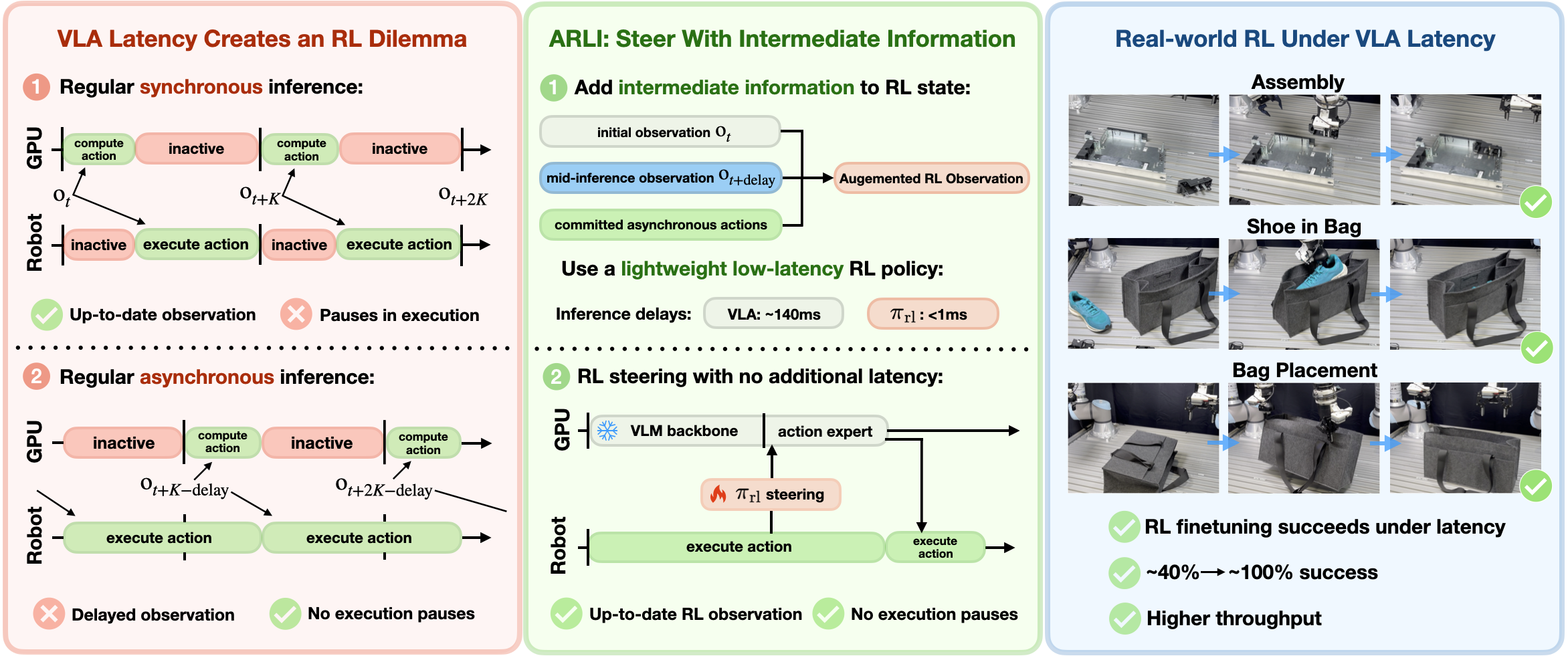
ARLI (Asynchronous RL with Intermediate Information) enables RL-based finetuning of generalist robot policies under inference latency. It uses asynchronous inference and state augmentations that restore near-Markovian structure by incorporating committed actions and a mid-inference observation. Experiments on simulated and real manipulation tasks show it matches or exceeds performance of standard RL in no-latency settings.
中文摘要: ARLI(异步强化学习与中间信息)框架使得在推理延迟下能够对通用机器人策略进行强化学习微调。它采用异步推理,通过结合已执行动作和推理中观测来恢复近似马尔可夫结构。该框架设计了低延迟策略,最大化推理窗口内的响应性。在模拟和真实操作任务中,该方法在存在推理延迟时有效地进行微调,而标准RL完全失效,甚至在理想无延迟设置中达到了与标准RL相当或更好的性能。这一方法对于部署大模型策略到实际机器人系统具有重要价值。
💬 Inference latency is a common issue for deploying large policies on legged robots; this framework provides a principled way to finetune under such constraints.
💬 推理延迟是腿足机器人部署大策略时常见的问题;该框架提供了一种在这种约束下进行微调的原则性方法。
Why read it / 推荐理由: It addresses a practical bottleneck (latency) in RL deployment, which is critical for real-time legged control. 它解决了RL部署中的一个实际瓶颈(延迟),这对实时腿部控制至关重要。
5. NeurRAFT: Robot Motion Planning via Anchor-Level Flow Matching with Clearance-Aware Preference Tuning
NeurRAFT:基于锚点级流匹配与间隙感知偏好调优的机器人运动规划
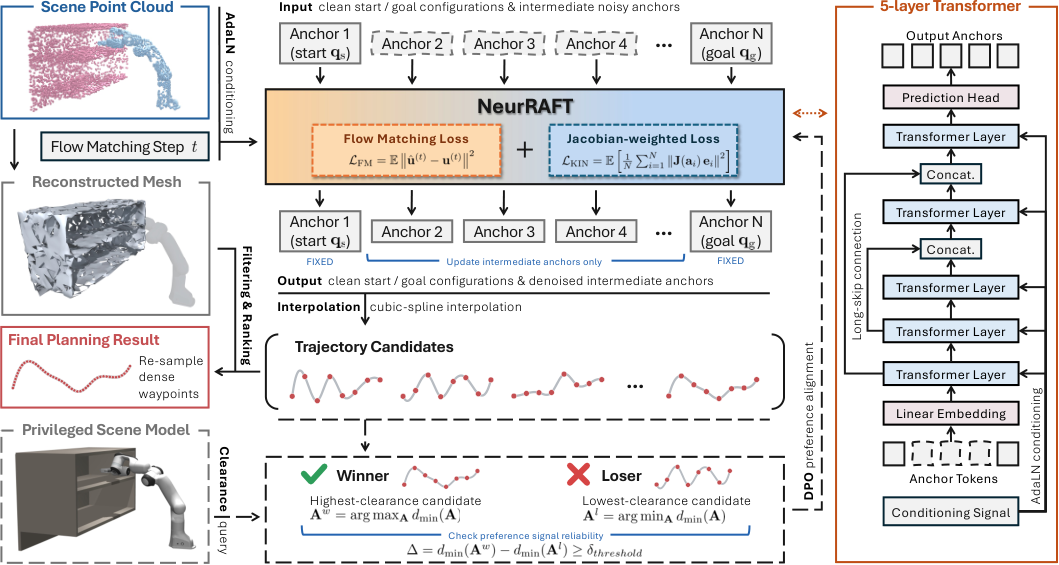
Authors / 作者: Sibo Tian, Chang Liu, Minghui Zheng, Xiao Liang
arXiv: 2608.24026 · PDF
NeurRAFT is a generative motion planning framework based on anchor-level flow matching and clearance-aware preference tuning. It operates on compact anchor waypoints with a Jacobian-weighted loss, and uses Direct Preference Optimization to shift probability mass toward trajectories with larger obstacle clearance, improving safety without post-hoc corrections. Experiments show substantial improvements over state-of-the-art planners.
中文摘要: NeurRAFT是一种基于锚点级流匹配和间隙感知偏好调优的生成式运动规划框架。与在密集路点上建模不同,它操作在紧凑的锚点路点上,并使用考虑任务空间影响的雅可比加权损失训练规划器。推理时,两步生成锚点,然后通过三次样条插值恢复光滑的全分辨率轨迹。由于模仿学习无法区分无碰撞和近碰撞轨迹,作者利用直接偏好优化将预训练规划器的分布重塑为更安全、间隙更大的轨迹。在多个基准上,NeurRAFT显著优于现有最优方法,并消融实验验证了目标相对全局表示和终端集成的有效性。
💬 The clearance-aware preference tuning aligns with traverse-capability-aware path planning for modular legged robots.
💬 间隙感知偏好调优与模块化腿足机器人的穿越能力感知路径规划相契合。
Why read it / 推荐理由: It addresses safe navigation in cluttered environments, relevant to path planning for legged platforms. 它解决了杂乱环境中的安全导航问题,与腿足平台的路径规划相关。