Robotics Digest
Robotics Paper Digest — 2026-08-25
🤖 Scanned 224 new arXiv papers (cs.RO / eess.SY / cs.LG, last 48 h), picked 5 for modular & legged robotics — summarized by DeepSeek.
🤖 扫描了近 48 小时 arXiv(cs.RO / eess.SY / cs.LG)的 224 篇新论文,围绕模块化与足式机器人精选 5 篇 — 由 DeepSeek 生成双语摘要。
1. Guided Riemannian Optimization (GuRO): Bridging Model Predictive Control and Decision Transformers
引导式黎曼优化(GuRO):弥合模型预测控制与决策Transformer之间的鸿沟
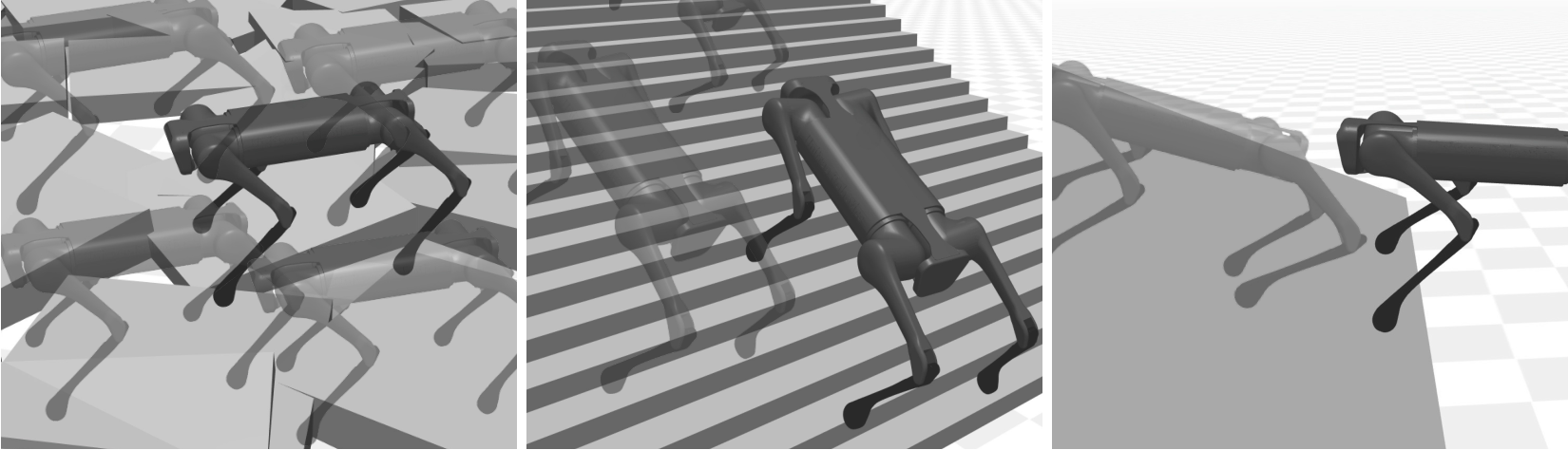
Authors / 作者: Hossein Abdi, Satya Prakash Dash, Mingfei Sun
arXiv: 2608.23204 · PDF
This paper proposes GuRO, a framework that integrates MPC with RL in a sequence decision-making setup, where MPC provides local trajectory predictions to guide a decision transformer, removing the need for offline pretraining. Policy training is done in a Riemannian parameter space using curvature-aware optimization for faster and more robust convergence. The method is evaluated on high-dimensional quadruped control tasks, showing consistent improvements over baselines.
中文摘要: 本文提出GuRO,一种将模型预测控制(MPC)与强化学习(RL)相结合的新型序列决策框架。MPC提供局部最优轨迹预测来指导决策Transformer,从而无需大量离线预训练。为解决传统优化器收敛慢且不稳定的问题,策略在黎曼参数空间中使用曲率感知优化方法进行训练,提高了优化效率和鲁棒性。在高维四足机器人控制任务上进行了评估,结果表明该方法持续优于现有基线。该方法将MPC的可解释性和样本效率与RL的自适应能力相结合,为四足机器人的运动控制提供了新思路。
💬 A strong integration of MPC and RL with curvature-aware optimization yields faster, more robust quadruped control policies.
💬 通过曲率感知优化将MPC与RL紧密结合,能够更快、更稳定地训练四足控制策略。
Why read it / 推荐理由: Directly advances MPC+RL for quadruped locomotion with a novel Riemannian optimization approach. 直接推进了四足运动中的MPC+RL方法,提出了新颖的黎曼优化策略。
2. Physics Filtering Favors the Generalization of Robot Learning
物理滤波有助于机器人学习的泛化
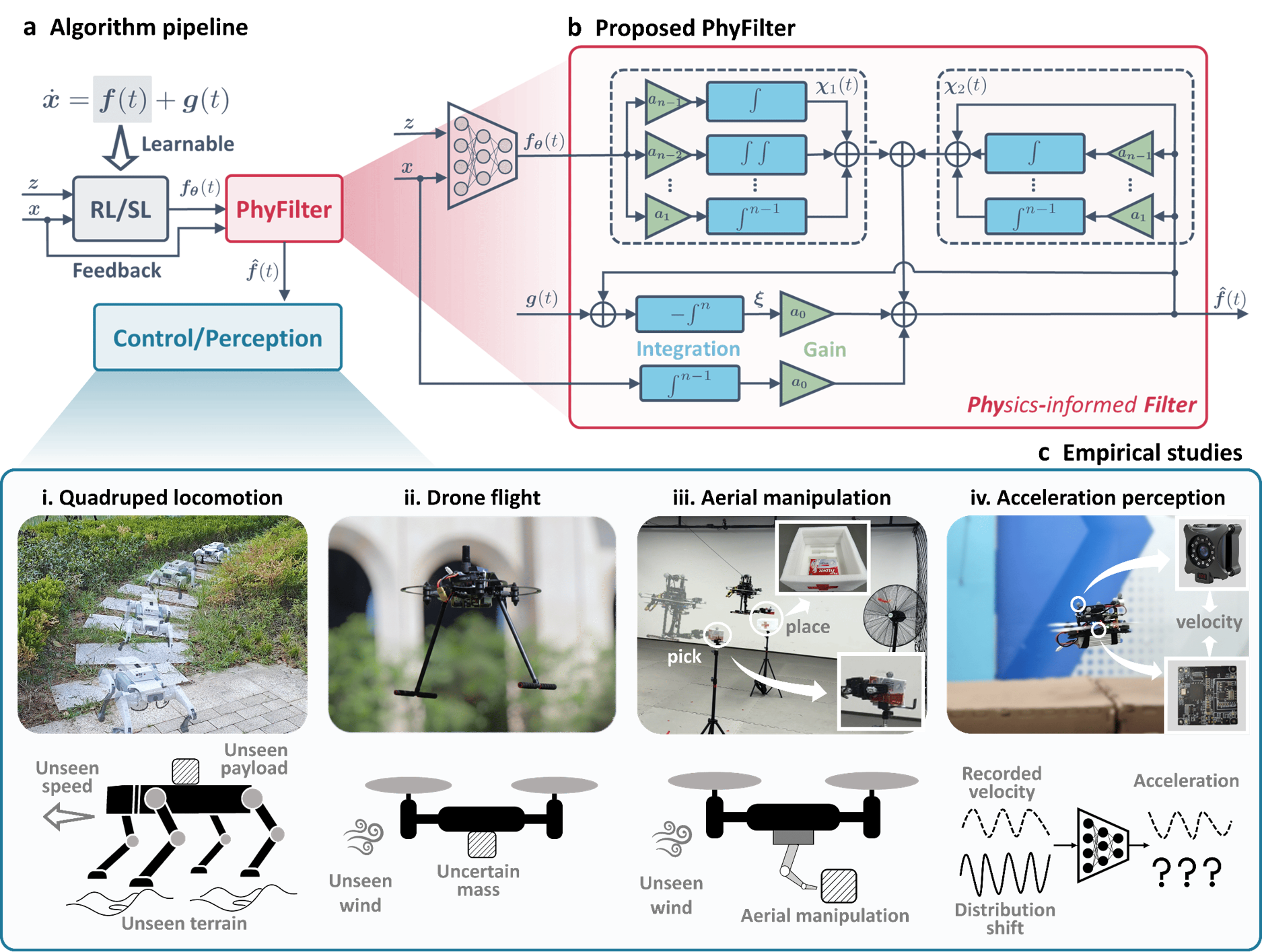
Authors / 作者: Jindou Jia, Shixuan Han, Meng Wang, Gen Li, Zihan Yang, Sicheng Zhou et al.
arXiv: 2608.22701 · PDF
This paper presents PhyFilter, a lightweight, model-agnostic feedback module that corrects learning-based policy outputs with physics-filtered residuals, improving generalization under dynamics uncertainties. Parameters are auto-optimized via an auto-learning algorithm, eliminating manual tuning. Validated on quadruped robots, drones, aerial manipulators, etc., it enables quadrupeds to generalize to unseen terrains, payloads, and speeds.
中文摘要: 本文提出PhyFilter,一种轻量级的、与模型无关的反馈模块,通过学习残差的物理滤波校正学习输出,从而在动力学不确定下提高泛化能力。该模块通过自动学习算法自动优化参数,无需手动调整。在四足机器人、无人机、空中机械臂等多个代表性机器人系统上进行了验证,表明其能使四足机器人适应未见过的地形、负载和速度范围。该方法突破了依赖大规模数据的限制,仅需有限训练数据即可实现良好的泛化,对机器人学习在真实世界中的应用具有重要价值。
💬 A clever, model-agnostic correction module that enhances sim-to-real generalization for quadruped locomotion with limited data.
💬 一个巧妙且与模型无关的修正模块,在有限数据下提升了四足运动的sim-to-real泛化能力。
Why read it / 推荐理由: Directly addresses a core challenge in RL-based legged locomotion: robust sim-to-real transfer under limited data. 直接应对基于RL的腿部运动中的核心挑战:在有限数据下实现稳健的sim-to-real迁移。
3. TONAV: Task-Oriented Navigation and Action-Velocity Chunk Learning for Articulated Object Quadrupedal Mobile Manipulation
TONAV:面向铰接物体四足移动操作的任务导向导航与动作-速度块学习
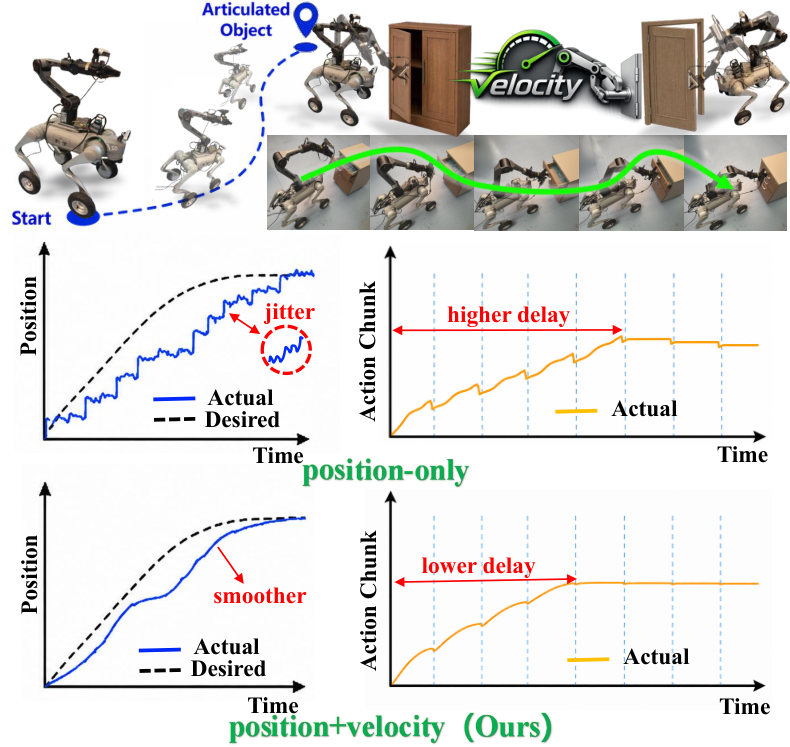
Authors / 作者: Haoran Lin, Mingyu Yang, Pengfei Qi, Kehan Chen, Qiang Diao, Liangji Zeng et al.
arXiv: 2608.22296 · PDF
TONAV unifies task-oriented navigation and action-velocity chunk learning for quadrupedal mobile manipulation. It introduces a position-velocity-coupled teleoperation framework for collecting smooth demonstrations, uses vision-language reasoning to refine the base to manipulation-ready configurations, and jointly models joint positions and temporal transitions to enable stable contacts. Real-world experiments on articulated objects show higher success rates in navigation and manipulation, mitigating the navigation-manipulation gap.
中文摘要: TONAV是一个统一的框架,结合任务导向导航与动作-速度块学习,用于四足移动操作。首先,提出位置-速度耦合的遥操作框架,以捕获运动动力学并收集平滑、时间上一致的演示。其次,任务导向导航利用视觉-语言推理将高级指令分解为可执行的子目标,并自适应地调整机器人基座至可操作配置。最后,动作-速度块学习在速度监督下联合建模关节位置及其时间变化,实现平滑稳定的持续接触操作。在多种铰接物体任务上的真实实验表明,TONAV提高了任务导向导航和完整移动操作的成功率,缓解了导航与操作之间的鸿沟。
💬 A well-engineered, real-validated framework directly tackling the navigation-manipulation coupling on quadruped robots.
💬 一个经过真实验证的工程化框架,直接解决了四足机器人导航与操作的耦合问题。
Why read it / 推荐理由: Offers practical, real-world validated methods for whole-body control and manipulation on quadruped platforms. 为四足平台上的全身控制与操作提供了经过真实世界验证的实用方法。
4. DreamMimic: Learning Visuomotor Whole-Body Loco-Manipulation via World Model
DreamMimic:通过世界模型学习视觉运动全身运动-操作
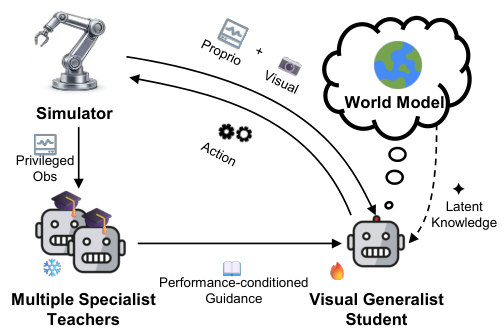
Authors / 作者: Jie Yin, Xingyu Lai
arXiv: 2608.22278 · PDF
DreamMimic distills privileged teacher policies into vision-based humanoid controllers via world-model-assisted distillation. It repurposes a Dreamer-style RSSM to learn predictive latent dynamics, providing a representation space and action-conditioned multi-step supervision. The framework includes auxiliary prediction heads for privileged state, contact, object state, and reward, and a Performance-Conditioned Guidance (PCG) schedule that dynamically balances teacher-student distillation. This enables contact-rich whole-body loco-manipulation from visual inputs.
中文摘要: DreamMimic通过世界模型辅助蒸馏,将特权教师策略蒸馏为基于视觉的人形机器人控制器。它重新利用Dreamer风格的RSSM学习预测性潜在动力学,既作为表示空间,又提供动作条件下的多步监督信号。为了减少长期漂移,向学生策略暴露紧凑的预测特征。除了标准的重建目标外,还添加了用于特权状态、接触、物体状态和奖励估计的辅助预测头,增强潜在表示对接触丰富的操作任务的保留。此外,引入性能条件指导(PCG),根据教师和学生的表现动态调整蒸馏过程,防止过早退火。该方法在视觉输入下实现了稳健的全身运动-操作。
💬 A novel world-model-assisted distillation framework that effectively handles high-dimensional visual inputs for whole-body loco-manipulation.
💬 一种新颖的基于世界模型辅助蒸馏的框架,有效处理高维视觉输入以实现全身运动-操作。
Why read it / 推荐理由: Provides a state-of-the-art method for whole-body control and sim-to-real transfer, highly transferable to modular legged platforms. 提供了全身控制与sim-to-real迁移的最新方法,对模块化腿部平台具有高度可迁移性。
5. Shaping the Evolutionary Dynamics of Robot Morphology via Adaptive Control Learning
通过自适应控制学习塑造机器人形态的进化动态
Authors / 作者: Junru Song, Yang Yang, Yaqing Xu, Ying Wen, Wei Peng, Guozhen Li et al.
arXiv: 2608.23100 · PDF
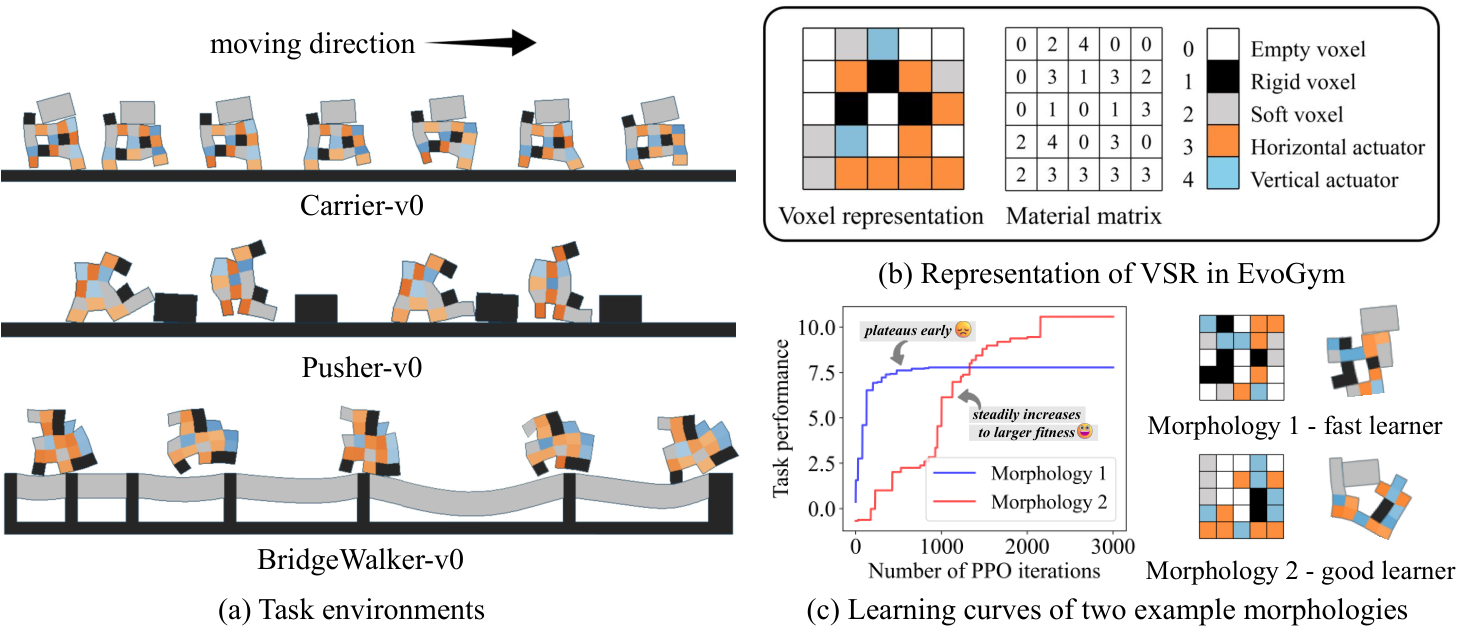
The paper investigates brain-body co-evolution in robot co-design, showing that morphological intelligence (convergence speed) and true potential (performance ceiling) are orthogonal dimensions. Using voxel-based soft robots, it reveals that premature fitness evaluation biases evolution towards fast learners, compromising diversity and optimization. The morphological Baldwin effect is shown to be an artifact of this bias, not a general tendency.
中文摘要: 本文研究机器人脑-体协同进化中控制学习对形态进化的影响。首先表明形态对控制学习的贡献可分解为两个正交维度:形态智能(收敛速度)和真实潜力(性能上限)。通过体素软体机器人的大量实验,揭示过早的适应度评估会系统性地低估真实潜力,并偏向选择快速学习者,从而限制了设计空间的探索,损害了优化效率和形态多样性。著名的形态鲍德温效应被证明是这种偏差的产物,而非普遍的进化趋势。该工作为模块化机器人的形态-控制协同设计提供了重要的理论洞见和实验方法。
💬 A rigorous study that clarifies how control learning shapes morphological evolution, informing modular legged design optimization.
💬 一项严谨的研究,阐明了控制学习如何塑造形态进化,为模块化腿部设计优化提供了参考。
Why read it / 推荐理由: Relevant for co-designing reconfigurable leg modules and controllers, offering evidence against premature fitness evaluation in evolutionary optimization. 与重构腿部模块和控制器的协同设计息息相关,提供了反对过早适应度评估的证据。