Robotics Digest
Robotics Paper Digest — 2026-08-24
🤖 Scanned 239 new arXiv papers (cs.RO / eess.SY / cs.LG, last 96 h), picked 5 for modular & legged robotics — summarized by DeepSeek.
🤖 扫描了近 96 小时 arXiv(cs.RO / eess.SY / cs.LG)的 239 篇新论文,围绕模块化与足式机器人精选 5 篇 — 由 DeepSeek 生成双语摘要。
1. Graph-Operator World Models for Morphology-Parameter Generalization in Continuous Control
面向连续控制中形态参数泛化的图算子世界模型
Authors / 作者: Xu Yang, Yiqin Yang, Qianchuan Zhao
arXiv: 2608.20936 · PDF
Proposes Graph-Operator World Models (GraphOp-WM), a structured world model that factorizes the transition dynamics into a morphology-independent local dynamics basis and a morphology-conditioned structured operator with node-local modulation, kinematic-tree coupling, and low-rank global correction. Evaluated on Hopper and Walker style robots with varying link geometry, mass, damping, and actuation parameters, including interpolation, extrapolation, and composition splits. The model improves generalization to unseen morphology parameters within related articulated robot families.
中文摘要: 提出一种用于连续控制中未见形态参数泛化的结构化世界模型Graph Operator World Models(GraphOp-WM)。该方法将机器人身体表示为属性图,并将状态转移分解为与形态无关的局部动力学基底和由形态条件化的结构化算子。结构化算子结合了节点局部调制、运动树耦合和低秩全局校正,并通过架构信息分离、基底归一化和配对形态监督,使静态形态依赖主要由算子通路承载。在图级读出和边级动作表征的支持下,模型可与奖励、价值函数及TD-MPC风格规划兼容。在Hopper、Walker等仿生腿上,针对连杆几何、质量、阻尼和驱动参数设计了插值、外推和组合保持的受控划分,实验表明其在未见形态参数下具有良好的泛化能力,为模块化腿式机器人因模块更换导致的动力学变化提供了有效的世界模型学习方案。
💬 Addresses morphology-parameter generalization directly, which is central to modular legged robot reconfiguration.
💬 直接处理形态参数泛化问题,对模块化腿式机器人的重构而言至关重要。
Why read it / 推荐理由: To learn a world model whose structured factorization can be reused when leg modules change. 了解一种结构化分解的世界模型,在腿部模块更换时可复用其动力学表示。
2. Demonstration-Guided Humanoid Stand-Up on an Emulated Deformable Surface
演示引导的人形机器人在仿真可变形表面上的站立动作
Authors / 作者: Aniruddh Kushwah, Vyankatesh Ashtekar, Ashish Dutta
arXiv: 2608.20852 · PDF
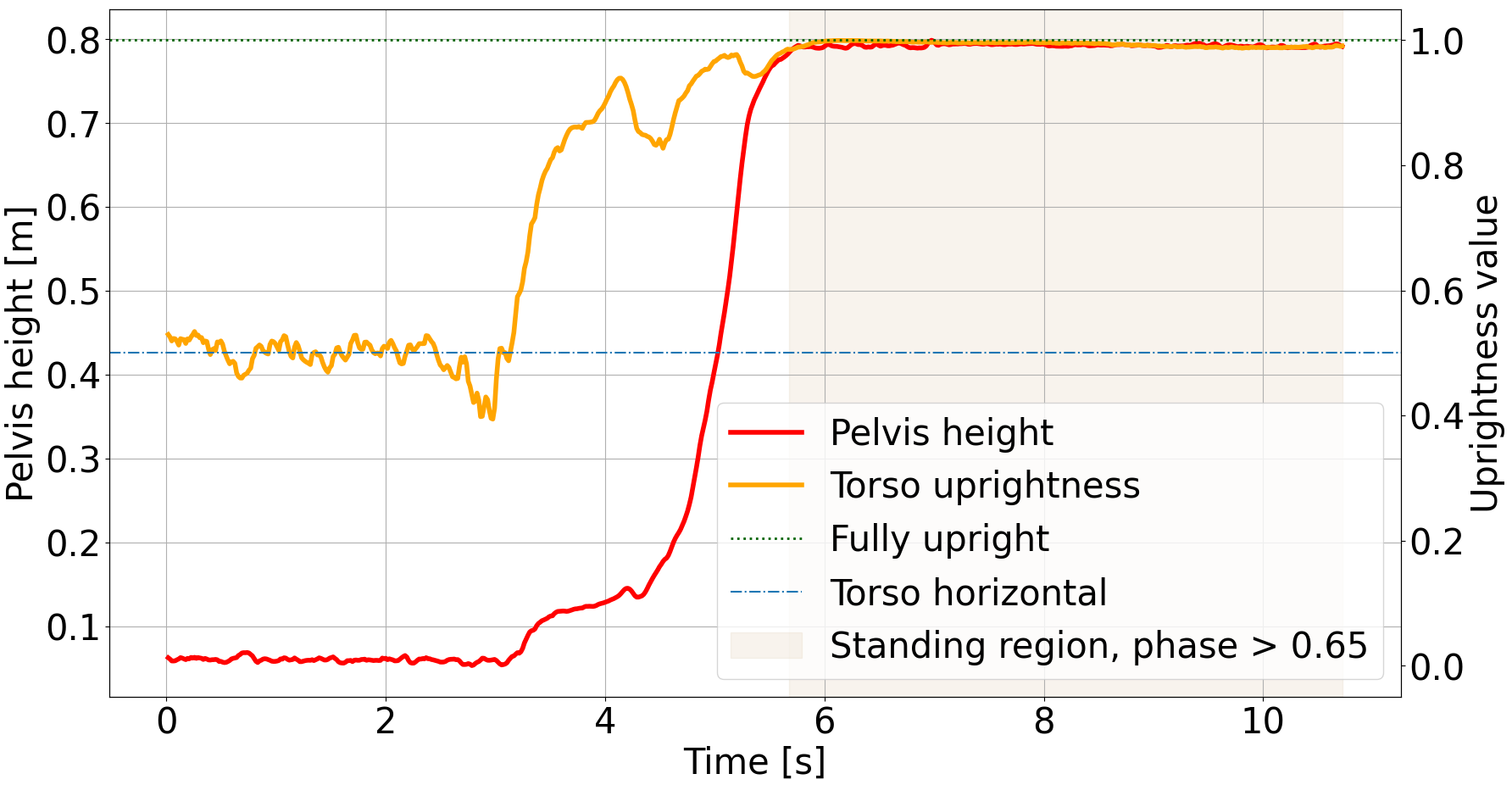
Presents a reference-guided reinforcement learning framework for generating stand-up motion of a 29-DOF Unitree G1 humanoid on soft deformable ground, using a human demonstration recorded on hard ground. Terrain compliance is modeled with MuJoCo’s solref and solimp soft-contact parameters, and training first on hard ground then on softer ground adapts the policy to delayed support forces. The learned policy succeeds in simulation with roughly 40 mm maximum contact penetration, and ablation shows reference tracking alone is insufficient.
中文摘要: 提出一种参考引导的强化学习框架,利用硬地面采集的人类演示为29自由度Unitree G1人形机器人生成可变形软地面上的站立运动。地形柔顺性通过MuJoCo刚体软接触模型的solref和solimp参数建模。奖励函数包含基于残差关节位置控制的参考运动跟踪,以及骨盆高度、躯干直立度和最终姿态等显式恢复目标。策略先在硬地面进行训练,随后通过更新solref降低地形刚度、扩大solimp名义表面穿透区域,使策略适应接触密集阶段因显著表面穿透而延迟的支持力生成,同时保留原始演示模式。学习策略在仿真中成功完成倒地到站立的过渡,达到目标骨盆高度和直立度,期间最大接触穿透约40毫米。在硬地面和软地面上均成功完成两次站立序列。消融研究表明,仅靠参考跟踪不足以实现成功站立,显式恢复目标与参考跟踪相结合是关键。
💬 Tackles legged whole-body RL under deformable contacts, a practical challenge for sim-to-real legged control.
💬 处理可变形接触下的腿式全身强化学习,是腿式机器人sim-to-real的实际挑战。
Why read it / 推荐理由: Directly relevant to RL-based stand-up and postural recovery on soft terrain, an edge case for legged robots. 与基于强化学习的软地面站立和姿态恢复直接相关,是腿式机器人面临的边缘情况。
3. Natural Sit-to-Stand Motion Synthesis For Humanoids via Guided Assistance Curricula and Staged Rewards
通过引导辅助课程和分阶段奖励合成自然人形机器人的坐站运动
Authors / 作者: Meet Pal Singh, Vyankatesh Ashtekar, Ashish Dutta
arXiv: 2608.20823 · PDF
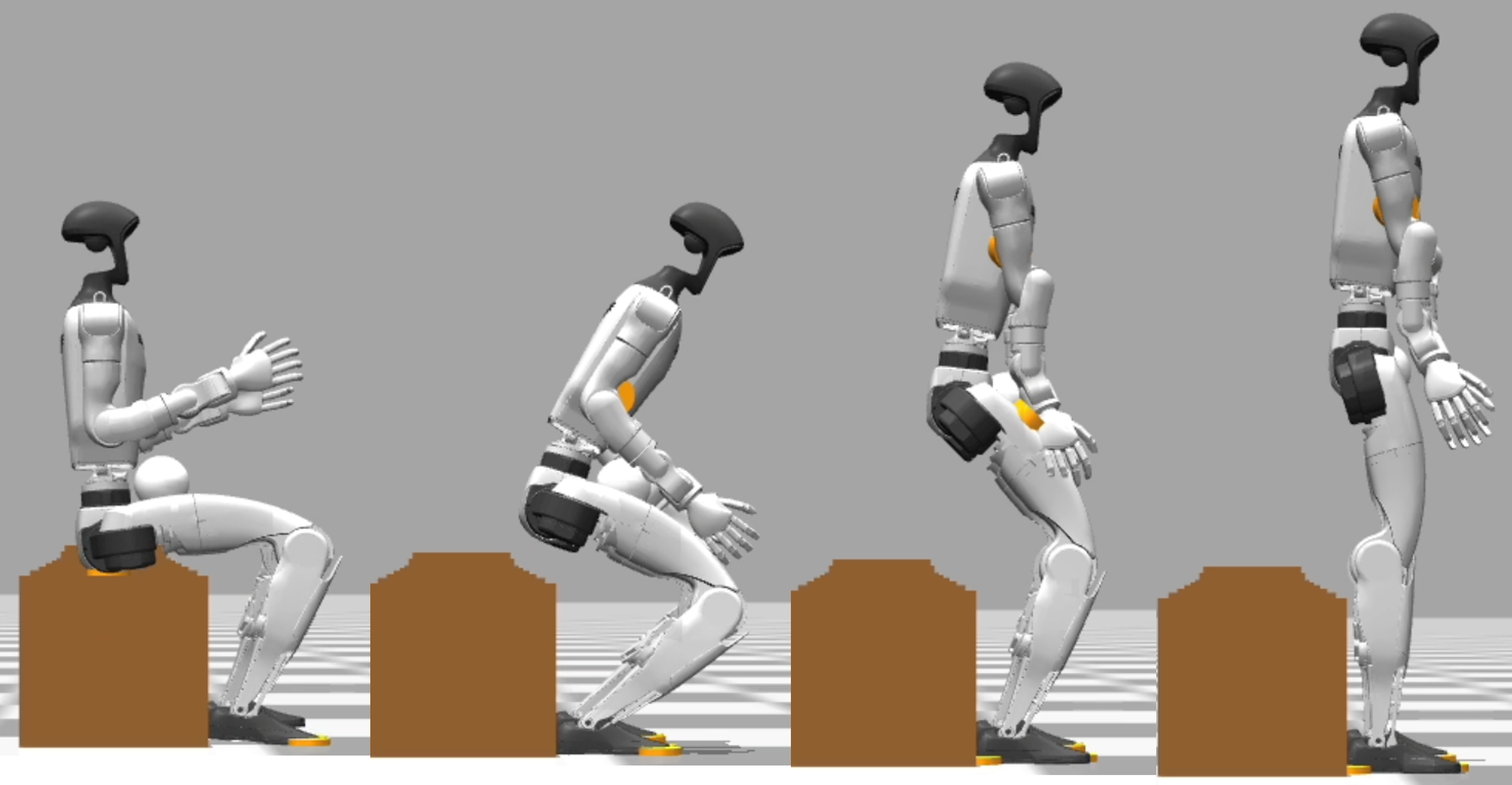
Synthesizes natural humanoid sit-to-stand motion from scratch using reinforcement learning without demonstrations, using a single PPO policy trained with a coupled force/chair-height curriculum, many IK-generated initial/target poses, and biomechanics-inspired rewards shaping angular momentum and center-of-pressure. The policy attains over 97% balanced-standing success across eight chair heights and produces smooth, human-like rising motion.
中文摘要: 提出一种无需演示或参考轨迹、从零合成自然坐站运动的强化学习方法。单个PPO策略依赖三个互补组件:(i)耦合的辅助力/椅子高度课程:垂直骨盆辅助力帮助早期轨迹探索并随训练衰减,同时逐步解锁更高椅子,确保策略在每个高度掌握可行轨迹后再面对更难任务,避免过早分布偏移导致泛化崩溃;(ii)通过逆运动学生成的覆盖八种椅子高度的大量初始和目标姿态进行随机采样,增强运动鲁棒性;(iii)受生物力学和最优控制启发的奖励函数,塑造离座时的角动量,并通过压力中心吸引函数实现支撑区域平稳转移,保证低力矩平滑驱动。在确定性无外力评估器上,策略在八种椅子高度下获得超过97%的平衡站立成功率,并泛化出平滑自然的起立运动,且无需任何外部辅助力。
💬 Whole-body RL with staged curricula and biomechanical rewards offers a robust recipe for difficult transition motions.
💬 采用分阶段课程和生物力学奖励的全身强化学习,为困难过渡动作提供了稳健的解决方案。
Why read it / 推荐理由: The curriculum and reward shaping can be transferred to modular legged platforms for sit-to-stand or stance transition control. 其课程设计和奖励塑形可迁移至模块化腿式平台,用于坐站或姿态转换控制。
4. SRL-MPC: Shape-Aware Reinforcement Learned Model Predictive Control
SRL-MPC:形状感知的强化学习模型预测控制
Authors / 作者: Ruihua Han, Rui Gao, Zhe Liu, Xinyi Wang, Chang Chen, Shuai Wang et al.
arXiv: 2608.21175 · PDF
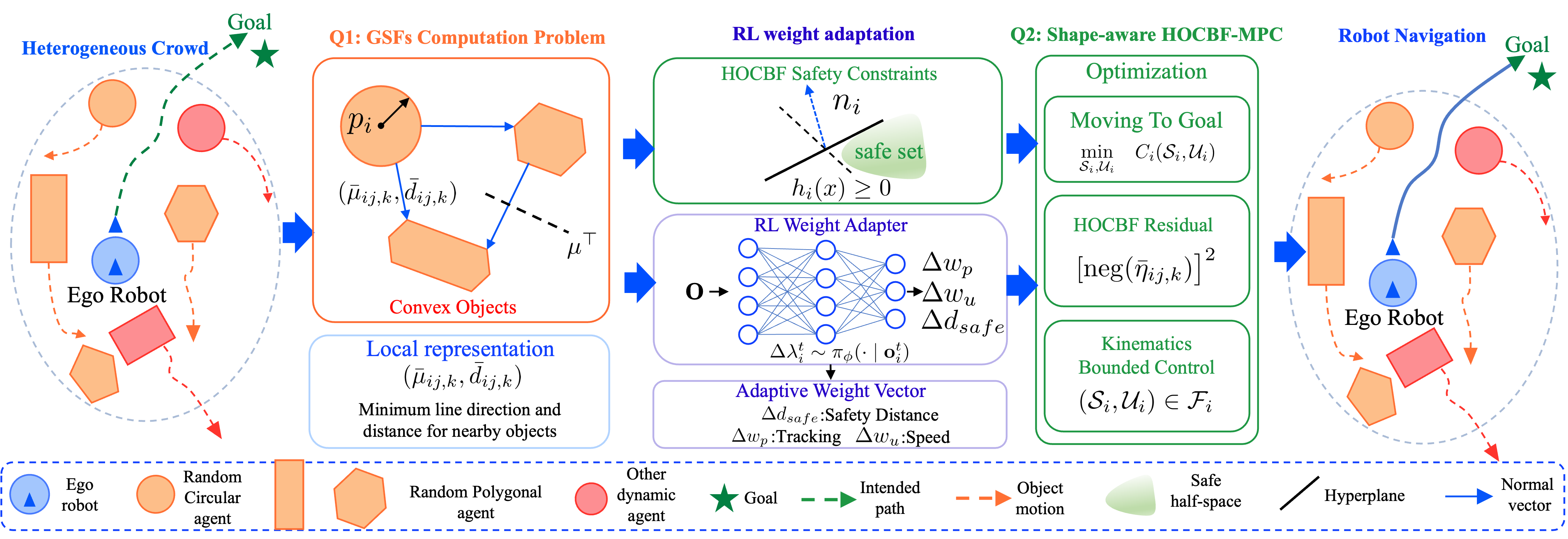
SRL-MPC combines MPC safety guarantees with RL adaptability for shape-aware navigation among heterogeneous robots. It formulates high-order control barrier function constraints from geometric separation features based on support function transforms, and an RL policy reads these features to adjust MPC parameters in real time. Experiments show substantial improvements over baselines in randomized crowd scenarios and robot fleets with arbitrary shapes.
中文摘要: 提出形状感知强化学习模型预测控制(SRL-MPC),用于异构人群和机器人车队中的安全高效导航,避免几何简化。基于支撑函数变换的几何分离特征(GSFs)构造高阶控制屏障函数(HOCBF)约束,以编码形状感知安全性。强化学习框架学习一个神经网络策略,读取GSFs并实时输出MPC参数更新,使MPC求解器能够适应周围人群的几何形状。SRL-MPC的关键优势在于保留MPC的安全结构和泛化性的同时,整合强化学习的适应性和智能性。在包含任意形状机器人车队的随机人群场景中进行了实验,结果表明SRL-MPC在安全性和适应性上显著优于代表性基线,并展现出良好的可扩展性和鲁棒性。该方法不需要手工调整参数,能够在线适应密集人群环境,为复杂交互场景下的运动规划与控制提供了有效框架。
💬 Methodological novelty in fusing HOCBF safety with RL-based MPC parameter adaptation, applicable to legged locomotion in dynamic environments.
💬 方法上创新地将HOCBF安全性与基于RL的MPC参数自适应相结合,可应用于动态环境中的腿式运动控制。
Why read it / 推荐理由: If you use MPC+RL for legged robots, this shape-aware safety formulation is relevant for cluttered multi-robot navigation. 如果你将MPC与RL结合用于腿式机器人,这种形状感知安全公式对拥挤多机器人导航具有参考价值。
5. Sharing the Control Authority Between Deep Reinforcement Learning and Model Predictive Control: Application to Multi-Class Transportation Networks
深度强化学习与模型预测控制之间的控制权共享:在多类交通网络中的应用
Authors / 作者: Giray Onur, Azita Dabiri, Bart De Schutter
arXiv: 2608.20858 · PDF
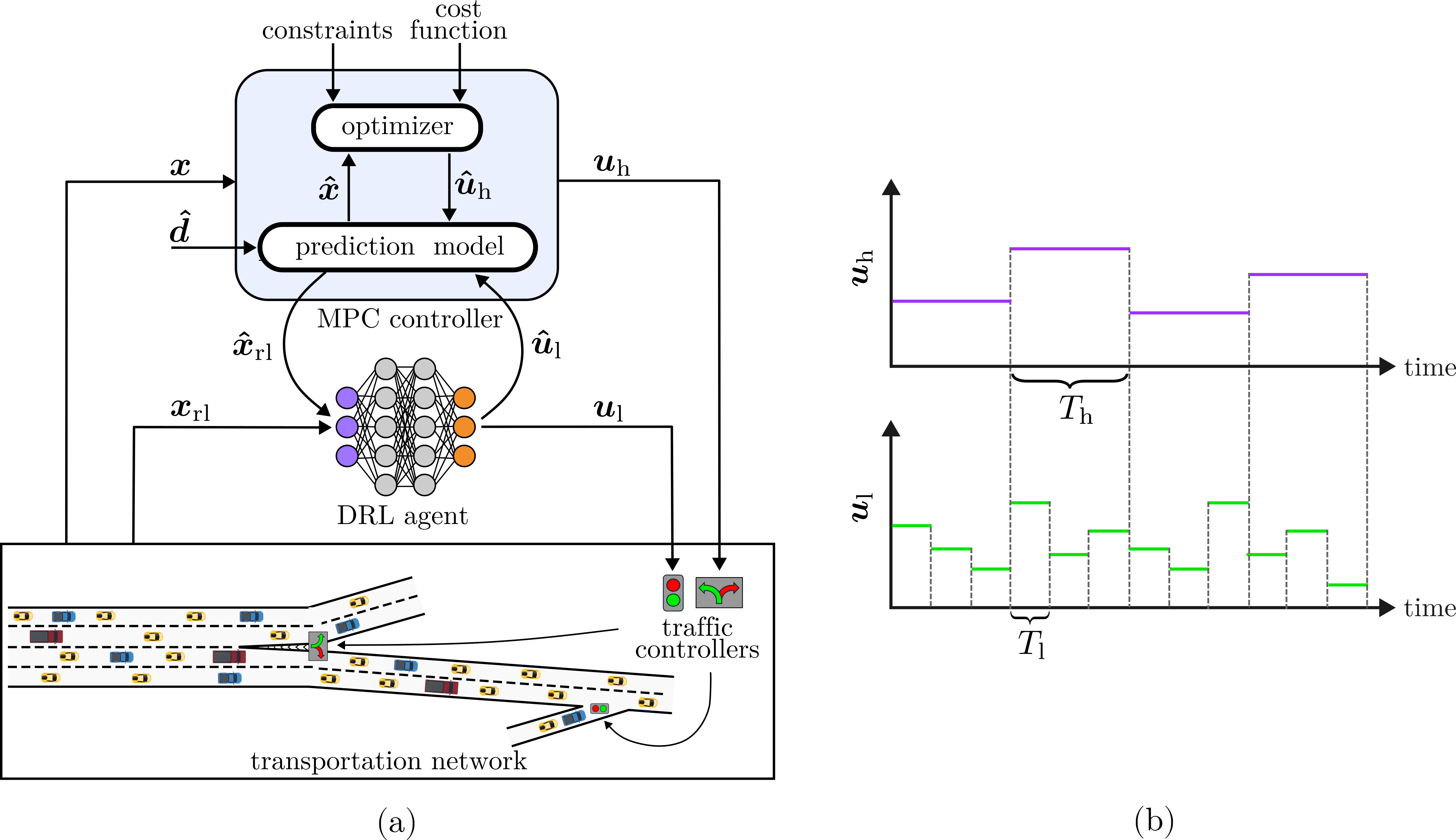
Proposes a hierarchical framework for multi-class transportation networks in which MPC runs at a higher level with low-frequency control inputs and DRL runs at a lower level with high-frequency inputs, combining DRL’s fast model-free computation with MPC’s constraint handling and built-in optimization. The approach mitigates DRL’s learning difficulty in high-dimensional state spaces and MPC’s heavy computational load with incomplete models.
中文摘要: 提出一种用于多类交通网络的分层DRL-MPC混合控制框架,将控制权在两种方法之间划分。在层次化框架中,MPC运行于较高层,以较低更新率生成低频控制输入,以适应其较高的计算时间;DRL运行于较低层,利用其快速在线计算生成高频控制输入。该框架结合了DRL的模型无关性和快速在线计算能力,以及MPC的固有优化和约束处理能力,解决了大规模网络非线性动力学和高维状态空间下DRL学习能力受限、MPC计算量大且依赖精确网络模型的问题。通过在MPC上层做慢速优化、在DRL下层做快速响应,实现了不同时间尺度上的协调控制。这种方法为难以获得精确模型、同时需要实时约束满足的复杂系统提供了一种实用的控制架构。
💬 The two-timescale control authority decomposition is an interesting architectural idea for legged controllers combining slow optimization with fast learned feedback.
💬 这种双时间尺度控制权分解是一种有趣的架构思想,可用于腿式控制器中慢速优化与快速学习反馈的结合。
Why read it / 推荐理由: The hierarchical MPC-DRL design is worth reading for modular legged robots needing both predictive trajectory optimization and agile reactive control. 对于需要同时具备预测轨迹优化和敏捷反应控制的模块化腿式机器人,这种分层MPC-DRL设计值得一读。