Robotics Digest
Robotics Paper Digest — 2026-08-18
🤖 Scanned 274 new arXiv papers (cs.RO / eess.SY / cs.LG, last 48 h), picked 5 for modular & legged robotics — summarized by DeepSeek.
🤖 扫描了近 48 小时 arXiv(cs.RO / eess.SY / cs.LG)的 274 篇新论文,围绕模块化与足式机器人精选 5 篇 — 由 DeepSeek 生成双语摘要。
1. Trajectory-Level Automatic Curriculum Learning for Legged Locomotion on Unstructured Terrain
非结构化地形上的腿部运动轨迹级自动课程学习
Authors / 作者: Rocky Liu, Tengyu Liu, Baoxiong Jia, Fangwei Zhong, Xinyi Tong, Hongzhao Xie et al.
arXiv: 2608.16164 · PDF
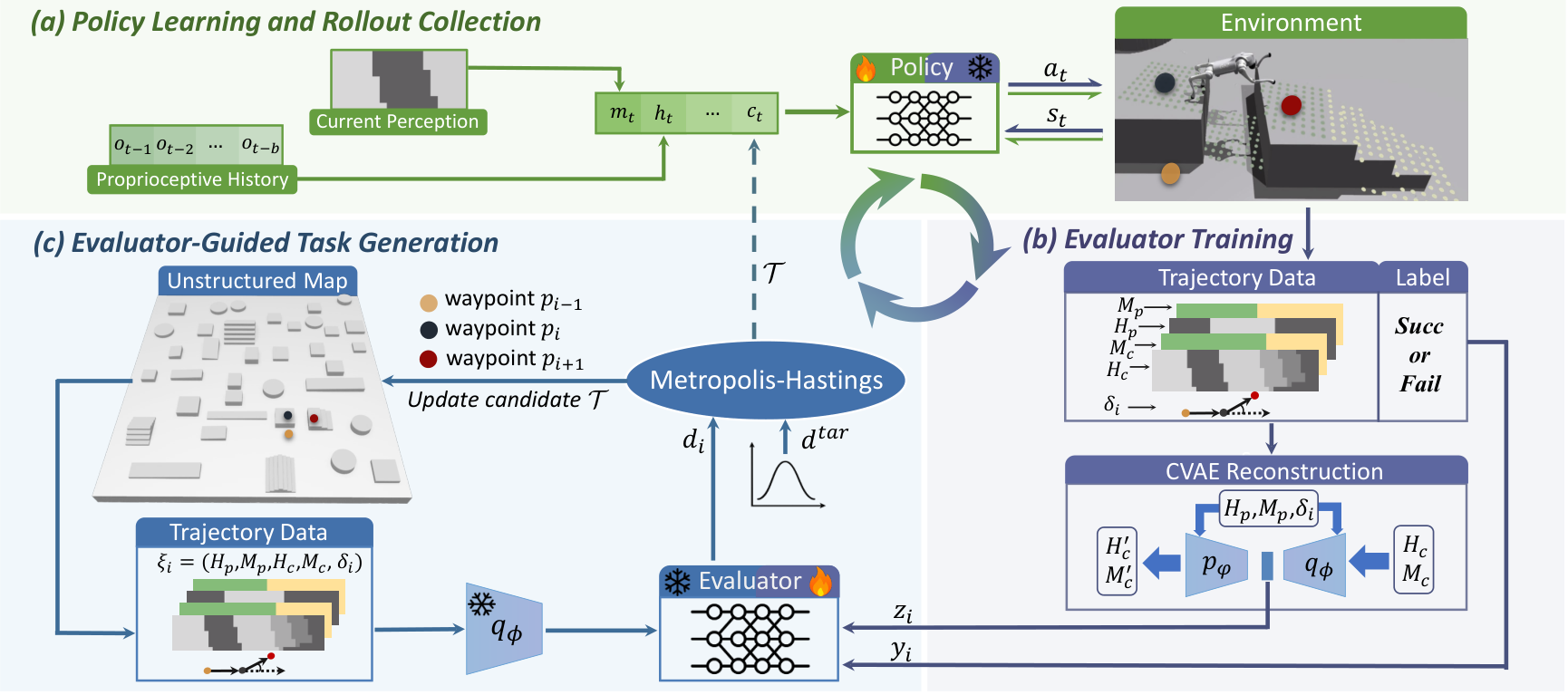
Proposes TACL, a trajectory-level automatic curriculum learning framework for legged locomotion on unstructured terrain. Instead of manually ordering terrain difficulty, an evaluator learns a difficulty function over trajectories for the current policy, and a sampler proposes new terrain-traversing trajectories as the next curriculum; this closed loop adapts the curriculum to the evolving policy. Experiments show a 56.3% success-rate improvement over no curriculum and 18.5% over handcrafted curricula on the hardest tasks.
中文摘要: 针对非结构化地形上腿部运动策略训练缺乏明确难度排序、启发式课程易导致策略对固定感知模式过拟合的问题,提出了一种轨迹级自动课程学习框架(TACL)。该框架直接在非结构化地形图上生成训练任务:每一次课程更新时,评估器学习一个针对当前策略的难度函数,将给定轨迹任务映射为难度评分;采样器根据该评估器提出新的轨迹候选,作为下一轮策略更新的课程,从而形成一个闭环,使课程随策略进化而自适应调整。实验表明,与无课程直接训练相比,TACL 将轨迹成功率提升56.3%;与手工设计的课程学习相比,在最困难地形任务上成功率提升18.5%,并在多方向穿越评估中最高提升39.74%。该工作为无显式难度度量的复杂地形提供了一条自动、可扩展的课程学习路径。
💬 Turns curriculum learning itself into a learned, trajectory-level closed loop rather than relying on heuristic terrain difficulty ordering.
💬 将课程学习本身转化为一个学习驱动的轨迹级闭环,而不依赖启发式地形难度排序。
Why read it / 推荐理由: Directly relevant to RL-based locomotion control for legged robots on unstructured terrain, a key deployment scenario for modular legged platforms. 直接涉及非结构化地形上腿部机器人的强化学习运动控制,是模块化腿部平台的关键部署场景。
2. HAF: Adapting Generalist VLAs to Humanoid Whole-Body Loco-manipulation via Hierarchical Action Flow and Spectral Latent RL
HAF:通过分层动作流与谱潜在强化学习将通用VLA适配到人形全身移动操作
Authors / 作者: Langzhe Gu, Chengkai Hou, Meng Li, Xinhua Wang, Jiaming Liu, Xinyuan Lv et al.
arXiv: 2608.16837 · PDF
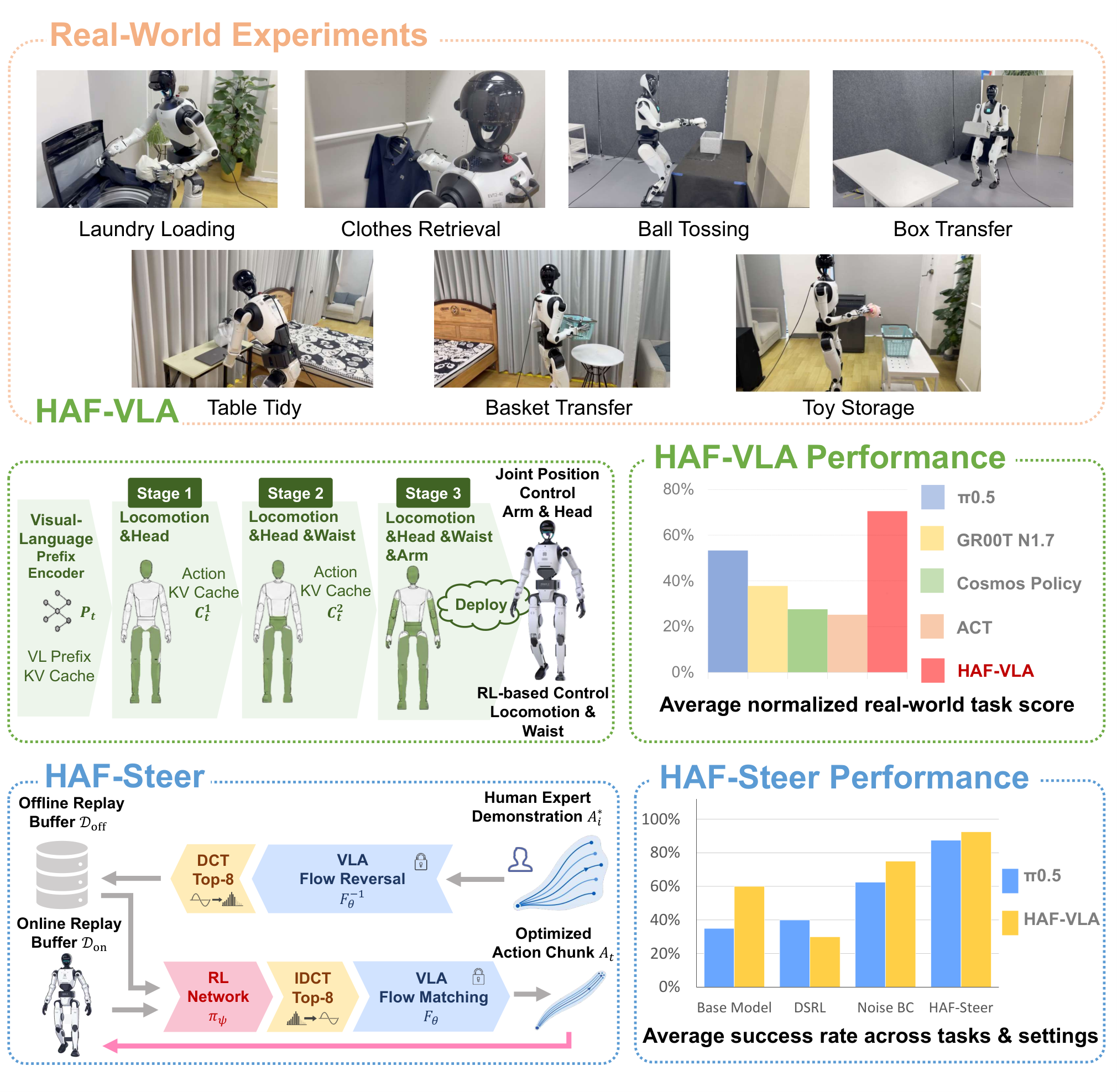
Presents HAF, a two-part framework to adapt off-the-shelf generalist vision-language-action (VLA) foundation models to humanoid whole-body loco-manipulation. HAF-VLA decouples full-body action denoising into three sequential stages with cross-stage key-value caches to preserve kinematic dependencies, while HAF-Steer applies a latent offline-to-online RL pipeline to refine the frozen policy in deployment. The design addresses the high dimensionality and interdependence of whole-body actions and reduces safety risk compared to direct large-VLA fine-tuning.
中文摘要: 针对通用视觉-语言-动作(VLA)基础模型难以直接用于人形机器人全身移动操作的问题,提出了HAF框架,由HAF-VLA和HAF-Steer两部分组成。HAF-VLA是一个基于预训练流匹配VLA的分层动作流生成器,将全身动作去噪分解为三个阶段,并通过阶段嵌入和跨阶段KV缓存保留运动学依赖,避免一次性生成导致全身动作不协调。在此基础上,HAF-Steer是一种冻结策略之上的潜在离线圈到在线强化学习流水线,利用谱方法在低维潜空间中进行策略优化,缓解直接微调大模型带来的计算开销和真实机器人探索安全风险。该框架将通用VLA能力迁移至高维人形全身移动操作,为自然语言指令驱动的复杂人形控制提供了可行路径。
💬 A principled pipeline for grounding large VLA models in whole-body legged loco-manipulation without expensive end-to-end fine-tuning.
💬 一种将大规模VLA模型落地到全身腿部移动操作的原则性流水线,避免昂贵的端到端微调。
Why read it / 推荐理由: Useful for whole-body control and hierarchical RL design that can transfer to modular legged manipulators. 有助于全身控制与分层强化学习设计,可迁移至模块化腿部操作平台。
3. Tac4Loco: Learning Spatiotemporal Plantar Pressure Representations for Humanoid Locomotion
Tac4Loco:学习足底压力时空表征用于人形机器人运动
Authors / 作者: Ziyun Liu, Sikai Guo, Zheng Li, Jiahang Cao, Haichao Liu, Pei Qu et al.
arXiv: 2608.15766 · PDF
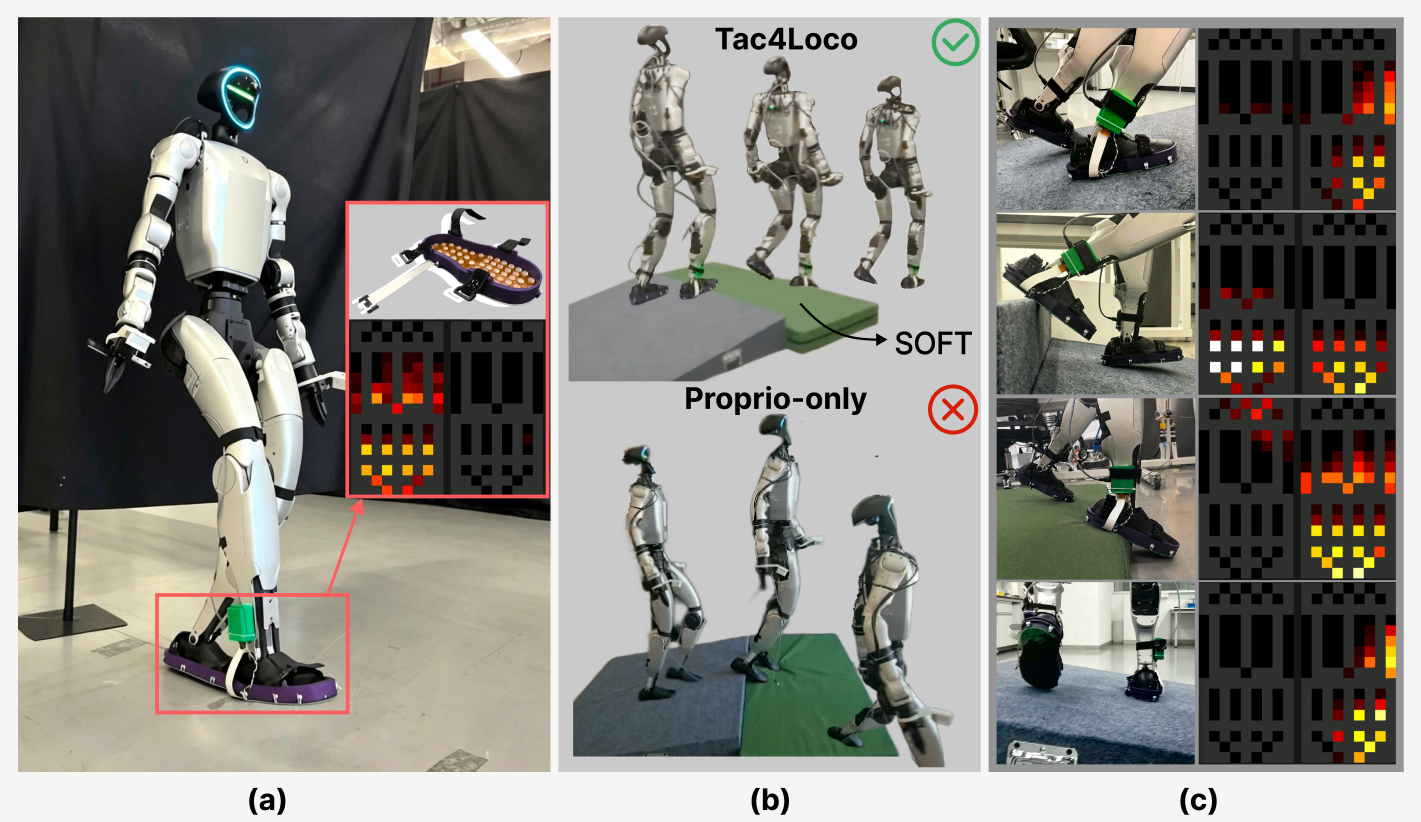
Presents Tac4Loco, a tactile-perceptive framework for legged locomotion that uses multi-array plantar pressure as direct feedback. A topology-preserving ordinal representation maps simulated and physical pressure signals into a shared space, and a dual-branch encoder extracts spatial and temporal features that augment proprioceptive observations for an asymmetric actor-critic policy. This direct contact-state feedback improves robustness on uneven terrain and uncertain foot-ground interactions.
中文摘要: 针对人形机器人在复杂地形中足底支撑多变、仅靠本体感觉或外部感知难以实时获取真实接触状态的问题,提出了Tac4Loco框架,将多阵列足底压力直接作为运动反馈。通过保持拓扑结构的序数表征,将仿真与物理传感器信号映射到共享观测空间,利用双分支编码器分别提取空间与时间特征;随后,这些时空特征与包含地形估计线索的增强本体感觉融合,输入非对称Actor-Critic架构生成运动策略。该方法直接刻画了足底压力空间拓扑,而不再依赖汇总统计量或落地前的接触预测,从而提升机器人对不平地形和不确定足-地交互的适应能力,为人形及腿式机器人鲁棒运动提供新思路。
💬 Directly models plantar pressure topology rather than using foot-contact summaries, a practical perceptual augmentation for legged locomotion.
💬 直接建模足底压力拓扑而非使用足底接触的汇总统计,为腿式运动提供了一种实用的感知增强。
Why read it / 推荐理由: Provides a tactile-perception method that can be directly integrated into modular legged robot foot modules for robust locomotion. 提供了一种触觉感知方法,可直接集成到模块化腿部机器人的足部模块中,增强运动鲁棒性。
4. Robot-Body-Aware Traversal Risk Graph Planning for Wheeled-Legged Robots in Complex Terrain
复杂地形轮腿机器人的机器人本体感知穿越风险图规划
Authors / 作者: Zhiqiao Guo, Bichi Zhang, Sören Schwertfeger
arXiv: 2608.16433 · PDF
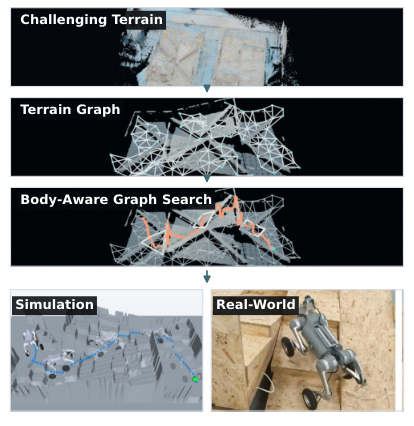
Presents RB-TRG, a robot-body-aware planning approach that lifts edge-wise terrain-risk search on Traversal Risk Graphs to heading- and turn-aware body-risk transitions. It samples an oriented rectangular footprint along graph edges and yaw sweeps to measure support variation, lateral inclination, terrain interference, and untrusted-map exposure, then runs A* over ordered node-pair states. In closed-loop MuJoCo trials, RB-TRG raises end-to-end success from 51.5% to 68.5% with only 2.3% longer paths, and the method is validated on a Go2-W wheeled-legged robot with a full LiDAR navigation stack.
中文摘要: 针对Traversal Risk Graph(TRG)中节点邻域圆形和边缘对齐区域无法反映轮腿机器人定向车身足迹的问题,提出了机器人本体感知的TRG规划方法(RB-TRG)。该方法在稀疏TRG表示的基础上,将沿边的地形风险搜索扩展为考虑航向和转弯的机体风险转移:沿图边和偏航扫描采样定向矩形足迹,度量纵向支撑变化、横向倾斜、地形干涉和不可信地图区域暴露程度,并将均值与上尾特征纳入转移代价,通过有序节点对状态上的A*搜索最小化累积代价,同时保留TRG的构建和规划接口。在四种扫描地形环境的同图研究和成对闭环MuJoCo实验中,RB-TRG降低了三种关键几何机体置放指标,端到端成功率从51.5%提升至68.5%,平均路径长度仅增加2.3%。Go2-W轮腿机器人上的完整LiDAR导航栈部署进一步验证了该方法。
💬 Makes traversal-cost evaluation truly body-aware for legged/wheeled-legged robots, directly improving planner success without changing the TRG interface.
💬 使穿越代价评估真正具备机器人本体感知,直接提升了腿式/轮腿机器人的规划成功率,且无需改变TRG接口。
Why read it / 推荐理由: Directly aligned with the reader’s interest in traverse-capability-aware path planning for legged platforms. 与读者对腿部平台穿越能力感知路径规划的兴趣高度契合。
5. Throwing a Tight Spiral American Football by a Humanoid Robot
人形机器人掷出稳定旋转螺旋美式足球
Authors / 作者: Zaid Mahboob, Bowen Weng
arXiv: 2608.16642 · PDF
Demonstrates a humanoid robot throwing a spin-stabilized tight-spiral American football by explicitly controlling coupled linear and angular momentum at release. The controller combines lower-body stabilization with a two-phase upper-body strategy: a throw phase that accelerates the ball through trajectory optimization and tracking, and a follow-through phase that uses MPC to actively control the wrist. The work addresses difficult sub-100 ms underactuated contact dynamics during release.
中文摘要: 针对美式足球精确投掷中释放条件耦合线动量与角动量的难题,提出了一种人形机器人全身耦合控制策略。该方法将下半身用于信息感知下的稳定支撑,上半身则分为两个阶段:投掷阶段通过轨迹优化与跟踪将球加速至目标释放状态,跟送阶段利用模型预测控制主动控制手腕及剩余肢体,实现对球在极短时间内(亚100毫秒)部分跨越手指时欠驱动接触动力学的有效管理。实验展示了稳定自旋的螺旋投掷,验证了高自由度快速运动中同时调节动量与接触状态的可行性。该工作为涉及瞬时接触、动量调控的动态全身控制提供了重要参考。
💬 A strong example of whole-body MPC for fast contact-rich dynamic tasks, with careful handling of the underactuated release phase.
💬 这是一个快速接触丰富动态任务中全身模型预测控制的典型示例,巧妙处理了释放阶段的欠驱动接触。
Why read it / 推荐理由: Valuable for whole-body control and momentum-based dynamic motion generation on legged robots. 对于腿部机器人的全身控制与基于动量的动态运动生成具有重要价值。