Robotics Digest
Robotics Paper Digest — 2026-08-16
🤖 Scanned 278 new arXiv papers (cs.RO / eess.SY / cs.LG, last 96 h), picked 5 for modular & legged robotics — summarized by DeepSeek.
🤖 扫描了近 96 小时 arXiv(cs.RO / eess.SY / cs.LG)的 278 篇新论文,围绕模块化与足式机器人精选 5 篇 — 由 DeepSeek 生成双语摘要。
1. Multi-AUV Ad-hoc network-based Target Tracking: A Value Gradient Guidance Multi-Agent Diffusion Reinforcement Learning Approach
基于多AUV自组网的目标跟踪:一种价值梯度引导的多智能体扩散强化学习方法
Authors / 作者: Jiaao Ma, Chuan Lin, Guangjie Han, Shengchao Zhu, Qian Zhu, Ying Liu et al.
arXiv: 2608.12436 · PDF
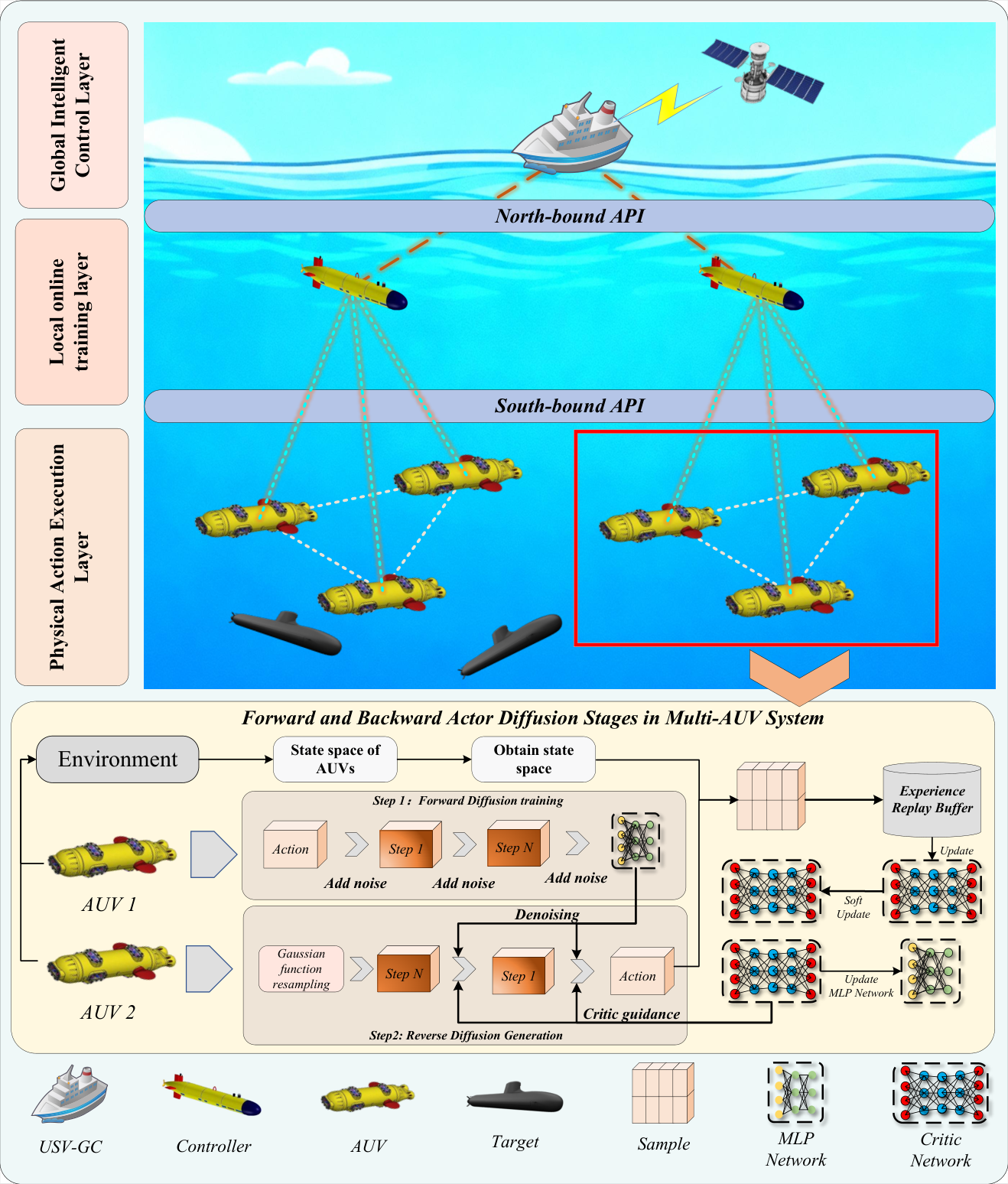
This paper proposes VGG-MADiffRL, a multi-agent diffusion reinforcement learning algorithm with value-gradient-guided action generation, and MDCA, a three-tier hierarchical control architecture for cooperative target tracking by multiple AUVs under constrained acoustic communication. The method models underwater tracking as an MDP and combines global task allocation, local online training, and physical execution. Simulation results demonstrate improved stability and tracking performance over existing MARL baselines.
中文摘要: 本文针对声学通信受限、拓扑动态变化和海洋扰动下的多AUV协同目标跟踪问题,提出了一种价值梯度引导的多智能体扩散强化学习算法VGG-MADiffRL,以及一种基于扩散的三层分层控制架构MDCA。该方法将水下多AUV协同跟踪建模为马尔可夫决策过程,并利用任务特性对声呐探测和洋流扰动进行建模。MDCA由全局智能控制层、局部在线训练层和物理动作执行层组成,能够在任务分配、局部决策和执行反馈之间进行协同优化。VGG-MADiffRL在扩散策略的基础上引入价值梯度来引导逆向去噪过程中的动作生成,缓解了传统多智能体强化学习中联合状态-动作空间维数高、策略生成对噪声敏感的问题。仿真实验表明,该方法在训练稳定性和目标跟踪性能上均优于现有基线。
💬 Multi-agent diffusion RL with hierarchical control provides an interesting template for decentralized control of modular legged platforms, though the domain is underwater robots.
💬 多智能体扩散强化学习与分层控制的结合为模块化腿足平台的分布式控制提供了有趣模板,尽管其应用场景是水下机器人。
Why read it / 推荐理由: Valuable for the modular-legged-robot control design due to its hierarchical RL architecture and value-gradient guidance, which could be adapted to multi-legged gait coordination. 其分层强化学习架构和价值梯度引导机制对模块化腿足机器人的步态协调控制具有借鉴价值。
2. Manufacturing Complex Airtight Soft Pneumatic Actuators for Soft Robotics: Process Evaluation and Optimization
用于软体机器人的复杂气密软气动执行器制造:工艺评估与优化
Authors / 作者: Mohammed Abboodi
arXiv: 2608.13233 · PDF
This paper systematically evaluates multiple fabrication routes for complex airtight soft pneumatic actuators, including heat-shrink forming, silicone casting, additive manufacturing, and FDM, identifying process-specific defects and correctable manufacturing issues. FDM proved the most adaptable, with defects reduced through process optimization. Key findings show airtightness depends on extrusion-path architecture and support-free geometry is crucial when internal post-processing is limited.
中文摘要: 本文针对复杂软气动执行器的制造难题,系统评估了热缩成型、硅胶浇铸、粉末/液体增材制造以及熔融沉积成型(FDM)等多种工艺路线,并通过工艺筛选、基线制造、失效分析和工艺改进来区分工艺固有局限与可修正的制造缺陷。结果表明,热缩成型受几何贴合性限制,浇铸受模具可达性和粘接界面影响,粉末基方法存在残留材料堵塞问题,数字光处理受材料性能和后处理要求制约;而FDM是最具适应性的路线,其主导缺陷可通过工艺优化逐步减少。研究还发现,气密性不仅取决于标称壁厚,还取决于挤出路径架构;在内部后处理受限时,无支撑几何设计至关重要。这些结论为软体机器人的设计-制造协同提供了实用指导。
💬 Although focused on soft actuators, the design-for-manufacturing analysis is directly relevant to fabricating modular soft leg segments and compliant joints.
💬 尽管聚焦于软体执行器,但其面向制造的设计分析对制造模块化软腿段和柔性关节具有直接参考价值。
Why read it / 推荐理由: Useful for the hardware side of modular legged robots, especially if the researcher plans to prototype compliant or soft leg modules with customizable morphology. 对模块化腿足机器人的硬件实现很有用,尤其当研究者计划原型化可定制形态的柔性或软腿模块时。
3. RGB-D Video Generation for Improving Human-to-Robot Object Handover Prediction
基于RGB-D视频生成提升人机物体交接预测
Authors / 作者: Tianyu Sun, Zhoujie Fu, Zihui Gao, Bang Zhang, Guosheng Lin
arXiv: 2608.13028 · PDF
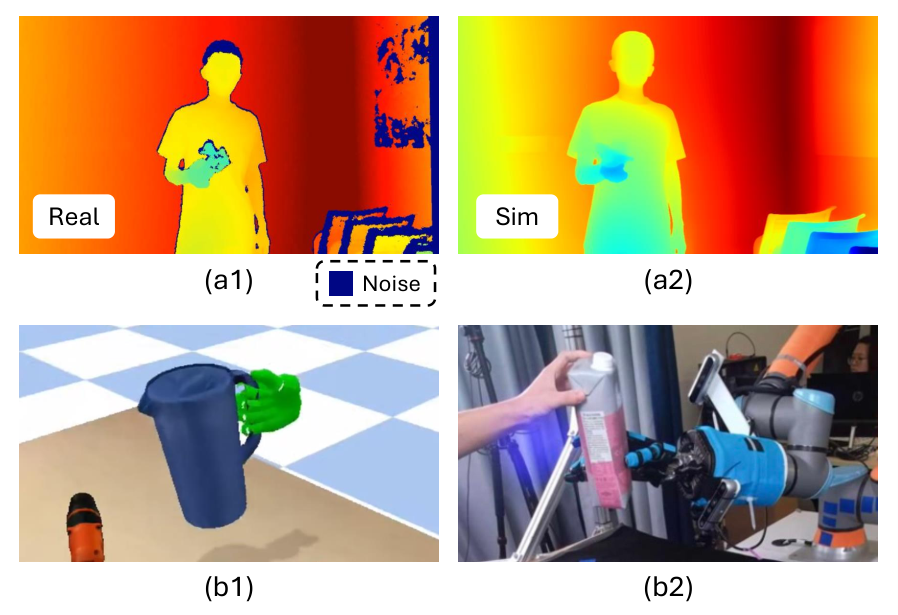
This paper introduces Hand2Bot, an RGB-D video dataset for human-to-robot handover, and PassGen, a generative pipeline using stable video diffusion and an intention-aware temporal face encoder to synthesize realistic handover sequences. A morphology-based depth editing strategy replicates real sensor noise to bridge the sim-to-real gap. Experiments show high intention identification accuracy and low false trigger rates, with zero-shot transfer on a physical robot and earlier intention anticipation than hand-centric baselines.
中文摘要: 本文针对人-机器人物体交接任务中大规模数据稀缺和仿真到现实差距大的问题,提出了Hand2Bot数据集和PassGen生成流水线。Hand2Bot提供包含身体姿态、面部表情等丰富上下文信息的RGB-D视频,并带有真实世界的噪声模式。PassGen利用稳定的视频扩散模型和意图感知的时间人脸编码器合成逼真的交接序列,同时通过基于形态学的深度编辑策略复制物理深度图中的传感器噪声,以弥合仿真到现实的差距。实验表明,该框架在消融研究和物理机器人部署中均实现了高意图识别准确率和低误触发率。PassGen训练出的模型相比传统以手为中心的基线,具有更强的零样本迁移能力和更早的意图预判,从而支持共享空间中具有社会意识的机器人行为。
💬 The sim-to-real and generative data augmentation techniques are directly transferable to legged locomotion tasks where real-world depth noise and human interaction are present.
💬 其仿真到现实迁移和生成式数据增强技术可直接迁移到存在真实深度噪声和人际交互的腿足运动任务中。
Why read it / 推荐理由: Relevant for sim-to-real transfer in legged robotics, offering a robust method to generate realistic training data and improve zero-shot deployment. 对腿足机器人中的仿真到现实迁移具有相关性,提供了一种生成逼真训练数据并改进零样本部署的稳健方法。
4. Learning-Based Behavior Planning for Automated Driving: Real-World Integration and Deployment
面向自动驾驶的学习型行为规划:实际集成与部署
Authors / 作者: Jean-Pierre Busch, Guido Linden, Jan Bergmann, Lutz Eckstein
arXiv: 2608.12198 · PDF
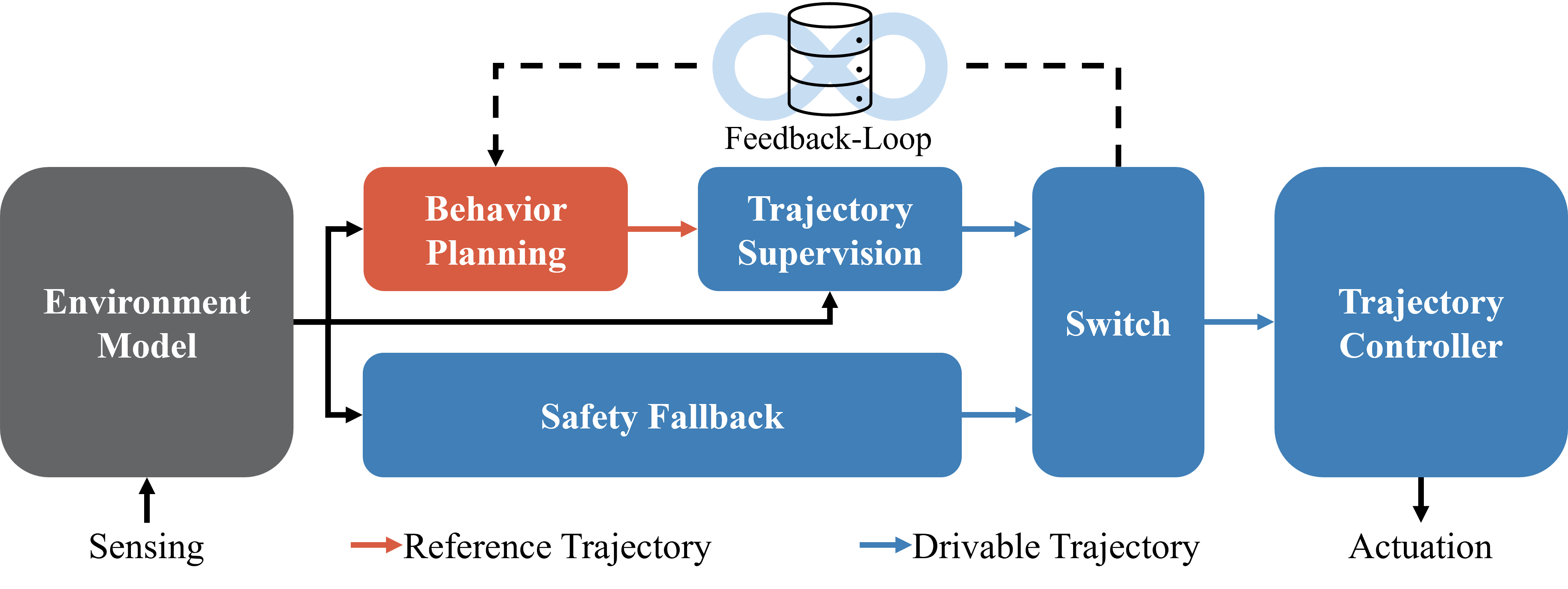
This paper proposes a hybrid planning architecture for automated driving that combines a deep neural network for interpreting traffic scenes and proposing driving behaviors with an optimization-based supervision layer that enforces drivability and safety constraints. The learned planner is evaluated open-loop on real-world urban data and closed-loop on a research vehicle, demonstrating stable real-world deployment. The approach balances the expressiveness of ML with the verifiability of classical optimization.
中文摘要: 本文提出了一种面向自动驾驶的混合规划架构,将深度神经网络用于解释复杂交通场景并提出驾驶行为,同时通过基于优化的监督层验证规划结果并强制执行可行驶性和安全约束。该系统结合了机器学习的表现力与传统优化方法的可验证性和确定性。作者在真实城市交通数据的开环实验中评估了学习型规划器的行为,并讨论了稳定闭环运行所需的系统集成问题,最后在实验车辆karl..上完成了实际部署。结果表明,该混合架构能够在不牺牲安全性的前提下充分利用学习方法的灵活性,为高复杂度环境下的自动驾驶行为规划提供了一条工程可行路径。
💬 The hybrid ML-plus-optimization-supervision architecture is conceptually similar to adding safety filters to RL-based legged locomotion policies.
💬 这种机器学习与优化监督相结合的混合架构,在概念上类似于为基于强化学习的腿足运动策略添加安全滤波器。
Why read it / 推荐理由: Offers a practical blueprint for integrating learned policies with MPC-like safety constraints in legged robots, enhancing trustworthiness and real-world reliability. 为在腿足机器人中集成学习策略与类MPC安全约束提供了实用蓝图,可增强可信度和现实可靠性。
5. Predictive Relative-Velocity Steering for Safe Robotic Manipulator Teleoperation in Dynamic Environments
面向动态环境中机械臂遥操作安全的预测相对速度转向
Authors / 作者: Changhao Hu, Zeyi Liu, Songqiao Hu, Shuang Liu, Zihan Meng, Xiao He
arXiv: 2608.13284 · PDF
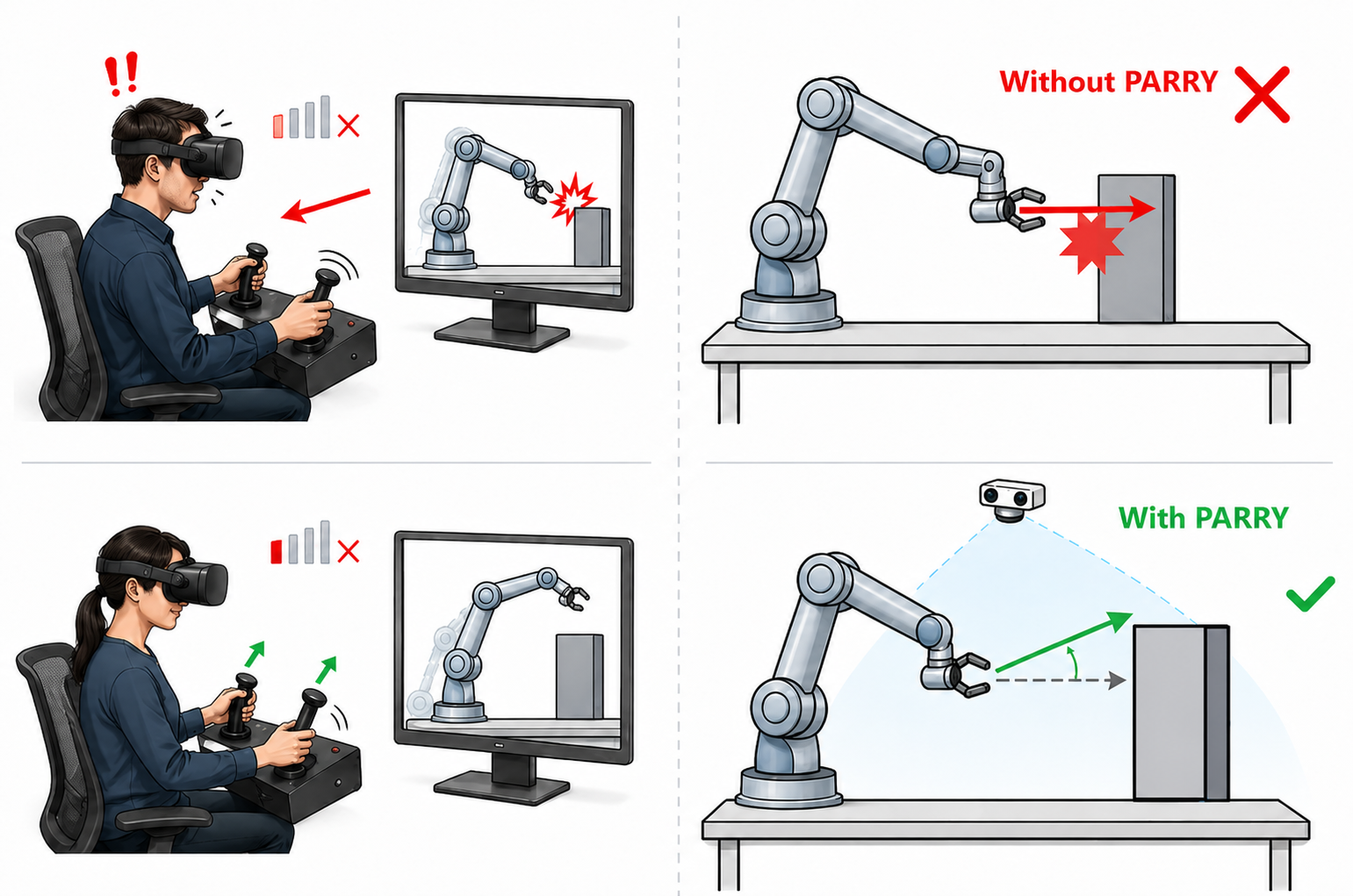
This paper proposes a lightweight modular framework for proactive collision avoidance in manipulator teleoperation, operating directly at the end-effector velocity-command level. After point cloud preprocessing, it predicts potential collisions using time-to-collision with overshoot protection and rotates the relative-velocity vector via Rodrigues’ rotation, preserving speed and mitigating deadlock. Simulations and physical robot experiments show higher collision avoidance rates than APF baselines.
中文摘要: 本文针对遥操作中操作员在动态环境下可能无法及时避障的问题,提出了一种轻量化的模块化碰撞避免框架。该框架直接作用于末端执行器速度指令层:在对点云进行预处理后,基于碰撞时间(TTC)预测潜在碰撞并集成过冲保护,再利用罗德里格斯旋转公式旋转相对速度向量。该方法只改变相对速度方向而保持其大小,从而缓解了传统人工势场法常见的死锁问题。预测模块补偿了点云处理延迟,轻量化设计保证了遥操作所需的高频控制。多种场景的仿真实验表明,该方法比基线方法具有更高的末端避碰率;物理机器人系统上的实验也验证了其避障有效性。
💬 The velocity-level obstacle avoidance method is generic and can be adapted to legged mobile manipulation or to reactive collision avoidance in walking robots.
💬 这种速度级避障方法具有通用性,可适用于腿足移动操作或行走机器人的反应式碰撞避免。
Why read it / 推荐理由: Practical collision-avoidance algorithm with real-robot validation that can be integrated into the whole-body velocity control of a legged manipulator. 一种经过真实机器人验证的实用避障算法,可集成到腿足机械臂的全身速度控制中。