Robotics Digest
Robotics Paper Digest — 2026-08-15
🤖 Scanned 113 new arXiv papers (cs.RO / eess.SY / cs.LG, last 48 h), picked 5 for modular & legged robotics — summarized by DeepSeek.
🤖 扫描了近 48 小时 arXiv(cs.RO / eess.SY / cs.LG)的 113 篇新论文,围绕模块化与足式机器人精选 5 篇 — 由 DeepSeek 生成双语摘要。
1. Towards Socially Compliant Navigation in Deep Reinforcement Learning via Proxemics-Based Reward Modeling
基于邻近学奖励建模的深度强化学习社交合规导航
Authors / 作者: Takieddine Soualhi, Jacques Saraydaryan, Laetitia Matignon
arXiv: 2608.12917 · PDF
This paper introduces a proxemics-based reward formulation for DRL social navigation that models each human’s personal space as a radial Gaussian-mixture field and computes a robot-centric local cost over the robot’s field of view. The reward provides a dense, interpretable social learning signal and is integrated into established DRL navigation methods. Simulation experiments across crowd scenarios, reward baselines, and density levels show consistent improvements in social metrics while maintaining competitive navigation performance.
中文摘要: 本文针对深度强化学习(DRL)社交导航提出了一种基于邻近学(proxemics)的奖励建模方法。该方法依据Hall的邻近学理论,将每个人的个人空间建模为径向高斯混合场,并在机器人视野内计算机器人局部代价,从而提供密集、可解释的社交学习信号,同时保持导航效率。作者将所提奖励集成到已有DRL导航方法中,并在多种人群场景、奖励基线和人群密度下进行了仿真评估。结果表明,该奖励在保持有竞争力的导航性能的同时持续改善社交指标。此方法可迁移至腿式机器人在人机共融环境中的运动控制与路径规划,通过调整奖励结构提升社交合规性。
💬 A dense, interpretable reward for socially aware DRL navigation that can be adapted to legged robot motion control in crowded environments.
💬 一种密集、可解释的社交感知DRL导航奖励,可适用于拥挤环境中腿式机器人的运动控制。
Why read it / 推荐理由: Offers a principled reward design that can directly improve RL-based navigation and path planning for legged robots in human environments. 提供了一种原则性的奖励设计,可直接改善腿式机器人在人类环境中的基于RL的导航和路径规划。
2. Deliberate Practice: Learning Robot Skills under a Budget
刻意练习:预算约束下的机器人技能学习
Authors / 作者: Shivam Vats, Sudarshan Harithas, Mete Tuluhan Akbulut, Arvind Raghunathan, George Konidaris
arXiv: 2608.13415 · PDF
This paper proposes an active skill learning algorithm, Deliberate Practice (DP), that computes a provably budget-optimal allocation of practice time to skills so as to maximize expected cumulative reward of the task plans those skills unlock. The key contribution is a bilinear program that solves the combinatorial allocation problem exactly with off-the-shelf solvers. Simulated and real-world long-horizon manipulation experiments show improved use of limited practice time.
中文摘要: 本文提出了一种主动技能学习算法“刻意练习”(Deliberate Practice, DP),用于在有限的练习预算下学习顺序任务中的机器人技能。DP通过估计掌握各项技能所需时间以及技能所解锁的任务计划的累积奖励,计算一个可证明为预算最优的技能练习分配方案。其核心贡献是将该组合优化问题表述为双线性规划,并可使用现成求解器精确求解。在仿真和真实世界的长时域操作任务实验中,该方法使机器人能最优地利用有限练习时间获取有用策略并改善长期规划。DP可推广至模块化腿式机器人的多技能学习,例如在不同地形中学习多种步态或动作技能。
💬 A principled framework for allocating limited practice time across skills, directly applicable to learning multiple gaits or manoeuvres for modular legged robots.
💬 一种在技能间分配有限练习时间的原则性框架,直接适用于模块化腿式机器人学习多种步态或机动动作。
Why read it / 推荐理由: Provides a budget-optimal active learning strategy that can help legged robots efficiently acquire multiple locomotion skills under real-world practice constraints. 提供了一种预算最优的主动学习策略,可帮助腿式机器人在实际练习约束下高效习得多种运动技能。
3. Attention from Action, for Action: Emergent Visual Bottlenecks for Policy Learning
从动作中学习注意力,为动作服务:策略学习中的涌现视觉瓶颈
Authors / 作者: Zheyu Zhuang, Ruiyu Wang, Nick Heppert, Johannes Fabian Hahn, Abhinav Valada, Florian T. Pokorny et al.
arXiv: 2608.13422 · PDF
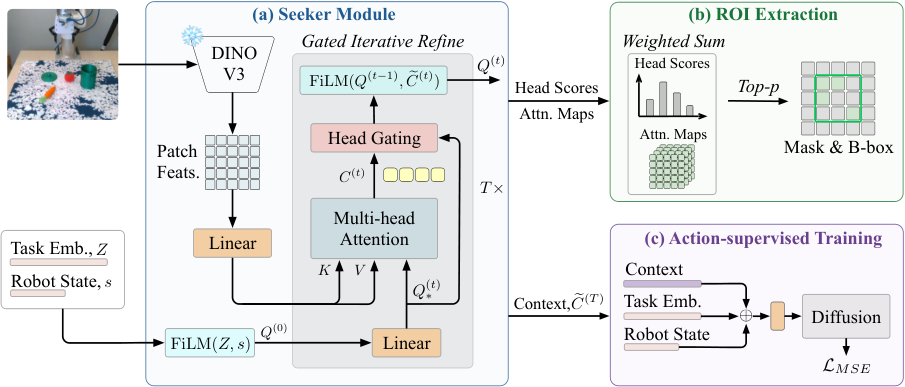
This paper proposes Seeker, a task- and state-conditioned readout that learns visual attention directly from action supervision, starting from frozen DINOv3 features. It produces progression-aware regions of interest that serve as spatial interfaces for RGB cropping, mask-guided background augmentation, and point-cloud filtering. In simulation and on real robots, Seeker improves data efficiency and robustness over baselines, raising average in-domain success from 48.3% to 76.7%.
中文摘要: 本文提出Seeker,一种任务与状态条件化的读出模块,利用冻结的DINOv3特征,仅从动作监督中学习视觉注意力。Seeker迭代更新查询以收集视觉证据,产生随任务进展变化的感兴趣区域(ROI),并用作RGB裁剪、掩码引导背景增强和点云滤波的空间接口。在仿真与真实机器人实验中,Seeker相比无裁剪、增强和动作派生裁剪基线显著提升了数据效率和鲁棒性,将平均域内成功率从最佳基线的48.3%提高到76.7%。该方法可应用于腿式机器人的视觉运动学习,通过自适应视觉瓶颈提升策略在复杂地形中的泛化性能。
💬 A label-free way to learn task-relevant visual attention from action, which can boost sample efficiency and robustness of visuomotor policies for legged locomotion.
💬 一种从动作中无标注地学习任务相关视觉注意力的方法,可提升腿式运动视觉运动策略的样本效率和鲁棒性。
Why read it / 推荐理由: The learned visual bottleneck could help legged robots focus on terrain-relevant cues for robust RL-based locomotion control. 学习到的视觉瓶颈可帮助腿式机器人聚焦与地形相关的线索,实现稳健的基于RL的运动控制。
4. NestDex: Nested Policy Learning with Copilot Assisted Teleoperation for Dexterous Manipulation
NestDex:副驾辅助遥操作下的嵌套策略学习用于灵巧操作
Authors / 作者: James Zhao, Jinhe Tang, Mingyuan Ba, Weiming Zhi
arXiv: 2608.13362 · PDF
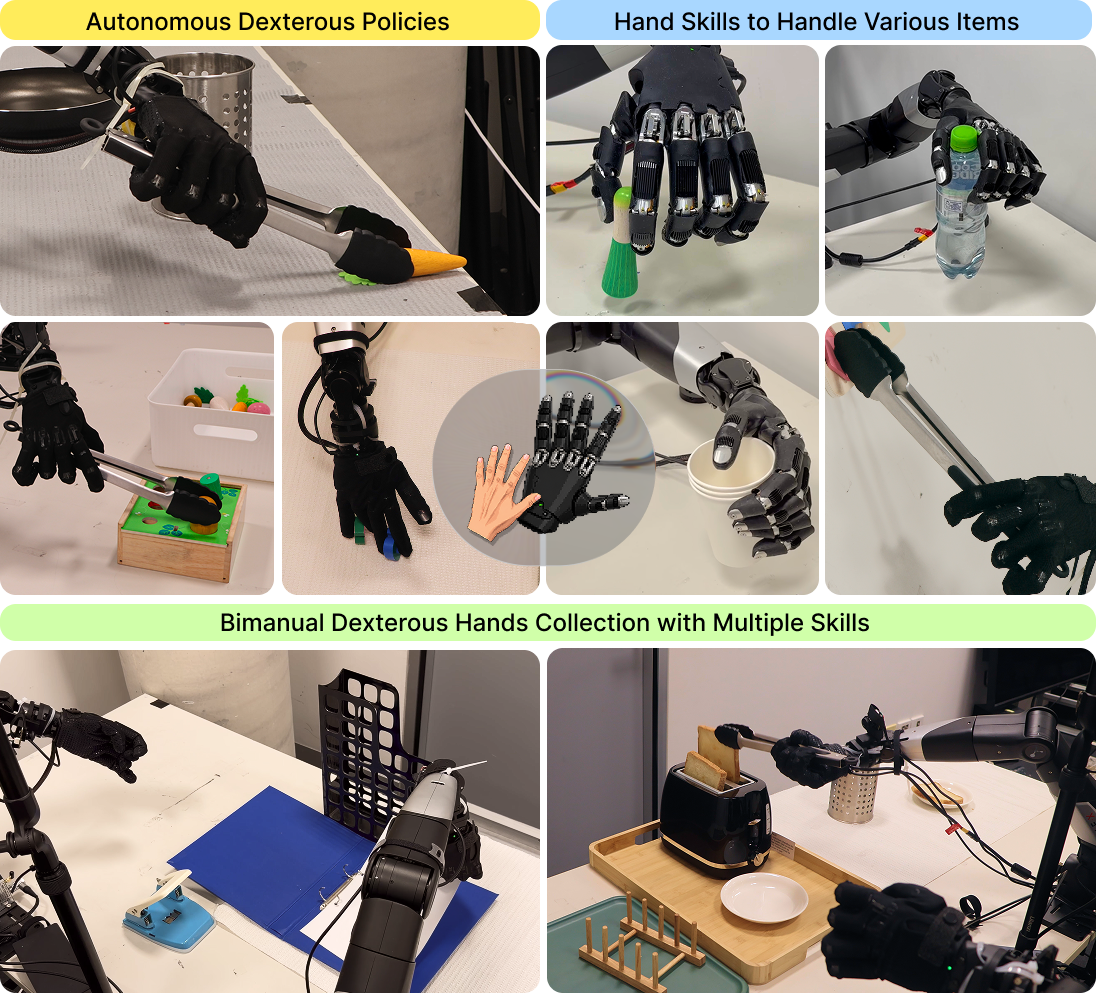
NestDex is a nested policy-learning framework that reduces the burden of collecting full-task demonstrations for dexterous manipulation. The operator controls the arm and regulates an active learned hand skill through a single-DoF clutch, while a vision-language selector activates appropriate skills. A separate outer visuomotor policy is trained from these demonstrations for autonomous deployment. Real-world experiments show improved demonstration reliability and effective autonomous policy learning.
中文摘要: 本文提出NestDex,一种用于灵巧操作的嵌套策略学习框架,通过利用学习到的手部技能辅助演示采集来减轻操作员负担。操作员仅需控制机械臂并通过单自由度离合调节激活的手部技能,而内层手部策略根据最新本体感受历史调整动作,视觉-语言选择器则根据任务阶段激活相应技能。由此采集的演示用于训练独立的外层视觉运动策略,部署时不依赖内层策略。真实灵巧操作实验表明,NestDex提升了演示采集的可靠性和效率,并支持有效的自主策略学习。该嵌套策略与遥操作辅助范式可推广至模块化腿式机器人的全身控制,简化复杂运动技能的演示采集。
💬 A nested policy-learning approach with copilot teleoperation that can simplify demonstration collection for complex whole-body skills of legged robots.
💬 一种嵌套策略学习与副驾遥操作方法,可简化腿式机器人复杂全身技能的演示采集。
Why read it / 推荐理由: The nested policy architecture and teleoperation interface are relevant for hierarchical control and data collection for modular legged platforms. 嵌套策略架构和遥操作界面与模块化腿式平台的分层控制及数据采集相关。
5. ContactGuard: Pre-Contact Execution Monitoring with Action-Conditioned Latent World Models
ContactGuard:基于动作条件潜在世界模型的接触前执行监控
Authors / 作者: Gehan Zheng, Matthew Johnson-Roberson, Weiming Zhi
arXiv: 2608.13438 · PDF
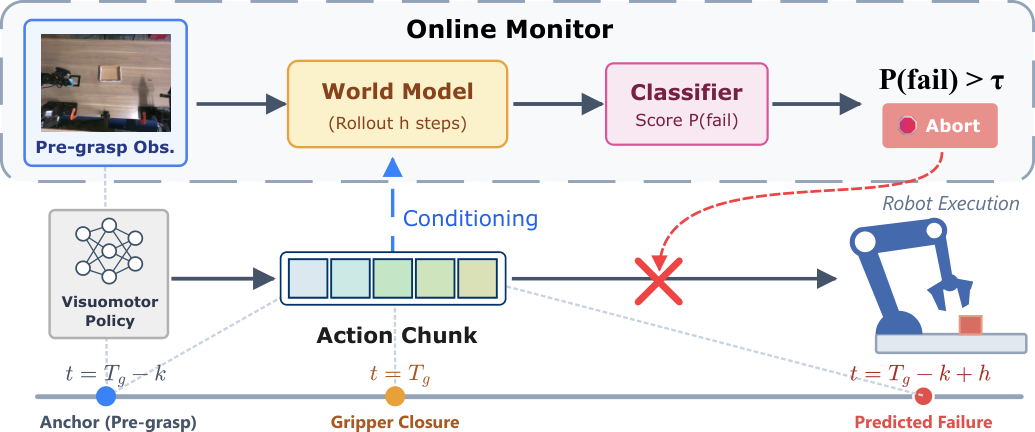
ContactGuard is a pre-contact execution monitor for chunked visuomotor policies that predicts short-horizon consequences of planned action chunks in latent visual space and aborts before likely failure. Its latent world model is trained from unlabelled trajectories to predict compact multi-view visual embeddings under planned actions, and a lightweight failure probe is trained from a small labelled set. Real-world contact-rich manipulation experiments show better failure prediction than ablations and successful live robot pre-contact aborts.
中文摘要: 本文提出ContactGuard,一种面向分块视觉运动策略的接触前执行监控器。给定策略规划的动作块,ContactGuard在潜在视觉空间中预测其短期后果,若预测的潜在状态表明可能失败则中止执行。其潜在世界模型使用无标注机器人轨迹训练,在给定动作下预测紧凑的多视图视觉嵌入,避免像素级视频预测;轻量级失败探针则从少量标注的接触前片段训练。在实际部署中,ContactGuard在与即将发生的接触事件对齐锚点,通过前滚模型验证预测的接触后潜在状态。在真实接触丰富操作任务中,它相比直接和破坏动作消融基线更准确地预测失败,并成功作为接触前中止信号迁移到实机,无需修改底层策略。该方法可为腿式机器人足端接触安全提供预防性监测。
💬 A world-model based execution monitor that can safely gate contact-rich policies, relevant for preventing unsafe foot contact or collisions in legged locomotion.
💬 一种基于世界模型的执行监控器,可为接触丰富策略提供安全门控,适用于防止腿式运动中不安全足端接触或碰撞。
Why read it / 推荐理由: Pre-contact execution monitoring can enhance safety of learning-based legged motion policies by aborting before hazardous foot placement. 接触前执行监控可在危险落脚发生前中止动作,增强基于学习的腿式运动策略的安全性。