Robotics Digest
Robotics Paper Digest — 2026-08-13
🤖 Scanned 293 new arXiv papers (cs.RO / eess.SY / cs.LG, last 48 h), picked 5 for modular & legged robotics — summarized by DeepSeek.
🤖 扫描了近 48 小时 arXiv(cs.RO / eess.SY / cs.LG)的 293 篇新论文,围绕模块化与足式机器人精选 5 篇 — 由 DeepSeek 生成双语摘要。
1. Learning Loco-Manipulation From SMPC Demonstrations With Sparse Offline-to-Online RL
从SMPC演示中学习运动-操作:基于稀疏奖励的离线到在线强化学习
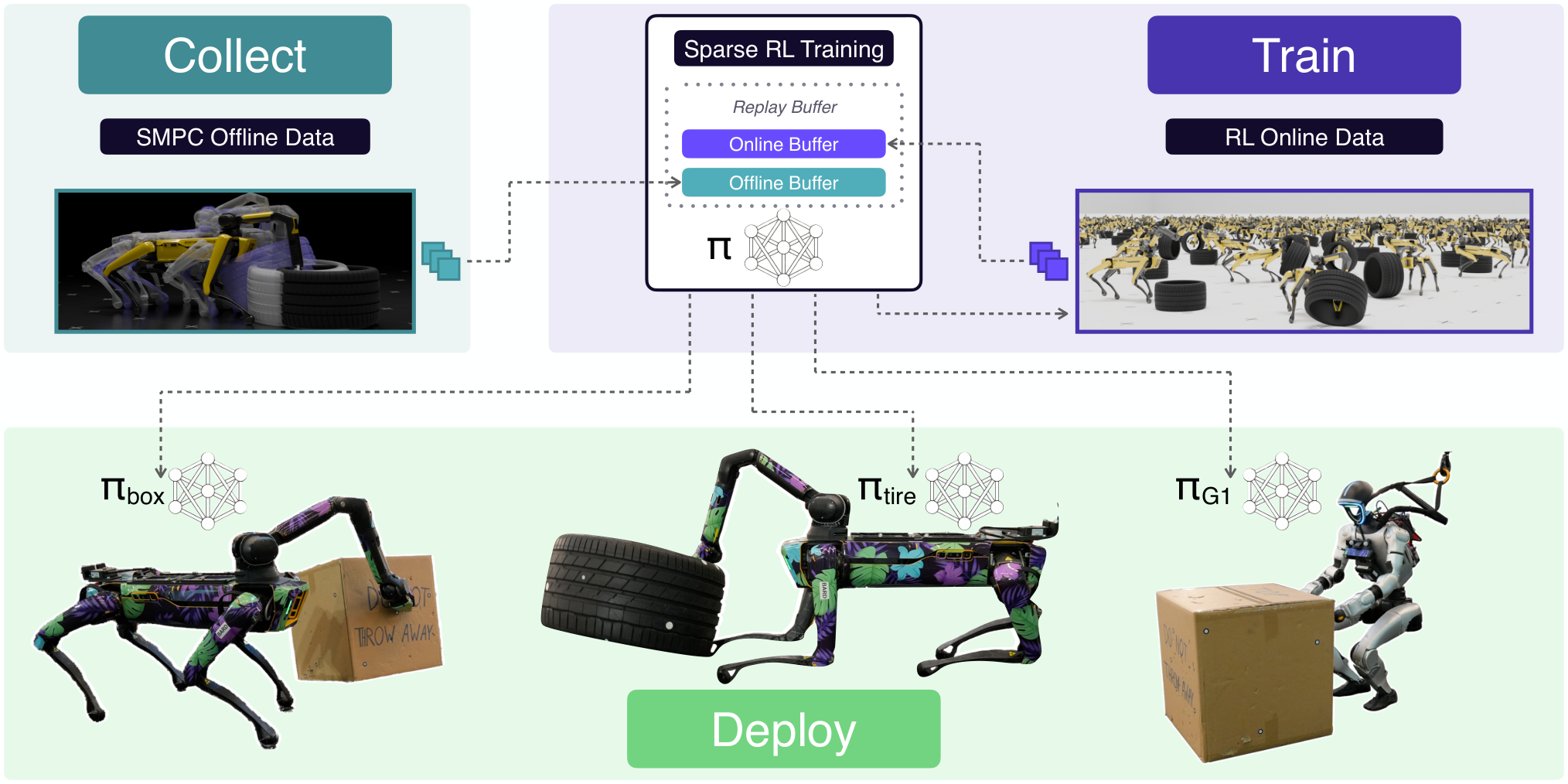
Authors / 作者: Martin Schuck, Maks Sorokin, Simone Manni, Duy Ta, Angela P. Schoellig, Marco Hutter et al.
arXiv: 2608.12063 · PDF
This paper uses sample-based model predictive control (SMPC) entirely in simulation as an automated expert to generate large offline datasets, bypassing dense reward shaping. An off-policy RL agent trained with purely sparse task rewards is integrated with a low-level dynamic stability controller, and the learned policies outperform the SMPC teacher on real robots including an arm-equipped Spot quadruped and a G1 humanoid.
中文摘要: 本文提出利用完全在仿真中的基于采样的模型预测控制(SMPC)作为自动专家,生成大规模离线数据集,从而绕过密集奖励整定的瓶颈。仅使用稀疏任务奖励训练离策略强化学习智能体,并与低级动态稳定控制器集成,使学习策略在真实机器人上超越原始SMPC教师,包括配备机械臂的Spot四足机器人和G1人形机器人,验证了框架在不同形态下的鲁棒性和高效性。
💬 A compelling combination of SMPC as an offline data generator and sparse-reward RL that achieves sim-to-real transfer on both quadruped and humanoid platforms.
💬 将SMPC作为离线数据生成器与稀疏奖励RL相结合,在四足和人形平台上实现了sim-to-real迁移,方法具有说服力。
Why read it / 推荐理由: Shows a practical recipe for learning complex loco-manipulation skills on legged robots without dense reward shaping. 展示了在无密集奖励整定的情况下学习腿足机器人复杂移动操作技能的实用方法。
2. ContactIPM: A Structure-Exploiting Interior-Point Solver for Contact-Implicit Trajectory Optimization
ContactIPM:面向接触隐式轨迹优化的结构利用内点求解器
Authors / 作者: Yucheng Chen
arXiv: 2608.11731 · PDF
ContactIPM is a primal-dual interior-point solver for contact-implicit trajectory optimization (MPCCs) that combines barrier-coupled elastic relaxation, stagewise elimination of slack/dual variables, and a Riccati recursion for the reduced Newton system. It is 2.17–8.87x faster than CRISP and 2.96x faster than IMPACT on benchmark cases, with higher robustness on Push Box and Push-T suites, making it attractive for whole-body legged robot control.
中文摘要: ContactIPM是一种针对接触隐式轨迹优化(互补约束数学规划)的原始-对偶内点求解器。它通过势垒耦合弹性松弛处理互补不等式对,并逐阶段消去松弛变量和对偶变量,利用Riccati递归求解约化牛顿系统;采用固定多阶段MPCC恢复策略进行连续化和重启。在CRISP基准上速度提升2.17至8.87倍,在IMPACT对比中快2.96倍,并在Push Box和Push-T鲁棒性测试中成功率更高,为腿足机器人全身控制中的接触规划提供了高效可靠的工具。
💬 A structure-exploiting solver that significantly speeds up contact-implicit trajectory optimization while improving robustness.
💬 一种利用问题结构的求解器,显著加速接触隐式轨迹优化并提升鲁棒性。
Why read it / 推荐理由: Directly useful for gait generation and whole-body control in modular legged robots requiring fast, robust contact planning. 对于模块化腿足机器人中需要快速鲁棒接触规划的步态生成和全身控制直接有用。
3. Policy-Induced Hand Priors in Humanoid Dual-Arm Manipulation: Diagnosing and Mitigating Initial-Pose Dependence
人形双臂操作中策略诱发的手部先验:初始位姿依赖性的诊断与缓解
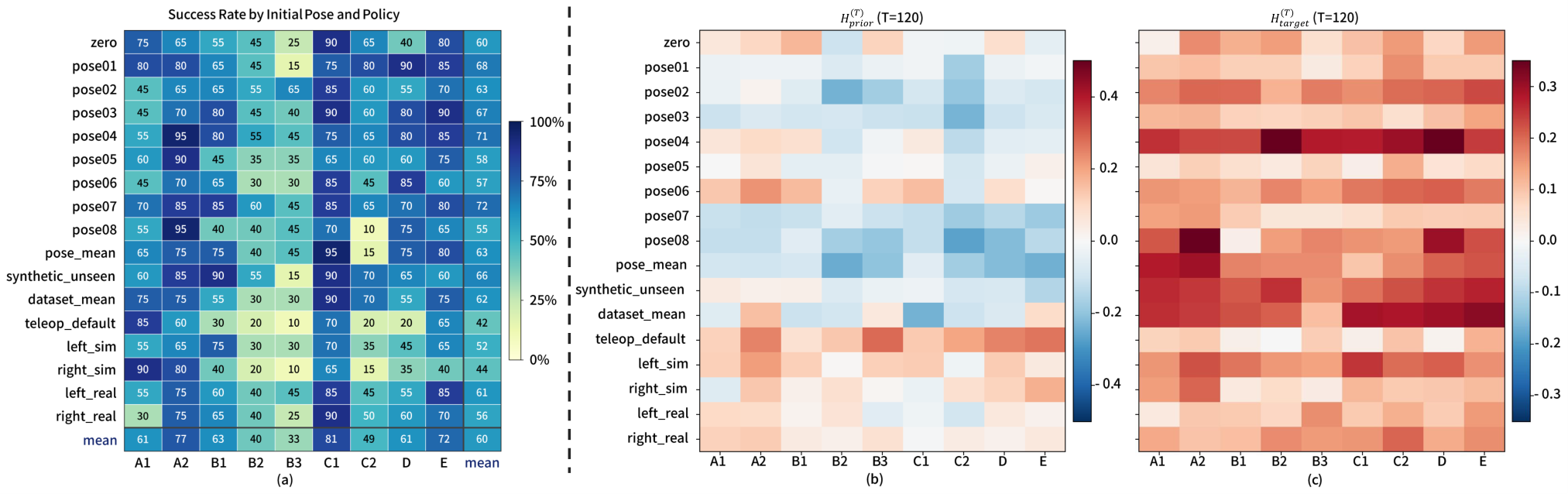
Authors / 作者: Chaeyeon Jung, Juyoun Park
arXiv: 2608.11769 · PDF
This paper diagnoses initial-pose dependence in vision-language-action policies for humanoid dual-arm manipulation, introducing HandPriorScore and residual hand bias to quantify policy-induced hand preference. Experiments show strong initial-pose–policy interactions, and expanding initial-pose coverage or targeted augmentation substantially improves robustness.
中文摘要: 本文研究视觉-语言-动作(VLA)策略在人形双臂操作中对初始构型的依赖问题,提出HandPriorScore、残余手部偏见和目标响应度等指标来量化策略诱发的手部先验。在17种初始构型和多个策略上的评估显示,相同初始位姿在不同策略间成功率差异显著,同一策略在不同位姿下表现波动大;腕部相机观测也影响手部选择。扩大训练数据中的初始位姿覆盖范围可显著提高鲁棒性,针对低性能位姿的定向增强也能提升成功率,为腿足人形平台上的策略训练提供了实用见解。
💬 Provides a clear diagnostic framework for initial-pose bias in humanoid policies, with practical augmentation fixes.
💬 为人形策略中的初始位姿偏差提供了清晰的诊断框架和实用的数据增强改进方法。
Why read it / 推荐理由: Useful for RL-based motion control on legged humanoid platforms where initial configuration strongly affects task success. 对于初始构型对任务成功率影响显著的腿足人形平台RL运动控制很有价值。
4. Deployment Is Not Destiny: Robot Recomposition in the Field with Unseen Software, Hardware, and Compute Payloads
部署不是终点:现场机器人重组以集成未知软件、硬件和计算载荷
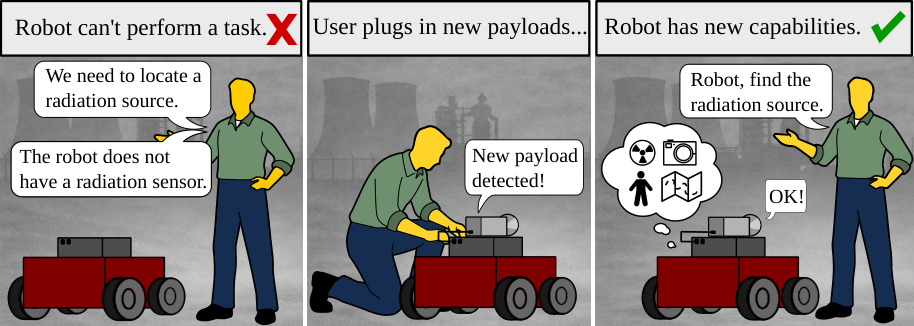
Authors / 作者: Steven Swanbeck, Jonathan Salfity, Jeffery Gunawan, Corrie Van Sice, Mitch Pryor, Robert Blake Anderson
arXiv: 2608.11063 · PDF
This paper presents a runtime reconfiguration framework with abstractions that allow robots to integrate previously unseen modular software, hardware, and compute payloads through true plug-and-play, also sharing resources with distributed peers. Demonstrations in disaster response scenarios show reconfiguration in minutes without developer intervention, contrasting with hours of manual integration.
中文摘要: 本文针对大多数机器人子系统紧耦合、部署后难以适应变化的问题,提出了一种运行时重组框架及支撑抽象,使机器人能够通过即插即用快速集成先前未见的模块化软件、硬件和计算载荷,并可将新资源与分布式对等体共享,从而帮助计算受限系统获取远程强大能力。在核设施放射源定位和黑暗空间热引导搜索两个灾难响应场景中,重组时间从传统数小时缩短到几分钟且无需开发人员干预,极大提升了现场灵活性和任务适应性,对模块化腿足机器人的设计与集成具有启示意义。
💬 A strong modularity-oriented framework for field reconfiguration that could simplify reconfigurable legged robot integration.
💬 一个面向现场重构的强模块化框架,可简化可重构腿足机器人的集成。
Why read it / 推荐理由: Relevant to the modular design philosophy of reconfigurable legged platforms, enabling quick integration of new sensors/compute in the field. 与可重构腿足平台的模块化设计理念相关,能够在现场快速集成新传感器或计算资源。
5. Locomotion Variability and User Experience in Smart Wheelchair Human-Robot Interaction
智能轮椅人机交互中的运动变异性和用户体验
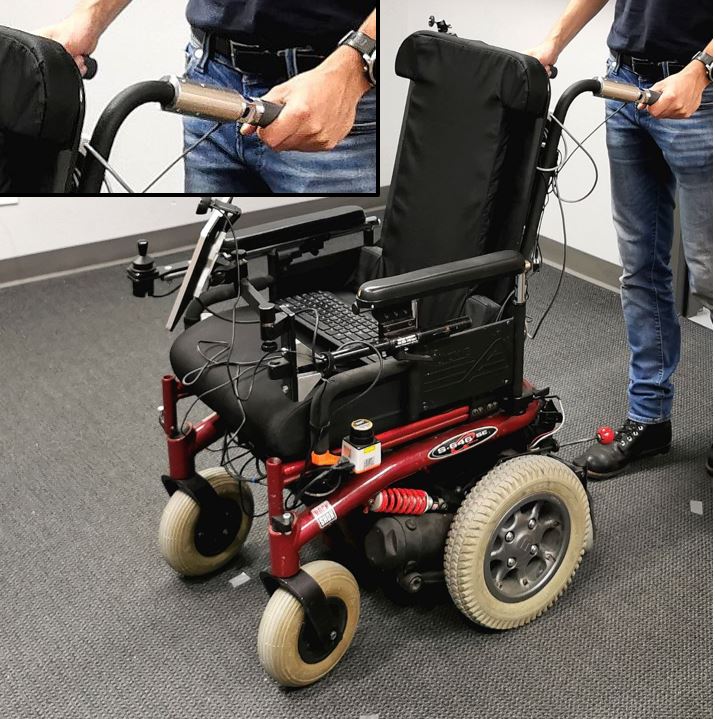
Authors / 作者: Sean Kille, Adina M. Panchea, Balint Varga, Sören Hohmann
arXiv: 2608.11417 · PDF
This paper empirically investigates how assistance strategies shape human movement variability in shared control of a smart wheelchair. An autonomy-supportive strategy that preserves natural movement variability yields comparable task performance but significantly higher perceived agency and better interaction experience than conventional variability-reducing assistance.
中文摘要: 本文在共享控制智能轮椅场景中研究辅助策略如何影响人体运动变异性、任务绩效和主观交互体验。作者提出一种保留用户自然运动结构的自主支持型共享控制策略,并在无辅助、传统降低变异性的辅助和保留变异性的辅助三种条件下开展用户实验。结果显示,保留自然运动变异性在任务相关绩效上与降低变异性的辅助相当,但显著提高了用户的感知能动性和交互体验,说明在辅助交互中保留运动变异性具有功能性意义,为以人为本的移动机器人控制设计提供了新视角。
💬 Shows that preserving natural movement variability in shared control improves user agency without sacrificing performance.
💬 表明共享控制中保留自然运动变异性可在不牺牲性能的情况下提升用户能动性。
Why read it / 推荐理由: Offers insights into human-centered control design that could inform shared-control strategies for assistive legged mobility. 为以人为本的控制设计提供见解,可启发辅助腿足移动的共享控制策略。