Robotics Digest
Robotics Paper Digest — 2026-08-10
🤖 Scanned 299 new arXiv papers (cs.RO / eess.SY / cs.LG, last 96 h), picked 5 for modular & legged robotics — summarized by DeepSeek.
🤖 扫描了近 96 小时 arXiv(cs.RO / eess.SY / cs.LG)的 299 篇新论文,围绕模块化与足式机器人精选 5 篇 — 由 DeepSeek 生成双语摘要。
1. Learning Fault-Tolerant Locomotion with Adaptive Gait Timing
基于自适应步态时机的容错运动学习
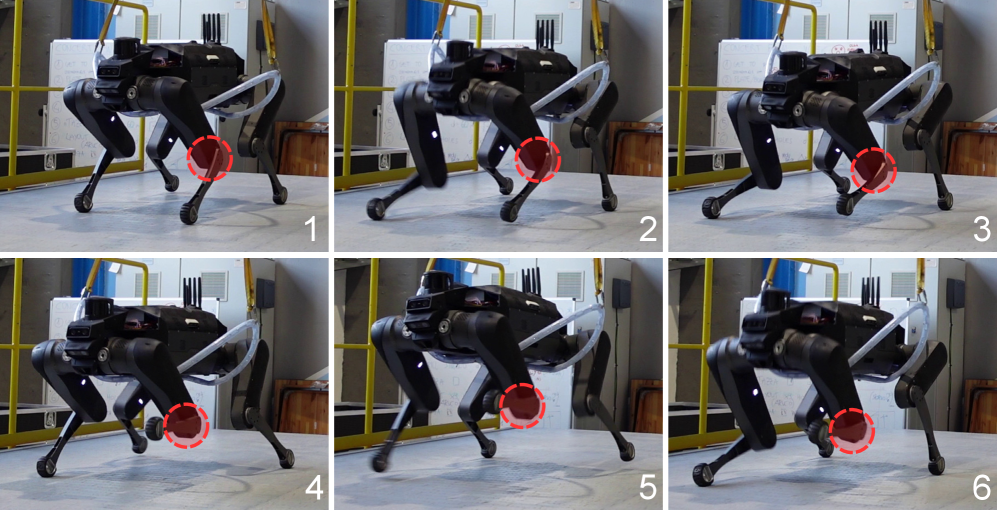
Authors / 作者: Giovanbattista Gravina, Luca Rossini, Carlo Rizzardo, Arturo Laurenzi, Nikos Tsagarakis
arXiv: 2608.07328 · PDF
This paper proposes a deep RL approach for fault-tolerant quadruped locomotion under actuator power loss, using an asymmetric actor-critic with privileged information and a latent-alignment loss. A learnable gait frequency parameter enables adaptive gait timing without predefined faulty-leg strategies. Validated in high-fidelity simulation on uneven terrain and real-world experiments on a 68 kg quadruped.
中文摘要: 本文提出了一种深度强化学习框架,用于在执行器功率损失下实现四足机器人的容错运动。该方法采用非对称actor-critic架构,在训练时向critic提供特权信息,并通过潜在对齐损失使actor与critic的表征一致。此外,行动空间中被加入可学习的步态频率参数,使机器人能够根据地形变化和执行器退化实时调整步态时序,而无需预设故障腿策略。该方法在非平坦地形的高保真仿真以及一台68公斤级四足机器人的真实实验中得到了验证。实验结果表明,该方法能够有效应对执行器失效,维持机器人的稳定性和机动性,优于传统固定步态策略。
💬 Directly addresses fault-tolerant locomotion via adaptive gait timing, a key requirement for robust modular legged robots.
💬 直接处理了通过自适应步态时序实现的容错运动,这对稳健的模块化腿足机器人至关重要。
Why read it / 推荐理由: Real-robot validation on a heavy quadruped and a learnable gait frequency parameter make this a must-read for legged locomotion RL. 在重型四足机器人上的真实机器人验证以及可学习的步态频率参数,使其成为腿足运动RL的必读文献。
2. Spatiotemporal Agility: Time-Constrained Reinforcement Learning for Vision-Guided Dynamic Quadrupedal Interception
时空敏捷性:面向视觉引导四足机器人动态拦截的时间约束强化学习
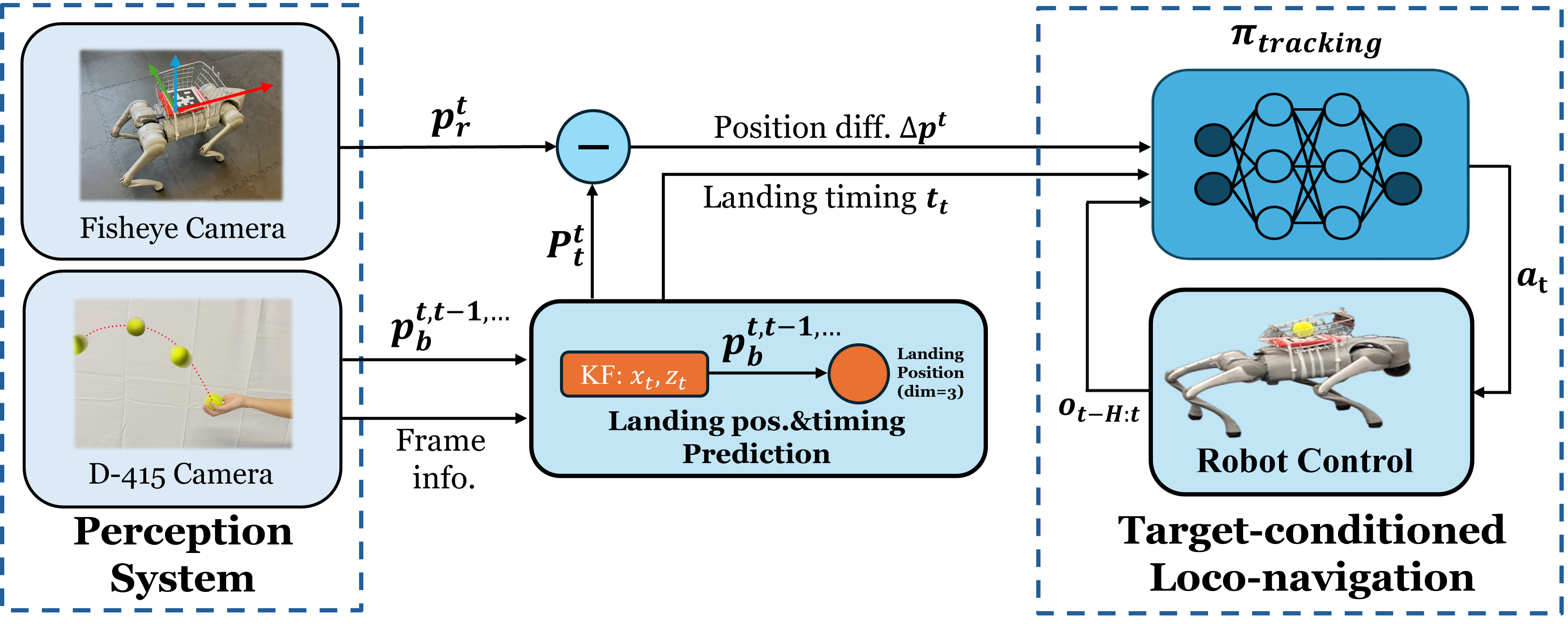
Authors / 作者: Yidong Zhu, Zibo Dai, Tongning Zhang, Leixin Chang, Hua Chen
arXiv: 2608.06907 · PDF
This paper introduces a ball-catching task for legged robots and proposes a vision module that predicts landing point/time, combined with a direct position-and-time conditioned RL locomotion policy. The system integrates multi-camera perception, trajectory prediction, low-latency communication, and sim-to-real. It outperforms velocity-tracking baselines in dynamic interception experiments.
中文摘要: 本文针对腿足机器人提出了一个球体拦截任务,并设计了集成视觉预测与直接位置-时间条件强化学习策略的框架。视觉模块预测球体落点与时间,而RL策略直接以目标位置和时间作为条件,取代了传统速度指令。该系统实现了多相机感知、轨迹预测、低延迟通信与sim-to-real的闭环部署,有效缓解了感知延迟问题。在四足机器人上进行了大量拦截实验,对比速度跟踪基线,所提方法在动态环境中表现出更高的任务成功率和响应速度,展示了时间约束在敏捷运动中的重要性。
💬 A system-level contribution that tightly couples perception and RL-based locomotion for time-critical interception.
💬 一项系统级贡献,将感知和基于RL的运动控制紧密结合,以实现时间关键型动态拦截。
Why read it / 推荐理由: Addresses time-constrained agile locomotion with vision, moving beyond velocity tracking for dynamic target interception. 关注带有视觉的时间约束敏捷运动,超越了动态目标拦截中的速度跟踪范式。
3. LyEvO: Lyapunov-Guided Evolutionary Optimization for Safe and Robust Sim-to-Real Policy Learning
LyEvO:基于李雅普诺夫引导的进化优化实现安全稳健的仿真到现实策略学习
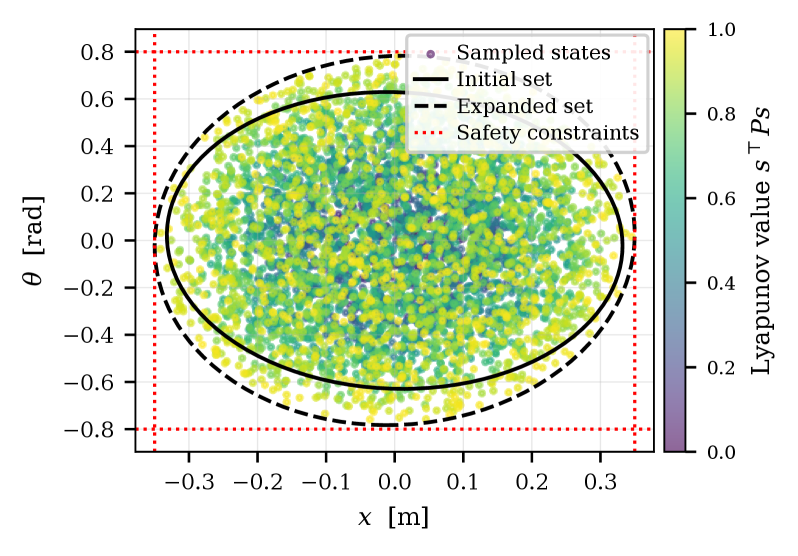
Authors / 作者: Riccardo Curcio, Hongpeng Cao, Marco Caccamo
arXiv: 2608.06481 · PDF
LyEvO combines constrained evolutionary optimization with statistical model checking and Lyapunov-based stability analysis to train controllers with guaranteed safety and robustness for sim-to-real transfer. It iteratively expands a verified stability region based on operational scenarios, providing a practical deployment-readiness criterion. Evaluated on Cartpole and 3D Quadrotor in simulation and real-world experiments.
中文摘要: 本文提出LyEvO框架,融合了约束进化优化、统计模型检验和基于李雅普诺夫函数的稳定性分析,以训练既安全又鲁棒的控制器,确保仿真到现实迁移的可靠性。该方法首先利用李雅普诺夫分析计算初始候选稳定域,然后在交互迭代中从该区域抽取运行场景,联合优化和统计验证策略,并根据验证结果逐步扩大稳定域边界,从而为实际部署提供定量判据。在Cartpole和3D四旋翼上进行了大量仿真和真实实验,验证了其在安全性和鲁棒性方面的优势,为腿足机器人等其他系统的sim-to-real策略学习提供了有力工具。
💬 A fresh methodology that turns Lyapunov analysis into a practical sim-to-real pipeline, though demonstrated on simpler platforms.
💬 一种新颖的方法论,将李雅普诺夫分析转化为实用的sim-to-real流程,尽管目前仅在较简单的平台上展示。
Why read it / 推荐理由: Offers a robust and safe sim-to-real pipeline that can be transferred to legged locomotion controllers. 提供了一种稳健且安全的sim-to-real流程,可迁移至腿足运动控制器。
4. Real-time Whole-Body Motion Planning for Mobile Manipulators Carrying Arbitrarily Shaped Payloads via Kinematically-Coupled SVSDF
基于运动学耦合SVSDF的移动机械臂任意形状负载实时全身运动规划
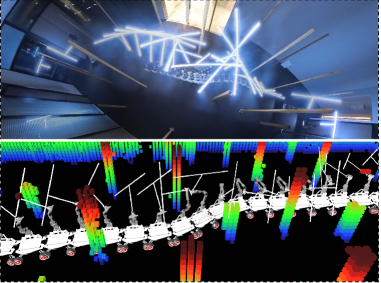
Authors / 作者: Yisheng Li, Longji Yin, Tingrui Zhang, Ruize Xue, Haoda Zhu, Nan Chen et al.
arXiv: 2608.07005 · PDF
This paper presents a real-time whole-body motion planning framework for mobile manipulators transporting arbitrarily shaped payloads. It uses chain-decomposed kernel-based collision checking and a Kinematically-Coupled SVSDF for trajectory optimization. Real-world experiments on a differential-drive mobile manipulator show reliable performance in tight cluttered environments.
中文摘要: 本文提出了一个用于携带任意形状负载的移动机械臂的实时全身运动规划框架。前端采用链分解的核式碰撞检测,保留机器人及负载的真实几何信息,并以紧凑存储和快速位级查询实现高效检测。后端采用基于运动学耦合SVSDF的轨迹优化,沿运动学链传播碰撞规避梯度,产生连贯的全身逃逸方向。框架还包括中间预处理阶段,将前端路径转化为平滑可行的轨迹,且在无障碍时绕过昂贵的后端优化。在差速驱动移动机械臂上的真实实验表明,该方法能够在狭窄杂乱环境中可靠地运输大型非凸负载,明显优于现有先进方案。
💬 A practical WBC framework for non-convex payloads, with real-time performance and a useful collision-gradient propagation idea.
💬 一个实用的全身控制框架,适用于非凸负载,具备实时性,并提供了有用的碰撞梯度传播思想。
Why read it / 推荐理由: The whole-body motion planning and kinematically-coupled gradient techniques are transferable to modular legged manipulators. 全身运动规划和运动学耦合梯度技术可迁移至模块化腿臂机器人。
5. CrossTracer: Cross-Embodiment Navigation via VLA Model Reasoning and Trace Residuals Adapting
CrossTracer:通过VLA模型推理与轨迹残差自适应的跨本体导航
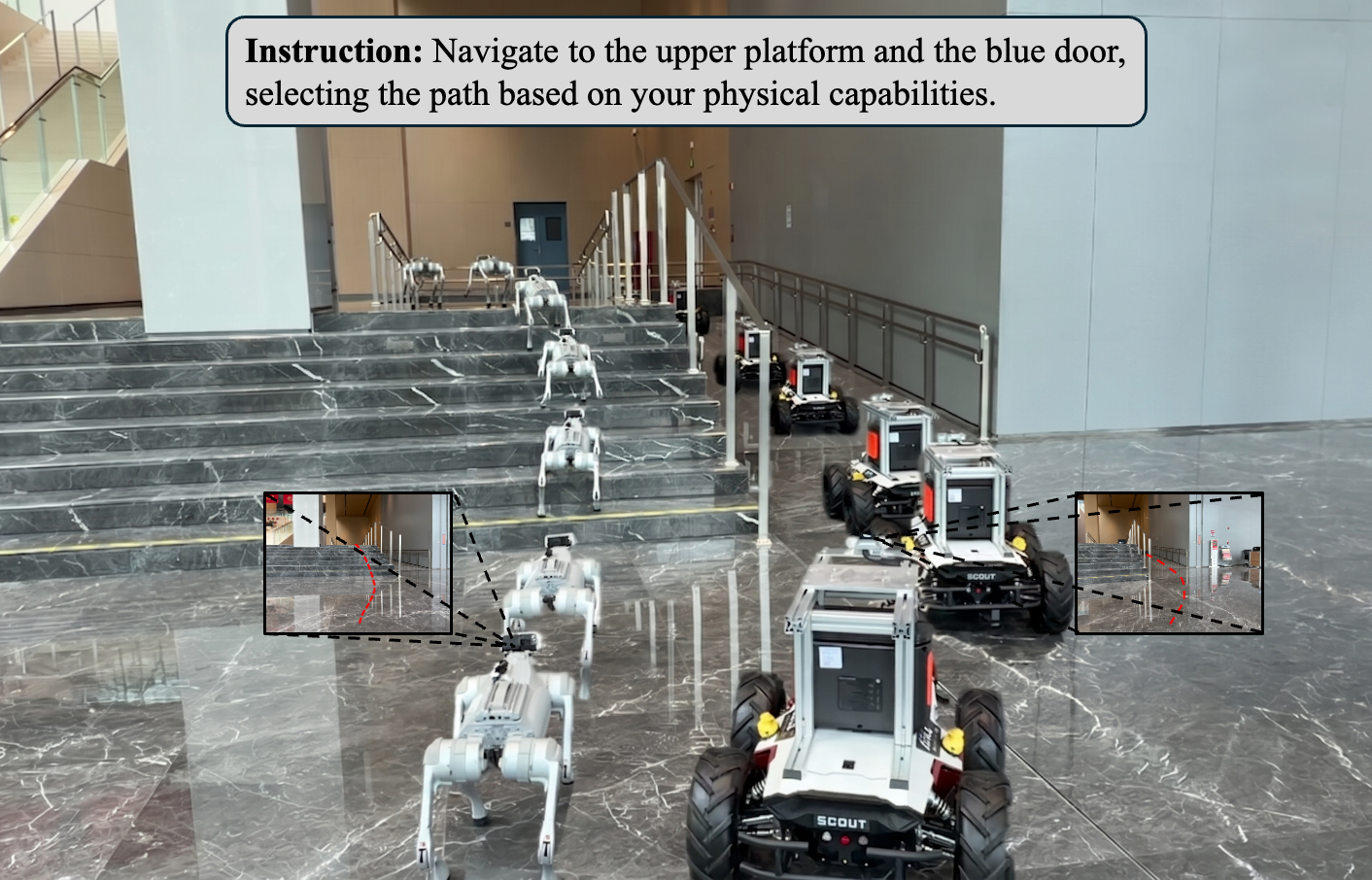
Authors / 作者: Yao Wang, Siyuan Wang, Zhirui Sun, Wenzheng Chi, Liang Lin, Jiankun Wang et al.
arXiv: 2608.06688 · PDF
CrossTracer is a hierarchical framework for cross-embodiment navigation that uses a Vision-Language Trace Proposer and a CE-Adapter to refine navigation traces with embodiment-conditioned residuals. CE-RRT* generates cost-minimizing pixel-space traces from panoptic segmentation to train the adapter without manual labels. It outperforms prior methods on the NaviTrace benchmark.
中文摘要: 本文提出CrossTracer,一种用于跨本体导航的分层框架。该框架将导航计划表示为图像平面上的归一化路标,形成语义推理与物理实现之间的统一接口。VL-Tracer模块利用预训练VLA模型预测初始导航轨迹,CE-Adapter则基于视觉可穿越性线索、机器人身份及初始轨迹预测残差修正,从而适应不同本体的运动学约束。为提高训练效率,CE-RRT*通过全景分割生成机器人条件化的可穿越成本图并产生成本最小的像素空间轨迹,无需人工标注。在NaviTrace基准上的实验显示,CrossTracer的总分达到45.68,优于现有方法,尤其在不同机器人本体间生成一致性导航轨迹方面具有显著优势。
💬 A novel approach to embodiment-aware navigation that explicitly encodes robot-specific traversability in a pixel-space interface.
💬 一种新颖的面向本体感知的导航方法,在像素空间界面中显式编码机器人特定的可穿越性。
Why read it / 推荐理由: Provides an embodiment-conditioned navigation framework that aligns with traverse-capability-aware path planning for modular legged robots. 提供了一种本体条件化的导航框架,与模块化腿足机器人的可穿越能力感知路径规划相契合。