Robotics Digest
Robotics Paper Digest — 2026-08-05
🤖 Scanned 354 new arXiv papers (cs.RO / eess.SY / cs.LG, last 48 h), picked 5 for modular & legged robotics — summarized by DeepSeek.
🤖 扫描了近 48 小时 arXiv(cs.RO / eess.SY / cs.LG)的 354 篇新论文,围绕模块化与足式机器人精选 5 篇 — 由 DeepSeek 生成双语摘要。
1. Shooting for Contact: Contact-Implicit Multiple Shooting for Dynamic Motion Retargeting
接触射击:用于动态运动重定向的接触隐式多重打靶法
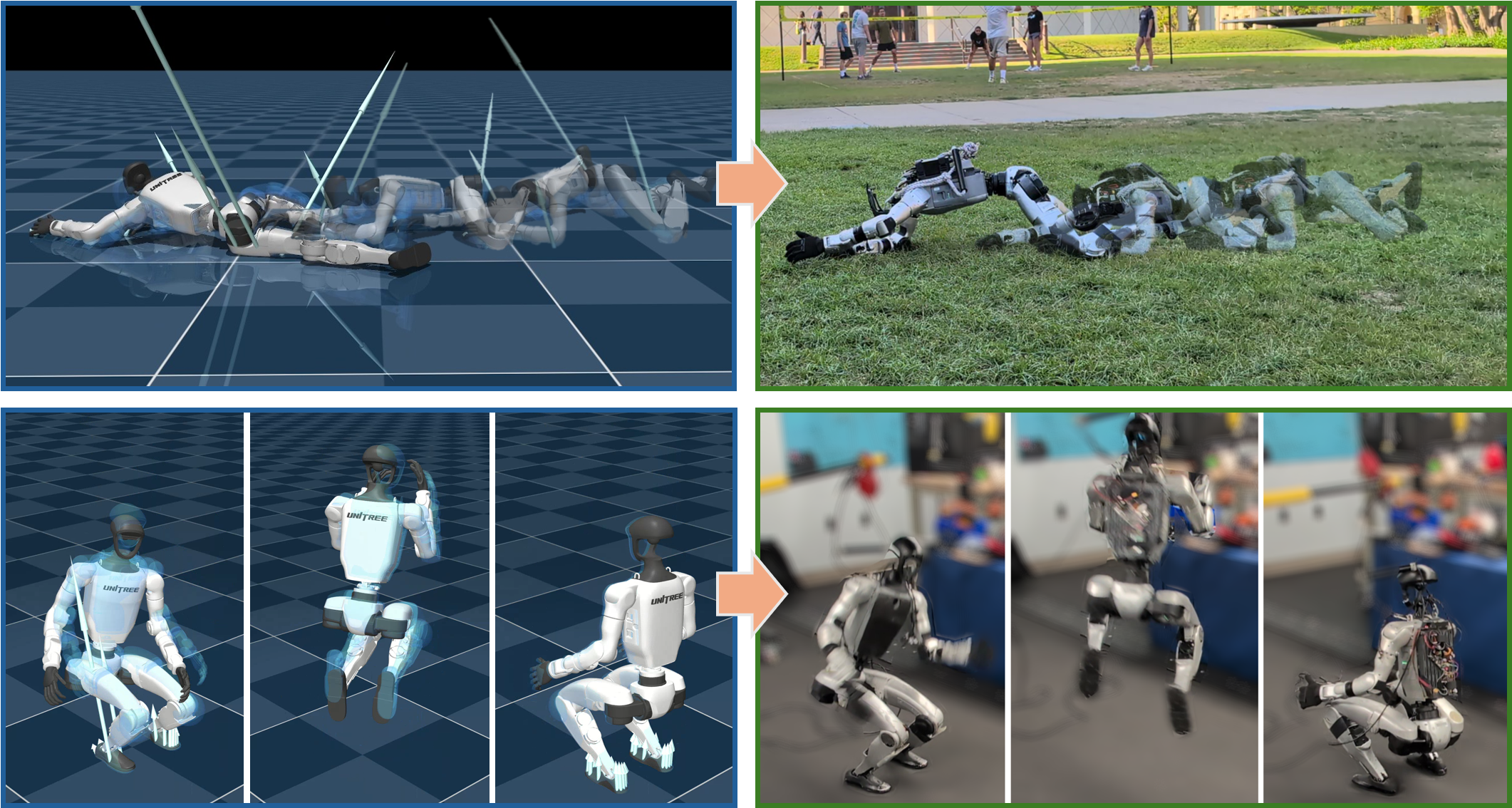
Authors / 作者: Sergio A. Esteban, Jason H. K. Siu, Derrick Mach, Junheng Li, Vince Kurtz, Joel W. Burdick et al.
arXiv: 2608.03116 · PDF
This paper presents a contact-implicit, direct simulation-based multiple shooting (DSMS) framework that transforms kinematically feasible motion references into dynamically feasible whole-body trajectories for legged robots. By embedding a differentiable simulator in a nonlinear program, it resolves contact, friction, impacts, self-collision, and actuation limits without prescribing a contact schedule. The method accelerates RL training for motion imitation and demonstrates zero-shot sim-to-real transfer on a Unitree G1 for contact-rich crawling and a 180-degree jump-turn.
中文摘要: 本文提出了一种基于接触隐式直接模拟的多重打靶法(DSMS),将运动学上可行的参考动作转化为动态可行的全身轨迹。通过将可微模拟器嵌入非线性规划中,该方法在不预设接触时间表的情况下解析接触、摩擦、碰撞、自碰撞和执行器限制。实验表明,该方法加速了运动模仿强化学习训练,并在Unitree G1上实现了命令条件下的接触丰富爬行和高动态180度跳转的零样本sim-to-real迁移。
💬 Strong real-robot validation and a generalizable retargeting method that can be applied to modular legged platforms.
💬 通过真实机器人验证和通用重定向方法,可推广至模块化腿足平台。
Why read it / 推荐理由: This paper offers a unified gradient-based pipeline that turns kinematic references into RL-ready dynamic trajectories, directly addressing the sim-to-real bottleneck for legged robots. 本文提供了一种统一的基于梯度的流程,将运动学参考转换为可直接用于强化学习的动态轨迹,直接解决腿足机器人sim-to-real的瓶颈。
2. CUDA MPC: A GPU-Native Solver for Model Predictive Control
CUDA MPC:用于模型预测控制的GPU原生求解器
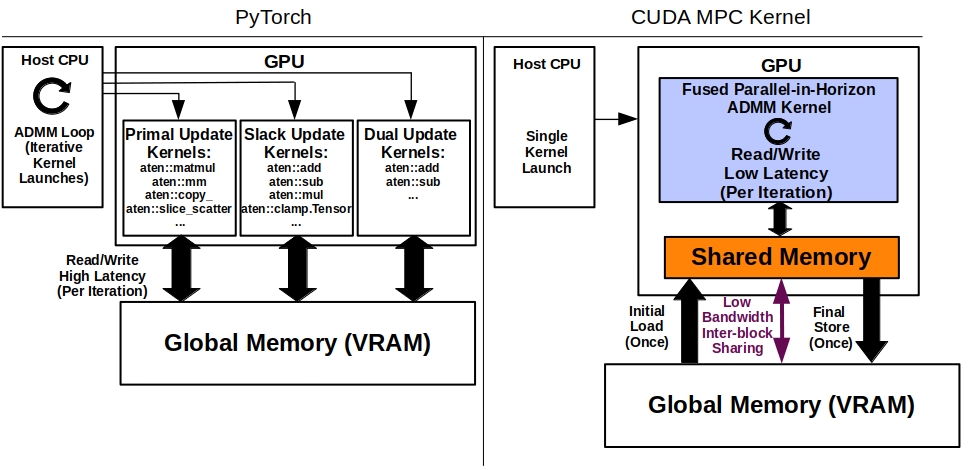
Authors / 作者: Babak Akbari, Melissa Greeff
arXiv: 2608.03051 · PDF
CUDA MPC is a GPU-native MPC framework that co-designs optimization algorithms, execution models, and memory architecture to keep the entire iterative solve on-device. It pairs parallel-in-horizon ADMM with a fused CUDA kernel and low-latency shared-memory, enabling real-time MPC at horizons one to two orders of magnitude longer than CPU solvers. It is validated on six nonlinear benchmarks, including a collision-avoidance parking problem with a 100-second lookahead within a 0.1s sampling time.
中文摘要: CUDA MPC是一个面向GPU的原生模型预测控制框架,通过协同设计优化算法、执行模型和内存架构,将整个迭代求解过程保留在设备端。它将并行地平线ADMM与融合的CUDA内核及低延迟共享内存相结合,使得MPC在比CPU求解器长一到两个数量级的地平线上实现实时计算。在六个非线性基准测试中验证了该方法的有效性,包括在0.1秒采样时间内完成100秒前瞻的避碰泊车问题。
💬 A practical method to overcome MPC’s online optimization bottleneck, which is critical for high-dimensional legged robots.
💬 一种实用方法,克服了MPC在线优化瓶颈,对高维腿足机器人至关重要。
Why read it / 推荐理由: If you use MPC for legged locomotion, this solver could unlock longer horizons and faster loops on embedded GPUs. 如果你在腿足运动控制中使用MPC,该求解器可在嵌入式GPU上支持更长的预测时域和更快的控制周期。
3. Contact-Driven Localization in a Freeform Robotic Self-Assembled Structure
自由形态机器人自组装结构中的接触驱动定位
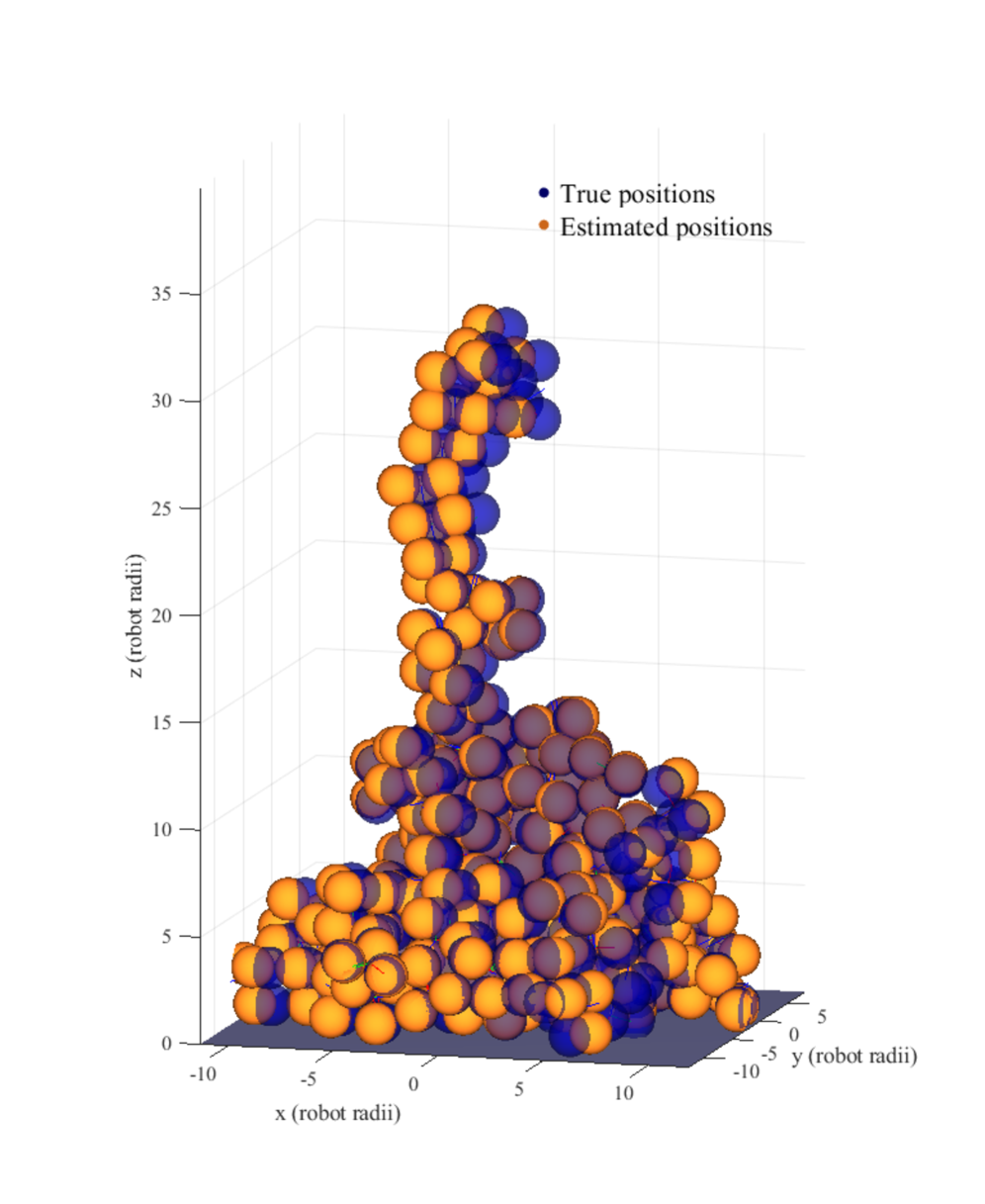
Authors / 作者: Mohammadali Rashidioun, Michael Sosa, Petras Swissler
arXiv: 2608.02895 · PDF
This paper introduces a contact-driven localization method for modular robots that relies solely on binary contact information (whether two robots are physically connected) and local communication. A virtual-force framework iteratively refines pose estimates using attraction to docked neighbors and repulsion from non-connected ones. Simulations of tower and cantilever self-assembly demonstrate accurate, scalable localization without external tracking infrastructure.
中文摘要: 本文提出了一种仅依赖二元接触信息(两个机器人是否物理连接)和局部通信的模块化机器人接触驱动定位方法。虚拟力框架利用对已连接邻居的吸引和对未连接邻居的排斥来迭代优化位姿估计。在塔状和悬臂状自组装仿真中,该方法无需外部跟踪基础设施即可实现精确、可扩展的定位。
💬 Directly applicable to reconfigurable modular legged robots that need to know assembly topology without global sensors.
💬 直接适用于需要在没有全局传感器的情况下了解组装拓扑的可重构模块化腿足机器人。
Why read it / 推荐理由: For modular platforms, robust relative localization is a prerequisite for coordinated multi-leg gait and reconfiguration. 对于模块化平台而言,鲁棒的相对定位是实现多腿协调步态和重构的前提。
4. Stochastic Multiple Shooting Trajectory Optimization via Sequential Local Policy Evaluation
基于序贯局部策略评估的随机多重打靶轨迹优化
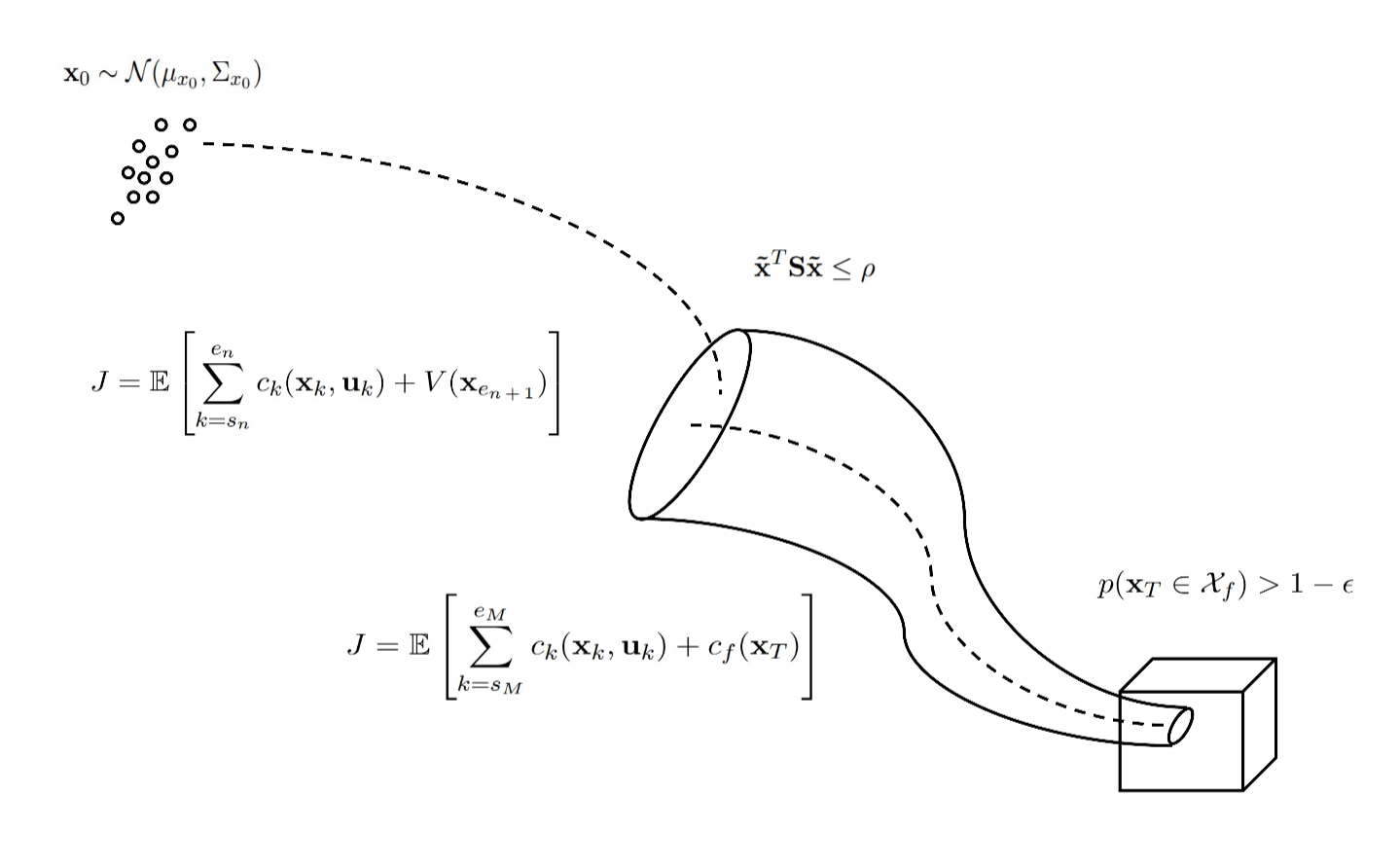
Authors / 作者: Ashwin Gupta, Joseph Moore
arXiv: 2608.03978 · PDF
This paper presents a stochastic multiple shooting method that optimizes short action sequences connected via local feedback policies, improving sample efficiency and terminal-set convergence compared to single shooting. It synthesizes approximate Jacobians purely from rollouts, making it suitable for black-box dynamics in model-based RL. The method is demonstrated on cartpole swingup tasks and a VTOL quadplane precision landing.
中文摘要: 本文提出了一种随机多重打靶方法,通过局部反馈策略连接短动作序列进行优化,相比单打靶提高了样本效率和终端集收敛性。该方法仅从rollout中综合近似雅可比矩阵,适用于基于模型的强化学习中的黑箱动力学。在cartpole摆动任务和VTOL四旋翼精密着陆中验证了有效性。
💬 A useful sample-efficient trajectory optimization for policy search, potentially transferable to legged locomotion with learned dynamics.
💬 一种样本高效的轨迹优化方法,适用于带有学习动力学的腿足运动策略搜索。
Why read it / 推荐理由: This method bridges trajectory optimization and RL, which could improve gait generation for modular legged robots. 该方法将轨迹优化与强化学习衔接,可改善模块化腿足机器人的步态生成。
5. TravKAN: Fast and Interpretable Nonlinear Traversability Analysis with Kolmogorov-Arnold Networks
TravKAN:基于Kolmogorov-Arnold网络的快速、可解释非线性可通过性分析
Authors / 作者: Daniel Fusaro, Simone Mosco, Wanmeng Li, Alberto Pretto
arXiv: 2608.02320 · PDF
TravKAN is a Kolmogorov-Arnold Network-based framework for fast, scalable, and interpretable traversability estimation. It represents multivariate functions with learnable univariate functions, enabling compact architectures and symbolic extraction after training, and introduces LiDAR reflectivity-based handcrafted features. On real-world urban and off-road datasets, TravKAN approaches XGBoost performance while providing symbolic rules for terrain-robot interaction.
中文摘要: TravKAN是一种基于Kolmogorov-Arnold网络的快速、可扩展且可解释的地形可通过性估计框架。它通过可学习的单变量函数来表示多变量决策函数,实现紧凑架构和训练后的符号表达式提取,并引入了基于LiDAR反射率的手工特征。在真实城市和越野数据集上,TravKAN在接近XGBoost性能的同时提供了地形-机器人相互作用的符号规则。
💬 Directly supports traverse-capability-aware path planning, and the symbolic output suits safety-critical modular legged systems.
💬 直接支持基于可通过性的路径规划,符号输出适用于安全关键的模块化腿足系统。
Why read it / 推荐理由: Interpretable traversability models can improve context-aware planning for modular legged robots in unstructured terrain. 可解释的可通过性模型可改善模块化腿足机器人在非结构化地形中的上下文感知规划。