Robotics Digest
Robotics Paper Digest — 2026-08-03
🤖 Scanned 270 new arXiv papers (cs.RO / eess.SY / cs.LG, last 96 h), picked 5 for modular & legged robotics — summarized by DeepSeek.
🤖 扫描了近 96 小时 arXiv(cs.RO / eess.SY / cs.LG)的 270 篇新论文,围绕模块化与足式机器人精选 5 篇 — 由 DeepSeek 生成双语摘要。
1. Advances, challenges, and opportunities for legged robots
腿足机器人的进展、挑战与机遇
Authors / 作者: Jonas Frey, Matías Mattamala, Hae-Won Park, Mayank Mittal, Georg Martius, Maike Osborne et al.
arXiv: 2607.28952 · PDF
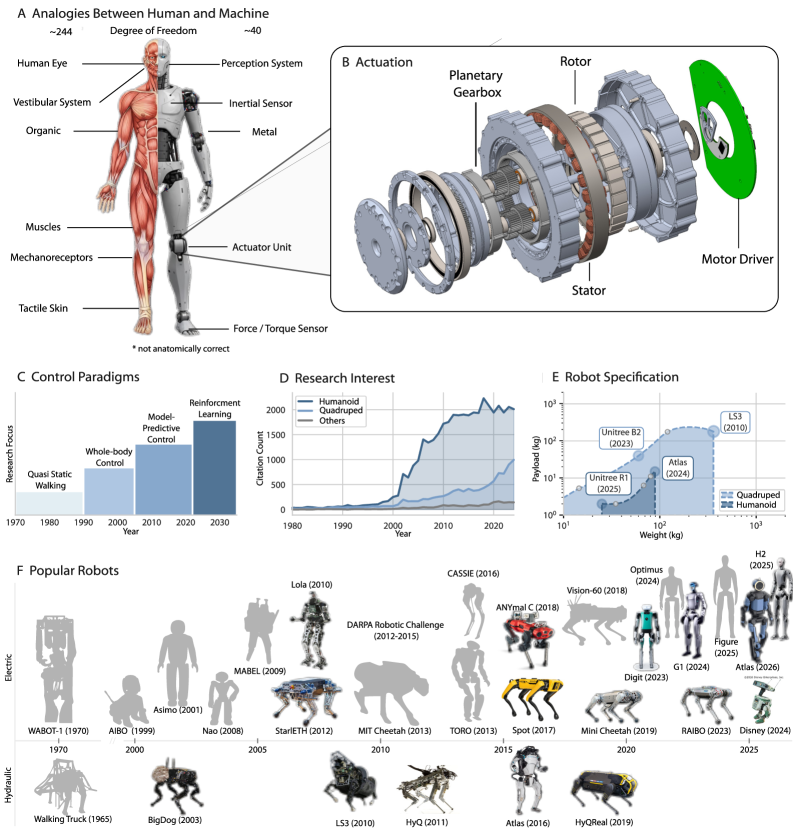
This survey assesses the current capabilities of humanoid and quadrupedal robots across hardware, locomotion, autonomy, data, and applications. It identifies recent advances and key open challenges that must be addressed for widespread adoption, and provides an outlook on future ethical, economic, policy, and societal implications. It is a comprehensive reference for the state of the art and open problems in legged robotics.
中文摘要: 本文综述了人形机器人和四足机器人在硬件、运动、自主性、数据和应用等方面的当前能力。文章评估了这些系统的现状,识别了近期进展和关键开放挑战,并展望了腿足机器人的未来,包括伦理考量、经济潜力、政策影响和更广泛的社会效应。对于从事模块化腿足机器人设计与控制的研究者,本文提供了领域全貌和关键技术瓶颈的系统总结,有助于确定研究方向并从整体上理解腿足系统的发展趋势。
💬 An authoritative survey from leading legged-robotics researchers, useful for framing a modular legged locomotion research agenda.
💬 来自腿足机器人领域领先研究者的权威综述,有助于构建模块化腿足运动研究议程。
Why read it / 推荐理由: Provides a structured map of current capabilities and open challenges in legged robotics, valuable for positioning modular legged robot work. 提供腿足机器人当前能力与开放挑战的结构化全貌,对定位模块化腿足机器人研究很有价值。
2. Balancing of Humanoid with Object Mass: Trade-off Analyses and Lifting Control
考虑物体质量的人形机器人平衡:权衡分析与举升控制
Authors / 作者: Hyunjong Song, William Z. Peng, Joo H. Kim
arXiv: 2607.29625 · PDF
This paper rigorously analyzes how object mass affects humanoid balance stability by incorporating mass parameters into whole-body dynamics with distributed contact wrenches and centers of pressure. It constructs the balanced state basin/boundary (BSB) to characterize balancing capability and introduces critical mass and transition mass to capture trade-offs between momentum regulation and balance limits. The approach is demonstrated on a humanoid robot and a reduced-order mechanism.
中文摘要: 该研究严格分析物体质量对人形机器人平衡稳定性的动态影响。通过将物体质量参数纳入具有分布式接触力和支撑接触压力中心的全身体动力学,量化了其对系统动量和约束的非线性效应。构建了平衡状态盆地/边界(BSB)以划分质心状态空间,并引入临界质量和过渡质量两个关键量,刻画动量调节与平衡限制因素之间的权衡关系。利用人形机器人和可解析降阶机构验证了BSB在预测和控制中的意义。
💬 Rigorous whole-body balancing analysis with practical quantities for controller design, directly relevant to WBC of legged humanoids under payloads.
💬 严格的全身体平衡分析,并为控制器设计提供实用关键量,直接适用于承载负载的腿足人形机器人全身控制。
Why read it / 推荐理由: Offers principled insight into how payload mass changes balance limits, useful for lifting and loco-manipulation control on legged platforms. 提供了负载质量如何改变平衡极限的原理性见解,对腿足平台的举升和移动操作控制很有用。
3. Self-Evolving Learning for Embodied AI with Criticality Model
基于关键性模型的自演化具身智能学习
Authors / 作者: Linxuan He, Yuying Tian, Lingxiang Fan, Jiaqi Pi, Yinqiao Lu, Shang Su et al.
arXiv: 2607.28251 · PDF
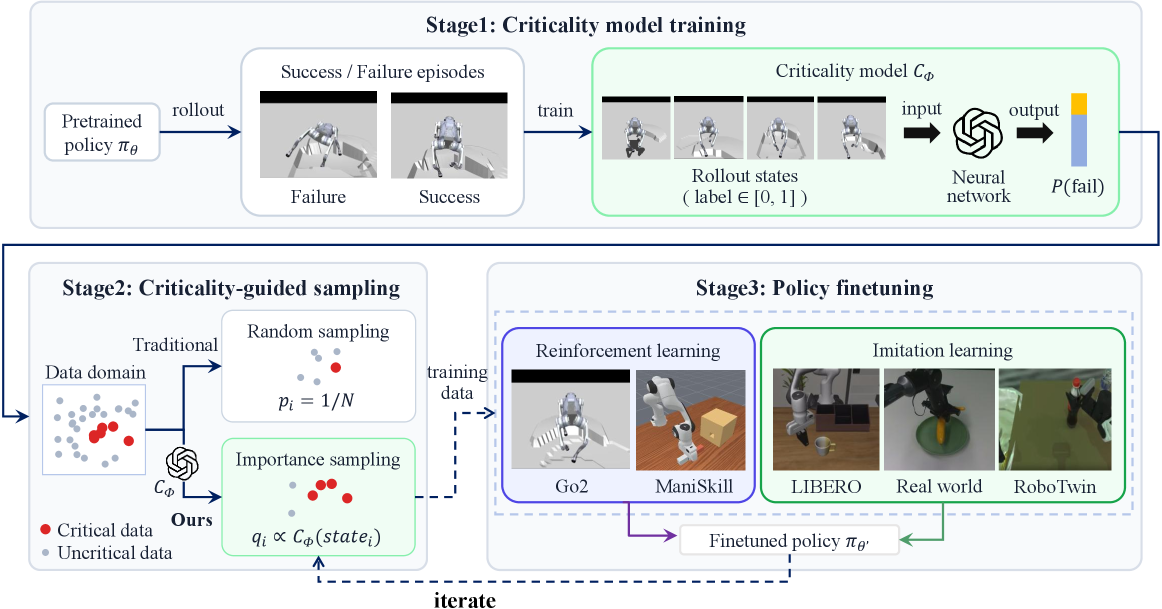
This work proposes a self-evolving learning method that learns a state-wise criticality model from the policy’s own execution outcomes to predict future failure, then uses importance sampling to focus training on failure-prone scenarios. This increases the information density of the training data while preserving an unbiased objective. It reduces failure rates by 51–67% over trained baselines and 8–25% over state-of-the-art VLA models, with validation on quadrupedal locomotion, manipulation, and real-robot tasks.
中文摘要: 提出一种自演化学习方法,通过从策略自身执行结果中学习状态级关键性模型来预测未来失败概率,并以重要性采样引导数据收集偏向易失败场景,替代随机收集的默认流程,从而打破微调阶段的表现平台期。在四足运动、多任务操作、视觉-语言-动作基准以及真实机器人任务上,该方法相比训练基线将失败率降低51–67%,相比最先进的视觉-语言-动作模型降低8–25%。该方法保留了无偏学习目标,同时提高训练池的信息密度。
💬 A data-centric RL method directly demonstrated on quadrupedal locomotion, addressing failure-case learning relevant to robust legged control and sim-to-real.
💬 一种以数据为中心的强化学习方法,已在四足运动任务上验证,对腿足运动鲁棒控制和sim-to-real迁移有直接参考价值。
Why read it / 推荐理由: Provides a simple, effective way to overcome performance plateaus by reweighting training data toward failure-prone states, directly applicable to legged locomotion policies. 提供一种简单有效克服性能平台期的方法,通过将训练数据重加权到失败风险高的状态,可直接应用于腿足运动策略。
4. Input-to-state Stable Approximate Nonlinear Model Predictive Control with Realtime Feasibility
具有实时可行性的输入-状态稳定近似非线性模型预测控制
Authors / 作者: Jan Olucak, Torbjørn Cunis
arXiv: 2607.28353 · PDF
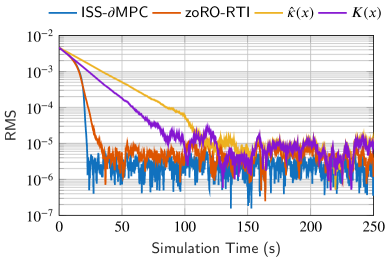
This paper presents a computationally lightweight approximate robust NMPC law based on a pair of input-to-state control Lyapunov function and robust control barrier function. It augments a nominal infinitesimal-horizon NMPC scheme with small quadratic programs for real-time embedded computation. Numerical experiments on constrained spacecraft control demonstrate effectiveness compared to other robust NMPC schemes.
中文摘要: 本文提出一种计算轻量的近似鲁棒非线性模型预测控制(NMPC)律,基于输入-状态控制李雅普诺夫函数和鲁棒控制障碍函数对,并增强了一种标称无穷小水平NMPC方案,使非线性约束系统可在嵌入式硬件上通过小型二次规划实时求解反馈律。数值实验针对非线性受约束航天器控制进行,并与文献中的其他鲁棒NMPC方案比较,证明了该方案的有效性。该框架为计算资源受限的实时MPC提供了稳定性保证。
💬 A methodological MPC advance with stability guarantees and real-time feasibility, transferable to legged robot locomotion and whole-body controllers.
💬 方法层面的MPC进展,具备稳定性保证和实时可行性,可迁移到腿足机器人运动控制和全身控制器。
Why read it / 推荐理由: Presents a tractable robust NMPC formulation with stability certificates that can underpin real-time whole-body or gait control on legged robots. 提供一种易于求解且带有稳定性证书的鲁棒NMPC公式,可为腿足机器人的实时全身控制或步态控制奠定基础。
5. CLIFT: Turning Gemini Robotics On-Device into Humanoid Specialists via Non-Invasive Closed-Loop Iterative Fine-Tuning
CLIFT:通过非侵入式闭环迭代微调将Gemini Robotics设备端模型转化为人形机器人专家
Authors / 作者: Yuxin Chen, Hari Srikanth, Nathan Jew, Menglin Wu, Pengcheng Wang, Junli Ren et al.
arXiv: 2607.29172 · PDF
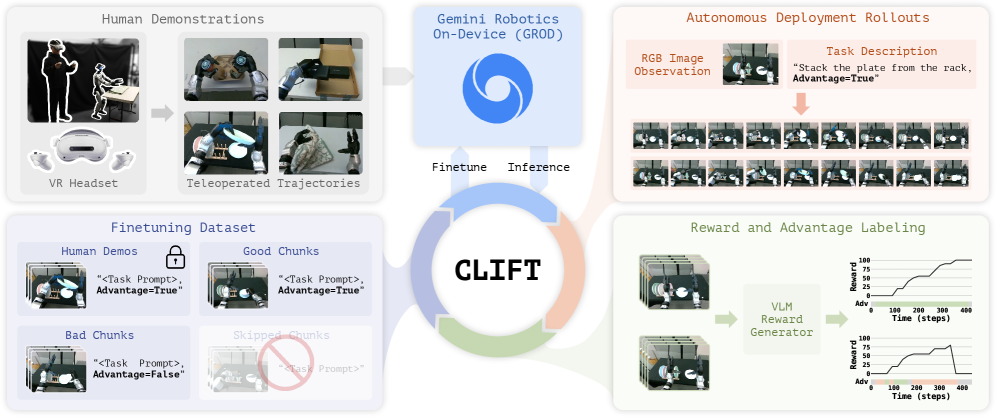
This paper studies the effectiveness of managed supervised fine-tuning (SFT) APIs for adapting closed-weight humanoid foundation models, showing that direct SFT substantially outperforms baselines but is limited by pure imitation. It introduces a non-invasive closed-loop iterative fine-tuning (CLIFT) method that enables policy improvement on a real humanoid without access to model weights or gradients. The approach is instantiated on Gemini Robotics On-Device and pushes policies toward task mastery in contact-rich humanoid manipulation.
中文摘要: 本文研究了托管式监督微调(SFT)API在适配闭源权重的人形机器人基础模型方面的有效性,发现直接SFT显著优于基线但仍受限于纯模仿。为此提出非侵入式闭环迭代微调(CLIFT)方法,在不接触模型权重或梯度的前提下,在真实人形机器人上实现策略改进。该方法在Gemini Robotics On-Device上实例化,并在接触丰富的人形操作任务中推动策略走向任务精通,为闭源基础模型的闭环策略优化提供了一种可行范式。
💬 Relevant to humanoid RL-style improvement without weight access, less about locomotion but useful for adapting legged humanoid controllers.
💬 与无需权重访问的人形机器人强化式改进相关,虽然较少涉及运动本身,但对腿足人形控制器适配有参考价值。
Why read it / 推荐理由: Shows how to perform closed-loop policy improvement on proprietary humanoid foundation models, relevant to sim-to-real and real-robot adaptation for humanoid legged systems. 展示了如何在专有人形基础模型上进行闭环策略改进,对人形腿足系统的sim-to-real和真实机器人适配具有参考价值。