Robotics Digest
Robotics Paper Digest — 2026-08-01
🤖 Scanned 108 new arXiv papers (cs.RO / cs.SY / cs.LG, last 48 h), picked 5 for modular & legged robotics — summarized by DeepSeek.
🤖 扫描了近 48 小时 arXiv(cs.RO / cs.SY / cs.LG)的 108 篇新论文,围绕模块化与足式机器人精选 5 篇 — 由 DeepSeek 生成双语摘要。
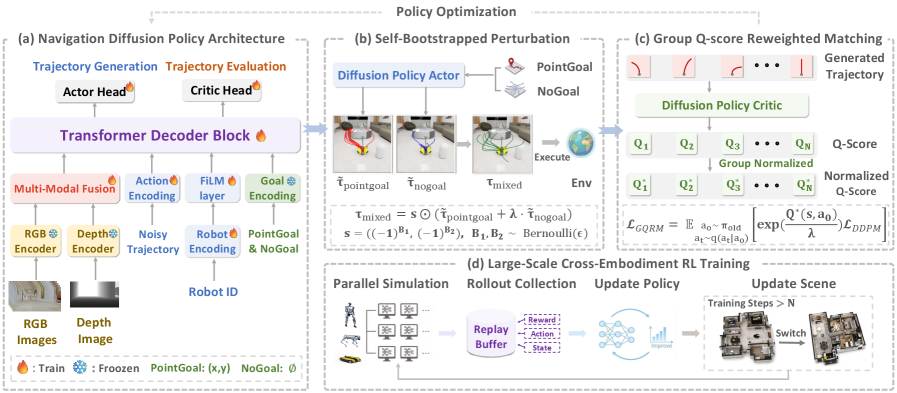
1. X-NavDP: Generalizing Navigation Diffusion Policy to Novel Behavior and Embodiments with Group Q-score Reweighted Matching
X-NavDP:基于分组Q值重加权匹配将导航扩散策略泛化到新行为与机器人形态
Authors / 作者: Tianyu Yang, Yiming Zeng, Wenzhe Cai, Yuqiang Yang, Jiaqi Peng, Hui Cheng et al.
arXiv: 2607.28560 · PDF
X-NavDP post-trains a navigation diffusion policy with distributed online RL across heterogeneous embodiments. It introduces self-bootstrapped exploration with behavior perturbation to preserve the pretrained policy prior, and a group Q-score normalization mechanism for efficient reweighted score matching. The fine-tuned policy achieves state-of-the-art cross-embodiment visual navigation performance, improving overall success.
中文摘要: 针对利用大规模专家演示预训练导航扩散策略在跨形态和复杂场景下泛化不足的问题,提出X-NavDP框架。通过分布式在线RL对策略进行后训练,引入自举式探索和行为扰动保留预训练先验,并通过分组Q值归一化对每条轨迹的每个状态计算归一化值,用于高效的重加权分数匹配。在异构机器人形态上进行训练后,策略在跨形态视觉导航任务上达到当前最优,显著提升成功率,并展现了应对死胡同、绕过障碍等行为的能力。方法特别适用于模块化腿足平台在改变构型后的快速适应。
💬 Despite being demonstrated on wheeled navigation, its cross-embodiment RL fine-tuning methodology is highly relevant to modular legged robots whose morphology changes with reconfiguration.
💬 尽管在轮式导航上验证,其跨形态RL后训练方法对于构型可变的模块化腿足机器人非常相关。
Why read it / 推荐理由: Because it offers a principled RL post-training recipe for pretrained diffusion navigation policies that can transfer across different robot embodiments. 因为它提供了一种将预训练扩散导航策略进行RL后训练并跨机器人形态迁移的系统性方法。
2. Learning Social Robot Navigation By Sensing Human Legs
通过感知人腿学习社交机器人导航
Authors / 作者: Alberto Vaglio, Andrea Garulli, Antonio Giannitrapani, Renato Quartullo, Tommaso Van Der Meer
arXiv: 2607.27922 · PDF
CALF is an end-to-end neural architecture that uses convolutional layers, attention, and MLP to interpret leg motion from low-mounted 2D LiDAR scans and generate safe navigation commands. The policy is trained with deep RL in LegNav, a custom simulator with a novel pedestrian gait model, and deployed zero-shot on a TurtleBot 4 in real-world experiments. It yields smooth and socially compliant trajectories and trains in under one hour on a consumer GPU.
中文摘要: 针对低置2D激光雷达主要观测行人腿部而非完整人体的现象,提出CALF端到端网络,通过卷积、注意力与MLP直接理解LiDAR扫描中的腿部运动并输出安全导航指令。策略在自定义轻量模拟器LegNav中采用深度强化学习训练,该模拟器结合2D LiDAR射线追踪和新的人行步态模型。真实环境中在TurtleBot 4上零样本部署,轨迹平滑且符合社交规范。虽然实验平台是轮式机器人,但腿部特征感知、步态建模和低成本快速训练对腿足机器人的人群导航和步态生成具有直接借鉴意义。
💬 Its leg-motion perception and gait-model-based training are directly transferable to legged robots navigating among pedestrians.
💬 其腿部运动感知和基于步态模型的训练可直接迁移到人群中的腿足机器人导航。
Why read it / 推荐理由: It shows how to exploit leg-level LiDAR features and a novel pedestrian gait model for socially compliant navigation, relevant for legged robots in human environments. 它展示了如何利用腿部级LiDAR特征和新颖行人步态模型实现社交合规导航,对在人居环境中的腿足机器人很有价值。
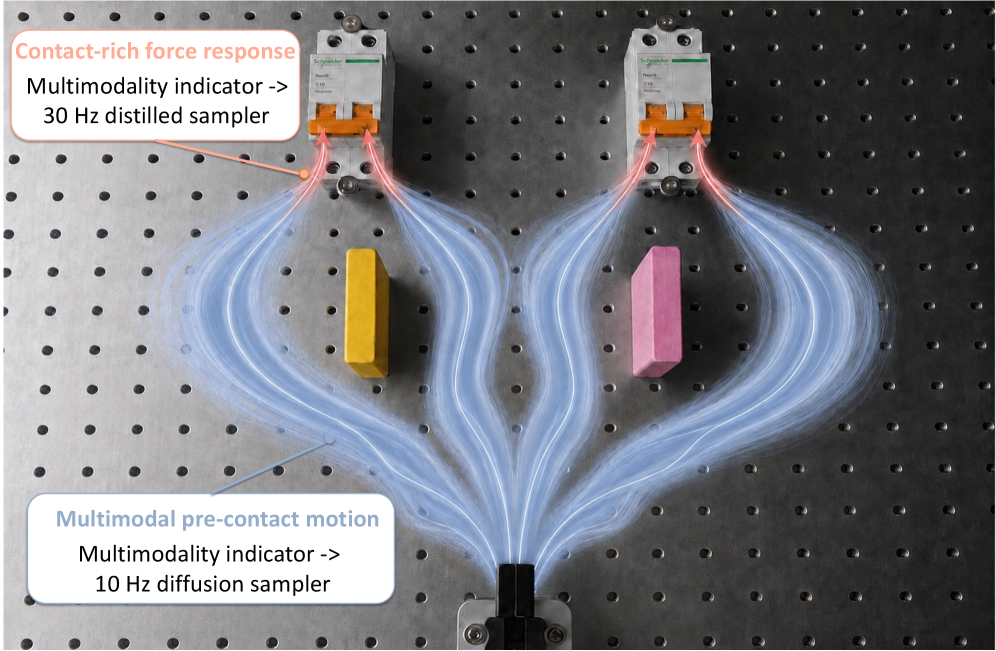
3. FA-RDP: A Frequency-Adaptive Reactive Diffusion Policy for Contact-Rich Manipulation
FA-RDP:面向接触丰富操作的自适应频率反应式扩散策略
Authors / 作者: Lifeng Zhuo, Wendi Chen, Han Xue, Shirun Tang, Jun Lv, Cewu Lu et al.
arXiv: 2607.28596 · PDF
FA-RDP is a frequency-adaptive reactive diffusion policy for contact-rich manipulation that resolves the tradeoff between preserving pre-contact multimodality and reacting to force feedback after contact. It uses a shared multi-frequency visual-force Transformer with low-frequency multi-step sampling before contact and one-step high-frequency sampling after, selected by a learned multimodality indicator. Manifold Consistency Distillation reparameterizes the diffusion network to predict actions on the robot action manifold, improving performance on contact-rich tasks.
中文摘要: 针对接触丰富操作中动作多模态性与反应速度之间在同一个任务不同阶段的冲突,提出FA-RDP。策略在共享的多频率视觉-力Transformer上同时预测低频和高频动作块,通过学习到的多模态性指标动态选择接触前的低频多步采样和接触后的高频单步采样,从而保留接触前多种动作模式并快速响应力反馈。进一步提出流形一致性蒸馏,将扩散网络重参数化以在机器人动作流形上预测动作,同时保留DDPM残差监督。在三个接触丰富操作任务上FA-RDP取得了优于基线方法的性能。该频率自适应思路可推广到腿足机器人的足地接触控制,在摆动相保留策略多样性与支撑相快速抗扰之间取得平衡。
💬 The contact-mode-aware frequency switching is a compelling idea for legged locomotion, where stance-phase force feedback demands high-rate reactive control.
💬 这种感知接触状态的频率切换思路对腿足运动很有吸引力,因为支撑相的力反馈需要高频反应控制。
Why read it / 推荐理由: Because it provides a new way to combine multimodality preservation and reactive force control, which is central to contact-rich legged locomotion. 因为它提供了兼顾多模态保持与力反馈反应式控制的新方法,而这正是接触丰富的腿足运动的核心问题。
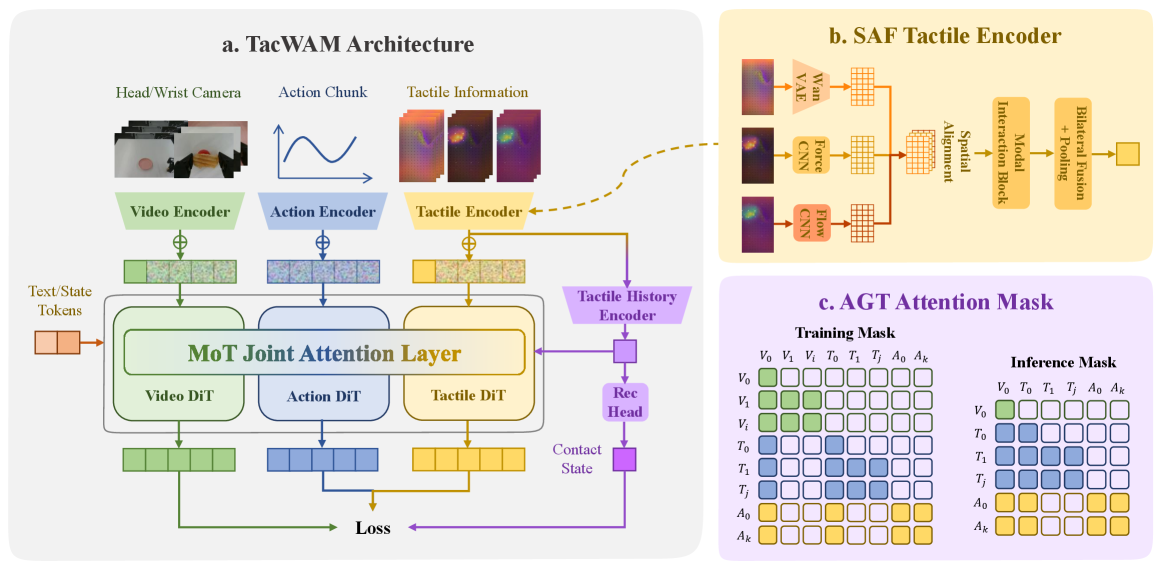
4. TacWAM: Anchor-Guided World Action Model with Mechanics-Aware Tactile Prediction
TacWAM:带有力学感知触觉预测的锚引导世界动作模型
Authors / 作者: Lei Jin, Yiding Ma, Xin Zhang, Chen Gao, Wei Wu, Yong Li
arXiv: 2607.28391 · PDF
TacWAM is a mechanics-aware world action model that predicts tactile futures (appearance, dense force fields, deformation flow) jointly with robot actions. It uses a Spatially Aligned Fusion tactile encoder, temporal history encoding, and Anchor-Guided Tri-Modal attention to keep future tactile predictions from becoming privileged cues. On four real contact-rich manipulation tasks, it demonstrates strong force/torque reconstruction and improved action generation.
中文摘要: 提出TacWAM,一种具有力学感知的世界动作模型,在生成机器人动作的同时预测触觉未来,包括触觉外观、密集力场和形变流。采用空间对齐融合触觉编码器并将双边力/力矩重建纳入共享潜空间,保留全局接触信息;触觉历史编码器提供时间上下文,使未来触觉预测反映力和形变随时间的变化。通过锚引导三模态注意力分离视觉/触觉锚点、未来预测token和动作token,避免未来触觉状态被动作分支直接读取。在四项真实接触丰富操作任务上验证了有效性。对腿足机器人而言,该框架可启发利用足底触觉预测和地面反作用力重建来改进地形感知与全身控制。
💬 Tactile future prediction with bilateral force/torque reconstruction could be adapted to foot contact estimation and terrain reasoning for legged robots.
💬 带有双边力/力矩重建的触觉未来预测可适用于腿足机器人的足底接触估计与地形推理。
Why read it / 推荐理由: Because it shows how to extract physically meaningful tactile predictions without letting them become privileged cues, useful for learning robust foot-contact models. 因为它展示了如何提取有物理意义的触觉预测且不使其成为特权信息,这对学习鲁棒足底接触模型很有用。
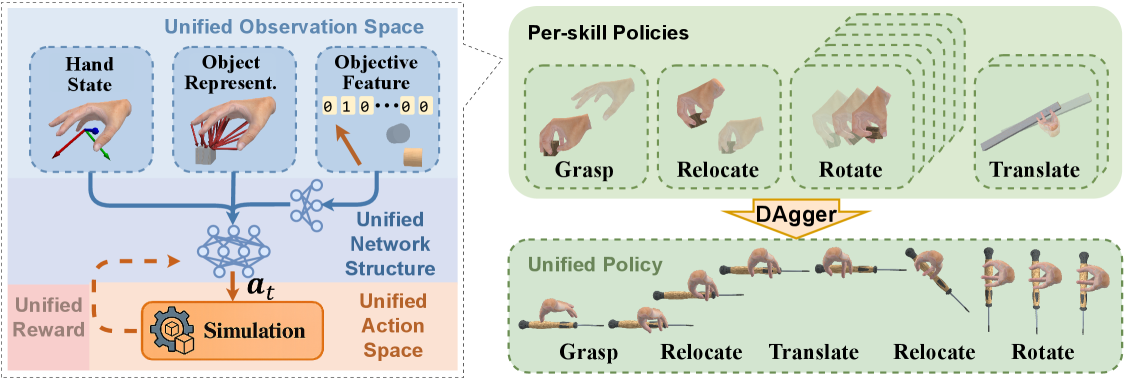
5. UniCross: Unified Cross-Skill Dexterous Manipulation Synthesis
UniCross:统一跨技能灵巧操作合成
Authors / 作者: Hui Zhang, Julian Ferchow, Jie Song, Mirko Meboldt
arXiv: 2607.28198 · PDF
UniCross is a unified framework that models grasping, relocation, in-hand rotation, and in-hand translation in a single state-action formulation with shared objectives. It distills a single cross-skill policy that performs well on each skill, generalizes to unseen objects, is robust to disturbances, and chains skills into long-horizon manipulation. The framework transfers across different hand morphologies.
中文摘要: 提出UniCross统一框架,将抓取、重定位、手中旋转和手中平移四种灵巧操作技能建模为共享状态空间、动作空间和公共目标函数的单一问题。通过蒸馏得到单个跨技能策略,在各技能上表现出色,可泛化到未见过物体,对扰动具有鲁棒性,并能无缝链接多个技能完成长时间操作。该框架还可迁移到不同手部形态。尽管面向灵巧操作,但其统一建模和跨形态迁移思想可用于模块化腿足机器人的可重构肢体控制,将行走、跨越、攀登等行为统一在单一策略框架中。
💬 Its unified modeling across skills and hand morphologies suggests how reconfigurable leg modules could share one policy across variable limb configurations.
💬 其跨技能和跨手型统一建模方式提示,可重构腿模块可以通过单一策略应对不同肢体构型。
Why read it / 推荐理由: Because it offers a template for cross-skill and cross-morphology policy unification that is directly relevant to modular reconfigurable legged systems. 因为它为跨技能、跨形态策略统一提供了模板,与模块化可重构腿足系统直接相关。